
The manual that came with your air conditioner probably says to have it serviced once a year. That advice was written for a climate with a dry season and a heating season. Bangkok has neither, and a coil here fills with dust and biofilm roughly twice as fast.
The short answer
For most Bangkok homes: every six months. That interval keeps a wall-mounted split running close to its rated output all year and catches drain problems before they become a wet wall.
Move to every three months if any of these apply:
- A dog or cat lives in the room. Fur and dander clog a filter in weeks and reach the coil behind it.
- Someone in the home has asthma or dust allergies.
- The bedroom faces a main road or an active construction site. Fine grey dust gets past the filter and sits on the fins.
- The unit runs twelve or more hours a day — a home office, a nursery, a room that never quite gets to sleep temperature.
- It is a restaurant, café, gym or salon. Grease and body heat both load a coil faster than a bedroom does.
A standard clean is ฿690 per unit. For a home that wants both visits handled automatically, the 2-Visit Year Package covers the two cleans at a lower per-visit price and adds a gas and drain check each time.
Why Bangkok is harder on a coil
Three things happen here that don't happen in Chiang Mai in December or in most of Europe at all.
Humidity. The evaporator coil runs cold and wet every night. That wet surface catches dust and then grows biofilm on it — the black slime you see when a unit is opened after a year. Biofilm is an insulator; it stops the coil transferring heat to the air.
Dust that never settles. Bangkok's PM2.5 is a health story, but it is also an air-conditioning story. Fine particulate passes through a mesh filter that was designed for lint and hair, and it coats fins that are only 1.5 mm apart.
Twelve-month running. In a climate with a cool season, a unit sits idle for months and dries out. In Bangkok it runs every night of the year, so the coil never gets a chance to dry and the dust never gets a break.
Signs a unit is due, in the order they appear
Most people wait for the smell or the drip. Those are late signs. The early ones are cheaper to act on.
- Weaker airflow at the vent. Put your hand a metre from the louvre on high fan. If it feels soft compared to a clean unit, the blower or coil is loaded.
- Longer cooling time. The room used to reach 25 °C in twenty minutes and now takes forty.
- A higher electricity bill with no change in use. The compressor runs longer to move the same heat. We cover the numbers in why a dirty AC costs more to run.
- A musty smell on start-up. That is biofilm on the blower wheel. Once this starts a standard clean may not be enough — see when a deep chemical wash is needed.
- Water dripping from the indoor unit. The drain pan or line has clogged with the sludge that comes off a dirty coil.
What you can do between visits
- Rinse the mesh filters every two to three weeks. Pull them out, rinse under the tap, shake, let them dry, put them back. Five minutes.
- Keep the outdoor unit clear. Plant pots, laundry racks and cardboard against a condenser make it run hot.
- Run the fan on high for a few minutes at shut-down if your remote has a dry or clean mode. It dries the coil and slows biofilm.
None of these clean the coil or the blower wheel. They stretch the interval; they do not replace the service.
What a proper clean actually includes
Not every "ล้างแอร์" advert means the same thing. The version that resets the six-month clock is:
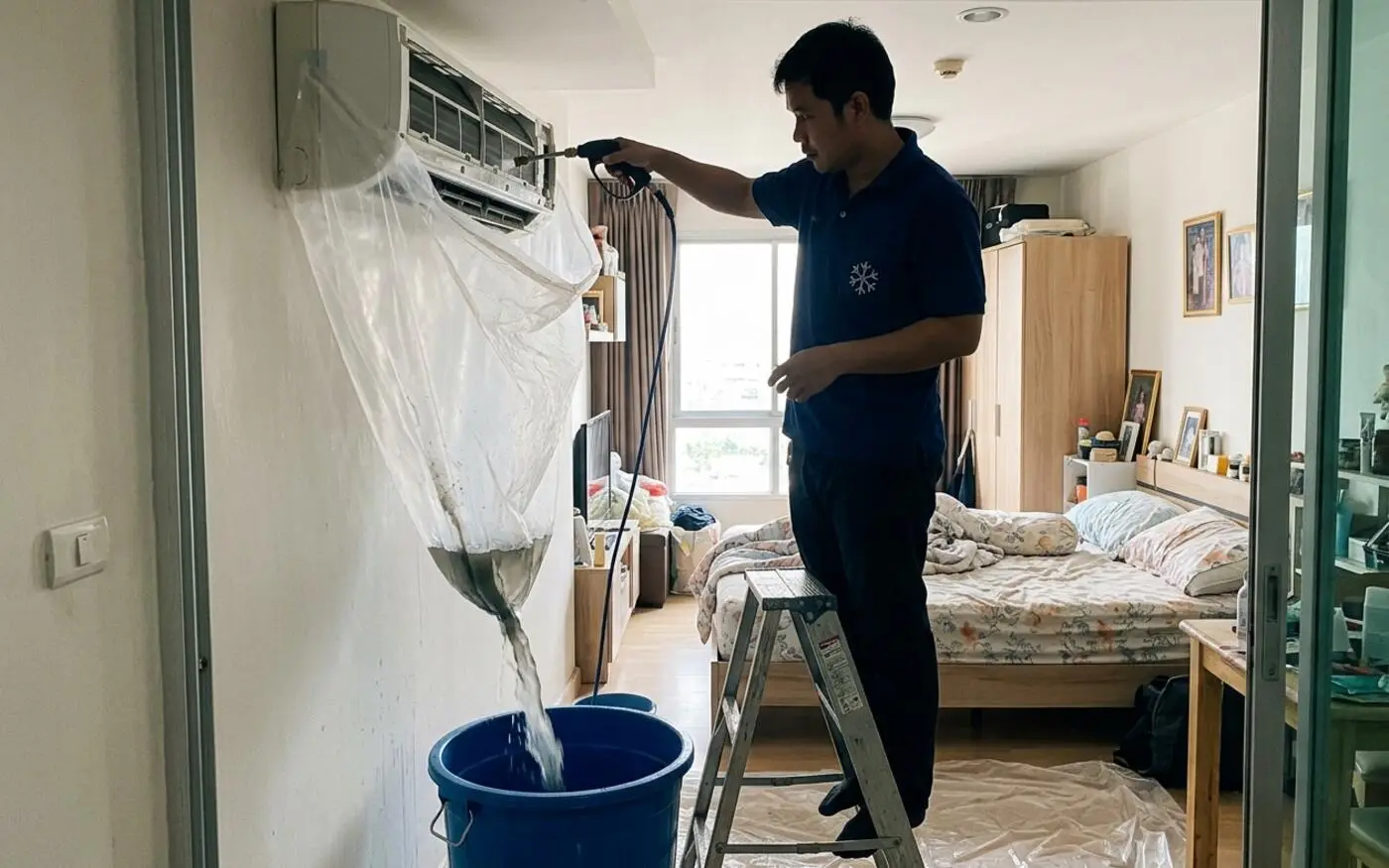
- Power isolated, unit sealed in a wash bag that drains to a bucket.
- Filter, evaporator coil and blower wheel washed with a foaming coil cleaner and low-pressure rinse until the water runs clear.
- Condensate drain line flushed and tested with water.
- Outdoor coil rinsed where it is reachable.
- Supply-air temperature and gas pressure measured and written down.
If a technician sprays the filter with a hose, wipes the cover and leaves in fifteen minutes, that was a filter rinse, not a clean, and it will not last six months.
Frequently asked questions
How often should an air conditioner be cleaned in Thailand?
Every six months for a typical Bangkok home that runs the unit nightly. Increase to every three months for homes with pets or allergy sufferers, bedrooms facing a main road or building site, and any unit running twelve or more hours a day. Restaurants and gyms should be on a quarterly schedule.
What happens if I don't clean my AC for a year?
The evaporator coil and blower wheel coat in dust and biofilm, airflow drops, the unit runs longer to reach temperature and electricity use rises, typically by 15–30%. Beyond a year the drain pan clogs and the unit starts dripping, and mould in the blower produces a musty smell. A standard clean usually recovers all of it.
Can I just wash the filter myself?
Yes, and you should — rinse the mesh filter every two to three weeks in Bangkok. It keeps the coil cleaner for longer. It does not clean the coil or blower wheel, which is where the real dirt and mould build up, so it extends the interval rather than replacing the service.
Need it handled professionally?
Get a fixed quote for your units in under 60 seconds.
Written by the CoolRova Team
We're Bangkok's documented AC crew — everything we write comes from real cleaning, repair and installation visits across condos, homes and short-stay rentals.
Get our Bangkok AC guides straight in Google — add CoolRova as a preferred source.