
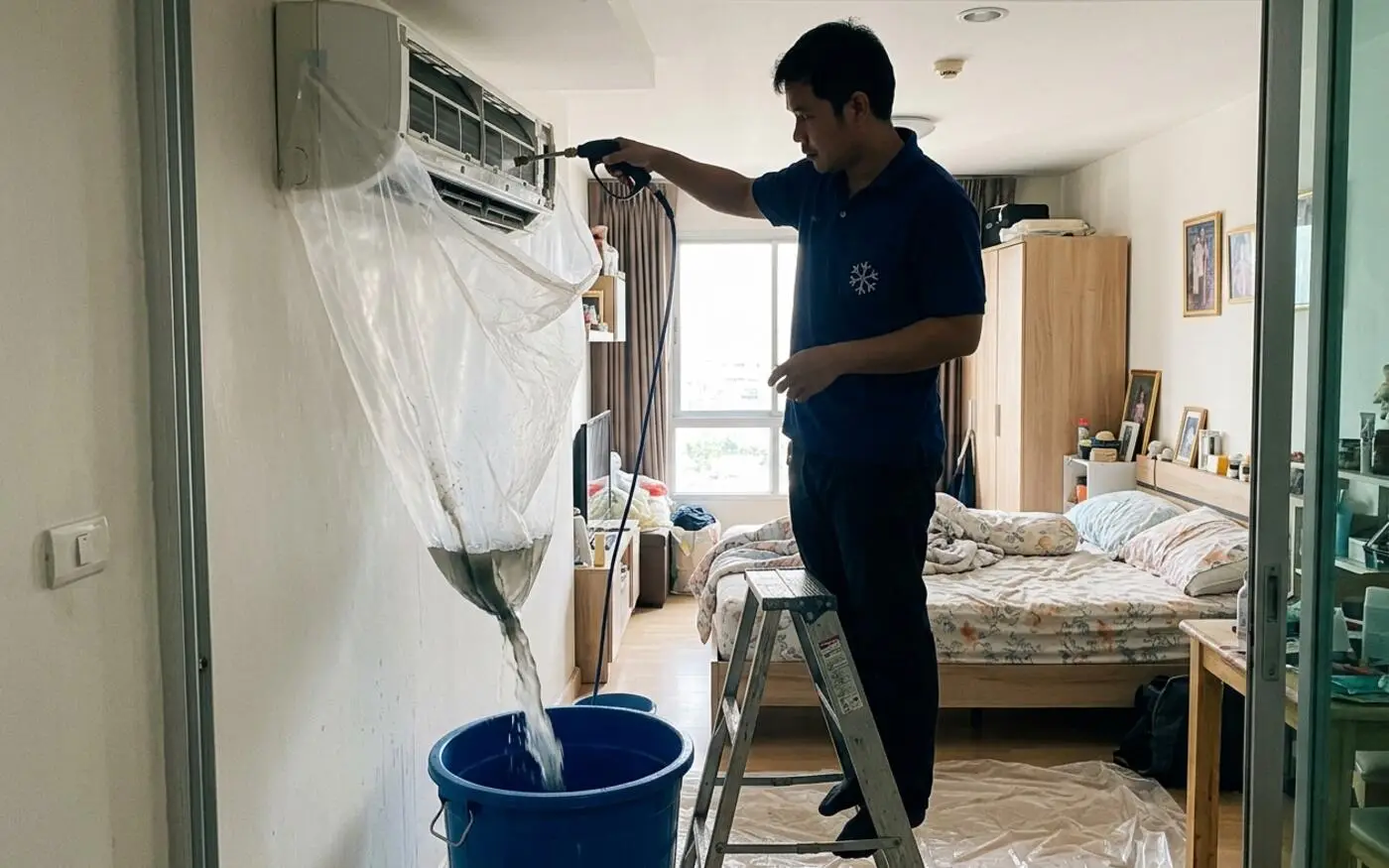
Most people judge an AC clean by how it looks when the technician leaves. The cover is shiny, the floor is dry, the air is cold. Three weeks later the smell is back. The shine was real; the clean was not.
The question people type in Thai is simple, ล้างแอร์ ต้องทำอะไรบ้าง, what does an AC clean actually involve? The answer is a sequence of specific steps that you can check, and most of them leave evidence. This guide gives you the before, during and after checklist so you can tell a thorough job from a quick rinse, whoever you hire.
Why checking matters: the ฿300 clean and what it leaves behind
Bangkok has a wide spread of AC cleaning prices, from adverts around ฿300 to much higher prices at brand service centres. We covered the spread in what AC cleaning costs in Bangkok. The difference is rarely margin. It is steps.
The reason this matters beyond appearance is how an AC gets dirty. The evaporator coil and blower wheel are cold and wet whenever the unit runs, which in Bangkok is most of the year. The US EPA notes that research suggests condensation on or near cooling coils is a major factor in moisture contamination of heating and cooling systems, and that where moisture is present the potential for mould growth rises and spores from it can be released into living space. The World Health Organization's dampness and mould guidelines associate damp indoor environments with respiratory symptoms, allergies and asthma. A partly cleaned unit keeps the damp reservoir and removes the evidence.
The EPA also makes a point worth keeping in mind whenever you hire anyone to clean a cooling system. If a provider does not clean all components, the missed part can re-contaminate the rest. And the EPA's advice for any such job is to get scope and cost in writing before work starts, to ask the provider to show you what they say is wrong, and to verify the result by inspection afterwards. The rest of this guide is that advice, translated for a wall-mounted split in a Bangkok flat.
This is a hygiene and performance guide, not a medical one. Cleaning reduces the reservoir of dirt and microbes in the unit. It does not prevent or treat any illness. If anyone in the home has persistent symptoms, asthma attacks or a weakened immune system, see a doctor.
Before the visit: three photos and a temperature reading
Five minutes of preparation turns a vague impression into evidence.
Photo 1: the coil, filter out. With the unit off, lift the front panel, remove the filter and photograph the coil face with your phone torch on. Fine dust, grey mats or a dark slime on the fins is what you are recording.
Photo 2: the blower wheel. Shine a torch through the outlet at the long drum behind the coil. A dark, furry coating on the blades, or black specks around the outlet, is worth photographing from a few angles.
Photo 3: the drain outlet. Outside, photograph the end of the drain pipe, noting whether it is clear, kinked, algae-stained or sitting in a puddle.
One temperature reading. Put a probe or kitchen thermometer in the airflow at the outlet louvre after the unit has been cooling for 10 to 15 minutes, with the same set point, fan speed and closed doors you will use again. Write down the outlet temperature, the room temperature and roughly how hot it is outside. CoolRova logs the supply-air temperature, the temperature of the air leaving the unit, before and after each standard clean for exactly this reason, but you can do the same on any clean.
A word of caution on interpreting the number. There is no universal right answer. A trade-association blog from ACCA, the US contractors' body, argues that the familiar 15 to 20 degree rule of thumb for the temperature difference across a coil is not one-size-fits-all, and that the correct figure depends on the manufacturer's data, the airflow and the indoor and outdoor conditions. So do not compare your reading with a number from the internet. Compare it with your own reading, before and after, under matched conditions. A proper clean should not make cooling worse, and it often improves airflow and cooling where the coil was restricted.
What a proper standard clean does, in order
Whatever the company, the sequence below is what a coil-and-blower clean looks like. It follows the steps in manufacturer guides such as Carrier's and Bryant's, adapted to a split unit. The coil itself is covered in more depth in the evaporator coil cleaning guide.
- Power off. Bryant says to shut power off at both the thermostat and the electrical panel before any work.
- Protect the electronics and the room. The control board and motor are covered, and the floor and furniture are protected.
- Fit a wash bag. A sealed bag or sheet is hung under the unit with a hose to a bucket, so run-off does not reach the wall or floor.
- Remove loose debris. Brush or vacuum dust off the coil with a soft tool before wetting it. Carrier warns against aggressive brushing because the thin aluminium fins bend.
- Apply coil cleaner and let it dwell. Bryant describes applying foaming coil cleaner and letting it dwell; the label sets the time, and Midea Thailand's care guide mentions five to ten minutes for foam before rinsing.
- Rinse at low pressure until the run-off is clear. Both Carrier and Bryant warn against pressure washers on the fins.
- Wash the blower wheel in place. In a standard clean this is done inside the bag, using the same cleaner and rinse.
- Clean the filter and louvres.
- Clean the drain pan and flush the drain line. Carrier's steps include inspecting the drain pan and condensate drain, removing foreign matter and flushing with clear water.
- Refit, run and test. Cooling, airflow, noise and drainage are checked, and the supply-air temperature is logged.
CoolRova's standard clean follows this path: filter, evaporator coil and blower wheel washed in place inside a sealed wash bag with coil cleaner and a low-pressure rinse, the drain line flushed and tested, the supply-air temperature logged before and after, and a before-and-after photo report. It is from ฿690 per unit.
What a deep chemical wash adds, in order
A standard clean works on parts it can reach in place. A deep chemical wash is for a unit where the blower wheel is black, the smell is established or the drain keeps blocking. In place of step 7 and 9 above, a deep wash takes things apart:
- The blower wheel is removed from the unit.
- The louvres and drain pan are stripped out.
- The coil is foamed with a biodegradable cleaner and left to soak.
- Everything is pressure-washed.
- An antibacterial, anti-mould treatment is applied.
- The unit is reassembled and tested, with a photo report.
CoolRova's deep chemical wash is from ฿1,290 per unit and takes 60 to 90 minutes per unit. The choice between the two is explained in standard clean vs deep chemical wash, and the blower step in detail in AC blower wheel cleaning.
| Step | Standard clean | Deep chemical wash |
|---|---|---|
| Wash bag and electronics protection | Yes | Yes |
| Filter, coil and blower washed | In place | Blower removed, coil soaked |
| Drain | Line flushed and tested | Pan stripped, line flushed |
| Louvres and drain pan | Not removed | Stripped out |
| Anti-mould treatment | Not included | Yes |
| Temperature log and photo report | Yes | Photo report |
On the anti-mould treatment, do what the EPA suggests for any chemical treatment applied inside a cooling system: ask what it is. The EPA says that chemical biocides should be understood, pros and cons, before you allow them, and that research has not demonstrated their effectiveness or potential adverse health effects in duct cleaning. That passage is about ducts, but the habit carries over. Ask for the product name and ask that it be rinsed or applied as its label directs.
During the visit: ten things to watch for
You do not need to supervise. You only need to notice.
- A wash bag, sheet or catch tray appears before any water does.
- The technician switches the unit off at the isolator or breaker.
- The control board is covered.
- The filter and front panel are removed and the coil is visible to you.
- Cleaner is applied and then given time to work.
- Water used is low-pressure, not a jet. A high-pressure washer on the fins is a reason to stop the job.
- The rinse continues until the water running into the bucket is clear.
- The blower wheel is washed, and you can be shown it.
- The drain is flushed and you see water leaving the outlet.
- The floor and wall are wiped, the cover is refitted properly and a test run happens before the visit ends.
If you want to see something, ask. The EPA's advice to ask a provider to show you any mould they say exists applies here too, partly because something that looks like mould may not be, and a positive identification can need an expert and sometimes a laboratory. A technician who is happy to show you a dirty blower wheel before and a clean one after is usually a good sign.
After the visit: four tests
These take ten minutes and need no tools beyond a torch and a thermometer.
The torch test
The EPA includes a flashlight check in its post-cleaning consumer checklist for cooling systems: with the torch pointed into the cooling coil, light should show through to the other side if it is clean. On a ducted system with an accessible coil, that is a literal test. On a wall split the coil is folded and mostly hidden, so adapt it. With the front panel open, check that the fins are straight and evenly spaced, the coil face is free of grey mats and the slime is gone. Then shine the torch through the outlet at the blower wheel: the blades should look like clean plastic, not furry or dark, and the area around the outlet should be free of specks.
The same EPA checklist asks whether the drain pan is completely clean and draining properly, whether the blower blades are clean and free of debris, and whether the system functions properly afterwards. You can adopt those questions as they stand.
The drain test
Run the unit in cooling for 10 to 15 minutes. Go outside, or ask the technician to show you, that water is dripping or running from the drain pipe end. Nothing there after a clean, or water pooling at the pipe end, means the line has not been flushed or the pipe is kinked. Inside, the unit should not be dripping or sweating at the cover; if it is, tell the technician before they leave.
The temperature test
Repeat your pre-visit reading in the same way: same set point, same fan speed, closed doors, 10 to 15 minutes of running, probe at the outlet louvre. Compare with your earlier note. As the ACCA piece above says, a single absolute number tells you little, but a clear improvement in how quickly the room cools and in outlet temperature, or at least no deterioration, tells you the airflow path is no longer restricted. If cooling is worse, do not wait. The usual causes are in AC not cold after cleaning.
The smell test
Close the room and switch the unit on. The first minute of air should not smell musty, sour or like wet socks, which is the signature of film on the coil and blower. A faint clean smell fades. A strong chemical or perfume smell that lasts means residue. Thailand's Department of Health, in its public advice on washing air conditioners, says that if a smell persists after the filter is washed, you should call a technician for a full-system clean, which tells you the same thing from the other direction: if the smell is still there after a clean, ask whether the full system was cleaned.
A caveat on mould, or mold as US sources spell it. The EPA states that it is impossible to eliminate all mould spores from an indoor environment and that growth is controlled by controlling moisture. A clean removes the growth and the food for it; it does not make a room sterile, and a damp room can regrow it. That is why the fan-dry habit and the cleaning schedule matter after a clean as much as before.
What a good report contains and why photos matter
A report is how a clean becomes something you can verify later. A good one contains:
- Before and after photos of the same parts: coil face, blower wheel, drain pan or outlet.
- The supply-air temperature before and after, with the settings.
- What was done on that unit, listed by step.
- Anything found that needs follow-up, such as a damaged fin, a corroded pipe or a suspected leak, with a quote in writing if it needs a repair.
- The date, the unit location and the guarantee terms.
CoolRova gives a before-and-after photo report with every standard clean and deep wash, and logs supply-air temperature before and after on a standard clean. The point of photos is not marketing. It is that you can compare them with the pictures you took.
For landlords, hosts and businesses, written records matter more. The UK Health and Safety Executive's page on what you must do about Legionnaires' disease says employers and those in control of premises, landlords included, must keep and maintain the correct records, and its list of systems most likely to create legionella risk includes evaporative cooling systems, hot and cold water systems and spa pools. A household wall split is a different category, so do not read that as a warning about your bedroom unit. The principle that carries across is that a maintenance record you can produce on request is worth more than a verbal promise. For short-let and commercial units, see the plans on the pricing page.
Red flags
| Red flag | Why it matters |
|---|---|
| No wash bag, sheet or catch tray | Dirty water goes to the wall and floor, and the technician is likely avoiding a proper wet wash |
| High-pressure hose on the fins | Carrier and Bryant both warn that pressure bends the thin aluminium fins and restricts airflow |
| The visit is over in minutes | Foam dwell, rinse, drain flush and test cannot all fit; Midea's foam dwell alone is five to ten minutes |
| No drain flush or test | The lines that cause leaks and sludge are left as they were |
| Only the filter and cover were cleaned | The film on the coil and blower, which causes the smell, is untouched |
| Bent or flattened fins afterwards | Poor technique; airflow and cooling suffer |
| Chemical or perfume smell that lasts | Cleaner or fragrance used as a mask, or not rinsed out |
| 'It needs gas' with no pressure or leak test | A sealed system does not run low unless it leaks; the claim should come with a test and a quote |
| Pressure to decide on the spot | Reputable work can wait for a written quote |
| No photos, no notes, no receipt | You cannot verify what was done |
Refrigerant deserves a separate comment because it is the classic upsell. Low gas means a leak, so a top-up with no leak test only delays a return of the problem. CoolRova's refrigerant top-up starts from ฿990 and includes a pressure and leak test first, with R32 and R410A weighed in to spec.
Questions to ask before you book
- What exactly is included? Ask for the steps, not the brand of chemical alone.
- Do you use a wash bag, and do you flush and test the drain?
- Is the blower wheel washed in place or removed, and do you charge extra if it needs removal?
- What pressure do you use on the coil?
- What treatment do you apply, what is the product, and is it rinsed?
- Will I get before and after photos and a temperature reading?
- What is the guarantee, in writing?
- If you find a fault, will you quote it in writing before doing anything?
The EPA's guidance on choosing a provider suggests getting written estimates, asking for references, checking complaint history and requiring a written agreement on cost and scope before work begins. It is written for duct cleaning in the United States, but it is sensible advice for any AC cleaning company.
What a guarantee should cover
A guarantee that cannot be written down is a slogan. A proper one states:
- What is covered: cooling, smell, leaks, or all three.
- For how long: a defined number of days.
- What the remedy is: a free return visit, a refund, or a repair.
- Who decides: how you claim and how fast you can expect action, as stated in the terms.
- What is excluded: faults that were not caused by the clean, such as an existing refrigerant leak.
CoolRova's 30-day cool-again guarantee is simple: if the unit is not cold within 30 days of the clean, we come back free. Repairs carry a separate 90-day warranty, with a fixed written quote first and a ฿590 diagnostic that is waived if the repair goes ahead. Whatever company you use, ask for the equivalent in writing. On frequency, Thailand's Department of Health suggests washing the filter at least monthly and doing a full-system clean at least once a year, around every six months with daily use. EGAT's energy-saving tips list a major clean at least twice a year.
When to call a professional back
Go back to whoever cleaned the unit, or to a second company, if after a clean any of these apply:
- The musty smell returns within days or a couple of weeks.
- The unit is warmer, weaker or noisier than before.
- Water is dripping from the indoor unit or the drain outlet is dry.
- You see dark specks coming from the outlet.
- The report does not show the items the ENERGY STAR maintenance checklist puts on the professional side, such as coil cleaning, blower components and the condensate drain.
- The unit shows signs Bryant lists for a dirty coil that should be gone after a clean: lukewarm air, short cycling, ice or frost on the coil and a musty odour.
Check the guarantee first, because a fault inside the guarantee window should be fixed free. If a unit has dark growth on the louvres or blower and you are not able to have it cleaned immediately, the EPA's mould cleanup advice is not to run an HVAC system you know or suspect is contaminated with mould, because it could spread the mould. Keep it off until it is cleaned.
If you want a clean that comes with the photos, the temperature log and a guarantee you can read, CoolRova's AC cleaning service starts at ฿690 per unit. Ask a question or request a quote on WhatsApp or through the form on our contact page, and bring this checklist. We would rather you checked.
Sources and further reading
- ENERGY STAR: heating and cooling maintenance checklist
- Carrier: how to clean evaporator coils
- Bryant: how to clean an evaporator coil
- US EPA: should you have the air ducts in your home cleaned?
- US EPA: mould remediation in schools and commercial buildings, chapter 1
- UK HSE: Legionnaires' disease, what you must do
- Thailand Department of Health: air-conditioner cleaning advice
Frequently asked questions
How do I know if my AC was cleaned properly?
Check four things after the visit. Shine a torch at the blower wheel and coil and look for clean, evenly spaced fins and blades. Confirm that the drain outlet runs freely once the unit is cooling. Repeat your before-and-after supply-air temperature reading under the same settings. Then smell the first minutes of airflow, which should not be musty or strongly chemical.
What should an AC cleaning include?
At minimum, the filter, evaporator coil and blower wheel should be washed with the electronics protected, the drain line flushed and tested, and the unit refitted and run to check cooling and leaks. Photos and a temperature check make the work verifiable. A deeper wash adds removal of the blower wheel, louvres and drain pan.
How long does a proper AC clean take?
It depends on the unit and how dirty it is, but a genuine wash cannot be a 15-minute job, because the cleaner needs time to work and the coil, blower, drain and test run all have to be done. CoolRova's deep chemical wash takes 60 to 90 minutes per unit.
Is it normal for the AC to smell of chemicals after cleaning?
A faint, brief clean scent can be normal, but a strong chemical or perfume smell that lasts suggests cleaner was not fully rinsed out. Run the unit with windows open and ask the technician to come back if it persists. A musty smell that returns within days means the film was not removed.
What are the red flags of a poor AC clean?
No wash bag or sheet, a high-pressure hose aimed at the fins, a visit that is over in minutes, no drain flush, wet marks on the wall or floor, and a claim that the unit needs gas without any pressure or leak test. Any of these is a reason to ask for the work to be corrected before you pay.
What should an AC cleaning guarantee cover?
It should say in writing what is covered, for how many days, what the remedy is and who pays. CoolRova's 30-day cool-again guarantee means that if the unit is not cold within 30 days of the clean, we come back free.
Need it handled professionally?
Get a fixed quote for your units in under 60 seconds.
Written by the CoolRova Team
We're Bangkok's documented AC crew — everything we write comes from real cleaning, repair and installation visits across condos, homes and short-stay rentals.
Get our Bangkok AC guides straight in Google — add CoolRova as a preferred source.