
If you have ever lifted the front panel of a wall-mounted air conditioner, you have seen the evaporator coil without knowing it: a block of thin metal fins, packed very close together, sitting behind the filter. It looks like a radiator, and in a way it is one. It is also the most important surface in the machine: the cooling happens there, and so does most of what goes wrong in a neglected unit.
This is the pillar guide to coil cleaning on CoolRova. It explains what the coil does, how it gets dirty, what that costs in cooling and air quality, and what a proper coil wash involves from isolating the power to logging the supply temperature. Where a topic has its own guide, such as the blower wheel or coil cleaner chemistry, you will find a link.
What the evaporator coil does, and why it is always wet in Bangkok
An air conditioner does not make cold; it moves heat. In the indoor unit, liquid refrigerant flows through the coil's tubes and boils at low pressure, absorbing heat from the room air that passes over the fins. Wikipedia's neutral summary describes an evaporator as the heat exchanger where a refrigerant boils into vapour, usually with fins fitted to the tubes to increase the surface area. The blower pulls room air through the filter, pushes it across the fins and returns it to the room cooler than it came in.
The fins run far colder than the room, and that has a second consequence. Bangkok air carries a lot of water vapour, and when it touches a surface colder than its dew point (the temperature at which vapour turns to liquid) the vapour condenses, just as droplets form on a glass of iced tea. On the coil, the droplets run down the fins into a drain pan and out through the drain line, which is why every indoor unit has a pipe leading outdoors. The unit is dehumidifying as well as cooling, which is why the drain pipe outside drips steadily on a humid night; how much water collects depends on the weather, the room and the unit.
So the coil is cold, wet and wet again every day. In a dry climate it may dry out between uses and seasons. In Bangkok the room air stays humid when the unit is off, the next start-up wets the fins again, and a bedroom unit may run for eight hours every night. That repeating wet-and-cold cycle is the root of nearly everything below.
How a coil fouls: dust, dander, soot, then biofilm
Fouling means any deposit that builds up on the coil's air side. It happens in stages.
Stage one is dust. The filter stops lint, hair and larger particles, but fine dust passes through, and a clogged or poorly seated filter lets more by. The air carries household dust, skin flakes, pet dander, cooking oil mist and fine particles from city traffic. The wet fins catch them like flypaper. A dry coil would shed some; a wet one holds them.
Stage two is a mat. The fins sit very close together, so even a thin layer on each narrows the gap between neighbours and air has to push through a tighter passage. Over months the surface becomes a grey felt you can see with a torch.
Stage three is biofilm. Wikipedia's definition describes a biofilm as a community of microorganisms that stick to each other and to a surface, embedded in a slimy matrix they produce themselves. That matrix holds the community together, and the dense structure can shield the cells inside, which is one reason a biofilm is harder to remove than loose dust. A damp coil loaded with dust offers everything it needs: water, nutrients and a stable surface.
How fast does that happen? The best evidence is not from a Bangkok bedroom, but it is telling. In a study published in Current Microbiology, researchers ran aluminium and copper heat exchangers in a full-scale test system in cooling mode and sampled them weekly. A robust biofilm formed on the aluminium within four weeks. The authors noted that the unfiltered outside air used at the start was probably the main source of organisms, that adding filters gave only a limited reduction before the biofilms rebounded with continued operation, and that HEPA filtration had little or no effect on the viable cells already established in the film. The air reaching the test exchangers was at 27 °C and 79% relative humidity, so it is not a prediction for your unit. But it points one way: the coil surface grows a biofilm quickly, and filtering the air does not undo one that has settled.
Other work agrees about where microbes live. A Scientific Reports paper that sampled central air-conditioning units in Dalian, China, found fungal communities in the equipment, with Candida and Cladosporium predominant, and modelled how Cladosporium growth responds to temperature and humidity. A US National Academies report on microbiomes of the built environment observes that conventional air-conditioning design involves frequently wet surfaces on cooling coils and drain pans, which may lead to microbial exposures not yet well characterised, that poor system condition and poor maintenance increase the risk, and that accumulated dust, dirt and moisture in HVAC systems provide a nutrient source and growth medium for microorganisms. The fair reading is not that every air conditioner is a hazard. It is that the coil is where the conditions for growth are built in, so keeping it clean is the sensible control.
What fouling does: airflow, heat transfer, freezing, drain sludge and smell
A dirty coil causes five problems, and they tend to arrive together.
Less airflow. Deposits narrow the gaps between fins, so the blower moves less air. ENERGY STAR's maintenance checklist lists coil cleaning among routine tasks and says that dirty coils reduce the system's ability to cool, so it runs longer and costs more. It also advises cleaning the blower components and notes that airflow problems can reduce efficiency.
Poorer heat transfer. Dirt on a metal fin acts as insulation, so the refrigerant has a harder time pulling heat from the air. Bryant describes it plainly: dirt insulates the coil and restricts airflow, so the coil absorbs less heat and the system works harder. A laboratory paper by Ali and Ismail in HVAC&R Research loaded the evaporator of a room air conditioner with fouling material and found the coefficient of performance fell from 2.82 on the clean coil to 1.89 after 100 g of fouling and 1.23 after 300 g. That was deliberate loading, not a typical home, so it shows direction rather than forecasting your bill. For practical costs, see what a dirty AC adds to the electricity bill.
Freezing. When too little air crosses a coil, its surface can fall below 0 °C and condensation turns to ice. Bryant says a dirty coil can cause the condensation on it to freeze, and lists ice on the coil or refrigerant lines as a warning sign. The ice blocks the fins entirely, and the unit blows warm or weak air until it thaws, often with a rush of dripping water.
Drain sludge. Whatever the wet coil sheds ends up in the drain pan and line, and the line narrows. ENERGY STAR warns that a plugged drain can cause water damage in the house and affect indoor humidity, and EPA tells homeowners to keep air conditioning drip pans clean and drain lines unobstructed. A dripping indoor unit is very often a sludge-blocked drain.
Smell. The musty start-up smell is what a biofilm smells like when air first moves across it. Because it comes from behind the filter, rinsing the filter does not remove it.
Our guide to dirty evaporator coil symptoms covers how each looks and feels from the room.
Why the coil, not the filter, is where health and performance problems start
The filter gets the attention because you can see it and remove it in ten seconds. Rinsing it every few weeks is worth doing and keeps the coil cleaner for longer. But a filter only reduces what reaches the coil. It does not clean the coil, and it is not a seal.
On health, the evidence is about association, not proof of harm from any single unit. WHO's guidelines on dampness and mould conclude that the most important effects of damp buildings are higher rates of respiratory symptoms, allergies and asthma, and that the main remedy is to prevent persistent dampness and microbial growth. The Asthma and Allergy Foundation of America states that air conditioners and dehumidifiers can themselves be a source of mould, and advises keeping condensation coils and collection buckets clean.
Put together: damp indoor spaces are associated with respiratory problems, a coil is a permanently damp surface with air moving across it, and a clean coil has less to release. That is a hygiene argument, not a medical claim. Cleaning a coil does not treat an illness, but it reduces the reservoir. There is a humidity angle too: EPA advises keeping indoor relative humidity below 60%, ideally between 30% and 50%, and a coil that is clean and draining well helps the unit dry the room, which a sludge-clogged one does less well.
If anyone in the household has asthma, recurring sinus trouble or symptoms that reliably flare when the air conditioner runs, please see a doctor. The NHS asthma guidance lists mould and dust among common triggers and advises seeing a GP if symptoms are not improving or are waking you at night. A cleaner coil can support your doctor's advice; it does not replace it.
The professional in-place coil wash, step by step
An in-place wash cleans the coil while it is still in the indoor unit on the wall. The order matters; each step protects the next.
- Inspect and photograph. The technician opens the panel, removes the filter and looks at the coil, blower wheel and drain pan with a torch. A "before" photograph fixes the starting condition and shows whether an in-place wash will be enough.
- Log the baseline. A thermometer in the supply air records how cold the unit actually delivers, the reference for the test at the end.
- Isolate power. The unit is switched off at the isolator or breaker, not just the remote. The coil sits beside the control board and fan motor, and the wash uses water.
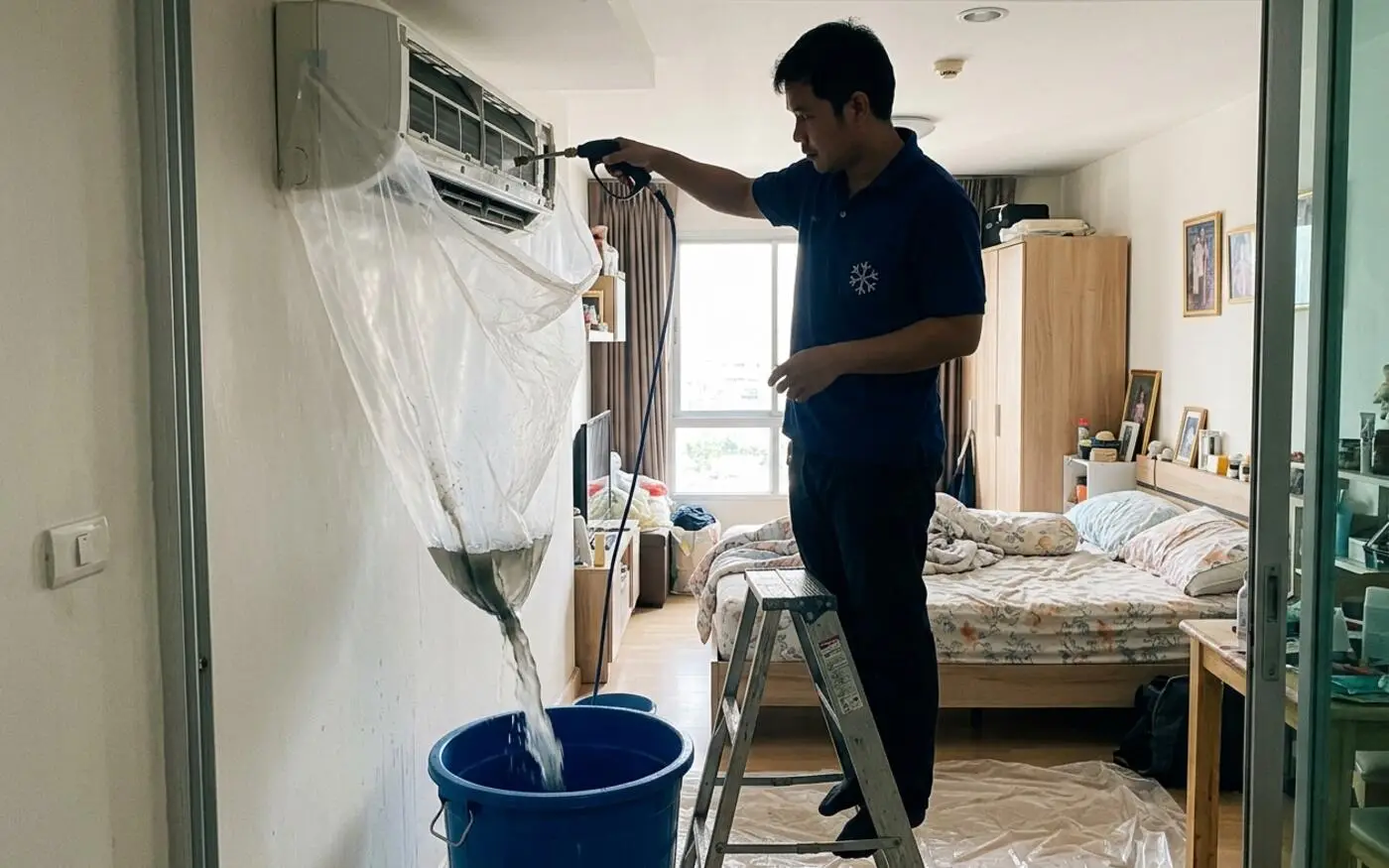
- Open and protect. The electronics and motor are covered with plastic, and a sealed wash bag is fitted under the coil so run-off is led to a bucket instead of down the wall or onto furniture.
- Dry removal. Loose dust is vacuumed or lightly brushed off the front face, with a soft brush used along the fins, never across them.
- Apply cleaner. A coil cleaner, usually a foam, is applied evenly so it penetrates between the fins. It should be a product intended for this coil.
- Dwell. The foam is left to work for the time stated on its label. This is the step that breaks down film and grease, and rushing it is a common reason a "cleaned" coil still smells.
- Low-pressure rinse. Water at low pressure carries the foam and loosened dirt out of the fins and into the bag. The rinse continues until the run-off is clear, not just until the foam is gone.
- Fin care. Any fins bent by age or earlier damage are straightened gently with a fin comb so air passes evenly.
- Blower wheel and drain pan. Both are cleaned in the same visit, for reasons covered below.
- Flush the drain. Clean water is run through the pan and line to confirm it flows freely. Carrier's guidance lists inspecting the drain pan and condensate drain, clearing debris and flushing with clear water as part of the job.
- Dry, reassemble and test. Covers come off, power is restored and the unit runs. The supply-air temperature is measured again against the baseline, and an "after" photograph is taken.
CoolRova's standard clean follows this pattern: filter, evaporator coil and blower wheel washed in place inside a sealed wash bag with coil cleaner and a low-pressure rinse, drain line flushed and tested, supply-air temperature logged before and after, and a before-and-after photo report. It starts from ฿690 for one unit.
Foam cleaners, dwell time and rinsing: what matters and what damages fins
The chemistry is unglamorous, but three principles matter.
Match the cleaner to the coil. Carrier notes that cleaner choice depends on the build-up and the coil. No-rinse cleaners suit light to moderate build-up on compatible indoor coils where the label says rinsing is not needed. Foaming cleaners suit stubborn dirt and grease but must be approved for the specific coil and diluted and rinsed as directed. Evaporator cleaners are not always suitable for condenser coils either, so labels matter. Our guide to AC coil cleaner chemicals explains how to judge them.
Give the cleaner time. Foam works by loosening the bond between deposit and metal. Scrubbing is a poor substitute for dwell time, because brushes bend fins before they shift a biofilm.
Rinse until the water runs clear, gently. Cleaner should not be left in the fins, so rinsing needs enough water to carry everything out at a pressure the fins can survive. Carrier points out that evaporator coils are hard to reach and their thin aluminium fins bend easily, and advises against pressure washers and aggressive brushing. A bent fin partly closes the gap beside it, so a careless wash can do more harm than the dirt it removed.
The blower wheel and drain pan: why a coil clean without them is half a job
The coil is only one part of the wet section. Behind it sits the blower wheel, a drum of curved blades spinning at the back of the unit, and below it the drain pan. All three are fed by the same moisture and dust.
EPA's guidance on duct cleaning names the cooling coils, condensate drain pans and fan motor and housing among the parts of a forced-air system that can become contaminated, and says that if moisture is present the potential for microbiological growth is increased. It also warns that failing to clean one component of a contaminated system can result in re-contamination of the entire system. That page is written for central ducted systems rather than wall splits, but the logic carries over: a clean coil in front of a coated blower is fed dirt and microbes again. In a wall split the blower wheel is the part hardest to clean in place, because dirt sits between closely packed blades; see AC blower wheel cleaning. The drain pan holds the sludge that restarts the cycle. A genuine coil wash includes both.
The removed deep wash: when the coil needs more than an in-place wash
Years of neglect, heavy pet hair, kitchen grease or a long-running smell can leave a layer that a wash bag and low-pressure rinse will thin but not remove. Then the technician takes parts off the wall to soak, scrub and rinse them from every angle.
CoolRova's deep chemical wash works this way: the blower wheel is removed, the louvres and drain pan are stripped, the coil is foamed with a biodegradable cleaner and soaked, everything is pressure-washed, and an antibacterial and anti-mould treatment is applied before reassembly. It takes 60 to 90 minutes per unit, includes a photo report and starts from ฿1,290 per unit. For choosing between the two, see standard clean vs deep chemical wash. Here is how the three levels compare.
| Level | Filter rinse (you) | In-place coil wash | Removed deep wash |
|---|---|---|---|
| What is reached | Mesh filter only | Filter, coil, blower wheel in place, drain line | Blower wheel, louvres and drain pan stripped; coil soaked |
| Coil cleaned | No | Yes, foamed and rinsed in a wash bag | Yes, foamed and soaked |
| Blower wheel | No | Rinsed in place | Removed and washed |
| Drain pan | No | Flushed | Stripped and cleaned |
| Time | A few minutes | Part of a standard clean visit | 60 to 90 minutes per unit |
| Best for | Every two to three weeks | Routine upkeep, thin film | Heavy coating, months-old smell, long gap since last clean |
| Limit | Does nothing for the coil | Cannot reach dirt packed between blower blades | More work and cost, not needed every visit |
Rinse the filter between visits, make in-place coil washes the regular rhythm, and ask for a removed wash when the first look shows a heavy coating or the smell has lasted months.
How often in Bangkok, and the signs it is due
Manufacturer advice is a starting point. ENERGY STAR recommends annual pre-season check-ups by a contractor, Carrier says evaporator coils should be cleaned at least once a year, ideally just before the cooling season, and Bryant recommends at least yearly, twice for homes with pets, high dust or heavy use. Those assume a unit that runs for a season. In Bangkok it works most of the year, often all night, in humid air, so a tighter schedule is reasonable: many households do well with a professional wash twice a year, faster for pet homes, open kitchens and busy rentals, with a deeper wash when the first look justifies it.
Signs the coil is due:
- a musty smell at start-up that returns soon after a "clean";
- weaker airflow than before with a clean filter;
- ice on the coil or copper pipes;
- water dripping from the indoor unit;
- dark specks on the louvres or blown from the vent;
- grey felt or slime on the fins when you shine a torch at them with the filter out.
What does coil cleaning cost in Bangkok? Coil washing is normally part of a cleaning visit rather than a separate item. CoolRova's standard clean starts from ฿690 per unit (two units ฿1,290, three ฿1,790, four ฿2,290, five ฿2,790, and six to eight units ฿3,290 per visit), and the deep chemical wash from ฿1,290 per unit. If a quote is far cheaper, check what is included: a coil spray without the drain flush, blower and bag is not the same job.
What to ask a technician, and what a report should show
A real coil wash and a quick spray look alike from across the room. These questions separate them.
- Do you wash the coil or just spray the front? The cleaner must reach between the fins and the rinse must carry the dirt out.
- How do you protect the electronics and the room? Plastic over the board and motor and a wash bag for the water are the visible signs of care.
- Do you clean the blower wheel and drain pan? If the answer is "only if needed", ask what "needed" means.
- What cleaner do you use, and is it made for evaporator coils? A technician should be able to name the product and what it is for.
- What pressure do you rinse at? Low pressure and plenty of water, not a pressure washer on the fin face.
- Do you flush and test the drain?
- Do you measure cooling before and after? A supply-air temperature log is the quickest honest test.
The best report is one a stranger could follow: before-and-after photographs of the coil, blower wheel and pan, plus the temperatures. Our guide to how to tell whether your AC was cleaned properly shows what believable evidence looks like and how to spot the shortcuts.
Mistakes that damage coils
Most coil damage is done in good faith. These are the mistakes manufacturers and technicians name most often.
- High-pressure water. It flattens fins and drives dirt deeper. Bryant lists high-pressure washers among the things that can damage fins and tubing.
- Household cleaners, bleach and vinegar. Bryant says to avoid them because they can damage the fins and tubing, and strong fumes in a closed bedroom are an unnecessary extra.
- Unapproved or aggressive cleaners. A product should only go on an indoor evaporator coil if its label and the unit manufacturer say it is meant for that coil.
- Scrubbing across the fins. A stiff brush used sideways folds fins flat.
- Cleaning over ice. Bryant's procedure lets ice thaw fully first; cleaning over ice hides the coil's true condition.
- Wet electronics. Water on the control board or fan motor turns a coil clean into a repair call. Isolating power and covering the electronics is non-negotiable.
Visibly flattened fins, corrosion or a refrigerant leak at a joint are repair questions, not cleaning ones. CoolRova's repair diagnostic is ฿590 and is waived if the repair goes ahead.
When to call a professional
Rinsing the filter and vacuuming dust from the vents are good habits for anyone. The coil itself sits behind panels beside electronics, and Carrier advises having evaporator coils cleaned by a qualified HVAC professional. Call someone if:
- the unit smells musty within days of a filter rinse;
- you can see dark growth on the coil, louvres or blower;
- there is ice on the coil or pipes, or water dripping;
- cooling has become weak or the unit runs constantly;
- anyone at home has asthma or allergies that seem tied to the unit running.
For symptoms that persist, a doctor is the right first call, not the air-conditioning technician.
If your unit is due, CoolRova's AC cleaning service covers filter, coil, blower wheel and drain in a single visit across all Bangkok BTS and MRT zones. Message us on WhatsApp or use the quote form at /contact, and we will confirm which level of wash the unit needs.
Sources and further reading
- ENERGY STAR heating and cooling maintenance checklist
- Carrier: how to clean evaporator coils
- Bryant: how to clean an evaporator coil
- Ali and Ismail, HVAC&R Research: evaporator air-side fouling and room air conditioner performance
- Schmidt et al., Current Microbiology: microbial communities on copper and aluminium heat exchangers
- Scientific Reports: microbial contamination of central air-conditioning units in Dalian
- US National Academies: Microbiomes of the Built Environment, chapter on sources of microbes in buildings
- US EPA: should you have the air ducts in your home cleaned?
- US EPA: a brief guide to mould, moisture and your home
- WHO guidelines for indoor air quality: dampness and mould
- Asthma and Allergy Foundation of America: mold allergy
- NHS: asthma
- Wikipedia: evaporator
- Wikipedia: biofilm
Frequently asked questions
What is evaporator coil cleaning?
It is the washing of the cold aluminium-fin coil inside the indoor unit, where air is cooled and moisture condenses. A proper job isolates power, protects the electronics, applies a coil cleaner, rinses it away at low pressure, flushes the drain and checks that cooling has recovered.
How often should the evaporator coil be cleaned in Bangkok?
Carrier and Bryant both suggest having the coil cleaned at least once a year, and Bryant says twice a year for homes with pets, high dust or heavy use. A unit that runs most nights in Bangkok's humidity is usually better served by a professional coil wash twice a year, with a deeper wash when the coil or blower is visibly coated.
Can I clean the evaporator coil myself?
You can rinse the filter and vacuum loose dust from the front, but the coil sits behind panels with live electronics and its thin aluminium fins bend easily. Carrier advises having evaporator coils cleaned by a qualified professional and avoiding pressure washers and aggressive brushing.
How much does ac coil cleaning cost in Bangkok?
Coil washing is normally part of a cleaning visit rather than a separate item. CoolRova's standard clean, which includes washing the coil and blower wheel in place, starts from ฿690 per unit, and the deep chemical wash starts from ฿1,290 per unit.
Is a dirty evaporator coil bad for your health?
A damp, dusty coil can harbour microbes, and damp indoor environments are associated with respiratory symptoms, allergies and worse asthma. Cleaning reduces the reservoir but is not a medical treatment, so anyone with persistent symptoms or asthma attacks should see a doctor.
Need it handled professionally?
Get a fixed quote for your units in under 60 seconds.
Written by the CoolRova Team
We're Bangkok's documented AC crew — everything we write comes from real cleaning, repair and installation visits across condos, homes and short-stay rentals.
Get our Bangkok AC guides straight in Google — add CoolRova as a preferred source.