
"It needs gas" is the most common sentence in Bangkok air-conditioning, and one of the least examined. Which gas? How much? Why is it low? This guide answers the first question so you can ask the other two.
The three refrigerants you'll find in Thailand
R22 — the old standard. Anything installed before about 2008 probably runs it. It damages the ozone layer and is being phased out under the Montreal Protocol; Thailand has cut imports sharply and the price has climbed accordingly. A leaking R22 unit is usually a replacement conversation, not a repair one.
R410A — the replacement for R22 from roughly 2008 to 2016. Ozone-safe but a potent greenhouse gas. Runs at much higher pressure than R22, so it needs its own gauges and cannot go into an R22 system. Plenty of these units are still running well in Bangkok.
R32 — what almost every new wall split sold in Thailand since 2016 uses. Daikin, Mitsubishi Electric, Panasonic, LG, Samsung and Saijo Denki have all moved to it. It has about a third of the global-warming impact of R410A, it is more efficient, and a system needs less of it by weight. It is mildly flammable, which is why installers pull a vacuum and leak-test before opening the valves.
How to check yours in thirty seconds
Go to the outdoor unit. On one side there is a sticker — the nameplate — with the model number, voltage, capacity in BTU or kW, and a line reading Refrigerant: R32 (or R410A, or R22) followed by a charge weight, for example 0.72 kg. That weight is what the system should contain, and it is what a technician should charge to after a repair.
If the sticker is faded, the model number searched online gives the same answer. If a technician connects a cylinder without looking, ask them to stop and check.
Why they can't be mixed
Each refrigerant has its own pressure–temperature relationship. A technician reads gauges against a chart for that gas; put R32 into an R410A system and the readings mean nothing, the charge will be wrong, and the compressor oil may not be compatible. Cooling suffers, the compressor runs hot, and the unit's life gets shorter. A serious technician carries both gases and separate gauge sets and checks the nameplate every time.
"It needs gas" — what that really means
Refrigerant circulates in a sealed loop. It is not consumed. It does not wear out. If the pressure is low, the gas has left through a hole — a loose flare nut at the indoor or outdoor connection, a cracked braze, a valve core, a pinhole corroded into a coil. Topping up refills the loop and the same hole empties it again, usually in two to six months.
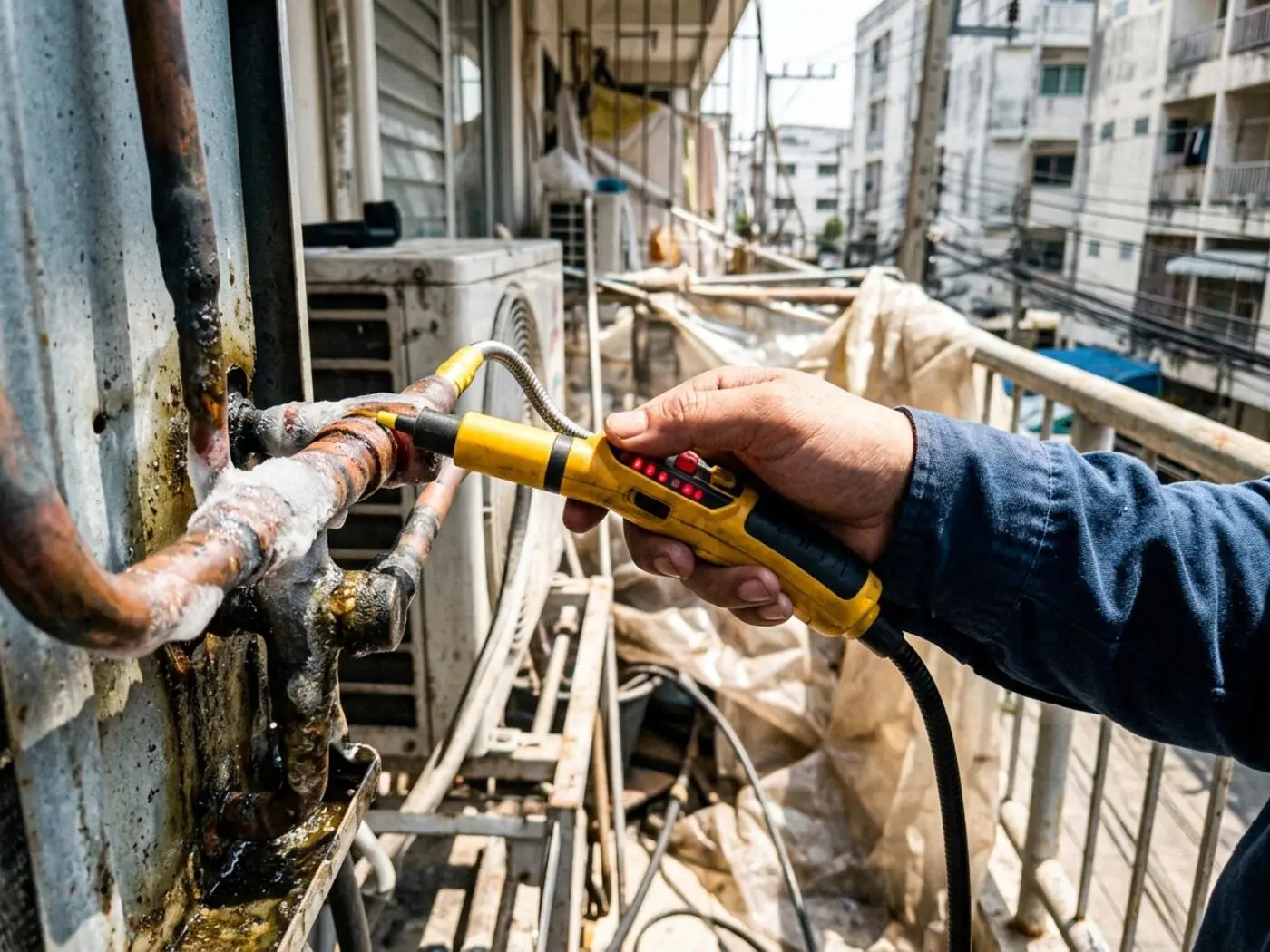
This is why a CoolRova refrigerant visit has the leak test built into the price. The sequence is: gauges on to confirm the charge is low, nitrogen pressure test and electronic detector to find the leak, fix it (often a flare remade or a valve core replaced), pull the system to a deep vacuum to remove air and moisture, then charge by weight to the nameplate. From ฿990 for a small top-up with the test, ฿1,800–3,500 for a full recharge after a repair.
If your unit isn't cold and you suspect gas, it is worth reading AC not cold after cleaning first — a dirty coil is the more common cause and costs less to fix.
Buying a new unit: does the gas matter?
Yes, a little. Every new unit you can buy in Thailand today is R32, so you won't be choosing. But it does mean the installer must know R32 procedure: vacuum pump, torque wrench on the flares, leak test before commissioning. R32's mild flammability makes shortcuts — "just purge with gas" — a genuine safety issue rather than a quality one. A proper installation includes all of it and the readings go in your report.
The one-line version
Check the nameplate, insist on the gas it names, and never accept a top-up without a leak test. The cylinder is the cheap part of the visit; the technician knowing what to do with it is what you are paying for.
Frequently asked questions
How do I know if my AC uses R32 or R410A?
Look at the nameplate sticker on the side of the outdoor unit. It lists the refrigerant type and the charge weight in grams or kilograms. Units sold in Thailand since about 2016 are usually R32; 2008–2016 models are usually R410A; older units may be R22.
Can R32 be used to top up an R410A system?
No. They run at different pressures and have different oil compatibility. Mixing or substituting refrigerants gives poor cooling, incorrect gauge readings and can shorten compressor life. A system must be charged with the gas on its nameplate.
How much does it cost to refill AC gas in Bangkok?
A small top-up including a pressure and leak test costs from ฿990 with CoolRova. A full recharge after a leak repair costs ฿1,800–3,500 depending on the system size and refrigerant. Any quote for gas that skips the leak test is a quote for doing the same job again in a few months.
Need it handled professionally?
Get a fixed quote for your units in under 60 seconds.
Written by the CoolRova Team
We're Bangkok's documented AC crew — everything we write comes from real cleaning, repair and installation visits across condos, homes and short-stay rentals.
Get our Bangkok AC guides straight in Google — add CoolRova as a preferred source.