
An office manager in a glass-fronted Bangkok building gets the same complaints every month. Headaches by mid-afternoon. A dry throat. Tired, foggy staff who seem fine again at the weekend. Someone suggests the air conditioning, someone else suggests stress, and nobody knows how to tell which it is.
That pattern has a name, sick building syndrome, and a body of research behind it. This guide explains what the term means, what studies have found about air-conditioned buildings, why Bangkok offices are prone to the problem, and how a manager can audit the building before spending money. It is general information: anyone with persistent symptoms should see a doctor, and a dirty air conditioner is one possible contributor, never a diagnosis.
What sick building syndrome is, and what it is not
The US Environmental Protection Agency's sick building syndrome fact sheet defines the term for situations in which occupants experience acute health and comfort effects that appear to be linked to time spent in a building, but where no specific illness or cause can be identified. The complaints may be confined to one room or zone, or spread through the whole building.
It contrasts this with building-related illness, where symptoms form a diagnosable illness that can be attributed directly to airborne building contaminants.
| Feature | Sick building syndrome | Building-related illness |
|---|---|---|
| Typical symptoms | Headache, eye, nose or throat irritation, dry cough, dry or itchy skin, dizziness, nausea, difficulty concentrating, fatigue, odour sensitivity | Cough, chest tightness, fever, chills, muscle aches |
| Cause | Not known | Clearly identifiable |
| After leaving the building | Most people report relief soon after | Recovery can take longer |
The NHS page on sick building syndrome lists a similar spread: headaches, a blocked or runny nose, dry or itchy skin, dry or sore eyes and throat, coughing or wheezing, and tiredness with trouble concentrating. It adds that the exact cause is unclear and probably a combination of factors, including poor ventilation or poorly maintained air conditioning, dust, smoke, fumes or fabric fibres in the air, bright or flickering lights, and cleaning or layout problems.
Two cautions belong here. Sick building syndrome describes a pattern; it is not a test result. And the EPA notes that complaints may come from causes outside the building, such as an illness caught elsewhere, allergies, or job-related stress, while also saying that studies show symptoms may be caused or made worse by indoor air quality problems. Both can be true at once, which is why a good investigation looks at people and plant together.
The symptom pattern: worse through the day, better away from the building
The most useful clue is timing. The EPA lists, as an indicator, that most complainants report relief soon after leaving the building. The NHS says symptoms get worse the longer you spend in the building and ease after you leave, and that if symptoms happen all the time or in many different places, sick building syndrome is unlikely.
For a manager, that translates into questions staff can answer:
- Do symptoms start after an hour or two at the desk, and build towards late afternoon?
- Do they fade within hours of leaving, and are weekends or holidays noticeably better?
- Are they worse on certain floors, near certain ceiling units, or in certain meeting rooms?
- Did they begin after a change, such as a refit, new carpet, new printers, a change of cleaning contractor or a period when fresh-air intake was reduced?
The US Occupational Safety and Health Administration's guide to indoor air quality in commercial and institutional buildings says to look at patterns such as occupant complaints and symptoms, location in the building, time of day, seasonal differences and relationship to activities.
One note on seriousness. NIOSH's guidance on mould and dampness describes a rarer condition, hypersensitivity pneumonitis, an immune reaction to substances such as fungi or bacteria. It can resemble flu or pneumonia, has been documented in workers in buildings with contaminated air conditioners, ductwork and filters, and may ease away from work and worsen on return. It is not the usual explanation for office headaches, but a fever, breathlessness or a cough that returns with the working week is a reason to see a doctor and mention the workplace. So is asthma, a weakened immune system or any persistent symptom.
What the research found in air-conditioned buildings
Research on this subject is old enough to have a history and new enough to still be running. The main studies share one message: air conditioning has been associated with more symptoms on average, and the explanation lies in how systems are designed, run and maintained rather than in cooling itself.
| Study | What it did | What it found | Worth remembering |
|---|---|---|---|
| Finnegan, Pickering and Burge, 1984 (BMJ) | Questionnaires in nine offices, five of them fully air-conditioned, three naturally ventilated | Highly significant excesses of nasal, eye and mucous membrane symptoms, lethargy, dry skin and headaches in the air-conditioned buildings | Very old study; seven of the buildings had no known problem |
| Seppänen and Fisk, 2002 (Indoor Air) | Review of studies on ventilation type and symptoms in offices | Air conditioning, with or without humidification, was consistently associated with about 30 to 200 percent higher prevalence of one or more symptoms than natural ventilation | The authors point to deficiencies in HVAC design, construction, operation or maintenance as possible contributors, and say other reasons remain unclear |
| Niven and colleagues, 2000 (Occupational and Environmental Medicine) | Five buildings, including three modern air-conditioned ones, a naturally ventilated one and a known sick building | Two air-conditioned buildings had few symptoms and outperformed the naturally ventilated one; a third, expected to do well, had many symptoms like the known sick building | Particulates and low-frequency noise were linked with symptoms, showing it is not only the air-conditioning plant |
| Ganji and colleagues, 2023 | About 200 healthy non-smoking adults in Hyderabad who had used air conditioning at least 6 to 8 hours a day for over two years, against a matched group of the same size in naturally ventilated workplaces (196 per group analysed) | More building-related symptoms and sickness absence, and lower results on several lung-function tests, in the air-conditioned group | Questionnaire-based and observational, from one city; association, not proof of cause |
Read together, the studies do not say that air conditioning is unhealthy. Niven's group found that well-run air-conditioned buildings could perform better than a naturally ventilated one, and also that a building expected to perform well from a design viewpoint could behave like a sick building. What recurs is the building as operated. The EPA fact sheet makes the same point, saying that problems frequently arise when a building is operated or maintained in a way that is inconsistent with its original design.
Why Bangkok offices are prone
No one has counted Bangkok offices the way these studies counted European ones, so what follows is reasoning about conditions, not a statistic. Several features of the typical workplace line up with the factors investigators examine.
Sealed envelopes. Many central offices have fixed glazing and no operable windows, so every litre of air a worker breathes has been handled by a machine. When the machine falls behind, there is no window to open.
Long hours of use. Offices that run twelve hours or more a day load coils and filters continuously and leave less time for them to dry.
Humid outdoor air. NIOSH notes that high relative humidity can itself cause excess dampness in a building. Bangkok's outdoor air is humid for most of the year, so a system has more moisture to remove, and any fault that leaves a coil or pan permanently wet matters more.
Haze season. When fine particles (PM2.5) climb in the cooler months, there is a temptation to close fresh-air intakes and keep everything shut. Our guide to PM2.5 season and your air conditioner covers what a unit can and cannot do, and the trade-off is real: less outdoor air in means less dilution of what staff exhale, print and shed.
Energy economy. The EPA fact sheet recounts how, after the 1973 oil embargo, energy-conservation measures cut recommended outdoor air from about 15 cubic feet per minute per person to about 5, a rate often found inadequate. Ventilation is among the first things turned down when electricity costs bite, and among the last things anyone checks.
Hidden equipment. Ceiling cassettes and ducted units sit above the ceiling tiles, out of sight and out of mind, so they are cleaned rarely and inspected less.
For Thai context, a Department of Health workshop summary, in Thai, reports measurements in 62 public buildings from January to May 2019. PM10 exceeded the surveillance values in almost every building except cinemas, PM2.5 in hotels and child-care centres, and carbon dioxide in child-care centres, and more than 70 percent of workers surveyed reported health problems from using the buildings. These were public venues rather than offices, so treat the study as an indication of the issue in Thailand, not a measurement of your floor.
The HVAC contribution
If the building is implicated, the heating, ventilation and air-conditioning system is the first place to look, because it handles every breath. Investigators usually work through the same short list.
| Component | What goes wrong | What a manager may notice | What to check |
|---|---|---|---|
| Filters | Overloaded or bypassed, so dust passes to the coil and the room | Dust on grilles, weak airflow | Condition, fit, replacement dates |
| Cooling coil | Dust and a wet film of microbial growth coat the fins | Musty smell on start-up, poor cooling | Visual inspection with the panel open |
| Drain pan and condensate line | Stagnant water, slime or blockage | Smell, stained ceiling tiles, drips | Free-flowing drain, no slime or standing water |
| Fresh-air damper and intake | Closed, throttled, failed or blocked; or placed near a pollutant source | Stuffy rooms by afternoon | Damper position, controls, intake location |
| Humidity control | Rooms stay damp, or humidifiers are fouled | Condensation, mould spots | Relative humidity readings |
OSHA's guidance supplies the yardstick. Its HVAC checklist calls for a written inspection and maintenance programme, monthly inspection of cooling coils and drain pans (or as required), removal of dirt, slime and mould, drains kept free-flowing, and no stagnant water. It also notes that many indoor air quality complaints are associated with inadequate preventive maintenance of the building enclosure, plumbing and HVAC systems.
The EPA's Building Air Quality guide, section on mitigating problems, names drain pans, the interior of ductwork, and filters with collected debris as examples of HVAC surfaces that can become sources of biological contaminants, and advises using biocides and disinfectants with extreme caution so occupant exposure is minimised. It also records that peak carbon dioxide above about 1,000 parts per million indicates inadequate ventilation, and that a broken damper linkage can virtually eliminate outdoor air intake and go undetected for years.
That is cheap to test: a basic carbon dioxide meter, read mid-afternoon in the most crowded rooms, tells you something a visual inspection cannot. The EPA's sick building fact sheet adds that basic readings of temperature, humidity, carbon dioxide and air movement give a useful snapshot, whereas sampling for specific pollutants seldom explains the cause and can even mislead.
Other contributors: chemicals, printers, carpets, lighting
An honest audit does not assume the air conditioner is guilty. The EPA fact sheet lists other sources:
- Volatile organic compounds from adhesives, carpeting, upholstery, manufactured wood products, copy machines, pesticides and cleaning agents. Some can cause effects at high concentrations, and low to moderate levels of several together may produce acute reactions.
- Outdoor pollutants drawn in through poorly placed air intakes, such as vehicle exhaust near a loading bay.
- Biological contaminants such as bacteria, mould, pollen and viruses, which may breed in stagnant water in ducts, humidifiers and drain pans, or where water has collected on ceiling tiles, carpet or insulation.
- Psychosocial factors, since stress and job dissatisfaction can add to physical complaints.
The NHS adds lighting and layout, and the Niven study found low-frequency noise associated with symptoms such as a stuffy nose, itchy eyes and dry skin. A perfectly clean air conditioner will not fix a printer room that vents into an open-plan floor, or a freshly laid carpet that is still off-gassing, so fix the cheapest, most likely factors first and measure the result.
A manager's audit: mapping complaints to zones and units
The EPA fact sheet describes an investigation as a cycle of gathering information, forming a hypothesis and testing it, beginning with a walkthrough of the problem area. Here is a version a facilities manager can run in a few weeks.
- Collect complaints in a structured way. A one-page, voluntary, confidential form: symptom, when it started, location, whether it eased after leaving, and any recent changes. Avoid leading questions.
- Put every complaint on a floor plan. Overlay the HVAC zones, which units serve which areas. The EPA recommends identifying known HVAC zones and complaint areas as part of the preparation for a walkthrough.
- Look for patterns. Time of day, day of week, floor, proximity to a unit or a copier, recent works. Complaints that cluster around one unit are very different from complaints spread evenly through the building.
- Take baseline readings. Temperature, relative humidity and carbon dioxide at several desks and at different times, plus airflow at supply grilles. These are inexpensive and informative.
- Walk the units serving the worst zones. Open the cassette panels or access hatches. Look at the filter, the coil, the drain pan, the condensate line or pump, and the fan. Photograph what you find. Check the fresh-air damper position and where the intake is located relative to exhaust, bins, parking and any cooling tower.
- Check the records. When was each unit last cleaned and who did it? When were filters last changed? If no one can say, that is itself a finding.
- Fix the most likely cause, then measure again. OSHA's investigation guidance ends with the question that matters: has the fix resolved the problems or complaints? If not, form the next hypothesis rather than assuming the first one was wrong in kind.
The NIOSH page gives employers a relevant principle: finding and promptly fixing the sources of dampness prevents health problems better than air sampling for mould. Resist the urge to commission expensive air testing first; the EPA fact sheet observes that measured contaminant concentrations rarely exceed existing standards even when occupants keep reporting symptoms.
Cassette and ducted units: where the dirt hides and how they are cleaned
Many small and mid-sized Bangkok offices are cooled by ceiling cassettes, ducted fan-coil units or wall splits. Each hides the same weak points in a different place.
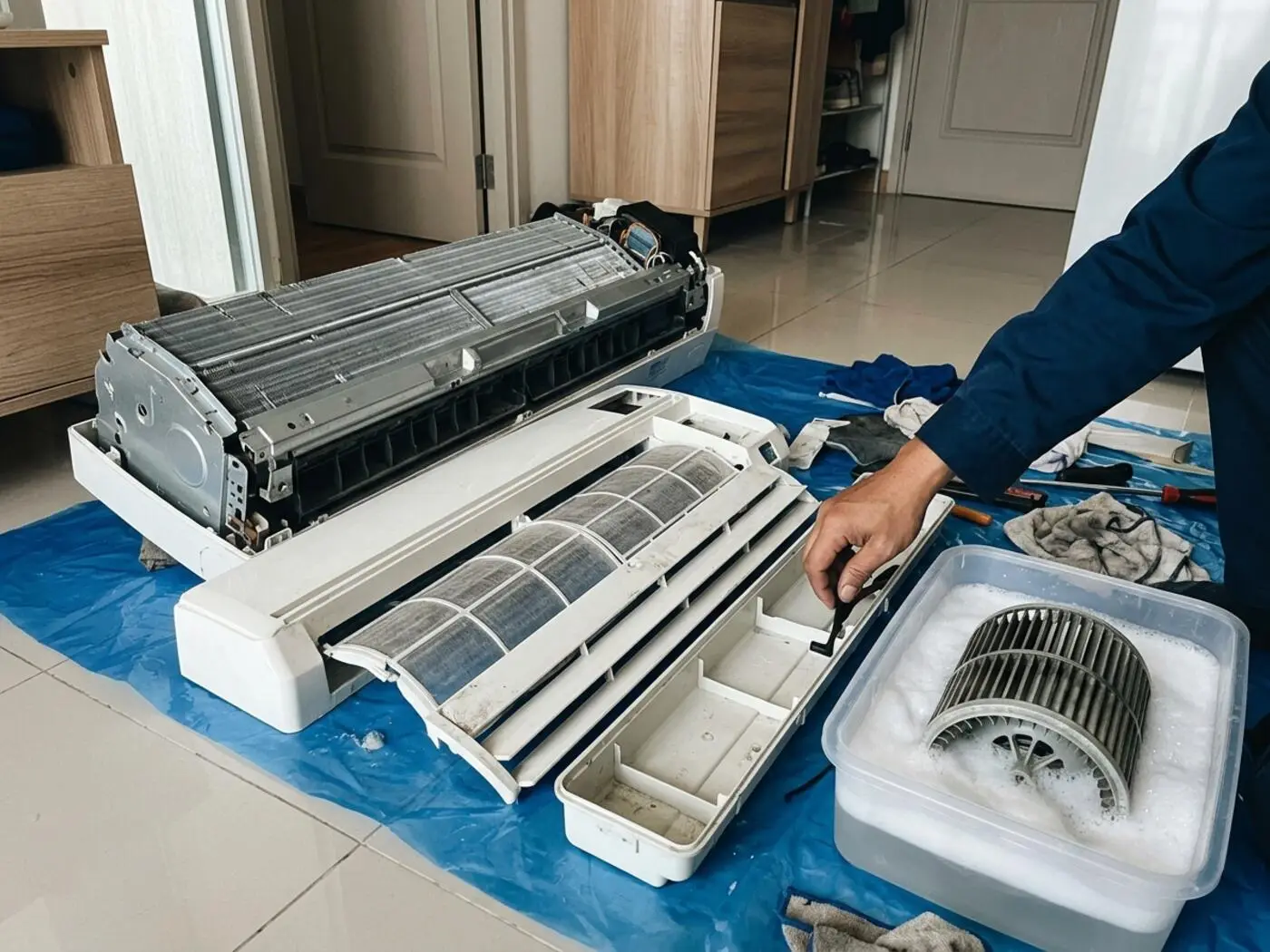
Ceiling cassettes are four-way units set into the ceiling, with a grille and filter underneath. Behind the grille sit the evaporator coil, a fan and a drain pan, often with a condensate pump that lifts water to a drain. Dust that bypasses a loaded filter coats the coil, and the pan holds stagnant water if it is not draining freely.
Ducted units push conditioned air through a plenum and ducts to grilles. They have the same coil, fan and pan in a ceiling void, plus ductwork and a return path: more surfaces, and more places for dust and damp.
A competent clean of either type typically involves:
- isolating the power and protecting the furniture below
- removing and washing the grille and filter
- washing the coil in place with cleaner and a low-pressure rinse, using a bag or tray so dirty water goes to a drain, not into the room
- cleaning the drain pan and flushing and testing the condensate line and pump
- cleaning the fan or blower where accessible
- recording temperatures and photographing before and after
Ducts are a separate question. The EPA's guidance for homes, Should you have the air ducts in your home cleaned?, says duct cleaning has never been shown to prevent health problems and is recommended only as needed, for example where there is substantial visible mould in hard-surface ducts, vermin, or ducts clogged with debris. It adds that cleaning heating and cooling system components such as cooling coils and fans may improve efficiency, and that if the cause of mould growth is not corrected it will return. For a manager the lesson is to put money first into the coil, fan and pan, which EPA says may be worth cleaning for efficiency and where moisture makes growth most likely, and into stopping water getting where it should not be.
Our guides to evaporator coil cleaning and dirty AC health effects go into the mechanisms. CoolRova services commercial cassette and ducted units; see cassette and ducted AC cleaning.
Legionella in commercial systems: cooling towers, not split units
Whenever air conditioning and illness appear in the same sentence, Legionnaires' disease follows, so it is worth being precise (our guide to whether air conditioning can make you sick covers the wider claims). The World Health Organization's legionellosis fact sheet says transmission is mainly by inhaling contaminated aerosols, and that sources linked with transmission include air-conditioning cooling towers, hot and cold water systems, humidifiers and whirlpool spas. The bacteria grow in water systems at temperatures of 20 to 50 degrees Celsius, and outbreaks have been tied to poorly maintained artificial water systems.
A typical split or cassette unit is air-cooled: it rejects heat through an outdoor condenser and does not spray water into the air. The organism is therefore a concern for buildings with a water-cooled chilled-water plant and cooling towers, and for hot-water systems, not a reason to fear an ordinary office cassette. The WHO also notes that most infections do not cause illness and that treatments exist.
For a manager the question is administrative. If the building has cooling towers or a central water-cooled plant, ask the building engineer or landlord who manages water treatment and monitoring, and ask to see the records. If a staff member develops pneumonia-like illness, urge them to see a doctor and to mention their workplace.
Putting a maintenance schedule in writing
The consistent advice is that preventive maintenance should be planned and recorded. OSHA says a preventive maintenance programme should be based on the system's recommended maintenance schedule from the architect or engineer, the manufacturer or an HVAC professional.
On the standards side, ASHRAE's Standard 62.1 sets minimum ventilation rates and other measures intended to reduce health risks for occupants, covering filtration, controls and building operations and maintenance; its companion Standard 62.2 covers homes. ANSI/ASHRAE/ACCA Standard 180, the standard practice for inspection and maintenance of commercial building HVAC systems, is among the standards ASHRAE publishes in read-only form; it establishes minimum inspection and maintenance requirements that preserve a system's ability to deliver acceptable thermal comfort, energy efficiency and indoor air quality. They are US-published standards, so treat them as yardsticks for what a written schedule should cover rather than as Thai legal requirements.
A practical template for a typical office, using OSHA's checklist intervals as a guide:
| Task | Interval | Record |
|---|---|---|
| Visual check of filters, grilles and supply airflow | Monthly | Date, condition, who checked |
| Filter wash or replacement | As the inspection shows, at least every few months | Date, filter type |
| Cooling coil and drain pan inspection | Monthly, or as required | Photograph and note |
| Coil, fan and drain pan cleaning, condensate line flushed and tested | Every six months as a baseline, sooner for dusty sites, long hours or complaint zones | Before and after photos, temperatures |
| Condensate pump and float test | With each clean | Pass or fail |
| Fresh-air damper and controls check | Quarterly | Position, operation, intake clear |
| Humidity and carbon dioxide spot readings | Monthly, in the busiest rooms | Readings and times |
| Duct and plenum inspection through access points | Twice a year (OSHA gives semi-annual as an example) | Findings |
| Complaint log reviewed against the schedule | Quarterly | Trends |
The intervals above for cleaning and damper checks are our practical suggestions, not figures from a standard; adjust them to the building and to what the inspections show. Our guide to how often to clean an AC in Bangkok explains why six months is a reasonable baseline here.
When to bring in an HVAC professional
Call a qualified HVAC contractor when:
- complaints cluster around particular units, and an inspection shows dirty coils, fouled pans or blocked drains
- carbon dioxide readings are high or rooms feel stuffy, suggesting a ventilation fault
- there is visible mould on ceiling tiles, grilles or insulation, or water is dripping or staining ceilings
- there is no maintenance record, or no one can say when units were last cleaned
- the building has cooling towers or a central water system and you are unsure who manages them
Staff whose symptoms persist or are severe should also see a doctor.
For a site with ceiling cassettes, ducted units or a mix of systems, CoolRova can clean and report on the units serving the zones you are worried about. Our cleans log supply-air temperature before and after and come with a before and after photo report, which can feed straight into your maintenance log, and we have cleaned 800+ AC units across Bangkok homes, rentals and businesses. See our commercial service page for how business sites are handled, and tell us the number and type of units through the contact page by WhatsApp or the quote form.
Sources and further reading
EPA sick building syndrome fact sheet · EPA Building Air Quality guide · EPA on air duct cleaning · OSHA indoor air quality guide · NIOSH on mould and dampness · NHS on sick building syndrome · WHO on legionellosis · ASHRAE Standard 62.1 · ASHRAE read-only standards, including Standard 180 · Finnegan et al. 1984 · Niven et al. 2000 · Ganji et al. 2023 · Seppänen and Fisk 2002 · Thailand Department of Health workshop summary (Thai)
This guide is general information, not a diagnosis. If you or your staff have persistent symptoms, asthma attacks, fever or breathlessness, see a doctor.
Frequently asked questions
What is sick building syndrome?
Sick building syndrome describes a situation where building occupants report acute health and comfort problems, such as headache, eye, nose or throat irritation, dry cough, fatigue and difficulty concentrating, that seem linked to time spent in the building. No specific illness or cause can be identified, and most people feel better soon after they leave.
Can office air conditioning cause headaches and fatigue?
It can contribute. Research has found more of these symptoms on average in air-conditioned offices than in naturally ventilated ones, and poorly maintained systems, low fresh-air supply and dirty components are among the factors investigators examine. Other causes, including stress, lighting, chemicals and illnesses caught elsewhere, can produce the same symptoms.
What is the difference between sick building syndrome and building-related illness?
In sick building syndrome the symptoms are general and the cause is unknown. In building-related illness the symptoms form a diagnosable illness that can be attributed directly to airborne contaminants in the building, and recovery after leaving the building may take longer.
How do I know if my office is the cause?
Look for a pattern. Symptoms that build during the working day, ease after leaving, and cluster on particular floors or near particular units point towards the building. Symptoms that happen everywhere and all the time are less likely to. A simple diary and a floor plan of complaints are the first tools.
Do split and cassette air conditioners cause Legionnaires' disease?
Legionella is mainly associated with cooling towers, hot and cold water systems, humidifiers and spas. Typical air-cooled split and cassette units do not use a cooling tower. A building with a water-cooled chilled-water plant should have its cooling tower water managed by qualified staff.
How often should office air conditioners be cleaned?
Inspect units regularly and clean them on a written schedule rather than waiting for complaints. A common baseline for a typical Bangkok office is a coil and drain clean every six months, with tighter intervals for dusty sites, long operating hours or any zone that generates complaints.
Need it handled professionally?
Get a fixed quote for your units in under 60 seconds.
Written by the CoolRova Team
We're Bangkok's documented AC crew — everything we write comes from real cleaning, repair and installation visits across condos, homes and short-stay rentals.
Get our Bangkok AC guides straight in Google — add CoolRova as a preferred source.