
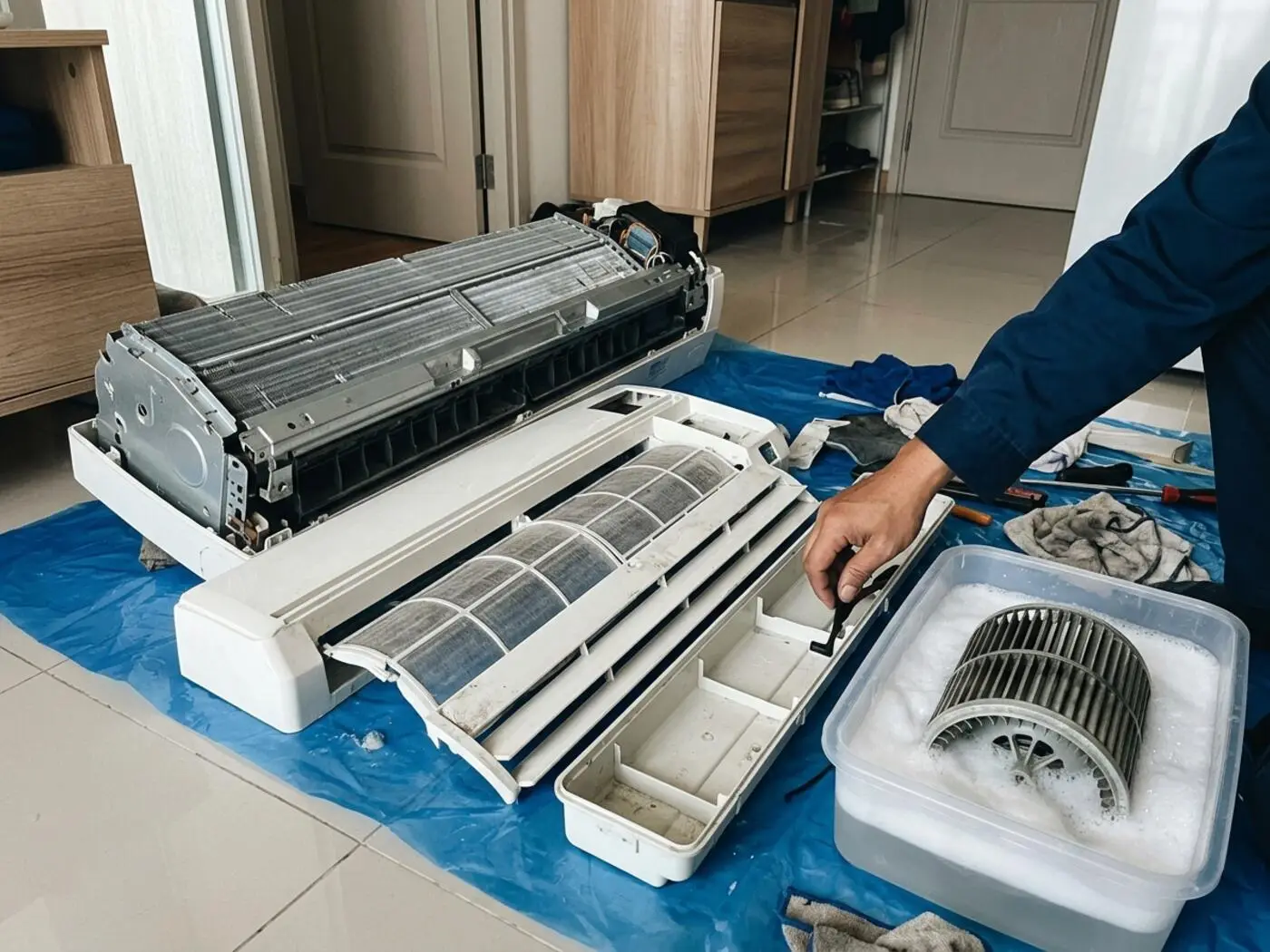
If your air conditioner has just been cleaned, the next question is how to keep it that way. If it has just been found mouldy, the question is how to stop it coming back. Either way the answer is the same, and it starts with a plain fact about mould: it cannot grow without moisture.
This is a prevention playbook for Bangkok. It explains the equation behind regrowth, the habits that genuinely help, what the evidence supports and what is marketing, and the honest ceiling: in this climate, prevention stretches the time between cleans but does not remove the need for them.
Why mould comes back: the moisture, dust and time equation
The US EPA puts it in one line: the key to mold control is moisture control. Mould spores float through indoor and outdoor air all the time. They start growing indoors only when they land on a surface that is wet, and according to the same guide, none of the many types of mould will grow without water or moisture. The EPA's mould course adds that mould can grow on virtually any organic material as long as moisture and oxygen are present, and that eliminating all spores indoors is virtually impossible.
Now look at an air conditioner through that lens.
- Moisture. The evaporator coil, the cold block of aluminium fins behind the filter, runs below the dew point of the room air whenever the unit cools. Water condenses on it by design. The EPA's guidance on air ducts notes that research suggests condensation on or near cooling coils is a major factor in moisture contamination of heating and cooling systems.
- Food. Dust that gets past the filter, along with skin flakes, pet dander, cooking residue and fine particles, lands on the wet fins and the blower wheel. That is the nutrient supply.
- Time. Every hour that the coil and blower stay damp adds to the odds that spores take hold. The EPA's advice for water-damaged materials is to dry them within 24 to 48 hours to prevent mould growth. A coil is not a flood-damaged carpet, but the principle carries over: the longer it stays wet, the likelier growth is.
You cannot stop the coil getting wet when the unit cools, because that is how cooling works. What you can influence is how long it stays wet after the unit stops, how much dust reaches it, how humid the room is, and whether the water drains away.
The result when none of that is managed is the biofilm described in why your AC smells musty: a dark film of bacteria and mould on the coil and blower wheel. The mould in air conditioner guide covers how to recognise it.
Bangkok's year and what each season does to a coil
Bangkok has a hot, a rainy and a cool season, but an air conditioner here runs through all three, unlike in climates where a unit sits idle for months and dries out.
The Thai Meteorological Department's seasonal outlooks give the pattern. April is the hottest month of the year, with summer thunderstorms. May is the transition: the second half of the month sees the start of the rainy season as the prevailing wind shifts to the southwest monsoon and the temperature falls as rain increases. In October, as the rainy season gives way to the winter season, the southwest monsoon begins to turn into the northeast monsoon, rainfall in upper Thailand falls and cooler weather starts from the middle of the month.
| Season | What the weather does | What it does to a coil | What to adjust |
|---|---|---|---|
| Hot (to about mid-May, peaking in April) | Hottest weather, with April the peak; storms build | Longest running hours, so the coil is wet for most of the day | Filter rinse every two weeks; fan-dry before every switch-off; keep the outdoor unit clear |
| Rainy (from late May to October) | Southwest monsoon, abundant rain, high moisture in outdoor air | Rooms, laundry and filters stay damp; the unit often runs on mild, wet days with less need to cool | Watch room humidity; dry filters fully; check the drain after heavy rain |
| Cool (from about mid-October) | Northeast monsoon takes over, less rain, cooler weather | Shorter running hours; a unit that is off for days can sit damp and closed | Do not leave a damp unit shut up; use fan-only to air the coil; clean before the next hot season |
The boundaries are approximate and shift from year to year, so treat the table as a guide to emphasis, not a calendar to the day.
Two things follow. The rainy season is the highest-risk period, not because it creates mould but because moisture is the limiting factor and the rains supply plenty. And the cool season is not a rest period for the coil: a unit switched off straight after a long cooling session leaves a wet coil in a closed, warm casing. That is where the first habit comes in.
Habit 1: let the coil dry
This is the single most useful habit, and it costs nothing.
When cooling stops, the coil is still cold and covered in condensate. If the unit is switched off at that moment, the fan stops and the coil dries slowly or not at all, sitting in a dark, warm, enclosed casing with a film of dust on it. If instead the fan runs without cooling for a few minutes, air moves across the fins and carries the moisture away. As a rule of thumb, five minutes is a sensible minimum, and longer is better. How to do it depends on the remote:
- A built-in dry-coil function. Many remotes have a "clean", "self-clean", "anti-mildew" or "X-fan" button or setting that keeps the fan running for a short period after shut-off. Brands name it differently, so check the manual for what your model does and how long it runs.
- Manual fan-only. Otherwise, switch from cool to fan mode a few minutes before you switch the unit off, for example when you wake, leaving it running while you get ready.
- Timers. A timer that switches the whole unit off cuts the fan with the coil still wet. Do the fan-dry step yourself in the morning rather than relying on the timer.
There is little independent research measuring how much a post-use fan run reduces coil mould in homes, so we present this as a sound application of the moisture logic, not a guarantee. It fits the EPA's advice to dry wet areas and reduce moisture. It will not remove biofilm that is already established.
Habit 2: dry mode and setpoints that reduce constant condensation
What dry mode does. "Dry" mode, usually a water-drop symbol, is designed to lower humidity with less cooling, typically by running the compressor at a reduced rate with a slow fan. It suits a clammy, mild rainy-season evening. Settings differ between brands, so the manual is the authority on yours.
For mould, dry mode helps through the room, not the coil. The EPA recommends indoor humidity below 60 percent, ideally 30 to 50 percent, and the CDC advises no higher than 50 percent all day, noting that air conditioners and dehumidifiers can help. But the coil is still cold and wet while the unit runs in dry mode, so finish with the fan-dry habit.
Setpoints and short cycling. The coil condenses water whenever it is colder than the dew point of the passing air. Two practical consequences:
- A stable, moderate setpoint beats big swings. Repeatedly dropping the setpoint very low and switching off gives cold, wet periods followed by a closed, damp casing. Cold draughts and dry air bring their own discomfort, as we explain in our guide to whether air conditioning can make you sick.
- Oversized or short-cycling units can leave humidity high. The EPA notes that in hot regions, air conditioners that cool the air too quickly may not run long enough to remove excess moisture. A room that feels cold but clammy is worth mentioning to a technician; it can reflect sizing, a faulty sensor or an air leak.
There is no magic temperature. The principle is steady operation, a dry coil at the end and a humidity level you have actually measured.
Habit 3: rinse the filter every two to three weeks
The filter is the dust gate: everything it catches is dust that never reaches the wet fins. In Bangkok, with year-round running, we recommend rinsing it every two to three weeks, as set out in how often to clean an AC in Bangkok. For US central systems, ENERGY STAR advises inspecting, cleaning or changing filters about once a month and warns that a dirty filter can raise energy costs and lead to early equipment failure. Pets and roadside rooms shorten the interval.
- Switch the unit off and open the front panel.
- Slide the mesh filters out gently.
- Rinse under a gentle tap from the clean side outwards, with mild soap if greasy. No hot water, no stiff brush.
- Shake off the water and dry the filters fully in a shaded, airy spot, because direct sun can warp some plastic frames.
- Refit and close the panel.
The drying step matters in the rainy season. A damp filter refitted into a damp unit adds moisture exactly where you do not want it, and the EPA's 24-to-48-hour drying principle is a reminder not to leave anything wet to sit. Keeping a second filter set to rotate makes this easy. A rinse stretches the interval between cleans; it does not touch the coil or blower wheel behind it.
Habit 4: keep the drain moving and the pan dry
Whatever condenses on the coil has to leave through a drain. If the pan or line is slow, standing water sits under the coil, and standing water is a mould and bacteria supply of its own. The EPA's mould guidance says to keep air conditioning drip pans clean and the drain lines unobstructed and flowing, and its course recommends removing standing water under cooling coils by making sure drain pans slope toward the drain and that the drain is flowing freely. ENERGY STAR lists inspecting the condensate drain among the routine checks, noting that a clogged drain can cause water damage and affect indoor humidity.
What you can check yourself: while the unit is cooling, the drain outlet should drip or run steadily, and a hose that stays dry after an hour of cooling is a warning. Indoors, look for water stains below the unit, drips from the louvres or gurgling at start-up. In high-rise condos the line often joins a shared stack, so if several units drip at once, tell building management as well as your technician.
Do not poke the line with a wire or pour chemicals into the unit. A blocked line usually means sludge from a dirty coil, which is a cleaning job; our guide to indoor units that drip water explains the causes. A CoolRova standard clean includes flushing the drain line and testing it.
Room humidity: targets, hygrometers, laundry and plants
An air conditioner cannot do its job in a room that keeps refilling with moisture. The authority sources agree on the target:
| Source | Target |
|---|---|
| US EPA | Below 60 percent, ideally 30 to 50 percent |
| CDC | No higher than 50 percent, all day |
| AAFA | 30 to 50 percent; mould thrives above 50 |
| American Lung Association | Below 50 percent |
If you pick one number, aim for 50 percent or less, and measure it. The EPA notes that a small, inexpensive humidity meter is available at many hardware stores. Put it at bed height, away from the unit's airflow, and read it at night and in the morning for a week.
Easy moisture sources to cut:
- Laundry and plants. The EPA lists drying clothes indoors and plants among the sources of excess moisture. Dry laundry on a balcony or in a vented area, not in the air-conditioned bedroom.
- Bathrooms and cooking. Run extractor fans and keep bathroom doors closed; a damp towel on a rail is a small humidifier.
- Open windows. Letting humid outdoor air in while the unit runs makes the coil condense more. Ventilate in short bursts, not all day.
- Condensation. The EPA recommends acting quickly on condensation on windows, walls or pipes, because it can signal high humidity.
Empty rooms matter too. ASHRAE's position document on mould and dampness lists musty odours, visible mould, water damage and previous leaks as indicators of health-relevant dampness, and for new buildings calls for humidity control during unoccupied hours, with a maximum dew point of 15 °C (the temperature at which the air becomes saturated). In a humid city, a shut-up rental or spare room with no cooling can plausibly exceed that, so ask whoever manages an empty room to run the unit periodically. ASHRAE also publishes guidance on humidity control covering dehumidification and mould avoidance in hot, humid climates.
Anti-mould treatments and coatings: what they do and how long they last
A CoolRova deep chemical wash includes an antibacterial and anti-mould treatment after the blower wheel is removed and everything is washed. Other providers sell sprays, coil coatings and "sanitising" add-ons. What should you expect?
- The EPA's mould guidance does not recommend using a biocide such as chlorine bleach as routine practice during mould cleanup, and the American Lung Association advises avoiding bleach for surface mould because it can irritate the lungs.
- The EPA's air-duct guidance says targeted biocide use may be appropriate in specific circumstances but that research has not demonstrated its effectiveness or potential adverse health effects in duct cleaning.
- Neither source is about an evaporator coil specifically, so we cannot cite an independent figure for how long a treatment lasts, and we would be wary of anyone who quotes one.
The sensible reading: a treatment is a head start, not a shield. On a freshly cleaned coil it may slow regrowth for a time; on a dirty one it is cosmetic. Ask what the product is, what it is meant to do, and whether it was applied after a full clean of coil and blower or instead of one. Our guide to coil cleaner chemicals covers the products technicians use. Never spray household bleach or disinfectant into an indoor unit yourself: the electrical parts are right there, and the fumes go straight into your room.
Ionisers, UV and self-cleaning features: what the evidence supports
Ionisers, plasma and electrostatic devices. The EPA's consumer guide advises avoiding air cleaners that intentionally produce ozone, calls ozone a lung irritant, and notes that those containing electrostatic precipitators, ionizers, UV lights without adequate lamp coatings and plasma air cleaners may have the potential to emit ozone. The AAFA likewise advises avoiding air-treatment devices that use heat, electrostatic ions or ozone. Neither says they control mould on a coil.
UV lamps. Manufacturers sell lamps designed to shine on a coil, and we found manufacturer test data for them. We did not find independent field evidence, in the authority sources cited here, that a UV lamp keeps a home coil free of mould. Treat it as unproven for this purpose; if you consider one, ask for third-party test data and check ozone emissions.
Filters and air cleaners. The EPA says filters may remove some mould-generated particles and reduce odours, but will not resolve a mould and moisture problem. The AAFA adds that air cleaners and filters cannot reduce mould spores if your home is too humid.
Self-cleaning modes. These are usually variations on a post-shut-off drying cycle. Use one if your unit has it, because it automates Habit 1, but it does not wash dust and biofilm out of the unit. Check the manual for what yours does.
None of these replaces controlling moisture and dust at the source.
What prevention cannot do: why professional cleaning still has a cadence
It is tempting to believe that enough good habits keep a coil clean indefinitely. In Bangkok that is not realistic.
- The coil is wet every time the unit cools. You can shorten the post-use wet period, but not remove the wetting.
- Dust still gets through. A mesh filter catches lint and hair; fine particles pass through and settle on the fins.
- Hidden surfaces stay hidden. The blower wheel and the back of the coil are not reachable from the front panel. The EPA's mould course lists poorly draining condensate pans inside air-handling units among the places where hidden moisture and mould can occur.
- No one removes all spores. The EPA states it is impossible to get rid of all mould and spores indoors; the goal is to deny them what they need.
- Maintenance is part of the system. ENERGY STAR's checklist lists cleaning both evaporator and condenser coils, cleaning blower components and a yearly contractor check, and says airflow problems can cut efficiency by up to 15 percent. Bangkok units run more hours than a US heating-and-cooling climate, so annual may not be enough.
For most Bangkok homes the practical cadence is a professional clean every six months, and every three months for pet homes, allergy households and units running twelve hours or more a day, as set out in how often to clean an AC in Bangkok. The habits in this guide are what make that cadence hold rather than shrink.
If you prefer to have the schedule handled for you, CoolRova's 2-Visit Year Package starts from ฿1,240 for one unit, with two scheduled cleans a year and a free gas and drain check each time. The 4-Visit Year Package, from ฿2,190 for one unit, adds quarterly cleans and includes one deep chemical wash per unit. See the pricing page for the current options.
A monthly and seasonal checklist
Use this as a starting routine and adjust it to your unit and your home.
| When | Task | Why |
|---|---|---|
| Every time you switch off | Fan-only or the unit's own dry/clean cycle for at least five minutes | Lets the coil dry |
| Every 2–3 weeks | Rinse the filter, dry it fully, refit | Keeps dust off the wet fins |
| Monthly | Check the drain outlet is dripping while cooling; look under the unit for stains | Catches a slow drain early |
| Monthly | Read the hygrometer morning and night | Confirms humidity stays at 50% or below |
| Monthly | Sniff for a musty note on start-up and look for dark flecks at the louvres | Early warning of a film |
| Every 3–6 months | Professional clean (frequency per your household) | Removes what prevention cannot |
| After any water leak or flood | Dry wet materials quickly, ideally within 24–48 hours | EPA's drying window |
A rainy-season calendar
| Time | What to do |
|---|---|
| Late April to mid-May (before the rains) | Book a clean if the unit has not been done in six months; clear plant pots and laundry racks from the outdoor unit |
| Late May to June (rains arrive) | Start the hygrometer log; move laundry out of the bedroom; fan-dry every night |
| July to September (peak rain) | Rinse filters every two weeks and dry them fully; check the drain after heavy storms; use dry mode on clammy mild evenings, then fan-dry; ask about a clean if there is a musty smell |
| October (rains ease) | Book a post-rainy-season clean; the coil has had the most wet months of the year behind it |
| November to February (cool season) | Keep to the fan-dry habit even on short cooling nights; do not leave a damp unit shut up for weeks |
The dates follow the Thai Meteorological Department's description of the rainy season's start in late May and its transition in October, and will vary year to year.
When to call a professional
Prevention is for a unit that is clean, or nearly so. Call a technician if any of these appear:
- A musty or sour smell on start-up that does not fade after a few minutes. See why your AC smells musty.
- Black or dark specks blowing from the vent, or visible dark film on the louvres, blower wheel or inside the casing.
- Water dripping from the indoor unit, which points to a blocked drain.
- Airflow that is weak even with a clean filter.
- People in the room with symptoms that start when the unit runs and ease within hours of leaving it.
The EPA's mould guide is cautious here: do not run an HVAC system that you know or suspect is contaminated with mould, because it could spread mould through the building. For a household split we would put it practically: if you can see mould, get the unit cleaned soon, rather than running it for months while you decide.
The CDC says people with asthma or mould allergy may have severe reactions, and people with weakened immunity or chronic lung disease may be at risk of lung infections. If you have persistent symptoms, an asthma attack or immune suppression, see a doctor; cleaning is not a treatment. For a closer look at the bedroom side, read our guide to bedroom air-conditioner hygiene and sleep.
The bottom line
Mould needs moisture, dust and time. Let the coil dry after every run, rinse and dry the filter, keep the drain flowing and keep the room at 50 percent humidity or below. Those habits make a clean last longer. They cannot replace one.
A CoolRova standard clean starts from ฿690 per unit: filter, evaporator coil and blower wheel washed in place inside a sealed wash bag with coil cleaner and a low-pressure rinse, drain line flushed and tested, supply-air temperature logged before and after, and a before-and-after photo report. If the blower wheel is already black, the deep chemical wash from ฿1,290 per unit removes it and soaks everything separately. We are open daily from 8:00 to 20:00 across Bangkok. Message us on WhatsApp or use the quote form on the contact page.
Sources and further reading
- US EPA: a brief guide to mold, moisture and your home
- US EPA: what are the main ways to control moisture in your home?
- US EPA: mold course, chapter 2, why and where mold grows
- US EPA: should you have the air ducts in your home cleaned?
- US EPA: guide to air cleaners in the home
- US CDC: about mold and your health
- ASHRAE position document: limiting indoor mold and dampness in buildings
- ASHRAE: humidity control resources
- ENERGY STAR: heating and cooling maintenance checklist
- AAFA: mold allergy
- American Lung Association: mold
- Thai Meteorological Department: 3-month climate prediction, April to June 2025
- Thai Meteorological Department: 3-month climate prediction, October to December 2024
This guide is general information, not medical advice. If you are unwell, see a doctor.
Frequently asked questions
How do I stop mould growing in my air conditioner?
Control moisture and dust. Switch the unit to fan-only for a few minutes before turning it off so the coil can dry, rinse and fully dry the filter every two to three weeks, keep the drain flowing, and keep room humidity below 60 percent, ideally 30 to 50 percent. These habits slow regrowth but do not remove an established film, which needs a proper clean.
Does dry mode stop mould in an air conditioner?
Dry mode lowers room humidity, which helps, but it does not by itself dry the coil, because the coil is still cold and wet while the unit runs in that mode. Settings differ between brands, so check your manual. The reliable way to dry the coil is a fan-only run, or the unit's own clean or anti-mildew cycle, before it switches off.
Why does my air conditioner get mouldy in the rainy season?
The coil is wet every time the unit cools, and in the rainy season the outdoor air carries more moisture into the room, so rooms and filters stay damp for longer. Dust sticks to the wet surface and microbes feed on it. The rainy season does not create the problem so much as speed it up.
How often should I clean my air conditioner to prevent mould?
For most Bangkok homes a professional clean every six months, and every three months for pet homes, allergy households and units that run twelve hours or more a day. Rinsing the filter yourself stretches the interval but does not clean the coil or the blower wheel.
Do UV lights or ionisers prevent mould in air conditioners?
The authority sources we reviewed do not endorse them as a way to control mould, and the US EPA warns that ionisers, plasma devices and some UV products can emit ozone, a lung irritant. Air cleaners also cannot make up for a home that is too humid. Moisture control and cleaning remain the dependable methods.
Is mould in an air conditioner harmful?
Damp and mould are associated with respiratory symptoms and with worse asthma, according to the WHO, EPA and CDC. People with asthma, mould allergy or weakened immunity are more affected. If you have persistent symptoms or an asthma attack, see a doctor, and have a musty or visibly mouldy unit cleaned.
Need it handled professionally?
Get a fixed quote for your units in under 60 seconds.
Written by the CoolRova Team
We're Bangkok's documented AC crew — everything we write comes from real cleaning, repair and installation visits across condos, homes and short-stay rentals.
Get our Bangkok AC guides straight in Google — add CoolRova as a preferred source.