
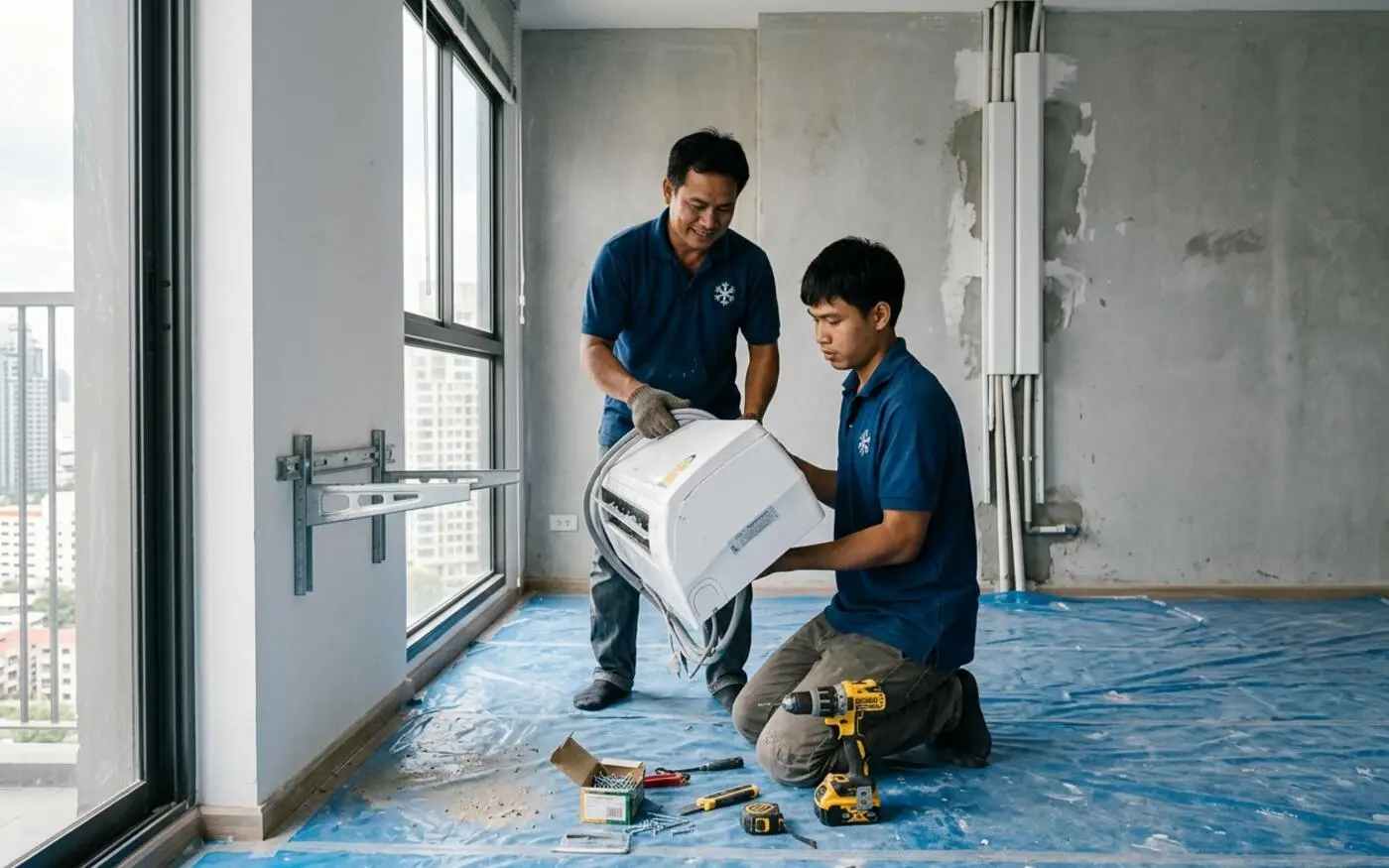
Two quotes for the same air conditioner can differ by a surprising amount, and the cheaper one is not always the same job. An installation is not a box that arrives with a price on it. It is a sequence of steps, some of which are visible (a bracket on the wall, a neat run of trunking) and some of which are invisible once the unit is running (how well the pipework was dried out, how the flares were made, whether the drain falls the right way). The invisible steps are where corners get cut, and they are the ones that decide whether the unit is still cooling and not leaking in five years.
This guide explains what an installation costs at CoolRova and what that covers, what changes the price for any installer, what a correct install involves according to the manufacturers' own manuals, and a checklist for comparing quotes. We do not quote other companies' prices, because we cannot verify them; we show you what drives the number instead.
What an installation costs at CoolRova, and what is included
CoolRova's installation and relocation service starts from ฿2,500 with a fixed written quote. "From" matters: the price you pay depends on the job, and the quote is where it is fixed. The starting price covers a defined scope rather than a bare minimum.
| Included in the quote | What it means for you |
|---|---|
| BTU sizing for the room | The unit is matched to the room before anything is ordered; see our BTU sizing guide |
| Brackets | The indoor and outdoor units are mounted securely |
| Standard pipe run and trunking | The refrigerant and drain pipes are run and covered in trunking for the standard distance |
| Deep vacuum and leak test before commissioning | The pipework is dried and checked for leaks before the unit is started |
| Commissioning readings in the photo report | You get recorded readings, not just a verbal "it works" |
| Old unit removed and recycled | Nothing is left for you to dispose of |
Other terms:
- Time. About three hours for a standard wall-mounted split with a short pipe run. Relocations take longer, because the gas has to be recovered and both ends re-flared.
- Warranty. The manufacturer's warranty on the unit plus 12 months on CoolRova's installation workmanship.
- Units. CoolRova can supply Daikin, Mitsubishi Electric, Carrier, LG, Samsung or Saijo Denki units at retail price or better, or install a unit you bought yourself.
- Offer. Every new install comes with 15% off a year package for aftercare.
To see the whole price range for our services, visit pricing; for the service itself, see AC installation and relocation.
What changes the price of any installation
The "from" in any installer's price exists because the real job varies. We give no figures here, because we have no verified market numbers and CoolRova's quote is written per job, but these factors move a quote at every installer.
| Factor | Why it changes the price | What to ask |
|---|---|---|
| Pipe length beyond the standard run | More copper, insulation, trunking and time; very long runs can need extra refrigerant | What distance is "standard" and what happens beyond it? |
| Unit size and type | A larger or multi-room system takes more work and more care than a single small split | Is the quote for exactly this model? |
| Outdoor unit position | A balcony ledge, a high-rise bracket or an awkward outdoor spot takes more time, safety measures and equipment | Where will it go and who is working at height? |
| Wall type | Drilling a thick or reinforced wall for the pipe hole is slower than a thin partition | Is coring included? |
| Drain route | A drain that cannot fall by gravity, or that must travel far, may need extra pipework or a pump | How will the condensate leave the room? |
| Electrical work | A new breaker, longer cable or a dedicated supply is extra work | Is the supply adequate, and who does it? |
| Old unit removal | Removing, recovering gas from and disposing of an old unit takes time | Is removal included? |
| Access and building rules | Lift booking, working-hours limits and deposits take time and may carry charges | Who handles building management? |
| What is supplied | Unit, pipes, bracket and cable can come from the installer or from you | What brand and specification are included? |
A quote that is silent on several of these rows may be leaving them as extras. Ask for the whole list in writing.
Why pipe length is more than just metres
Manufacturers set limits on how long and how high the refrigerant pipework can be. In Daikin's installation manual for its RXF20–42F R32 outdoor units, for example, the maximum pipe length is 20 m and the maximum height difference is 12 m, with a minimum length of 1.5 m. That is one model series, and other models and brands differ, which is exactly why the model number matters. The same manual says additional refrigerant may need to be charged when the total liquid piping length is more than specified. The US Department of Energy's mini-split job aid tells installers to make sure the total length of refrigerant piping will not exceed the manufacturer's specification.
Insulation matters in Bangkok in particular. The Daikin manual gives a minimum insulation thickness on the refrigerant pipes and says that where the temperature is above 30°C and relative humidity above 80%, the insulation should be at least 20 mm thick to prevent condensation on its surface. Bangkok is hot and humid, so it is worth asking what insulation is being used on the pipes and whether any bare copper will be left exposed.
What a proper installation involves
Manufacturers publish installation manuals for installers, and they are the best check on what "correctly" means. We drew on Daikin's manuals for a wall-mounted FTXJ indoor unit and the RXF outdoor unit above, Mitsubishi Electric's MSZ-AP installation manual, and the DOE job aid. The exact numbers differ by model, so your unit's own manual is the final word, but the sequence is consistent.
- Survey and sizing. The room, wall, outdoor position and electrical supply are checked before the unit is chosen. The Daikin manual tells the installer to check that the wall can carry the indoor unit, reinforcing it if there is a risk, and to keep airflow unblocked.
- Mount the bracket. The mounting plate is fixed level to the wall with proper anchors, at the height and clearances the manual specifies. Daikin's manual calls for the indoor unit to be at least 1.8 m above the floor.
- Drill the pipe hole with a fall. The Daikin manual says to bore the feed-through hole with a downward slope towards the outside, to fit a wall-embedded pipe and cover, and to seal the gaps around the pipes to prevent water leakage. For walls with a metal frame or board it requires a wall-embedded pipe and cover to prevent possible heat, electrical shock or fire.
- Connect the pipes and drain. Flare joints are made on the refrigerant copper, oiled only on the inside of the flare, and tightened to the torque in the manual. Daikin's manuals warn that incomplete flaring may cause refrigerant gas leakage, and Mitsubishi Electric's manual tells the installer to fasten flare nuts with a torque wrench to its torque table and warns that excessive tightening damages the flare. The drain hose must run downward; the Mitsubishi manual shows a downward slope and warns against raising the hose.
- Insulate and wrap. The pipes are insulated and wrapped together with the drain and cable, and the outdoor unit is placed on a level, stable support with room for service. The DOE job aid lists an outdoor unit elevated above flooding, with clearance on all sides, and refrigerant lines protected from damage.
- Wire the unit. The electrical connections follow the manual. Both Daikin and Mitsubishi require proper earthing, and Daikin says not to earth to a utility pipe, surge absorber or telephone earth. The Daikin manual also requires an all-pole disconnection breaker and prohibits extension cords on the supply, and the Mitsubishi manual says not to extend the connecting wires or use an intermediate connection.
- Pressure test, then vacuum. This is the step to ask about, and it has its own section below.
- Open the valves and commission. Only after the vacuum are the stop valves opened. The Daikin manual warns that running the system with the stop valves closed may break the compressor, and the Mitsubishi manual warns that operating without fully opening them lowers performance.
- Test the drain and run the unit. The Daikin manual says to pour about one litre of water into the drain pan and check for leaks. The installer then runs the unit and takes readings, and the DOE job aid ends by handing the owner the manual, warranty details and installer contact information.
The pressure test and vacuum, step by step
A new refrigerant circuit starts with air and moisture in the pipes, and neither should be left there. The manuals handle it in two stages.
First, a leak check with nitrogen. The Daikin outdoor-unit manual says to charge the system with nitrogen gas to a gauge pressure of at least 200 kPa (2 bar), recommends pressurising to higher figures to detect small leaks (depending on local legislation), and then to check every connection with a bubble test solution and discharge the nitrogen. It warns never to use soap water, because soap water can damage components such as flare nuts and may contain salt or ammonia that absorbs moisture or corrodes the flared joints. The DOE job aid describes the same sequence: a trained technician purges the system with nitrogen to check for leaks, removes nitrogen and moisture, and then opens the outdoor valves.
Second, vacuum drying. The Daikin manual's procedure is to vacuum the system until the manifold reads −0.1 MPa (−1 bar), leave it for four to five minutes and check the pressure. If the pressure does not change there is no moisture in the system. If it increases there is moisture, and the manual says to keep vacuuming for at least two hours, then turn the pump off and watch the pressure for at least an hour. If the target cannot be reached or held, check for leaks and vacuum again. Mitsubishi Electric's manual describes the same idea with a different target: run the vacuum pump until 500 microns is achieved, close off, leave it for a minute or two and confirm the gauge stays put.
You do not need to memorise the numbers. What matters is that the pipework is evacuated and shown to hold a vacuum before the refrigerant is released, and that the technician can show you the gauge. CoolRova's installation includes a deep vacuum and leak test before commissioning, with commissioning readings recorded in the photo report.
Shortcuts that cost you later
Because the vital steps are hidden behind walls and trunking, they are the easiest to skip. These are the shortcuts to watch for, with the consequence the manuals describe.
| Shortcut | What the manuals say it risks | How you would notice |
|---|---|---|
| No vacuum or too short a vacuum | Moisture and air stay in the system; the manuals require vacuum drying before the valves are opened | Not visible; a technician with a gauge can show it was done |
| No nitrogen pressure test | Leaks go undetected until the gas has gone | Weak cooling and ice after weeks or months |
| Poor flares or over-tightened nuts | Daikin says incomplete flaring may cause refrigerant gas leakage; Mitsubishi Electric says excessive tightening damages the flare | Oil staining at the joint; cooling that fades |
| Drain without a fall | The Daikin and Mitsubishi manuals require a downward slope; poor drainage can cause water leakage | Water dripping from the indoor unit |
| Thin or missing pipe insulation | Condensation can form on the surface, especially in humid conditions | Wet or dripping pipes and stained walls |
| Wires extended or joined | Mitsubishi says not to extend the wires or join them midway | Overheating risk; not visible |
| Wrong refrigerant tools | Mitsubishi notes that R32 pressure is 1.6 times that of R22 and that unsuitable tools or materials can cause pipes to burst | Not visible |
| Oversized or undersized unit | ENERGY STAR says an oversized unit wastes energy and can leave a room damp and clammy | A room that feels cold but sticky |
Several of these symptoms overlap with the faults in our guide to why an indoor unit drips water.
Choosing the unit before the installer arrives
A good installation of the wrong unit is still the wrong unit.
Size. ENERGY STAR's guide to room air conditioners says an oversized air conditioner costs more to buy, wastes energy and does not cool better, and can cool a room before removing humidity so it feels damp and clammy. The US Department of Energy's Energy Saver guide likewise notes that an oversized air conditioner performs less efficiently and effectively than a smaller, properly sized unit. Our guide to what BTU air conditioner you need explains the method, and CoolRova includes BTU sizing in every install quote.
Type and efficiency. Whether to pay more for an inverter model depends on how many hours a day the unit runs; see our comparison of inverter and non-inverter air conditioners in Thailand. Thailand also runs an energy-saving label project, the No.5 label, which EGAT reported in September 2026 is implemented by DEDE and EGAT with the Ministry of Energy, and under which entrepreneurs with multi-split type air conditioners were among those honoured. Check the label on the models you compare.
If the unit you are replacing is old, our guide to repairing or replacing an air conditioner helps you decide.
Relocations
Moving an existing unit to a new room, or taking it with you to a new flat, costs less than buying new but is not simply "reinstalling". CoolRova's installation and relocation service starts from the same ฿2,500 with a fixed written quote, and relocations take longer than a standard install because the gas is recovered and both ends re-flared.
The reason is that the refrigerant has to go somewhere. Mitsubishi Electric's manual says that when relocating or disposing of an air conditioner the system should be pumped down following its procedure so that no refrigerant is released into the atmosphere, and it warns that pipes must not be disconnected while the compressor is running with the stop valve open, because air could be drawn in and pressure rise abnormally. Daikin's outdoor manual lists "when relocating the system" as a case that can require completely recharging the refrigerant, with vacuum drying beforehand. In the United States, the Environmental Protection Agency's Section 608 programme prohibits intentionally venting refrigerants and their substitutes during service or disposal; we cite it as a clear statement of why recovery matters, not as a description of Thai rules, which you should confirm with your installer.
Daikin also says not to reuse flares, so a relocation means fresh flares at both ends and fresh vacuum drying before restart. If old pipework is being reused, ask how its condition was checked.
Condo rules and building management
In a condominium, the installer is not the only party you deal with. Some buildings restrict where outdoor units may go, require them to sit in a designated space, set working hours, ask for a deposit or a notice period, or specify where condensate may drain. We do not have a single rule to quote, because these vary by building. So before you book:
- ask the juristic person or building management for the rules on installing or relocating an air conditioner;
- ask where the outdoor unit and drain must go, and whether a lift or service access needs booking;
- tell the installer about working-hour or noise limits before the quote is fixed, and check whether an existing pipe hole or sleeve can be reused.
The drain deserves special attention. The US EPA advises keeping air conditioning drip pans clean and drain lines unobstructed and flowing properly in its guide to mould and moisture, and a drain that cannot fall properly to a suitable outlet is a common source of the leaks owners complain about later.
Supplying your own unit
If you have bought a unit online or in a store, CoolRova installs it as it would one it supplies. Two cautions:
- Check the model matches the room, because a great price on the wrong BTU rating is not a bargain, and tell the installer what pipe set (if any) is in the box before the quote is fixed.
- Keep the receipt and warranty card. The unit is covered by its manufacturer; the installation by whoever did it. CoolRova's 12 months on workmanship is separate from the manufacturer's warranty, and knowing the dividing line avoids disputes later.
A checklist for comparing quotes
Put two quotes side by side and check the following; know what is missing from each.
- The exact unit model, BTU rating and refrigerant type are written down.
- The standard pipe length included is stated, with the cost beyond it.
- Bracket type for the outdoor unit and who is working at height are stated.
- Trunking, drain, insulation and cable are included, with the insulation type stated.
- A pressure leak test and a vacuum are included, and the installer will show you the gauge reading.
- The electrical supply is checked and any breaker or cable work is priced.
- Old unit removal, wall coring and making good are included.
- Building management approvals and working-hours limits are addressed.
- The warranty on workmanship is written down, with the period.
- A fixed written quote is given before work starts.
- Commissioning readings or photos are provided at handover.
Aftercare and your first service
A new unit is clean, but it does not stay that way, and Bangkok dust and humidity start working on the filter and coil from the first week. ENERGY STAR's maintenance checklist advises regular filter checks and cleaning of evaporator and condenser coils, and warns that a plugged condensate drain can cause water damage. Thailand's DEDE, in an EGAT-published campaign, advises cleaning air filters every one to two months and doing a major clean every six months. For a schedule suited to how much you run the unit, see how often to clean your AC in Bangkok.
Every new CoolRova install comes with 15% off a year package. The installation warranty of 12 months on workmanship is worth keeping in mind too: if a joint weeps or the drain misbehaves in the first year, that is the time to call, with the commissioning readings from the photo report as your baseline.
When to call a professional
Installation is not a do-it-yourself job: it involves refrigerant, electrical connections and work at height, and Daikin's manual states that installation shall be done by an installer. Call a professional at once if you notice any of these after an install:
- water dripping from the indoor unit or the pipes;
- an oily patch or staining at a pipe joint, or ice on the pipes;
- cooling that fades over days or weeks;
- a burning smell, or a breaker that trips when the unit starts;
- a loose-feeling indoor unit or bracket.
For a quote, CoolRova gives a fixed written price for installation and relocation across all Bangkok BTS and MRT zones, with the vacuum and leak test and commissioning readings in the photo report. Message us on WhatsApp or use the quote form at /contact, and tell us the room, the unit and the building so we can price the job properly.
Frequently asked questions
How much does air conditioner installation cost in Bangkok?
CoolRova's installation and relocation starts from ฿2,500 with a fixed written quote. The final price depends on pipe length, outdoor unit position, wall type, drain route, electrical work and building rules, so the quote is written per job.
What is included in a CoolRova AC installation?
BTU sizing for the room, brackets, a standard pipe run and trunking, a deep vacuum and leak test before commissioning, commissioning readings in the photo report, and removal and recycling of the old unit. It comes with the manufacturer's warranty on the unit plus 12 months on CoolRova's installation workmanship.
How long does an air conditioner installation take?
About three hours for a standard wall-mounted split with a short pipe run. Relocations take longer because the refrigerant is recovered and both pipe ends are re-flared.
Can I buy my own air conditioner and have it installed?
Yes. CoolRova installs a unit you bought yourself as well as units it supplies from Daikin, Mitsubishi Electric, Carrier, LG, Samsung or Saijo Denki at retail price or better. Check that the BTU rating suits the room and keep the receipt and warranty card.
Why does an extra pipe length cost more?
Longer runs need more copper, insulation, trunking and time, and manufacturers set maximum pipe lengths and may require additional refrigerant beyond a specified length. Ask what distance is included in the quote and what happens beyond it.
What should I check before paying for an AC installation?
Check that the quote names the unit model, states the pipe length included, covers a leak test and vacuum, prices any electrical work, includes old unit removal, and gives a written workmanship warranty. Ask to see the gauge reading and a drain water test at handover.
Need it handled professionally?
Get a fixed quote for your units in under 60 seconds.
Written by the CoolRova Team
We're Bangkok's documented AC crew — everything we write comes from real cleaning, repair and installation visits across condos, homes and short-stay rentals.
Get our Bangkok AC guides straight in Google — add CoolRova as a preferred source.