
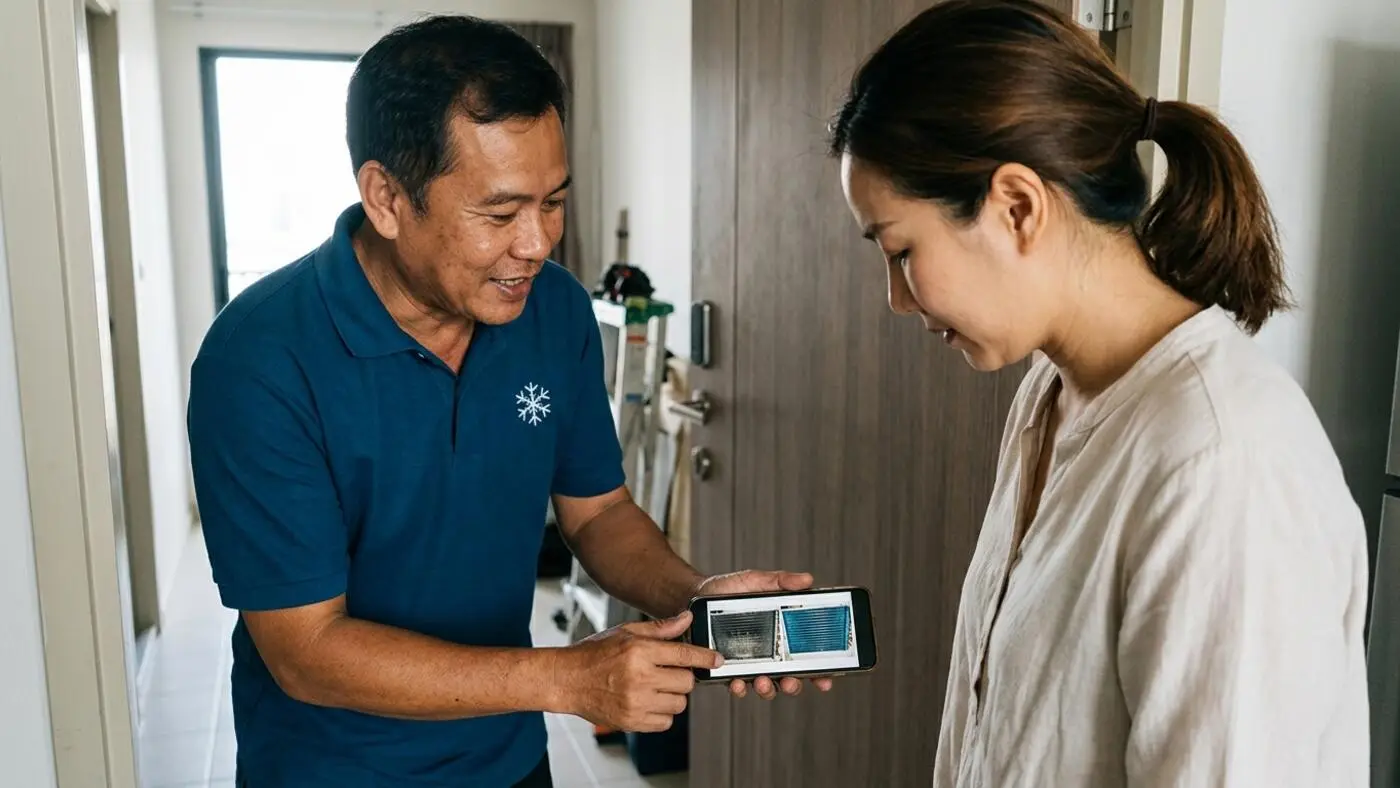
A technician has looked at your unit and given you a number. It might be a capacitor, a fan motor, a circuit board, or the words "compressor" and "leak", and you are standing in a hot room wondering whether to pay or to buy a new unit. The wrong answer is expensive both ways: pay for a repair on a machine that is about to fail again, or buy a new unit when a modest repair would have given you years.
This guide gives you a way to decide. It covers how long units usually last and what the sources say, what common repairs cost at CoolRova, why compressors and leaks are different, how running costs change the sums in Bangkok, a decision table, and the questions to ask before you spend anything. CoolRova repairs and installs air conditioners, so we have an interest in both answers; the honest position is that we want you to make the choice that costs you least over the next five years, and that sometimes means telling you not to repair.
The short answer
Repair when the fault is a single, moderate part, the unit is under roughly ten years old or in good condition, and the quote is small next to the cost of a new installation. Replace when the unit is well past ten to fifteen years, the fault is a compressor or a leaking coil, repairs are becoming a pattern, or the unit's running cost is clearly higher than a modern one's. In between, which is where most people are, the details below decide.
Before anything else, rule out the cheap causes. A unit that is weak, noisy or icing is often just dirty, and a clean costs a fraction of any repair; see why an indoor unit freezes for a typical example, where dust on the coil and blower looks like a serious refrigerant fault.
How long do air conditioners last?
There is no single number, and anyone who gives you one with confidence is guessing. What the sources say:
- Daikin states that an AC unit usually lasts between 10 and 15 years, that efficiency often starts to drop around year 10, and that a well-maintained unit in a mild climate can last 15 years or more. It also says that hot, humid or dusty climates make a unit work harder and wear faster, and that skipping maintenance is a leading cause of failure. Daikin's Middle East and Africa knowledge-centre article lists signs of replacement time: rising bills with the same usage, repairs needed more than once a season, rooms that never reach the set temperature, grinding or rattling noises, and weak or warm airflow.
- ENERGY STAR advises considering replacement of an air conditioner or heat pump that is more than 10 years old, and notes that frequent repairs combined with rising energy bills can mean equipment has become less efficient; see its replacement guidance. The page's savings figure of up to 20 percent is for correctly installed ENERGY STAR high-efficiency units, and ENERGY STAR is a US programme writing for US homes, so treat it as a direction, not a Bangkok forecast.
- The US Department of Energy lists a system more than 15 years old among the indications that a condensing unit should be replaced, along with a compressor drawing more current than rated or noisy and failing, and a damaged condenser coil. That comes from the Building America measure guideline, written for US central systems.
Put together, ten years is the age at which to start asking, and fifteen is the age at which a major failure usually points to replacement. Bangkok shifts the odds toward the early end for units that run every night: heat, humidity, dust, and months of continuous operation, with little chance for the unit to rest, all fit Daikin's description of conditions that wear a unit faster. A unit cleaned twice a year and a unit never cleaned at ten years old are not the same machine.
Common repairs and what they cost at CoolRova
Most repair bills are for a handful of parts. These are CoolRova's price ranges for parts and labour together; the first step is always the ฿590 diagnostic (waived if you go ahead with the repair), followed by a fixed written quote before any work, and repairs carry a 90-day warranty on parts and labour.
| Repair | CoolRova price (parts and labour) | Usually worth doing? |
|---|---|---|
| Capacitor | ฿1,500–2,500 | Yes, on almost any unit that is otherwise sound |
| Indoor fan motor | ฿2,500–4,500 | Usually, if the unit is under about ten years old or has been well kept |
| PCB board | ฿3,500–6,000 | Depends on age and whether the fault is the board or a symptom of something else |
| Refrigerant top-up (after pressure and leak test) | From ฿990 | Only if the leak is found and fixed; otherwise it is money spent twice |
| Compressor | Quoted per unit | Often the point where replacement is worth pricing seriously |
Two notes on reading that table. First, a capacitor is a small component that helps a motor start and run, and replacing one is among the best-value repairs there is. Second, a board fault deserves a second look, because a board can be the victim of another fault and a new board will not cure the cause. That is why the diagnostic comes before the quote.
The expensive ones: compressors and coil leaks
The compressor is the pump at the heart of the outdoor unit. It is the most expensive part of the machine, and CoolRova quotes it per unit because the price depends heavily on the model and size. The Department of Energy guideline observes that when a compressor fails in a US central system, the contractor generally replaces the entire condensing unit, though it adds that replacing only the compressor in older systems with large condenser coils in good condition can be much more cost-effective than full replacement. In a wall-mounted split the economics are different, but the principle holds: the answer depends on the unit's condition around the compressor, not only on the compressor.
It also matters why the compressor failed. Running a frozen coil strains the compressor, according to Carrier and Bryant (both writing about US central systems, but the compressor does the same job in a split), and the DOE guideline says very low airflow can cause icing and greatly shorten compressor life. A compressor that has failed because of a neglected dirty coil tells you something about the rest of the unit's history.
A leaking coil is the other bill that tips decisions. Refrigerant circulates in a sealed loop, so losing it means a leak. A leak at a flared joint or a service valve is a modest repair. A leak inside the evaporator or condenser coil, such as a pinhole in thin tubing, can mean replacing the coil, and on many splits a new coil costs enough that pricing a replacement unit is worthwhile. A technician's pressure test and leak detection tell you which case you have. Our refrigerant top-up service does the pressure test before any gas, for exactly this reason; a top-up on an unfound leak is a recurring cost.
When the quote is for a compressor or a coil on a unit past about ten years old, ask for the replacement price alongside it. CoolRova will give you both and will say when replacing makes more sense.
Running cost: old fixed-speed versus new inverter
In Bangkok the running cost of the old unit is often the largest number in the decision, because the unit runs for hours every night. A repair is a one-off bill; an inefficient unit charges you every month.
The best official source for Thai efficiency is the Electricity Generating Authority of Thailand (EGAT), which runs the No. 5 energy-saving label. EGAT's label criteria for air conditioners say the labelling of air conditioners began in 1996 and that the label was redesigned into the five-star No. 5 format from 1 January 2024. Efficiency is measured by SEER, a ratio of cooling delivered to electricity used over a typical cooling season; as Wikipedia's definition puts it, a higher SEER means more cooling for each unit of electricity. EGAT's tables set separate bands for fixed-speed and inverter units. For units up to 8,000 W of cooling (about 27,300 BTU/h), the lowest labelled band starts at a SEER of 13.17 for fixed-speed and 17.06 for inverter, and the top star starts at 15.85 for fixed-speed and 24.56 for inverter.
EGAT's document also gives the method behind the baht figure printed on every label: power in kilowatts equals declared cooling capacity in BTU/h divided by the declared SEER (in BTU/h per watt) and by 1,000; running hours are assumed to be 8 hours a day (8 × 365 = 2,920 hours a year); and electricity is assumed to cost ฿5.00 per unit, the document's 2023 assumption. Applying that method to a hypothetical 12,000 BTU/h unit at the floor of each band gives the following illustration:
| Unit type (12,000 BTU/h, illustration only) | SEER at the band's floor | Electricity per year (EGAT formula) | Cost per year at EGAT's assumed ฿5.00 per unit |
|---|---|---|---|
| Fixed-speed, lowest labelled band | 13.17 | about 2,660 kWh | about ฿13,300 |
| Inverter, lowest labelled band | 17.06 | about 2,050 kWh | about ฿10,300 |
| Inverter, top star band | 24.56 | about 1,430 kWh | about ฿7,100 |
To be clear about what this table is: it is our own arithmetic from EGAT's published formula and the band thresholds in its criteria document, not measured consumption from any unit, and it uses the label's assumed hours and tariff, not your hours or your actual MEA bill. The point is the gap between rows, not the baht figures: an inverter at the floor of its band needs about 23% less electricity than a fixed-speed unit at the floor of its band for the same cooling, and the top inverter band is far further ahead. Your old unit may not match any of these rows; if you can find its efficiency figure on the nameplate or in its manual and it is below 13.17, the gap is wider.
Two cautions. First, the savings only count if the old unit is clean. A fouled coil makes any unit worse: a laboratory paper by Ali and Ismail found a room air conditioner's coefficient of performance fell from 2.82 to 1.89 after 100 g of fouling material was loaded on its evaporator. That was deliberate loading, but it explains why a dirty unit can look much worse than it is, and why cleaning comes before a verdict. Our guide to what a dirty AC adds to the electricity bill covers the real-world side.
Second, the efficiency gain has to be weighed against the cost of buying and installing. The DOE guideline notes that replacement is easier to justify in buildings with very long blower run times, which depend on climate, the building enclosure and set-point habits. A bedroom or shop unit that runs many hours a day makes replacement easier to justify than a spare room used on weekends. For how inverters work and when they pay back, see our inverter vs non-inverter guide.
Refrigerant type, parts and an honest look at age
Refrigerant. Older units may use R22, a refrigerant that is being phased out. The US EPA's phaseout schedule says production and import of HCFC-22 ended in 2020 in the United States, production and import of all HCFCs end in 2030, and uses such as servicing air-conditioning equipment continue for now. That is a US schedule and it does not tell you what supply or pricing looks like in Thailand. If a repair on your unit needs gas, ask the technician which refrigerant it uses, whether it is available, and what it will add to the quote. Most recent units use R32 or R410A; our R32 vs R410A guide explains the difference.
Parts. Ask whether the part for your model is in stock or must be ordered, and how long that takes. A discontinued board for a twelve-year-old model is a different proposition from a common capacitor. Also ask if the repair has a warranty; CoolRova gives 90 days on parts and labour.
Pattern of faults. A single failure after nine years is a data point. The third call-out in two years is a trend. Daikin lists repairs needed more than once a season among its signs of replacement time, and ENERGY STAR links frequent repairs and rising bills to lost efficiency. Keep a note of what has been fixed and when.
Noise and performance. Persistent grinding, rattling or buzzing sounds, uneven cooling and warm airflow are on Daikin's list. They are not all expensive; a noisy blower may just be dirty, and a technician can tell the cheap causes from the serious ones.
The decision table
Use this as a prompt, not a formula. Each row pushes the decision one way; if most rows lean the same direction, that is your answer.
| Factor | Leans toward repair | Leans toward replace |
|---|---|---|
| Age | Under about 10 years, or older but well maintained | Past 10–15 years, especially with a history of faults |
| The fault | Capacitor, fan motor, sensor, drain, a found and fixable leak | Compressor failure, coil leak, or several parts failing together |
| Repair history | First significant repair | Repeated call-outs, or repairs more than once a season |
| Running cost | Efficient unit, light use | Old fixed-speed unit running many hours a day |
| Refrigerant | R32 or R410A, gas available | R22 or a model whose parts and gas are hard to source |
| Condition | Clean coil and blower, no corrosion | Corroded coil, heavy dirt that cannot be removed, damaged fins |
| Room needs | Right size and layout for the room | Wrong size, room use has changed, or the unit is noisy for a bedroom |
| Quote | Small next to a fixed installation quote | Large next to the cost of a new installed unit |
Where a row is mixed, weigh the money rather than the age. A ฿1,500–2,500 capacitor on a ten-year-old unit is rarely a hard decision. A compressor quote on a fifteen-year-old fixed-speed unit that runs every night usually is.
Questions to ask before you decide
- What exactly failed, and how do you know? Ask for the reading or test that proves it, not just the part name.
- Has the unit been properly cleaned? If not, clean first. A coated coil and blower cause icing, weak cooling and noise that mimic mechanical faults.
- Is it one fault or several? A technician who finds a worn motor, a weak capacitor and a failing board has told you something about the unit's remaining life.
- What is the fixed written quote, and what does it include? CoolRova's is fixed and written before work, and the ฿590 diagnostic is waived if you go ahead.
- What refrigerant does it use, and is gas and the part available?
- What warranty comes with the repair? CoolRova gives 90 days on parts and labour.
- What would a new installed unit cost, and what are the running savings? Get this in writing from a fixed quote, so you are comparing like with like.
- Is the room's size and use still right for this unit? A repair does not fix a unit that was never the right size for the room.
What replacement involves
If replacement wins, the work is more than swapping a box. At CoolRova, installation starts from ฿2,500 with a fixed written quote, and includes BTU sizing for the room, brackets, a standard pipe run and trunking, a deep vacuum and leak test before commissioning, commissioning readings in the photo report, and removal and recycling of the old unit. A standard wall-mounted split with a short pipe run takes about three hours. Installations carry the manufacturer's warranty on the unit plus 12 months on CoolRova's installation workmanship, and every new install comes with 15% off a year package.
You can buy the unit yourself or have CoolRova supply Daikin, Mitsubishi Electric, Carrier, LG, Samsung or Saijo Denki at retail price or better; the AC installation service page has the detail. What drives installation cost, including pipe length, brackets, condo rules and electrical work, is covered in our AC installation cost guide.
There is also an environmental side to replacement, usually ignored. A 2011 Energy Policy study by De Kleine, Keoleian and Kelly modelled replacement schedules for US central air conditioners. It weighed operating savings from newer units against the burden of manufacturing them and concluded that proper servicing should take priority over optimal replacement for reducing environmental burdens. You can read the abstract at IDEAS/RePEc. It does not say never to replace; it says that keeping a unit properly serviced matters more than replacing it on a schedule. ENERGY STAR's maintenance checklist makes the practical version of the same point, listing coil cleaning, refrigerant checks and blower airflow among the routine tasks that protect efficiency and equipment life.
When to call a professional
Do not guess at this one. Call a technician if:
- the unit has stopped cooling and you do not know why;
- there is a burning smell, repeated tripping of the breaker, or a loud grinding noise (switch it off first);
- cooling has faded over weeks, which may be a leak;
- you have been quoted a compressor, coil or board and want a second view;
- the unit is more than ten years old and has needed repeated repairs.
CoolRova's AC repair service starts with a ฿590 diagnostic, waived if you go ahead, followed by a fixed written quote and, where relevant, the cost of replacing instead. We are open daily 8:00 to 20:00, with same-day no-cool call-outs until 22:00 across all Bangkok BTS and MRT zones. If you are not sure whether a unit is worth fixing, message us on WhatsApp or use the quote form at /contact with the model, the age and what the last technician said, and we will tell you what we would do.
Sources and further reading
- Daikin: how long does an AC unit last?
- ENERGY STAR: when to replace heating and cooling equipment
- ENERGY STAR: heating and cooling maintenance checklist
- US Department of Energy Building America: Air Conditioner Diagnostics, Maintenance, and Replacement
- EGAT label No. 5: air conditioner criteria, SEER bands and electricity-cost formula (Thai PDF)
- EGAT label No. 5 website
- US EPA: phaseout of Class II ozone-depleting substances
- De Kleine, Keoleian and Kelly, Energy Policy 2011: optimal replacement of residential air conditioning equipment
- Ali and Ismail, HVAC&R Research: evaporator air-side fouling and room air conditioner performance
- Wikipedia: seasonal energy efficiency ratio
- Carrier: will a frozen AC fix itself?
- Bryant: why does my AC keep freezing?
Frequently asked questions
How long does a split air conditioner last?
Daikin says an AC unit usually lasts between 10 and 15 years and that efficiency often starts to drop around year 10. Climate and maintenance change the figure: Daikin notes that hot, humid or dusty conditions make a unit work harder, which is a fair description of Bangkok.
Is it worth repairing a 10-year-old aircon?
Often yes, if the fault is a single moderate part such as a capacitor, fan motor or board and the rest of the unit is sound. ENERGY STAR flags frequent repairs combined with rising energy bills as the signal that equipment has become less efficient, so one repair is different from a pattern of them.
How much does an AC compressor replacement cost in Bangkok?
It varies with the unit, so CoolRova quotes compressors per unit after a ฿590 diagnostic, which is waived if the repair goes ahead. Because a compressor repair is one of the larger bills, we will say honestly when replacing the unit makes more sense.
Will a new inverter air conditioner save money?
It can, especially in a room that runs for many hours a day. EGAT's label criteria require a far higher seasonal efficiency (SEER) from inverter units than from fixed-speed ones, and a unit that runs eight hours a day uses its electricity for 2,920 hours a year. The saving depends on your old unit's actual efficiency, your hours of use and your tariff.
Should I replace my AC if it uses R22 refrigerant?
An R22 unit is not automatically a write-off, but it deserves a closer look. The US EPA's phaseout schedule shows production and import of HCFC-22 ended in 2020 in the United States while servicing uses continue, so ask your technician about availability and cost in Thailand before paying for a repair that needs gas.
What should I check before paying for an AC repair?
Get a written diagnosis and a fixed quote, confirm the unit has been properly cleaned, and ask for the refrigerant type, the warranty on the repair and the price of a like-for-like new installation. A dirty coil or blower can mimic a serious fault, so a clean should come before an expensive repair.
Need it handled professionally?
Get a fixed quote for your units in under 60 seconds.
Written by the CoolRova Team
We're Bangkok's documented AC crew — everything we write comes from real cleaning, repair and installation visits across condos, homes and short-stay rentals.
Get our Bangkok AC guides straight in Google — add CoolRova as a preferred source.