
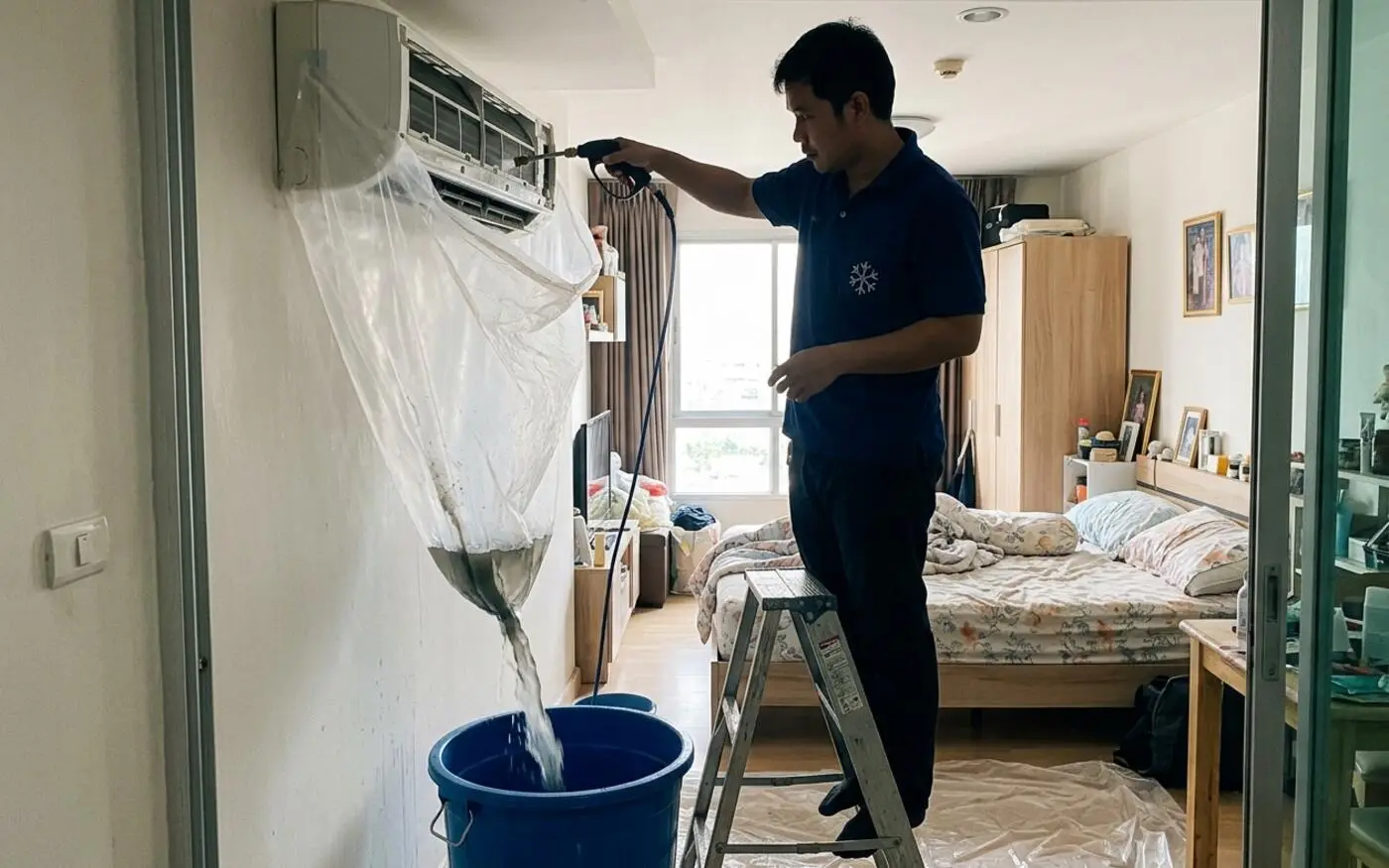
You know the smell. The unit clicks on, the fan spins up, and for the first minute the room smells like a gym bag left in a car. Then it fades, and you tell yourself it is fine.
It is not fine, and the filter has nothing to do with it.
What the smell actually is
Behind the filter is the evaporator coil — a block of aluminium fins that runs cold and wet whenever the unit is on. Behind that is the blower wheel, a long plastic drum that pushes air across the coil and out of the vent. Both are wet every night of the year in Bangkok.
Dust that gets past the filter lands on those wet surfaces. Bacteria and mould feed on it. Within a few months the coil and the blower are coated in a dark, slimy layer — technicians call it biofilm, and it is what you are smelling. When the fan starts, it blows air across a damp, living film and the volatile compounds come out as that sour, musty note.
Once the coil is running cold the smell fades, because cold air carries less odour and the film is being washed by fresh condensate. That is why it is worst on start-up and after the unit has sat idle for a few hours.
Why Bangkok grows it faster
In a climate with a dry or cold season, the coil dries out for months at a time and the film dies back. In Bangkok the unit runs every night, the coil never dries, the air is 70% humidity when the unit is off, and the room is 27 °C — close to the temperature bacteria like best. A unit here can go from clean to smelly in a single rainy season.
Pet homes, kitchens and rooms where people smoke are worse, because they add more organic dust for the film to feed on.
Why a filter clean doesn't help
The mesh filter catches lint, hair and large dust. It sits in front of the coil, and you can rinse it in a sink in two minutes. That is worth doing every two or three weeks — see how often to clean an AC in Bangkok — but it does not touch the film on the coil or the blower wheel behind it. If your technician "cleaned" the unit last month and it still smells, that is what happened: filter rinsed, coil untouched.
When a standard clean is enough
If the smell is faint and recent, a standard clean fixes it. The coil and blower wheel are foamed with a coil cleaner and rinsed at low pressure inside a wash bag until the water runs clear. On a coil with a thin film this removes it completely, and you can see the difference in the before and after photo.
When it needs the deep chemical wash
If the blower wheel is visibly black when the technician opens the cover, or the smell has been there for a year, a rinse in place won't reach the film packed between the blower's blades and behind the coil. The deep chemical wash takes the blower wheel out of the unit, strips the louvres and drain pan, foams and soaks everything separately, pressure-washes it clean and applies an antibacterial, anti-mould treatment before reassembly.
It takes 60–90 minutes per unit and costs ฿1,290. It is the reset button; after it a six-monthly standard clean keeps the unit there. The choice between the two is set out in standard clean vs deep chemical wash.
Signs it has gone past cosmetic
- Black specks from the vent. Pieces of the film are breaking off and being blown into the room.
- Sneezing, coughing or a blocked nose that starts when the AC runs and eases when it is off. Spores.
- Water dripping from the unit. The same sludge has now blocked the drain — see why your AC is dripping.
- Weak airflow despite a clean filter. The blower blades are so coated they are moving less air.
Any of these and the unit needs the deep wash, not a rinse.
Slowing it down between cleans
- If your remote has a dry, clean or "X-fan" mode, use it: it runs the fan for a few minutes after cooling stops and dries the coil.
- If it doesn't, switch cooling off and run fan-only for five minutes before turning the unit off at night.
- Rinse the filter every two to three weeks.
- Keep bedroom humidity down where you can — a bathroom door left open after a shower feeds the coil.
None of these remove an established film. They stretch the time between proper cleans from six months towards eight.
Frequently asked questions
Why does my air conditioner smell bad when it turns on?
Water condenses on the cold coil every time the unit runs, and in Bangkok's humidity it never fully dries. Dust settles on the wet surface and bacteria and mould grow on it, producing a sour, musty smell that is strongest on start-up when the fan first pushes air across the dirty coil and blower wheel.
Is mould in an air conditioner dangerous?
It is an indoor air quality problem rather than an emergency, but spores blown into a bedroom every night aggravate asthma, allergies and sinus problems, and children and elderly people are more sensitive. If the smell comes with black specks from the vent or symptoms that ease when the unit is off, have it cleaned properly rather than masking it.
Will cleaning the filter get rid of the smell?
Rarely. The filter catches lint and hair; the smell comes from the coil and blower wheel behind it. If the smell is faint a standard coil and blower clean removes it; if the blower wheel is visibly black a deep chemical wash is needed.
Need it handled professionally?
Get a fixed quote for your units in under 60 seconds.
Written by the CoolRova Team
We're Bangkok's documented AC crew — everything we write comes from real cleaning, repair and installation visits across condos, homes and short-stay rentals.
Get our Bangkok AC guides straight in Google — add CoolRova as a preferred source.