
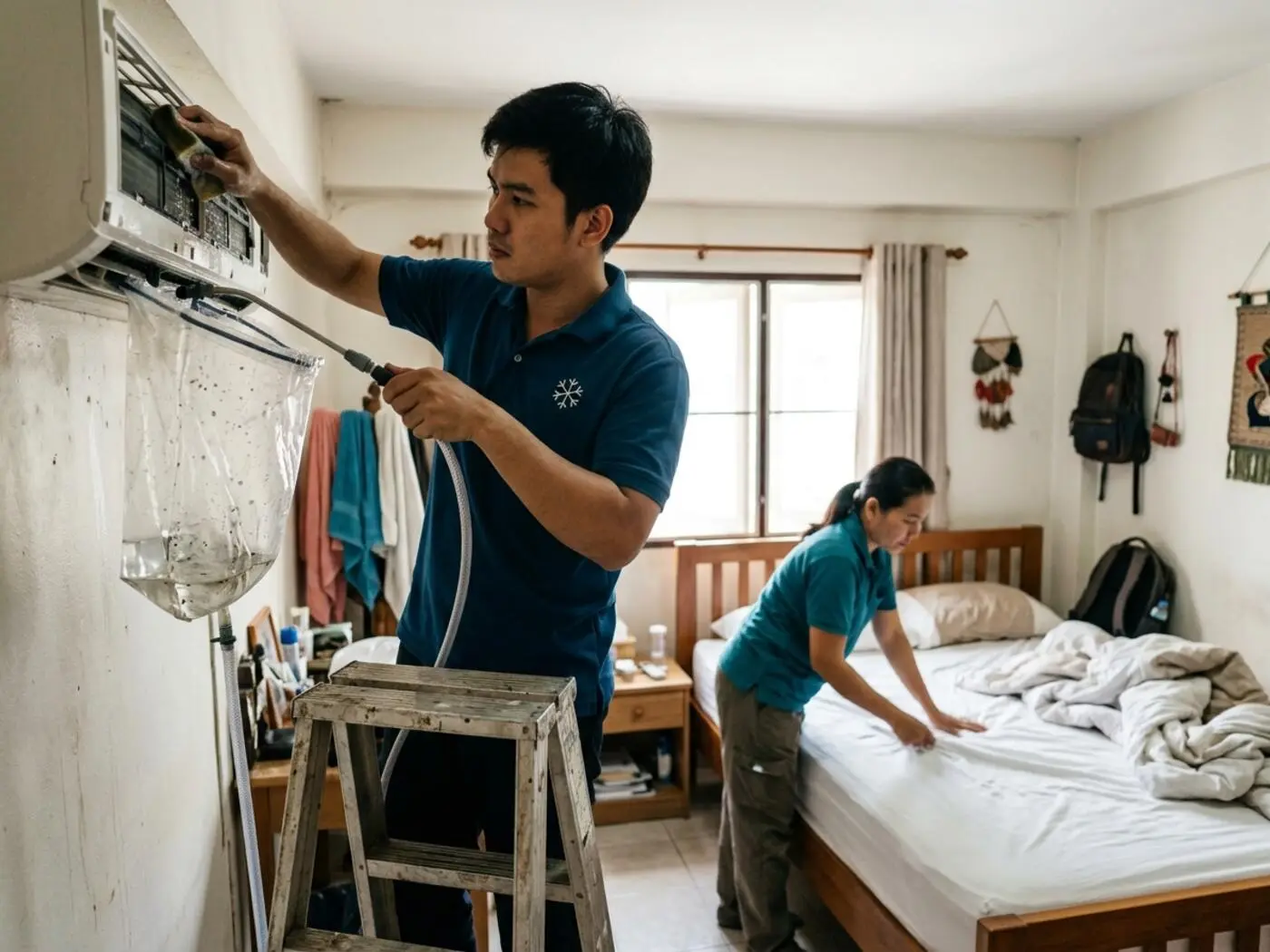
Read a hundred bad reviews of Bangkok short-stay listings and one line comes up more than any other: the air con didn't work properly. Not dirty, not noisy, not the location — hot. It is the complaint most likely to trigger a refund request, and it almost always arrives after 10pm.
This is the schedule that keeps it out of your listing.
Why a short-stay unit dies faster
A home air conditioner runs eight hours a night at 25 °C behind a closed door. A short-stay unit runs at 18 °C from check-in to check-out, the door opens twenty times a day, the balcony door is left open with the AC on, and the guest turns it to maximum because they are not paying the electricity. The coil condenses more water, catches more dust, and grows biofilm faster. Six months is the interval for a home; three months is the interval for a listing.
Roadside buildings and pet-friendly listings are harder still. See how often to clean an AC in Bangkok for the reasoning; for hosts, just take quarterly as the floor.
The quarterly clean
Every three months, every unit, scheduled between bookings so no guest ever meets a technician:
- Standard clean: filter, coil and blower washed in a wash bag, drain flushed and tested, outdoor coil rinsed.
- Vent temperature and gas pressure logged, before and after.
- Once a year, a deep chemical wash to strip the blower wheel — a listing that smells musty on check-in never recovers in the review.
For a one-bedroom with two units, that is four visits a year. Booked as a HostCool Year it is one price per property, cleans scheduled around your calendar, and the guarantee runs all year rather than 30 days.
The two-minute turnover check
Your cleaner is already in the unit between guests. Add this to the checklist:
- Pull and rinse the filters. Under the tap, shake, back in. Sixty seconds.
- Run the unit ten minutes on high, then read the vent. A ฿150 kitchen thermometer in the airflow should read 10–14 °C below the room. If it doesn't, message us before the next check-in.
- Look at the drain outlet outside. After ten minutes of running in Bangkok humidity, it should be dripping. If it's dry, the drain is blocking — see why an AC drips.
- Check under the unit for water marks on the wall or floor.
- Reset the remote to 25 °C, auto fan, and make sure the batteries work. Guests who can't work the remote report the AC as broken.
Photograph the thermometer reading. It goes in the same folder as the cleaning photos and it is your evidence if someone claims the room was hot on arrival.
The 11pm plan
Even with all of that, a capacitor will fail on a Friday night in April. What matters is what happens next.
Before you need it: have a technician who will come the next morning, not "sometime this week". Know where the breaker is. Keep a standing fan in the unit's storeroom.
When the message arrives: reply within minutes. Ask the guest to set 25 °C and high fan and confirm the filter is clipped in (guests remove them). Offer the fan. Book the technician for first thing — with HostCool that is a same-day call-out with the diagnostic free, and hosts get priority in the turnover window.
After the fix: message the guest with what was found and done, and attach the dated photo report. A guest who was warm for one night and watched it get fixed with evidence by 9am rarely leaves a one-star review; a guest who was told "the technician will come this week" always does.
When the platform gets involved
A refund claim for "AC not working" is decided on evidence. A quarterly cleaning log with dated photos, a turnover thermometer reading from the day of check-in, and a technician's report from the morning after the complaint is a complete answer. Hosts who can show a maintenance history win these; hosts who can't, refund.
The numbers
Quarterly cleans for two units cost ฿6,290 a year as a HostCool package, including the call-outs. A single refunded three-night booking in high season costs more than that, before the rating damage. The pricing page has every unit count; the hosts page has the full HostCool detail and the bundle with CleanRova turnovers.
Frequently asked questions
How often should an Airbnb air conditioner be cleaned in Bangkok?
Every three months. A short-stay unit runs far harder than a home unit — often around the clock at the lowest setting, with the door opening all day — and the coil loads in roughly half the time. Hosts near a main road or with pet-friendly listings should stay on three months without exception.
What should I check on the AC at every turnover?
Rinse the filters, run the unit for ten minutes and check the vent air is 10–14 °C below room temperature, confirm water is dripping from the drain outlet outside, check the remote has batteries and is set to a sensible default, and look for any water marks under the unit. It takes two minutes and catches most problems before a guest does.
What do I do when a guest says the AC isn't cold at night?
Ask them to set 25 °C and high fan and check the filter is in place, then book a technician for first thing in the morning. Offer a fan for the night if you have one on site. Follow up with the guest before check-out with what was done and the dated report; a fast, documented fix usually turns a complaint into a neutral or positive mention.
Need it handled professionally?
Get a fixed quote for your units in under 60 seconds.
Written by the CoolRova Team
We're Bangkok's documented AC crew — everything we write comes from real cleaning, repair and installation visits across condos, homes and short-stay rentals.
Get our Bangkok AC guides straight in Google — add CoolRova as a preferred source.