
Open the front panel of a wall-mounted air conditioner, look down behind the coil, and you will see a long black drum with rows of thin blades running along the bottom of the unit. That is the blower wheel, and on a unit that has been running in Bangkok for a couple of years it often looks like the inside of a chimney: a grey, furry coating with black spotting along the blade edges, and a darker band where the air hits it.
Most owners have never seen it. Many have paid for a "full clean" without anyone touching it. This guide explains what the blower wheel is, why it ends up as the dirtiest part of the unit, what a packed one does to airflow, noise and smell, how to check yours with a torch, and what actually cleans it. It sits alongside our pillar guide to evaporator coil cleaning, which covers the coil in front of it.
What the blower wheel is and where it sits in a wall split
The blower wheel is the fan that moves air through the indoor unit. In a typical wall-mounted split it is a cross-flow fan, also called a tangential fan: a drum that is long compared with its diameter, fitted with many forward-curved blades. Wikipedia's entry on cross-flow fans notes that this design is widely used in ductless split air conditioners. In ducted units and ceiling cassettes the fan is usually a centrifugal "squirrel cage" instead, and the Wikipedia article on centrifugal fans says forward-curved blades are sensitive to particulates, which is why they are usually specified for clean-air uses such as air conditioning. Technicians say blower wheel, blower, fan barrel or fan roller for all of these. The dirt story is the same.
The path of the air in a wall unit runs like this:
- Room air enters through the grille at the top and passes through the filter.
- It flows across the evaporator coil, which is cold and wet.
- The blower wheel draws the cooled air through and throws it out through the louvres at the bottom.
So the blower is the last moving surface the air touches before it enters your room. Everything that was in the air stream on its way through, and everything that has grown on the surfaces ahead of it, can reach the blades.
Why it is the dirtiest part of the unit
Three things combine.
It sits in the damp, cold air stream. The air leaving the coil is cool and has just been through a surface that is dripping. In Bangkok, with humid air outside and a unit that runs for hours, the surfaces around the blower are damp for much of the day, and the wheel sits in that moisture. The same damp-plus-dust conditions that grow a biofilm on the coil apply here. A study in Current Microbiology that ran aluminium heat exchangers in cooling mode found a robust biofilm formed on the aluminium within four weeks, and a Scientific Reports paper that sampled central air-conditioning equipment in Dalian, China, found fungal communities in the units. Neither paper studied a wall-split blower, so the honest statement is that the conditions that produce biofilm on a coil are present around the blower too.
Its geometry catches dirt. A blower wheel has dozens of narrow blades, and fine dust, skin flakes, pet dander and cooking oil mist settle in the sheltered corners of each blade's curve and stick to damp edges. Over time the gap between blades narrows and a felted layer forms along the leading edge of each blade and down inside the curve.
A spray cannot reach most of it. The blades are packed closely, and dirt sits inside them where a nozzle held at the front cannot go. A technician can rinse the exposed face of the wheel and the part visible through the bottom slot, but the inside of the curve and the hidden side of the blades need removal.
The result is a part that gets dirty fast, and cleans badly in place. That combination is why technicians commonly find the blower among the dirtiest parts of the unit, and why it is the part most often skipped.
What a packed blower does: airflow, noise, vibration and strain
A coated blower affects the unit in four ways.
Less air. The blades are shaped to throw a given volume of air, and a layer of dirt changes their profile and closes the gaps. Less air crosses the coil, and ENERGY STAR notes that cleaning and adjusting blower components is part of proper cooling maintenance and that airflow problems can reduce a system's efficiency by up to 15 percent. That page is written for central systems, so treat the figure as indicative rather than a prediction for a wall split.
Colder, weaker, uneven cooling and freezing. With less air passing over the coil it absorbs less heat. Bryant says that when a coil cannot absorb heat properly the condensation on it can freeze, and calls ice on the indoor coil a major warning sign of restricted airflow; a packed blower is one way to restrict it. Ice then blocks the coil further.
Noise and vibration. Dirt does not build up evenly on every blade, so the wheel can go out of balance. A wheel spinning off-balance can hum, rattle or make a rhythmic whoosh, and can wear the bearings and bushings faster. This is mechanical common sense rather than something we can cite a study for, but it explains why many noisy units quieten after a proper blower clean.
Strain on the motor. The fan motor works against a heavier, less efficient wheel. How much matters depends on the motor and the build-up, which is why we avoid giving a number.
Why it is the main source of the musty start-up smell
The musty, wet-sock smell on start-up is the clearest sign of a dirty blower. Air from a cold start passes over a damp film on the blades before it reaches the room. We explain the smell in why your AC smells musty and why a filter clean won't fix it, and the blower is half of the answer.
On the health side, the evidence is about association and exposure, not proof of harm from any one unit. EPA's guidance on duct cleaning lists the fan motor and fan housing among the parts of a heating and cooling system that can become contaminated, and says that when moisture is present the potential for microbiological growth is increased and spores from such growth may be released into the living space. That page is written for forced-air systems, but the principle holds for a wall split. WHO's guideline on dampness and mould concludes that damp indoor environments are associated with respiratory symptoms, allergies and asthma, and the Asthma and Allergy Foundation of America states that air conditioners and dehumidifiers can themselves be a source of mould and advises keeping condensation coils and collection buckets clean.
The research record on contaminated cooling equipment is old but instructive. A 1983 NIOSH investigation, prompted by two of fourteen workers in one office reporting recurrent cough, wheeze, breathlessness and fever that eased at weekends, reported in the American Industrial Hygiene Association Journal and archived by the CDC, found heater/cooler units that had not been cleaned in two years and were heavily contaminated, mostly with Penicillium moulds; airborne fungal counts in the affected office rose 50 to 80 times when the units ran, and one worker was diagnosed with probable hypersensitivity pneumonitis. The authors found no significant difference in symptoms between the affected office and a comparison office, so this is one case rather than a rule. NIOSH's page on mould and health problems says research has found that people who spend time in damp buildings report respiratory symptoms, new or worsening asthma and hypersensitivity pneumonitis, among other problems, and its reference list includes a 1970 New England Journal of Medicine case report titled "Hypersensitivity pneumonitis due to contamination of an air conditioner". These are rare outcomes, but they show why a heavily contaminated unit is worth cleaning rather than ignoring.
If anyone in your home has asthma, recurring sinus problems or symptoms that flare when the air conditioner runs, please see a doctor. The NHS asthma guidance lists dust and mould among common triggers and advises seeing a GP if symptoms are not improving or are waking you at night. Cleaning the blower reduces a source; it does not replace medical advice. If you want to know what the dark growth on a blower is and is not, read black mould in an AC unit.
The torch test: checking your own blower wheel in two minutes
You can learn a lot without opening anything. You need a torch and, ideally, a phone to take a photo.
- Switch the unit off at the remote, then at the wall isolator or breaker. Do not put anything near the fan while the unit has power.
- Open the louvres or lift the front panel only as far as the manual shows. Many units let you swing the horizontal vane aside; do not force anything.
- Shine the torch along the slot at the bottom of the unit where the drum sits, and look along the blades. Angle the light low so it rakes across the surface and shows texture.
- Photograph what you see with the flash on if you can, so you can compare after a clean.
- Look, do not touch. Never spin the wheel by hand or poke it with anything; the blades bend easily.
What you may see:
| What you see | What it probably means |
|---|---|
| Blades evenly pale grey or white, clean edges | Wheel is in good condition, or recently cleaned |
| A thin, even grey layer | Normal dust build-up; a standard clean will address it |
| Grey fur, gaps between blades looking narrowed | Heavy dust; ask for the wheel to be washed carefully, possibly removed |
| Black or dark brown spotting along blade edges | Biofilm or mould growth; a removed wash is the realistic fix |
| Slimy or wet-looking film | Active biofilm is likely; arrange a proper clean |
If you see anything past the thin grey layer, you have your answer about the smell. Take the photo to the technician and ask what they will do about it. Our guide to how to tell whether an AC was cleaned properly covers how to check the result afterwards.
In-place rinse versus removal: what each reaches
A blower wheel can be cleaned in two ways, and they reach different amounts of dirt.
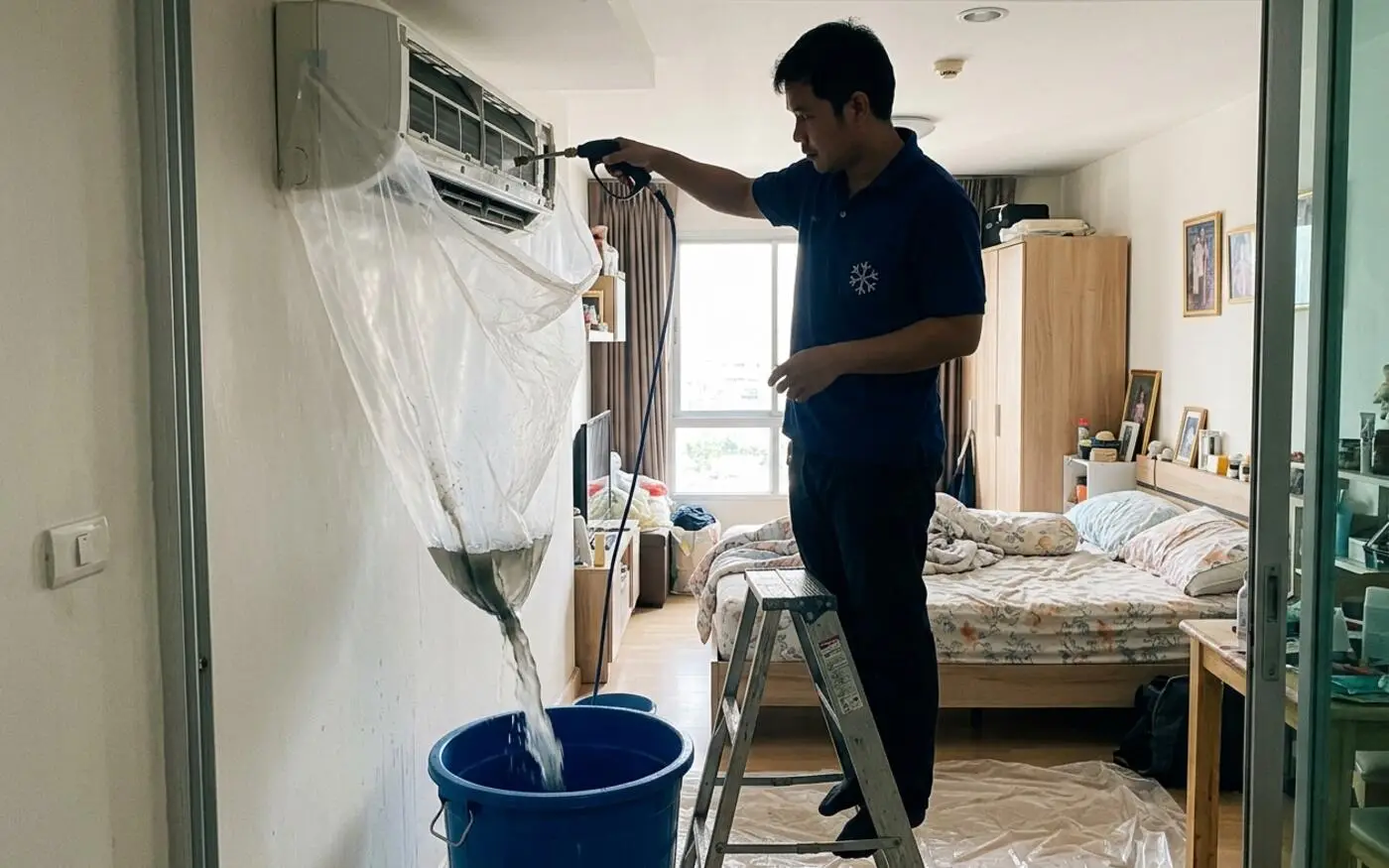
In-place rinse. The technician protects the electronics, hangs a sealed wash bag under the unit, applies cleaner to the exposed part of the wheel, and rinses at low pressure. With a thin layer this works. It does less when dirt has built up inside the blade curves, between blades and on the hidden side, because the nozzle does not reach there and the wheel has to be rotated to expose new surface. CoolRova's standard clean washes the blower wheel in place in this way, with the filter and the coil.
Removal. The technician detaches the wheel from the unit, takes it off the wall, and cleans it where it can be soaked, scrubbed with a soft brush between the blades and rinsed from every angle. It is more work, but it is the only method that reaches everything. In CoolRova's deep chemical wash the blower wheel is removed, the louvres and drain pan are stripped, the coil is foamed with a biodegradable cleaner and soaked, everything is pressure-washed, and an antibacterial and anti-mould treatment is applied. It takes 60 to 90 minutes per unit and comes with a photo report.
| Compared | In-place rinse | Removed wash |
|---|---|---|
| Exposed blade faces | Cleaned | Cleaned |
| Inside the blade curves and between blades | Partly reached | Reached |
| Hidden side of blades | Not reached | Reached |
| Bearings, bushings and mounts | Seldom inspected | Inspected |
| Good for | Thin film, regular schedule | Heavy coating, persistent smell, long gap since last clean |
| Time | Part of a standard clean | 60 to 90 minutes per unit (deep chemical wash) |
| CoolRova price | Standard clean from ฿690 per unit | Deep chemical wash from ฿1,290 per unit |
To choose between them, our guide to standard clean vs deep chemical wash sets out when each is the right call.
How a technician removes, strips and refits a blower wheel
The exact procedure depends on the model, but a careful removal follows a pattern.
- Photograph and isolate. The technician photographs the wheel as found, then isolates the power at the breaker or isolator.
- Protect and open. The electronics are covered, the front panel and louvres come off, and the coil assembly is released far enough to get at the wheel.
- Free the wheel. The wheel is typically held between a motor coupling on one side and a bearing or bushing on the other. A fixing screw or clip is released, and the wheel is withdrawn without flexing the blades.
- Note the details. The technician notes the wheel's orientation and any small balance weights or clips, so everything goes back in the same place.
- Wash it off the wall. The wheel is soaked in a suitable cleaner and then washed, with soft brushes used between the blades and a rinse carried out until the water runs clear. Removed parts are the place where more pressure is possible than on a coil inside a unit; the blades still need care.
- Clean the housing. The scroll or housing behind the wheel gets cleaned too, because it carries the same coating.
- Dry and inspect. The wheel is dried, then checked for bent or cracked blades and for wear at the ends.
- Refit. The wheel goes back with its weights or clips in place, the fixing is tightened, and the wheel is turned by hand to confirm it spins freely without touching the housing.
- Test. The coil is reassembled, power is restored, and the unit is run. The technician listens for rubbing, rattling or humming, measures the supply-air temperature and takes the "after" photograph.
On a deep chemical wash at CoolRova the louvres and drain pan are stripped in the same visit, which matters because a clean blower should not sit above a sludge-filled pan.
Why the cheap clean skips it, and how to tell from the report
A quick clean is built around time. Opening the unit, spraying the coil and rinsing the filter takes a few minutes. Cleaning a blower, particularly with removal, takes much longer. At a low price that time is the first thing to go, and some quotes quietly redefine "cleaning" to mean filter, front grille and a spray over the visible coil.
You can usually tell from the report, and from what you saw before the visit:
- The photographs show the filter and the front of the unit only. There should be a photo of the blower wheel before and after.
- The "after" blower photo looks identical to the "before". If the grey fur is still there, it was not cleaned.
- There is no supply-air temperature log. It is one measure of whether the job did anything.
- The visit was short. A job that includes coil, blower and drain flush is not a ten-minute job.
- Nothing was mentioned about the blower. If the technician cannot say whether it was washed in place or removed, assume it was not touched.
EPA's guidance on duct cleaning makes a related point for central systems: failure to clean a component of a contaminated system can result in re-contamination of the entire system, negating the benefit. A freshly washed coil above a coated blower is a small version of the same mistake. Carrier's coil-cleaning guidance recommends professional cleaning of evaporator coils because they are hard to reach and their fins bend easily; the blower sits behind the coil and is no easier.
How often a blower needs removal in Bangkok
There is no universal interval, and we would be inventing one if we gave a number. What matters is condition and conditions.
- Condition: if the wheel has a heavy grey coating or dark spotting, the answer is now. If it is a thin even layer, a standard clean at the usual rhythm is enough.
- Conditions: pet homes, kitchens that open onto the living room, smoking households, rentals with high turnover and units that run all night coat faster. Building works nearby add dust too.
- History: a unit that has never had a removed wash, or has not had a proper clean in more than a year, is a candidate for one reset, after which regular standard cleans keep it there.
For most homes the pattern that works is one removed wash to reset a neglected unit, then regular in-place cleans, with a removed wash again when the torch test or the smell says so. ENERGY STAR recommends annual pre-season check-ups by a contractor, and a unit in Bangkok that works most of the year is reasonable to check more often than that. For a household-by-household breakdown, the standard clean vs deep wash guide is the next read.
Mistakes that damage blower wheels
Most damage is done by well-meaning attempts to reach the wheel.
- Bending blades. The blades are thin, and a wheel with one bent blade will vibrate. Do not push brushes or fingers between blades.
- Wetting the motor. Water on the fan motor or control board is the fastest way to turn a clean into a repair. Isolate power and cover the electronics every time.
- Missing the balance clip or weight. Some wheels carry small weights or clips. If they come off in the wash and are not refitted, the wheel can hum or rattle.
- Forcing a stuck wheel. A wheel that does not come free easily may be held by a bushing or a corroded fixing. Forcing it can crack the wheel or the housing.
- Harsh chemicals. Use a cleaner intended for the job and rinse it away. Bryant advises against bleach, vinegar and household cleaners on the coil, and the same caution is sensible around the blower, where strong fumes in a bedroom are an unnecessary extra.
- Wrong refit. A wheel put back reversed or not fully seated can rub the housing. Turn it by hand before powering up.
- DIY with the unit powered. Never put tools or fingers near the fan while the unit has power.
When to call a professional
Rinsing the filter and doing the torch test are things anyone can do. Washing the blower wheel is not, because it means isolating power, opening the casing, and handling a delicate part next to electronics. Call a technician if:
- the torch test shows dark growth or heavy fur on the blades;
- the smell returns within days of a clean;
- the unit has become noisy, humming or rattling;
- airflow is weak with a clean filter;
- anyone at home has asthma or allergies that seem tied to the unit running.
For persistent symptoms, a doctor is the right first call.
CoolRova's standard clean includes the blower wheel, and a deep chemical wash removes it for heavy cases, with a photo report you can check. Prices are on the pricing page. Message us on WhatsApp or use the quote form at /contact, and we will say which level of clean your unit needs.
Sources and further reading
- ENERGY STAR heating and cooling maintenance checklist
- Bryant: how to clean an evaporator coil
- Carrier: how to clean evaporator coils
- Schmidt et al., Current Microbiology: microbial communities on copper and aluminium heat exchangers
- Scientific Reports: microbial contamination of central air-conditioning units in Dalian
- US EPA: should you have the air ducts in your home cleaned?
- WHO guidelines for indoor air quality: dampness and mould
- Asthma and Allergy Foundation of America: mold allergy
- NIOSH: mould and health problems
- Bernstein et al., 1983, via the CDC stacks: contaminated heater/cooler units in an office
- NHS: asthma
- Wikipedia: cross-flow fan
- Wikipedia: centrifugal fan
Frequently asked questions
What is the blower wheel in an air conditioner?
It is the fan that moves air through the indoor unit. In a wall-mounted split it is usually a long drum of closely spaced curved blades running along the bottom of the unit, behind the evaporator coil. It pulls room air across the cold coil and pushes it out through the louvres.
How do I know if my AC blower wheel is dirty?
Switch the unit off at the wall, shine a torch along the fan slot or lower vent and look at the blades. Grey fur, a dark coating, slime or black spotting on the leading edges means it is dirty. Other signs are a musty start-up smell, weaker airflow, a rattling or humming noise and black specks near the louvres.
Can the blower wheel be cleaned without removing it?
A technician can rinse the visible part of the wheel in place and thin a light layer. Dirt packed between the blades and on the hidden side is hard to reach without taking the wheel out, which is why heavy build-up calls for a removed wash.
Is black mould on the AC fan dangerous?
It is an indoor air quality problem rather than an emergency. Damp indoor environments are associated with respiratory symptoms, allergies and worse asthma, so it is worth cleaning properly. Anyone with persistent symptoms, asthma attacks or a weakened immune system should see a doctor.
How often does a blower wheel need to be removed and washed?
There is no universal interval. In Bangkok, where the coil and blower stay damp most of the year, a removed wash is worth considering when the wheel is visibly coated, the smell keeps returning after a standard clean, or the unit has gone a long time without a proper clean. Pet homes, open kitchens and busy rentals reach that point sooner.
Need it handled professionally?
Get a fixed quote for your units in under 60 seconds.
Written by the CoolRova Team
We're Bangkok's documented AC crew — everything we write comes from real cleaning, repair and installation visits across condos, homes and short-stay rentals.
Get our Bangkok AC guides straight in Google — add CoolRova as a preferred source.