
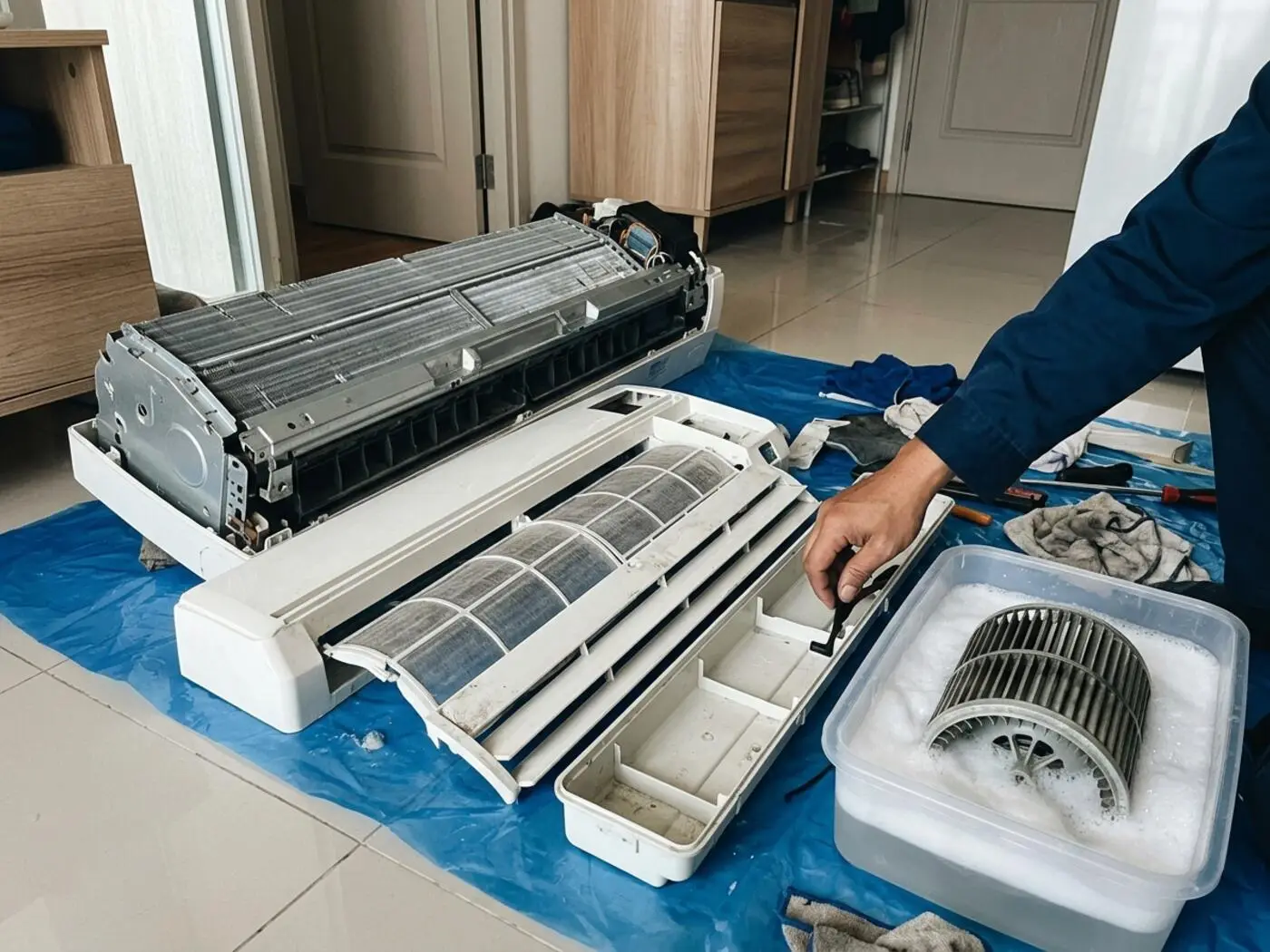
You switch the AC on and a few dark specks drift down onto the bedsheet. Or you lift the front cover to rinse the filter and find the plastic drum behind it coated in black. The first thought, understandably, is the phrase you have read online: toxic black mould, or "black mold in AC" if you searched with the American spelling.
Take a breath. What you are looking at is common, and the right response is practical rather than frightening. This guide explains what the black material usually is, why the colour tells you very little, what to do tonight and this week, who should move fastest, and how to check that a clean has actually worked.
What the black stuff on an AC actually is
Black or dark grey material inside an air conditioner is rarely one thing. It is usually a mixture of four:
- Dust and lint. Fine particles that pass the filter and settle on wet surfaces. Dust itself is grey, but it darkens when it is damp and compacted.
- Other airborne particles. EPA notes that indoor particles come from outdoor air and from indoor activities such as cooking and burning candles, so a dark deposit can simply be settled particles. In a city with traffic and a hazy season, that matters.
- Biofilm. A slimy layer of microbes held together in their own sticky matrix. It builds on any surface that stays wet, and on an evaporator coil and blower wheel it often looks like a dark, greasy coat. Our guide to why an AC smells musty covers the smell it produces.
- Common moulds. Moulds that grow on the dust and film. Many are dark. The CDC says mould can look like spots of many different colours and lists Cladosporium, Penicillium and Aspergillus as the most common indoor moulds. Wikipedia's neutral summary of Cladosporium describes it as one of the most common indoor and outdoor moulds, with olive-green, brown or black colonies.
That last point is backed by AC-specific research. A 2023 study in Indoor Air took apart household ductless units in 17 Japanese homes and found Cladosporium and Toxicocladosporium were the most common fungi inside them, followed by Aureobasidium, Aspergillus and Rhodotorula, with the blower fans the most contaminated part. Dark, ordinary moulds are what you would expect to find.
You cannot separate these four by eye, and the next section explains why you do not need to.
Why "toxic black mould" is the wrong frame
The phrase usually refers to Stachybotrys chartarum. It is real, but it is much narrower than the legend. CDC's fact sheet describes it as a greenish-black mould that grows on cellulose-rich materials such as fibreboard, gypsum board and paper, and needs constant moisture from water damage, leaks, condensation or flooding. An air conditioner's interior is mostly plastic, aluminium and copper rather than paper or board, although the dust that settles on those parts can contain fibres, and a coil that stays wet is certainly a moist place. So it cannot be ruled out. But nobody can say a particular patch is or is not Stachybotrys by looking at it, and that is exactly the point.
The CDC fact sheet goes on to say that a possible link between Stachybotrys and a rare infant lung bleeding condition has not been proven, that no test proves an association between the mould and particular symptoms, and that it is not necessary to determine what type of mould you have: all moulds should be treated the same with respect to potential health risks and removal. The CDC main mould page repeats the point: you do not need to know the type, and CDC does not recommend mould testing.
Two things follow:
- Dark does not mean worse. Colour is not a measure of danger. Wikipedia's Cladosporium page notes that this very common mould produces no major mycotoxins and is rarely pathogenic to humans, though its airborne spores are significant allergens and in large amounts can severely affect people with asthma and other respiratory diseases. A pale mould can bother a sensitive person as much as a dark one.
- Nor does it mean harmless. EPA says moulds produce allergens and irritants, and in some cases potentially toxic substances called mycotoxins, and that reactions vary from person to person. The UK government's guidance on damp and mould puts it plainly: damp and mould pose a risk to anyone's health and should always be acted on quickly.
So the useful question is not "is this the famous one?" It is "is mould growing somewhere that blows air into the room I sleep in?" If yes, remove it and keep it from rebuilding. That is the same advice whether the colour is black, green or white. For the wider picture on mould in air conditioners, see our pillar guide to mould in air conditioners.
The four places black growth shows up
Black marks around an AC turn up in four places, and each says something different.
| Where you see it | What it usually means | Does wiping fix it? |
|---|---|---|
| Louvres and vanes (the flaps at the air outlet) | Damp air and dust at the exit; a sign the interior behind is also dirty | Cosmetically, for a few days |
| Blower wheel (the drum behind the louvres, seen with a torch) | The most important site: film packed between the blades | No, it cannot be reached with a cloth |
| Drain pan and drain line (low inside the cover, sometimes visible at the outlet) | Standing water and sludge; often goes with dripping | No, and a blocked drain needs clearing |
| The wall or ceiling around the unit | A separate moisture problem, such as a leaking drain or condensation on refrigerant pipework | No: the source of the moisture has to be found |
The first three are inside the AC and a cleaning issue. The fourth is a building moisture issue. CDC says mould grows where there is moisture, such as around leaks in roofs, windows or pipes, and EPA's brief guide advises keeping air-conditioning drip pans clean and drain lines flowing, and insulating pipes that develop condensation. If you see black marks on the wall beneath or beside the unit, the AC may be dripping or the pipe lagging may be damaged; a repair technician needs to look. CoolRova's repair diagnostic is ฿590, waived if the repair goes ahead, with a fixed written quote first (see AC repair).
Black specks from the vent: what is being blown into the room
Specks that fall out of the vent when the unit starts are worth taking seriously, mainly as a signal. Biofilm and mould on a blower wheel are not fixed in place like paint. When the wheel is idle the film can dry and flake; when it spins up, pieces can break off and are thrown out into the room. The same thing happens with dust that has built up on the louvres.
What that means for health is more modest than the visual suggests, and more specific than "toxic". EPA explains that mould spreads through tiny spores, 2 to 10 micrometres across, and that they are naturally present in indoor and outdoor air. EPA's page on what moulds are also says that spores can remain able to grow for years, and that even dead spores can keep their allergens. A unit that regularly delivers fragments and spores into a bedroom adds to what you breathe, and for a person who is sensitive, that can matter. For a healthy adult it is more likely to mean irritation than illness.
Keep a sense of proportion, and keep a record. A photo of the specks on a white sheet and a photo of the blower wheel are useful for a technician and for you.
What to do tonight
You do not need to rush to a hospital or throw out the bed. A calm, short list is enough.
- Switch the unit off. EPA's brief guide advises not to run an HVAC system you know or suspect is contaminated with mould, because it could spread the mould. That advice is written for building systems in general. In a Bangkok bedroom it is a counsel of caution, not an absolute rule, so use the unit as little as comfort allows until it is cleaned.
- Ventilate if the outdoor air allows. Open a window or door for a while if the outside air is not smoky, polluted or very damp. EPA advises avoiding ventilation with outdoor air when pollution or pollen is high or temperature and humidity are extreme, so in a haze season check the air quality first. A standing fan moving room air can bridge a night.
- Move sensitive sleepers. If a child, an older person, or anyone with asthma or allergies sleeps in that room, use another room or sleep with the unit off until it has been cleaned.
- Do not spray bleach, disinfectant or air freshener into the unit. The reasons are in the section on mistakes below.
- Do not scrub at it or blow it out. Disturbing dry growth releases spores. CDC's cleanup guidance says to protect your mouth, nose, skin and eyes when cleaning mould, with at least an N95 respirator, gloves and goggles. It also says people with asthma, allergies, immune suppression or underlying lung disease should not take part in the cleaning.
- Take photos. The front cover open, the blower wheel with a torch, and any specks. These are your baseline.
- Book the clean. This week, not next quarter.
Rinsing the filter is fine for most healthy adults and takes two minutes. Do it outdoors or at a sink, wear gloves and a mask, and leave it to someone else if you are in a sensitive group.
Who should act fastest
For most healthy people, a dark blower wheel is a reason to schedule a clean soon. For some it is a reason to move quickly.
CDC lists people with asthma or mould allergy (who can have severe reactions), immune-compromised people, and people with chronic lung disease (who can get lung infections) as the main at-risk groups. The UK guidance names a wider list of those who should be treated with urgency: people with a pre-existing condition such as allergies, asthma, COPD or cystic fibrosis, people of any age with a weakened immune system, pregnant women, children and young people, and older people.
Cleveland Clinic's mould allergy page lists Alternaria, Aspergillus, Cladosporium and Penicillium as common allergy-causing moulds, and notes that mould allergy can trigger asthma. The NHS page on aspergillosis lists air-conditioning systems among the many places Aspergillus is found. It also keeps things in proportion: the infection is rare in healthy people, and the people at risk are those with a lung condition such as asthma or COPD, a weakened immune system, or a history of tuberculosis.
In practice:
- Healthy household, mild smell, a few specks: book a standard clean within a few weeks.
- A bedroom for a baby, a child, a pregnant woman or an older person: book within days and use another room meanwhile.
- Asthma, mould allergy, lung disease or immune suppression: book promptly, keep out of the room while it is done, and mention it to your doctor if symptoms are persistent.
Why wiping the visible louvres does not fix it
The louvres are the part you can see and reach, so the instinct is to wipe them. It does make the unit look better. It does not address the source.
The air path runs: room air in, through the filter, across the cold wet coil, through the blower wheel, past the drain pan area, out through the louvres. The film grows where the surfaces are wet and dusty, which is the coil, the blower wheel and the pan. Those are behind the louvres, not on them. In the Japanese study above, the blower fans were the most contaminated part and the parts downstream of the coil were identified as the major sites of fungal contamination. The louvres are the shop window. The blower wheel is the stockroom.
Our guide to blower wheel cleaning shows what that part looks like. A related trap is the filter. Rinsing it is worth doing, but it sits in front of the coil, so it does not touch anything that grows behind it. If the unit smells musty after a filter rinse, this is why.
Which clean removes it: standard clean or deep chemical wash
Two professional cleans cover this, and the difference is how much of the unit is taken apart.
| Situation | Recommended clean | Why |
|---|---|---|
| Faint smell, light film, a few specks, cleaned within the last year | Standard clean, from ฿690 per unit | Filter, evaporator coil and blower wheel are washed in place inside a sealed wash bag with coil cleaner and a low-pressure rinse; drain line flushed and tested |
| Blower wheel visibly dark or slimy, smell for months, specks from the vent | Deep chemical wash, from ฿1,290 per unit | Blower wheel is removed; louvres and drain pan are stripped; coil is foamed with a biodegradable cleaner and soaked; everything is pressure-washed; antibacterial and anti-mould treatment applied |
Both include a before and after photo report. The deep wash takes 60 to 90 minutes per unit. If the black growth is visible on the blower wheel and you are choosing, the deep chemical wash is the one that reaches it. The full reasoning is in standard clean vs deep chemical wash.
Two points explain why removal beats treating. First, EPA says it is not enough to kill mould; it must be removed, because dead mould can still cause allergic reactions. Second, the evidence base: in the Japanese study, disassembly followed by high-pressure washing cut fungal abundance by more than 99% in all parts tested. That was a research protocol with its own measurements, not a guarantee about any particular job, and a DNA count is not a health outcome. But it supports taking the dirty parts out and washing them, rather than spraying something on them.
How to check the job: the blower wheel photo
A good clean should leave evidence, and the best single piece is a photo of the blower wheel. The front of the unit looks tidy after almost any visit, so ask to see the part that matters.
Look for:
- The blower wheel, not just the front panel. In the before photo you should see the dark coating on the blades; in the after photo, the blades should be a uniform colour, with the grooves between them open rather than clogged.
- A view of more than one position. The wheel rotates. A single clean-looking patch proves little.
- The coil face. Fins should look open and metallic, not matted, and you should be able to see through the gaps in places.
- No slime, no smell. EPA's brief guide says that after mould cleanup, visible mould and mouldy odours should not be present, with the caveat that mould can leave staining or cosmetic damage. Old dark staining on plastic can remain after a thorough clean, so judge by whether the film is gone, not whether the plastic is brand new.
- A drain that runs. The technician should be able to show water flowing away.
On a standard clean, supply-air temperature is also logged before and after, which gives you a number as well as a picture. If the smell or specks return within a few weeks, the film was probably not fully reached, and that is worth raising with the technician. Our guide to how to tell whether your AC was cleaned properly goes into detail.
Mistakes to avoid
Spraying bleach or disinfectant into the unit. The authorities differ slightly on hard surfaces. CDC allows a weak bleach solution for hard surfaces and stresses never mixing bleach with ammonia or other cleaners; EPA does not recommend bleach as a routine mould treatment; and the UK guidance prefers mould and mildew products over bleach for health and safety reasons. None of them suggests spraying it into an appliance. An indoor unit has a circuit board and motors, the spray does not reach the film packed between the blower blades, and killing mould does not remove it.
Masking the smell. Scented sprays, essential oils and odour neutralisers cover the symptom and leave the film. CDC's advice is to remove mould and fix the moisture.
Buying a test kit. CDC does not recommend mould testing, and EPA says sampling is generally unnecessary when growth is visible. A photo of the wheel is more useful.
Scrubbing it dry or blowing it out with a hairdryer or compressor. That puts spores into the air you are about to breathe.
Assuming a filter rinse equals a clean. The film sits behind the filter.
Doing it yourself when you are in a sensitive group. CDC says people with asthma, allergies, immune suppression or underlying lung disease should not take part in mould cleanup.
Keeping it from coming back in Bangkok humidity
Bangkok's warm, humid air and the way many people run their AC nearly every night mean the coil is wet most days of the year. You cannot remove the condensation, so the aim is to slow regrowth and clean on a rhythm.
- Rinse the filter every few weeks. It keeps dust from reaching the coil.
- Dry the coil after cooling. Use the unit's dry, clean or fan mode, or run fan only for a few minutes before turning it off. This is a low-cost habit rather than a proven fix, and it does not remove an existing film.
- Keep the drain clear and the pan clean. EPA's guide lists this explicitly.
- Keep room humidity down. CDC recommends no higher than 50%; EPA says below 60%, ideally 30 to 50%, and notes that in warm, humid climates air conditioning alone may not hold humidity down if the home stays above 60%.
- Avoid long closed-door idle periods in a damp room.
- Clean on a schedule rather than when it smells. A regular rhythm beats a reaction. CoolRova's 2-Visit Year Package (from ฿1,240 for one unit) gives two scheduled cleans a year with a free gas and drain check each time, and the 4-Visit Year Package (from ฿2,190 for one unit) gives quarterly cleans including one deep chemical wash per unit. How often is right depends on your use; our guides to preventing mould in an air conditioner and dirty air conditioner health effects give more context.
When to call a professional, and when to see a doctor
Call a cleaning professional when:
- you can see dark growth on the blower wheel or drain pan,
- specks come out of the vent,
- a musty smell has lasted weeks or returned after a filter rinse,
- the unit is dripping or you see black marks on the wall beside it,
- someone in the room is in a sensitive group,
- you have moved into a rental or reopened a unit that has been shut for months.
See a doctor if you have symptoms that are persistent, such as a cough lasting more than a few weeks, wheezing, a stuffy nose that eases when you leave the room, or breathing that is getting harder, and especially if you have asthma, a lung condition or a weakened immune system. The NHS lists a cough lasting more than three weeks, or a lung condition getting harder to control, as reasons to see a doctor, and coughing up blood as urgent. Cleveland Clinic advises seeking emergency help for severe breathing problems. Cleaning the unit can reduce a possible source of exposure, but it is not a treatment for any condition.
CoolRova cleans split units across all Bangkok BTS and MRT zones and has cleaned more than 800 AC units in homes, rentals and businesses. If you can see dark growth on the blower wheel, our deep chemical wash is the clean that removes it, and every job comes with a photo report so you can see the result. You can reach us on WhatsApp or through the quote form on the contact page. The 30-day cool-again guarantee applies to every clean: if the unit is not cold within 30 days, we come back free.
Frequently asked questions
Is black mould in an AC unit dangerous?
Dark growth is not automatically more dangerous than other mould. CDC says all moulds should be treated the same with respect to potential health risks and removal, and no test proves that Stachybotrys, the species behind the legend, caused particular symptoms. It is still an indoor air problem worth fixing, especially for people with asthma, allergies, lung disease or weakened immunity.
Is the black mould in my air conditioner toxic black mould?
Probably not in the way the internet suggests. Stachybotrys, the species usually called toxic black mould, grows on cellulose-rich materials such as paper and gypsum board and needs constant moisture. A study of household units in Japan found Cladosporium the most common fungus inside them, although you cannot identify a species by looking at it.
What are the black specks coming out of my AC vent?
They are usually a mix of dust, other airborne particles and fragments of the film that grows on the blower wheel and louvres. Specks blowing out when the unit starts mean something inside has dried, loosened and been carried into the room, so the interior needs cleaning rather than the vent wiping.
Can I just wipe or spray the black mould off my AC vents?
Wiping the louvres removes only what you can see, and the blower wheel, coil and drain pan behind them stay dirty. Spraying bleach or disinfectant into the unit is not recommended: EPA does not advise bleach as routine mould treatment, dead mould can still trigger allergies, and liquids can reach the electronics.
What should I do tonight if I find black mould in my AC?
Switch the unit off, open a window if the outdoor air quality allows, and use a fan or sleep in another room if someone is in a sensitive group. Take a photo, avoid disturbing the growth, and book a coil and blower clean. If anyone has breathing difficulty or severe symptoms, seek medical help rather than waiting.
How do I know the black mould has really been removed?
Ask for before and after photos of the blower wheel and coil, not just the front cover. A cleaned wheel should be free of slime and visible growth and the musty smell should be gone, although old staining on plastic may remain. If the smell or specks return within weeks, the blower wheel was probably not reached.
Need it handled professionally?
Get a fixed quote for your units in under 60 seconds.
Written by the CoolRova Team
We're Bangkok's documented AC crew — everything we write comes from real cleaning, repair and installation visits across condos, homes and short-stay rentals.
Get our Bangkok AC guides straight in Google — add CoolRova as a preferred source.