
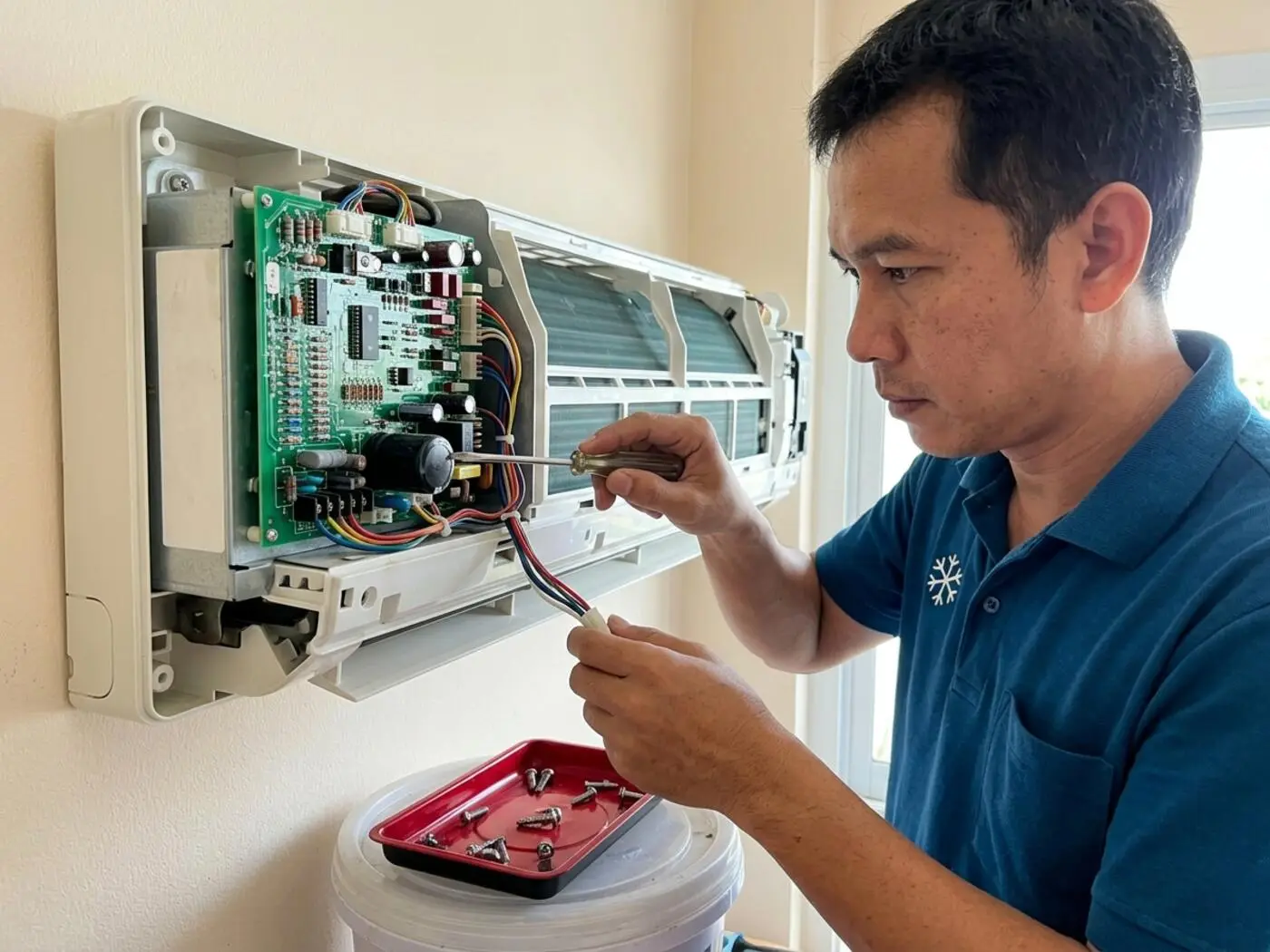
An air conditioner that blinks a lamp, beeps in a pattern or shows a letter and a number is not being mysterious. It is reporting that one of its own checks has failed, and the report is useful if you read it correctly and harmful if you reset it three times and hope. This guide explains what error codes are, how to read them on the three brands most common in Bangkok condos (Daikin, Mitsubishi Electric and Carrier), and which ones you can reasonably act on yourself.
One rule runs through everything below: codes vary by model and series. Manufacturers publish their own tables, and the same code can be worded differently, or mean something different, on two units from the same brand. We list only codes whose meaning we could confirm on an official manufacturer document, we say which document, and where we could not confirm a brand's codes we say so rather than guess. Your own unit's manual is the final word. Treat any code as a starting point for diagnosis, not a repair instruction: it tells you where to look, and the looking is a technician's job once it goes beyond filters, batteries and breakers.
What an error code is, and why your unit shows one
Inside the indoor and outdoor units are sensors (usually thermistors, which are temperature-sensing resistors), motor feedback signals, pressure switches and a control board that watches them all. When a reading is missing, impossible or out of range, the board protects the machine, often by stopping the compressor or fan, and records what it saw.
That report takes one of three forms. A lamp on the indoor unit or remote flashes. A display on the indoor unit or wired remote shows a letter and number. Or the unit beeps in a pattern when you request a diagnosis. Daikin's global service page describes the purpose simply: checking an error code helps identify the status of the unit and the problem it has.
Three things are worth knowing before you read any table.
A code points to an area, not a part. "Fan motor" can mean a failed motor, a seized bearing, a loose connector or a faulty board that is not driving it. The code narrows the search; it does not replace one.
Some codes describe the machine protecting itself. A pressure or temperature protection code can appear because the unit is clogged with dirt or short of airflow, and the fault vanishes once the cause is fixed. ENERGY STAR's maintenance checklist notes that dirty coils reduce a system's ability to cool and make it run longer, which is the kind of strain that protection circuits are built to catch.
The unit may remember a fault after the lamp goes quiet. Mitsubishi Electric's service manual for its MSZ-AP wall-mounted series says the unit can memorise an abnormal condition that has occurred once, and that the stored details can be recalled even after the normal indication disappears. We come back to that when we look at why codes return.
Why the same code can mean different things
You will find confident code lists all over the internet, and many of them disagree. The manufacturers' own documents show why. Daikin's global chart words U2 as a power supply failure or instantaneous power failure, while a Daikin FTXC-C split-unit manual lists U2 as a DC voltage out of range.
Mitsubishi Electric gives a clearer example. The service manual for the MSZ-AP wall-mounted series reads three blinks of the operation lamp as an indoor fan motor fault. A Mitsubishi Electric Singapore code sheet for a different family, the Mr. Slim indoor models named PLY, PEY and PCY, reads three blinks (output pattern A) as an indoor/outdoor communication error. Same blink count, same brand, different units and different fault.
Carrier is harder still. Public Carrier code lists disagree: some read E1 as an indoor/outdoor communication fault, others as an indoor temperature sensor fault. Carrier Thailand's own approach is to point owners to the user manual.
So treat any list, including ours, as a guide to the kinds of fault each brand reports, and confirm the exact meaning in your model's manual.
Before you touch anything: capture the evidence
Whatever the brand, do three things first.
- Photograph the display or film the blinking. Carrier's mini-split repair guidance advises writing down any error codes shown on the indoor unit or remote so a technician can use them, and noting symptoms such as short cycling, noises, leaks or weak cooling.
- Count the blinks properly. Mitsubishi Electric's service manual tells technicians to check at least two consecutive blinking cycles before reading the pattern, because a cycle is a run of blinks followed by a 2.5-second pause. Count how many blinks come in a group, which lamp is blinking (the manual refers to the upper lamp on some models) and whether the blinking is fast and continuous or in groups.
- Note the model. The model number is on a label on the side or underneath the indoor unit, and on the outdoor unit's nameplate. A technician, or the manual search, needs it.
Also note what the unit was doing: a code on start-up in a hot room is a different clue from one after a thunderstorm or a building power dip.
How to read the code on a Daikin
Daikin's approach is the most documented of the three. Its codes are two characters: a letter and a digit (or a second letter). In Daikin's global chart, letters group by where the fault sits: A and C for the indoor unit, E, F, H, J, L and P for the outdoor unit, and U and M for system and communication faults.
How you read the code depends on your remote. Siam Daikin's Thai error-code page walks through several, and Daikin's printed guide to checking error codes shows the same methods for residential units. In summary:
- Wired remotes (BRC1C62 and BRC1E62 types): when a fault stops operation the on/off light flashes and the code, or a prompt to press the Menu button, appears on screen. On the BRC1C62, holding the on/off button for four seconds or more while in check mode clears the malfunction history, which you should not do until the code is written down.
- Wireless remote, ARC447A type: point the remote at the indoor unit and hold the timer cancel button for 5 seconds. The temperature display changes to the error code and the unit gives a long beep. Hold again for 5 seconds to exit; it also exits by itself after a minute.
- Other wireless remotes (ARC455A, ARC452A, ARC433B, ARC423A, ARC417A): hold cancel for 5 seconds until "00" flashes, then press cancel repeatedly until you hear a continuous beep. A second method steps each digit with the temperature buttons: one short beep means the digit does not match, two short beeps mean the first digit matches, and one long beep means both match.
Daikin's FTXC-C split-unit operation manual describes the same idea for its remote: hold a button for 5 seconds to enter diagnosis, keep pressing until a long beep is heard from the indoor unit, and hold again for 5 seconds to exit. In that manual a long beep means the code on screen corresponds to the fault, while a short beep, or two in a row, means it does not.
Your remote may differ from every one of these, so match the model name printed on the remote to the list. Daikin's troubleshooting page says that if the operation light is flashing the air conditioner is likely malfunctioning, and points you to your nearest Daikin representative.
Daikin codes confirmed on official documents
The table below uses Daikin's global self-diagnosis chart, which covers residential, SkyAir and VRV equipment, cross-checked against the code list in the FTXC-C split-unit manual linked above. Every code below appears in both documents; where the manual words a code differently from the chart, we say so in brackets. We paraphrase the wording. The third column is our practical advice, not Daikin's.
| Code | What Daikin's documents say it indicates | Sensible next step |
|---|---|---|
| A1 | Malfunction of the indoor unit's circuit board (PCB) | Technician; a power reset is worth one try only |
| A3 | Drain level control system abnormality | Check for a blocked drain or water in the unit, then technician |
| A5 | High-pressure control in heating, freeze-up protection control in cooling (the FTXC-C manual calls it antifreeze) | Check the filter and airflow; see the guides linked under this table |
| A6 | Malfunction of the indoor fan motor | Technician |
| C4 | Malfunction of the liquid pipe thermistor on the indoor heat exchanger | Technician |
| C9 | Malfunction of the suction air thermistor (the FTXC-C manual says indoor room thermistor) | Technician |
| E1 | Defective outdoor unit circuit board | Technician |
| E3 | Actuation of the high pressure switch (the FTXC-C manual says high pressure protection) | Check the outdoor unit is not blocked, then technician |
| E5 | Inverter compressor motor or overheat problem (the FTXC-C manual says compressor motor lock or overload) | Technician, do not keep restarting |
| E7 | Malfunction of the outdoor unit fan motor system (the FTXC-C manual says outdoor DC fan motor lock) | Technician |
| L3 | Electrical component box temperature rise (the FTXC-C manual says outdoor control box overheat) | Check the outdoor unit airflow, then technician |
| U0 | Shortage of refrigerant (the FTXC-C manual says insufficient gas) | Technician; find and fix the leak |
| U4 | Transmission fault between the indoor and outdoor units (the FTXC-C manual says communication error) | One power reset, then technician if it returns |
This is a selection, not Daikin's whole chart. Note too that a "thermistor malfunction" code can be a failed sensor, a loose plug or a broken wire, and only a technician with a meter can tell which.
If your unit shows A5, read our guides to why an indoor unit freezes and evaporator coil cleaning, since restricted airflow over a fouled coil is a common reason for freeze protection. If A3 appears with water around the indoor unit, see our guide to an indoor unit dripping water.
How to read a Mitsubishi Electric unit
Mitsubishi Electric wall-mounted units signal faults by blinking the operation indicator lamp. The owner's guidance is brief: the operating instructions for the MSZ-LN series list the cases in which you should stop using the air conditioner and consult your dealer: water leaking or dripping from the indoor unit, a blinking operation indicator lamp, a breaker that trips frequently, an abnormal sound and any refrigerant leakage.
The detail is in the service manual. Mitsubishi Electric's service manual for the MSZ-AP series tells technicians to check the operation indicator lamp for blinking and to count the blinks before starting work. The pattern for these units reads as follows.
| Lamp pattern | Fault area in the MSZ-AP service manual |
|---|---|
| Fast blinking at 0.5-second intervals | Miswiring or serial signal fault, where the indoor unit has not received the outdoor unit's signal for 6 minutes |
| 2 blinks, then a 2.5-second pause | Indoor coil thermistor or room temperature thermistor short or open circuit |
| 3 blinks | Indoor fan motor: no rotation feedback signal during operation |
| 4 blinks | Indoor control system: the indoor board cannot read its memory |
| 5 blinks | Outdoor power system: the compressor has stopped for overcurrent or start-up failure protection three times in a row within a minute of starting |
| 6 blinks | Outdoor thermistors short or open circuit while the compressor is running |
| 7 blinks | Outdoor control system: the inverter or outdoor board cannot read its memory |
| 14 blinks or more | Another abnormality, including thermistor faults, with the stop valve and four-way valve to be checked |
This table is for that series only. The same manual describes a "failure mode recall" mode, entered with a key sequence on the remote, that replays the stored fault; it warns that the mode must be released afterwards or the unit cannot operate properly, which is a good reason to leave it to a technician.
Codes on a Mitsubishi Electric wired remote
Units with a wired controller show a code on the screen as well. The Mitsubishi Electric Singapore code sheet for Mr. Slim indoor units lists check codes alongside the blink count. A sample:
| Check code | Meaning on that document |
|---|---|
| P1 | Intake sensor error |
| E6 and E7 | Indoor/outdoor unit communication error |
| P5 | Drain pump error |
| P6 | Freeze protection in cooling, or overheat protection in heating |
| PB | Indoor unit fan motor error |
| UP | Compressor overcurrent interruption |
| U2 | Abnormal high discharge temperature or insufficient refrigerant |
The sheet is for the indoor models it names, not for every Mitsubishi Electric product, and it separates faults detected by the indoor unit from faults detected elsewhere. Use it for the flavour of the codes and the structure, not as your unit's answer key.
How to read a Carrier unit
Carrier is the brand where it is hardest to give you a reliable table, and we would rather say so than print an unverified one. Carrier Thailand's FAQ page (in Thai) defines an error code as a number that indicates where the problem is, and says to read it in the Carrier In The Air app and look up its meaning in the user manual. It does not publish a list of codes. The Carrier Thailand owner's manual for the X-Inverter Plus range shows the app displaying an error-code description as a pop-up notification, which fits that advice.
What Carrier's guidance does give owners is a sensible order of operations. The same Thai owner's manual lists check points for a unit that does not operate (main switch off, breaker tripped, a power cut, an ON timer set) and for one that cools too little (blocked filters, an improper temperature setting, open doors or windows, a blocked outdoor air inlet or outlet, a low fan speed, FAN or DRY mode selected, or power selection set to 75 or 50 per cent). Work through those before assuming a fault.
Carrier's mini-split guidance adds a reset method (below) and advises against attempting refrigerant, electrical or component repairs yourself.
Safe things to try first
Before booking a visit there is a short routine that never involves opening a panel.
- Write down or photograph the code or blink count. Do this first, every time.
- Check the obvious. Remote batteries, timers, the breaker, the filter, doors and windows, and anything blocking the indoor outlet or the outdoor unit. The Daikin FTXC-C manual's troubleshooting list includes a dirty filter, open doors or windows and clogged air suction and discharge, and the US Department of Energy's cooling guide advises cleaning or replacing filters and clearing debris and leaves from a split system's fan, compressor and condenser.
- Wait three or four minutes if the unit has just stopped and started. The same Daikin manual says the compressor has protection against frequent starting and that you should wait three to four minutes for it to start operating. A unit that is merely waiting is not faulty.
- Try one power reset. Turn the unit off with the remote, switch off the breaker or unplug it, wait several minutes (Carrier suggests about 20), and restore power. Run the unit and watch.
- Stop at one. The US Department of Energy notes that compressor and fan controls can wear out when a system is switched on and off too frequently, and advises calling a professional to check electrical connections. Repeated resets stress the very parts that are already complaining.
Codes and symptoms that mean stop and call
Some situations call for switching the unit off at the breaker and leaving it off.
- A burning smell, smoke, or a breaker that trips repeatedly. The Daikin FTXC-C manual says to turn off power to the unit when it is malfunctioning, giving off a burning odour for example, and Mitsubishi Electric lists frequent breaker trips as a stop-using case.
- Compressor, inverter or high-pressure codes (such as Daikin E3, E5 and the L family, or Mitsubishi's five-blink pattern). These describe stress on the most expensive parts of the machine.
- A refrigerant shortage code. A sealed refrigerant circuit does not use gas up, so a shortage normally means a leak. The EPA's page on repairing home air conditioners notes that refrigerant leaks raise operating and maintenance costs and recommends technicians with EPA certification for handling refrigerants. Adding gas without finding the leak only postpones the same call.
- The same code returning after a reset. That is a fault, not a glitch.
- A code with water near electrical parts, or one that appears along with a new loud noise. Our guide to why an air conditioner makes noise helps you judge which noises are urgent.
Why codes come back after a reset
A reset clears the display, not the cause. Several things commonly bring a code back.
The fault is real and constant. A failed thermistor, a seized fan or a broken connection trips the same check every time, usually soon after starting.
The fault is intermittent. A loose connector, a marginal capacitor or a coil that is just dirty enough to trip high-pressure or freeze protection on the hottest afternoons will come and go with temperature and load. In Bangkok's heat, a unit that is happy at 7 am can trip at 3 pm.
The cause is upstream of the machine. Mitsubishi Electric's Mr. Slim sheet recommends checking around the outdoor unit and its air passage when it reports board or fin overheat protection. A condenser that is clogged, boxed in or breathing its own hot exhaust can cause a protection code even when the electronics are fine; our guide to cleaning the outdoor condenser coil explains what a build-up does.
The unit remembers. Mitsubishi Electric's manual describes stored fault memory, and a Daikin wired remote can show an error history from its menu, so a code you saw once may still be on record for a technician.
What a technician checks, step by step
A proper diagnosis is an ordered process, not "replace the board and see". Mitsubishi Electric's manual follows that logic: verify that all connectors and terminals are properly connected before servicing, and only suspect the control board after checking for broken copper tracks and burnt or discoloured components.
- Confirm the code and history with the controller methods above.
- Inspect: filters, coils, fan wheel, outdoor airflow, drain, wiring and connectors.
- Check the power: supply voltage, breaker and earth.
- Test the suspected part: a thermistor's resistance against the manufacturer's chart, fan motor feedback, communication between the units.
- Measure the refrigerant side with gauges and, if a refrigerant code is involved, a leak test.
- Replace only what the tests implicate, then run the unit, log temperatures and confirm the code stays away.
At CoolRova, the repair diagnostic is ฿590 and is waived if the repair goes ahead. You receive a fixed written quote before any work, and repairs carry a 90-day warranty on parts and labour. Typical repair ranges, parts and labour, are ฿1,500 to ฿2,500 for a capacitor, ฿2,500 to ฿4,500 for an indoor fan motor and ฿3,500 to ฿6,000 for a circuit board; compressors are quoted per unit. Where the refrigerant is the problem, a refrigerant top-up from ฿990 starts with a pressure and leak test, and R32 and R410A are weighed in to specification. If a unit is old and the quote is large, our repair or replace decision guide sets out how to think about it, and CoolRova will say when replacement makes more sense.
When CoolRova can help
If your Daikin, Mitsubishi Electric or Carrier unit is blinking, showing a code or tripping the breaker, send a photo of the display and the model number through WhatsApp or the quote form on our contact page. CoolRova technicians read the code, test before replacing and give you a fixed written quote before any work begins; same-day no-cool call-outs run until 22:00. Hosts can ask about the HostCool plan, which includes unlimited same-day no-cool call-outs, and pricing lists the rest. If the code turns out to be a dirty coil rather than a failed part, our guide to why an AC may not cool even after cleaning covers the other causes.
Frequently asked questions
What does the blinking light on my air conditioner mean?
A blinking operation lamp usually means the unit has detected a fault or is in a protection mode. Mitsubishi Electric's operating instructions list a blinking operation lamp among the cases where you should stop using the unit and consult your dealer, and Daikin says a flashing operation light means the unit is likely malfunctioning. Count the blinks, note them down and check your model's manual, because the pattern differs between series.
How do I check the error code on a Daikin air conditioner?
On many Daikin wireless remotes you point the remote at the indoor unit and hold the timer cancel button for 5 seconds, after which the temperature display changes to the error code and the unit beeps. Daikin Thailand lists steps for several remote models, and other models need a different sequence, so follow the one for your remote.
Can I reset an air conditioner error code myself?
You can try one power reset: switch the unit off, cut the power for several minutes and restore it. Carrier's guidance suggests waiting about 20 minutes, and says that if the problem returns it needs professional diagnosis. If the same code comes back, stop resetting and book a technician.
Do Daikin, Mitsubishi and Carrier use the same error codes?
No. Each manufacturer has its own code system, and meanings can differ between series from the same brand. Daikin's global table and a Daikin split-unit manual word U2 differently, and Mitsubishi Electric documents show the same blink count meaning different faults on different indoor unit families. Always check the manual for your exact model.
Which air conditioner error codes are serious?
Codes that point to the compressor, inverter, circuit board, high pressure, refrigerant shortage or a repeated indoor-outdoor communication fault need a technician. A code together with a burning smell, a tripping breaker or an unusual noise is a reason to switch the unit off and call, not to keep resetting it.
Need it handled professionally?
Get a fixed quote for your units in under 60 seconds.
Written by the CoolRova Team
We're Bangkok's documented AC crew — everything we write comes from real cleaning, repair and installation visits across condos, homes and short-stay rentals.
Get our Bangkok AC guides straight in Google — add CoolRova as a preferred source.