
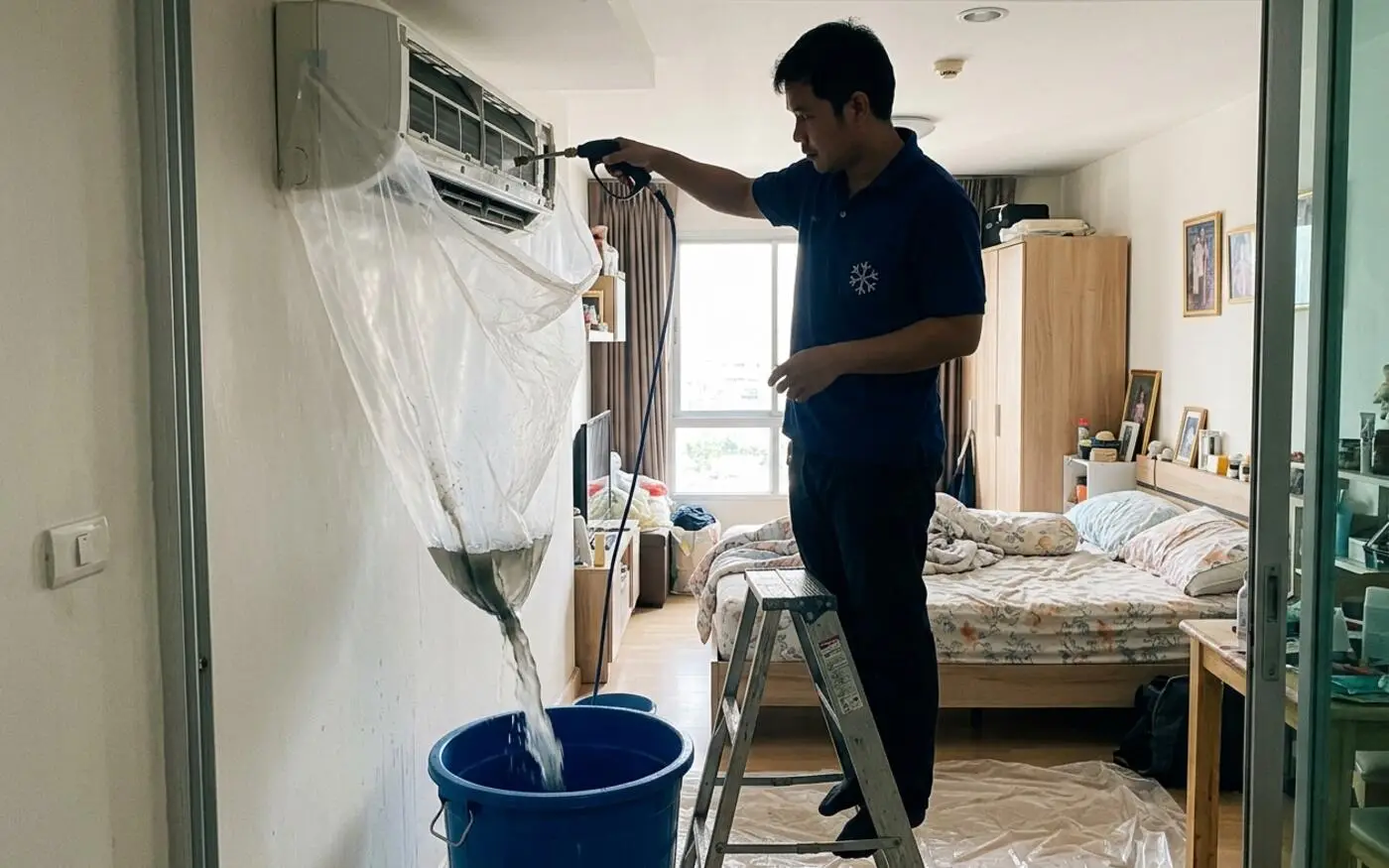
Most people who have had their air conditioner cleaned can tell you what happened indoors: the panel came off, the filter was washed, the coil was sprayed, and the room smelled better. Very few can tell you what was done to the box on the balcony. It hums away outside, nobody sees inside it, and it is easy to assume that it looks after itself.
It does not. The outdoor unit is the half of the machine that gets heat out of your home, and in Bangkok, where the air carries traffic dust, construction grit and, on a laundry balcony, a steady supply of lint, it can quietly choke. The result is not a smell or a drip, which is why it gets missed. It is a unit that cools a little less, runs a little longer, costs a little more and wears out a little sooner.
This guide is the outdoor-side companion to our guide to evaporator coil cleaning. It covers what the condenser does, how it clogs, what that costs, what a technician does about it, and where the limits of a hose and a Saturday morning lie.
What the outdoor unit does: rejecting the heat the indoor coil collected
An air conditioner does not make cold. It moves heat. The U.S. Department of Energy's Energy Saver 101 guide to home cooling describes it plainly: the evaporator coil indoors removes heat and humidity from the room air using refrigerant, a compressor pumps the refrigerant around the loop, and the hot coil outdoors, the condenser, releases the collected heat into the outside air while a fan blows air across it. In a typical split system the condenser and compressor sit in the outdoor unit and the evaporator sits in the indoor unit.
In the standard vapour-compression cycle, the compressor raises the refrigerant vapour to a high pressure and temperature, and the condenser then removes heat from it until it condenses into a liquid, with the heat carried away by the air or water flowing across the coil. For a household split unit, that medium is outdoor air.
Here is the part that matters for dirt. For heat to flow from refrigerant into outdoor air, the refrigerant has to be hotter than that air. On a sun-baked balcony in April the air can be well above 35 °C, so the refrigerant must be hotter still. How much hotter depends on how easily the coil can pass heat to the air. If the coil is clean and air flows freely, the gap is modest. If it is blocked, the only way to push the same heat out is for refrigerant temperature and pressure to climb.
Think of a car radiator. A clean one with a working fan keeps the engine steady. One packed with leaves does the same job only by running the engine hotter, and eventually it cannot manage even that.
How a condenser clogs in Bangkok
The condenser coil is built to be open to the air: thin aluminium fins, packed closely and threaded with copper tubes, with a fan moving a large volume of air through the gaps. That is excellent for heat transfer and terrible for dirt, because anything the air carries gets caught.
The DOE's Measure Guideline on air conditioner diagnostics and maintenance lists the usual culprits: dust, lint, leaves, grass clippings and other debris sucked into the fins. These obstructions lower the effectiveness of the coil, raise the condensing temperature and reduce cooling efficiency. Bangkok adds its own ingredients.
- Lint and balcony life. On a condo balcony the unit often shares space with a drying rack. Every wash puts fibres into the air, and the condenser fan draws them onto the fins, where they knit into a felt-like mat. A common case is a balcony unit blocked solid while a garden-side unit of the same age is fine.
- Road dust, grit and fine particles. The U.S. Environmental Protection Agency's particulate matter basics page lists sources including construction sites, unpaved roads, fields, smokestacks and fires, notes that other particles form in the atmosphere from pollutants emitted by power plants, industry and vehicles, and observes that some, such as dust, dirt, soot or smoke, are large or dark enough to see. Thailand's Pollution Control Department, in a PM2.5 forecast and preparedness announcement, lists particulate matter from vehicles and factories in urban areas and burning in communities among the sources its measures target, and ties a forecast spike in Bangkok to stagnant air that stops particles dispersing. The coarse material lodges between fins; finer material tends to settle as a thin grey film that is easy to overlook but still gets in the way of heat transfer.
- Leaves, pollen and plants. Balcony plants, street trees and the odd bird's nest add material you can often see and remove yourself.
- Salt. Near the sea, salt in the air speeds up corrosion of fins and tubes. Central Bangkok is some way from the coast, so for most city units this is a minor factor, but it is worth knowing about if you live towards the Gulf. The DOE guideline lists a condenser coil with compressed or corroded fins among the signs that replacement may be worth considering, which is a reason to keep a coil clean and undamaged.
What a dirty condenser does: head pressure, compressor temperature, longer run times
"Head pressure" is the pressure on the high side of the system, the pressure the compressor pushes against. Condenser dirt raises it, and several consequences follow.
Less cooling. The ENERGY STAR maintenance checklist says dirty coils reduce the system's ability to cool the home. Refrigerant leaving a struggling condenser is hotter than it should be, so it absorbs less heat when it reaches the indoor coil, and the room cools more slowly.
Longer run times and higher bills. The same checklist adds that dirty coils make the system run longer, which raises energy costs and shortens equipment life. Our guide to what a dirty air conditioner adds to your electricity bill covers the money side, but the saving varies hugely between units and no single figure fits every home.
More strain on the compressor. The compressor is usually the most expensive part of the unit, and it is the part working against head pressure. The higher the pressure and temperature it handles, the harder and hotter it runs. That is the physical link behind ENERGY STAR's point about equipment life, and it is why compressor trouble tends to surface on the hottest days.
Protective trips. Many units shut the compressor or outdoor fan down if temperatures or pressures climb too far. A badly choked coil on a 37 °C afternoon can trigger that, which looks to the owner like the unit "just stopped" or cycled without cooling. It was protecting itself.
One caution on numbers. The DOE guideline reports a laboratory case in which a poorly installed system with 50 percent condenser coil blockage, a hot attic, duct leakage, low airflow and a refrigerant undercharge lost 67 percent of its application SEER. That is several faults combined and cannot be read as the cost of a dirty condenser alone. The takeaway is that condenser blockage is a recognised fault that degrades performance, not a price list.
Why it is a performance and lifespan issue rather than an indoor-air issue
Most guides in this series are about health. This one is not, and the distinction matters.
The indoor evaporator coil is cold and wet. Water condenses on it every time the unit runs, and in Bangkok's humidity it rarely dries completely. Moisture plus dust lets microbes grow on the coil and blower wheel, and because the blower pushes room air across them, what grows there can reach the room. The EPA's page on air duct cleaning states the principle: where heating and cooling components are contaminated and moisture is present, the potential for microbiological growth such as mould (mold, in the American spelling most people search with) rises, and spores can be released into the living space. That is the mechanism behind the smell in our guide to musty AC odours.
The outdoor condenser is different on every count. It is hot, not cold. It is mostly dry apart from rain. And none of the air through it enters your home: the fan takes outdoor air across the coil and returns it outdoors. A choked condenser does not breathe anything into your bedroom.
It makes the machine less effective, dearer to run and shorter-lived, which is a genuine problem, but one for the "performance and bills" column. Do not let anyone sell condenser cleaning as a cure for allergies or asthma. If your worry is a blocked nose or a damp smell, look at the indoor coil and blower; our guide to the benefits of AC cleaning for health and performance covers both sides honestly.
Signs your outdoor coil is choked
No single sign proves a dirty condenser, since other faults look similar, but together they are a prompt to look.
| What you notice | What it can mean | What to check |
|---|---|---|
| Air is cool but not cold, and takes far longer | Dirty condenser, dirty evaporator or low refrigerant | Outdoor fins; see why a unit may not be cold after cleaning |
| Outdoor fan runs but air leaving the unit is barely warm | Compressor not working, or heat not moving through the coil | Feel the air from a safe distance; never touch the fan |
| Cycles that never seem to finish | Heat cannot be rejected fast enough | Fin condition and clearance |
| Unit stops on the hottest afternoons | Protective trip from high temperature or pressure | Blockage, direct sun, recirculating hot air |
| Mat of lint or leaves; no daylight through fins | Physical blockage | Inspect with the unit off |
| Bent, flattened or corroded fins | Restricted airflow | A fin comb can fix mild bending |
| Loud or struggling outdoor unit | Failing fan motor or compressor | Technician, not a hose |
If cooling has dropped and you see no obvious blockage, do not assume the condenser is the cause. Low refrigerant, a failed capacitor and a dirty indoor coil can produce the same complaint, so diagnosis starts with measurements rather than guesses. CoolRova's repair diagnostic is ฿590, waived if the repair goes ahead, with a fixed written quote before any work starts.
What a technician does: fin inspection, straightening, inside-out low-pressure rinse
The DOE guideline's condenser procedure, written for home performance contractors, is a useful outline, and a skilled technician follows the same logic with more refinement.
- Isolate the power. The system is switched off at the thermostat and the outdoor unit is isolated from its supply, so the fan cannot start and nothing is live. On a ledge unit that means finding and confirming the right breaker, which is a job in itself.
- Inspect first. A visual check usually shows whether the coil needs cleaning: lint and film on the intake face, bent or corroded fin edges, and anything restricting airflow nearby.
- Remove loose debris and straighten fins. Lint and leaves come off with a soft brush or vacuum, without bending the fins. The DOE's home cooling guide notes that bent fins can be straightened with a fin comb, a small tool with teeth matched to the fin spacing, and advises hiring a certified professional when a unit needs more than basic maintenance. Mild bending is a few minutes' work for someone practised; a rough hand makes it worse.
- Rinse from the inside out. The DOE procedure removes the cabinet top, setting the fan motor aside without straining its wires, then sprays the coil from inside and outside, first with water, then with a coil cleaner left to sit for the time the product states, then flushes it clean. It also warns that some two-row coils are split and curved so the fins do not line up, trapping dirt between rows; separating them is a job for a qualified technician. Direction matters. The fan packs dirt onto the outer face, so spraying only from outside compresses the mat or drives lint deeper; spraying from inside pushes it back the way it came. Bryant's page on coil cleaning explains why all this effort pays: dirt insulates the coil, restricts airflow and reduces its ability to transfer heat.
- Protect the electricals. The control board, capacitor, contactor and wiring are covered or kept out of the spray path. Once the cabinet and guard are back, power is restored and the unit run, checking that the fan spins freely and the air leaving is warm.
- Measure rather than guess. The DOE guideline suggests comparing the liquid-line temperature (the thinner, uninsulated copper pipe) before and after cleaning as a rough indication of effect. A technician with gauges can compare pressures with expected values, which shows whether the condenser was really the problem.
What a garden hose can and cannot do
A hose is not useless. It is limited.
What it can do. With the unit isolated at the breaker, a gentle spray removes loose surface dust and some outer-face lint. For a lightly dusty unit that is a reasonable job between professional visits, especially after brushing or vacuuming leaves and fluff off the intake face.
What it cannot do. Water alone does not dissolve the greasy film traffic grime leaves on fins. A hose from outside does not reach the packed layer in the middle of a thick coil, tends to push lint inwards, and cannot reach the inner face of the coil, the second row of a two-row design or the base pan.
The two things that damage the coil.
- High pressure. The aluminium fins bend under a hard jet, closing the gaps the air needs. Bryant warns that high-pressure washers can bend the fins and reduce efficiency, and the DOE guideline says any pressure-washer stream must not be strong enough to bend them. A household hose on a gentle setting is the sensible ceiling.
- The wrong cleaner. Bryant also warns that vinegar, bleach and standard household cleaners can corrode the aluminium fins and copper tubing, possibly leading to refrigerant leaks, and lists ammonia and acidic cleaners among the harsh chemicals to avoid. Our guide to what is in AC coil cleaners explains the types.
Two more hazards have nothing to do with the coil. Never hose a unit that is merely "off at the remote": isolate it at the breaker and keep water away from the control box. And if the unit sits on a ledge, bracket or roof, or you would need a ladder or to lean out of a window, do not do it yourself. OSHA states that falls are among the most common causes of serious work-related injuries and deaths, and a condo ledge many floors up is where a small slip has the worst outcome. For the wider comparison, see cleaning your air conditioner yourself versus hiring a professional.
| Task | Owner? | Why |
|---|---|---|
| Clearing pots, boxes and laundry away from the unit | Yes | Free, safe, improves airflow at once |
| Brushing or vacuuming lint off the intake face, unit off at the breaker | Yes, at floor level | Gentle and reversible |
| Low-pressure exterior rinse, unit isolated | Cautiously, floor level only | Removes surface dust, not deep dirt |
| High-pressure washing or household cleaners | No | Bends fins; corrodes metal |
| Opening the cabinet, inside-out rinse, fin comb | Technician | Wiring, sharp fins, water near electronics |
| Anything on a ledge, bracket or roof | Technician | Fall risk |
Clearance, airflow and siting on condo ledges and balconies
A condenser needs a clean intake and somewhere for hot air to go. In a tight city many units get neither.
The DOE's home cooling guide advises clearing debris and leaves from the fan, compressor and condenser of a split system. Manufacturers go further and specify clearances. Daikin's installation reference for a split-system condensing unit, a U.S.-market R-410A model, asks for the top of the unit to be unobstructed where possible, gives minimum airflow clearances at the sides and discourages corner installations; its troubleshooting table also lists recirculation of condensing air as a cause of poor performance. Distances differ by model, so use your own installation manual rather than someone else's number. The principle carries over.
Typical Bangkok problems:
- Ledge and slot installations. The unit is wedged into a narrow ledge or an enclosure with a decorative louvre, so discharge air hits the louvre or wall and swings back to the intake. The unit breathes its own exhaust, and the refrigerant must run hotter.
- Stacked units. The unit above can blow hot air down onto the one below.
- Things stored against it. Pots, folded drying racks and cardboard. Our guide to how often to clean an air conditioner in Bangkok recommends keeping the unit clear for this reason.
- Sun and screens. Direct afternoon sun adds heat load, and a close-slatted decorative screen can cut airflow more than it looks. A shade that leaves airflow free helps; a solid box around the unit does not.
If the siting is not yours to change, the clutter still is. If a unit clearly recirculates its own air, describe the setup to a technician; sometimes a small change, such as removing a louvre panel where building rules allow, makes a visible difference.
Dust season and construction: when to add an extra condenser clean
There is no official "every X months" rule for condensers and we would be wary of anyone claiming one. ENERGY STAR places coil cleaning in the annual contractor check-up, and the DOE advises inspection and cleaning as needed. In Bangkok, match the schedule to the conditions around the unit. Add a look or a clean when:
- A dusty spell has passed. The Pollution Control Department's announcement described a late-October rise in a particular year, driven by a cold air mass, reduced rainfall and still air. The Thai Meteorological Department's monthly summaries record the rainy season beginning on 15 May in 2025 and on 20 May in 2024, so the start shifts from year to year; the rains do some natural rinsing of outdoor units and the dry months that follow do not. Our guide to PM2.5 season and your air conditioner covers what it means indoors.
- There is construction nearby. Demolition, cutting and road works put coarse dust straight onto outdoor equipment.
- You have a laundry balcony or pets. Lint and fur build up faster.
- The unit faces a busy road. Traffic grime forms the greasy film that water alone will not clear.
- You can no longer see daylight through the fins. The simplest test of all.
- Before the hottest months. A condenser that rejects heat easily in March has more margin in April.
For rentals, Airbnb hosts running units hard between guests should treat the outdoor unit as part of the schedule, because a unit that struggles on a hot afternoon is exactly what a guest notices first.
How condenser cleaning fits with indoor coil cleaning and gas checks
The outdoor coil, the indoor coil and the refrigerant charge affect each other, and treating them as separate boxes wastes money.
- Treat both sides together. The EPA notes that some research suggests cleaning components such as cooling coils, fans and heat exchangers may improve efficiency, giving longer operating life and some energy and maintenance savings, and that missing one component of a contaminated system can recontaminate the rest. That page is about indoor air systems, but the logic carries over: a clean condenser does not rescue a unit whose indoor coil and blower are caked. See standard clean versus deep chemical wash for the indoor side.
- Do not top up gas to fix a dirty condenser. Extra refrigerant in a unit struggling with a blocked coil can overcharge it and raise pressures further. A proper refrigerant service starts with a pressure and leak test; CoolRova's refrigerant top-up is from ฿990 with that test first and R32 or R410A weighed in to spec. If you are curious about the two gases, see R32 versus R410A in Thailand.
- Clean first, gauge second. Gauges on a unit with a blocked condenser give high-side readings that point the wrong way. The DOE guideline's diagnostic steps include checking for a fouled condenser coil and cleaning it if clearly plugged, before refrigerant conclusions are drawn.
- Make it a schedule. The 2-Visit Year Package starts from ฿1,240 for one unit, with two scheduled cleans a year and a free gas and drain check each time; the 4-Visit Year Package starts from ฿2,190 for one unit, with quarterly cleans including one deep chemical wash per unit. See the pricing page.
On energy figures, we would rather quote officials than invent numbers. Thailand's Department of Alternative Energy Development and Efficiency has said, in a national energy-saving campaign with EGAT, that cleaning an air conditioner can save up to 10 percent of its electricity cost, about 210 baht a month, and recommended cleaning filters every one to two months with a major clean every six months. That is for air conditioner cleaning in general, not the outdoor coil alone; treat it as a ceiling, not a promise.
A point of honesty on scope: CoolRova's standard clean is built around the indoor unit (filter, evaporator coil and blower wheel washed in place, drain line flushed and tested, a supply-air temperature log and a photo report), and the AC cleaning service page adds a rinse of the outdoor coil where there is ground or balcony access. A unit on a ledge, bracket or roof is a different job, so if yours is hard to reach, say so when you request a quote and the visit can be scoped properly.
When to call a professional
Do the easy things yourself: clear the area, brush off loose lint with the power off, look for fin damage. Call a professional if:
- the unit is on a ledge, bracket or roof, or needs a ladder or leaning out of a window;
- the coil is matted or greasy and a hose will not clear it;
- fins are bent or corroded over a significant area;
- the unit trips, shuts down on hot afternoons or makes new noises;
- cooling has dropped and you cannot tell whether dirt, gas or a failed part is to blame;
- you have cleaned the outside and cooling has not recovered.
A technician treats the whole system: inspects the outdoor coil and its surroundings, washes the indoor coil and blower, and measures before and after. If you are in Bangkok and want the outdoor unit looked at alongside a clean, see our AC cleaning service; if cooling has already dropped, the AC repair service starts with the ฿590 diagnostic. CoolRova covers all Bangkok BTS and MRT zones and is open daily 8:00 to 20:00; reach us on WhatsApp or through the quote form on the contact page. If a cleaned unit still is not cold, the 30-day cool-again guarantee means we come back free.
Sources and further reading
- ENERGY STAR maintenance checklist
- U.S. Department of Energy, Energy Saver 101: home cooling
- U.S. Department of Energy, Measure Guideline: air conditioner diagnostics, maintenance and replacement
- Bryant, how to clean an evaporator coil
- Wikipedia, vapour-compression refrigeration
- U.S. EPA, particulate matter basics
- U.S. EPA, should you have the air ducts in your home cleaned?
- Thailand Pollution Control Department, pollution outlook announcement
- Thai Meteorological Department, monthly weather summary, May 2025
- Thai Meteorological Department, monthly weather summary, May 2024
- EGAT, energy-saving campaign for the hot season
- OSHA, fall protection overview
- Daikin, split-system installation and service reference
Frequently asked questions
Do I need to clean the outdoor unit of my air conditioner?
Yes, it needs periodic attention, because the outdoor condenser coil is where the heat leaves the system and dirt on it makes the unit work harder. ENERGY STAR lists cleaning both the evaporator and condenser coils as part of a yearly contractor check-up. In dusty, busy Bangkok streets and on laundry balconies, many units benefit from a look at least when the indoor unit is cleaned.
What happens if the condenser coil is clogged?
Heat cannot leave the refrigerant as easily, so the system runs at a higher condensing temperature and pressure, cools less effectively and runs longer to reach the set temperature. Over time that means higher electricity use, more strain on the compressor, and in bad cases the unit trips or stops cooling on hot afternoons.
Can I clean my outdoor AC unit with a garden hose?
You can rinse loose surface dirt with a gentle spray after switching the unit off at the breaker, but a hose from the outside mostly cleans the surface and can push lint deeper. High-pressure jets bend the fins, and household cleaners such as bleach or vinegar can corrode aluminium and copper. For anything beyond a light rinse, or any unit on a ledge or high up, use a technician.
Is a dirty outdoor unit a health risk?
Not in the way a dirty indoor coil can be. The outdoor coil sits in open air, stays mostly dry and does not supply the air you breathe, so there is no mold-and-biofilm reservoir feeding your rooms. The problem is performance: weaker cooling, higher running cost and a shorter compressor life. If you have breathing symptoms that seem linked to the AC, the indoor coil and blower are the place to look.
How often should the condenser coil be cleaned in Bangkok?
There is no single official interval. A sensible approach is to inspect it whenever the indoor unit is serviced, and to add a clean after dusty spells, nearby construction or if you can no longer see through the fins. Keeping the area around the unit clear helps it stay clean between visits.
Need it handled professionally?
Get a fixed quote for your units in under 60 seconds.
Written by the CoolRova Team
We're Bangkok's documented AC crew — everything we write comes from real cleaning, repair and installation visits across condos, homes and short-stay rentals.
Get our Bangkok AC guides straight in Google — add CoolRova as a preferred source.