
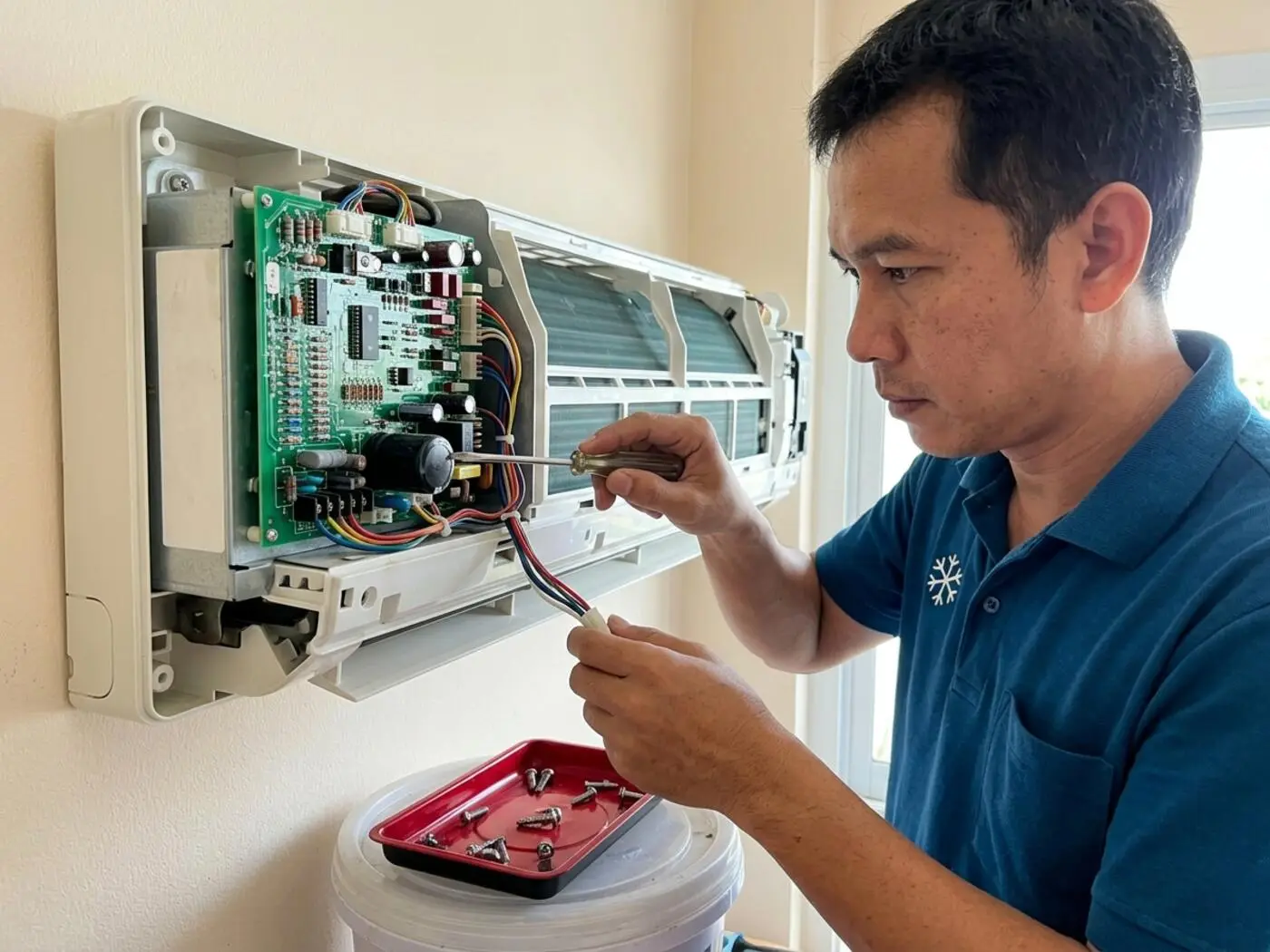
Air conditioners are not silent machines. They have fans, a compressor, pipes carrying a liquid that boils and condenses, flaps driven by small motors and a drain that carries away the water the coil pulls out of humid air. The trick is knowing which of the noises they make are routine and which are a warning. This guide goes through the common sounds one at a time: what they usually mean, whether it is safe to keep running the unit, and what fixes them.
Two honest limits first. A noise is a clue, not a diagnosis; the same rattle can be a panel screw or a cracked fan blade, and you cannot always tell by ear. And the sources we cite describe the sounds of units from specific manufacturers, so your model may differ. When in doubt, the manual and a technician outrank this page.
The quick guide
This table is our practical summary, built from the manufacturer and agency sources linked in the sections below. "Keep running?" is a judgement about risk, not a promise.
| Sound | Common causes | Keep running? |
|---|---|---|
| Soft cracking or ticking as the unit starts or stops | Panels and parts expanding and contracting with temperature | Yes |
| Click at start-up or shut-down | Valve or relay operating; compressor or fan switching on or off | Yes if brief; no if it clicks repeatedly and will not start |
| Rattling | Loose panel, screw, fan blade, debris or an unlevel outdoor unit | Only if mild; stop if vibration is strong |
| Buzzing or humming | Flap motor (normal); outdoor capacitor, contactor or fan motor | Stop if continuous or the fan does not turn |
| Hissing | Refrigerant flow changes (brief); refrigerant leak (continuous) | Stop if continuous, especially with weak cooling |
| Gurgling or bubbling | Air pulled through the drain hose; blocked drain | Yes if there is no leak; fix the drain if it drips |
| Flowing water sound | Refrigerant or condensate moving through the unit | Yes |
| Squealing or grinding | Worn bearing, fan blade damage, compressor or motor fault | No |
| Banging or loud thump from the outdoor unit | Loose or broken fan blade, mounting or compressor fault | No |
Normal sounds you can ignore
Before worrying, learn what a healthy unit does. Mitsubishi Electric's operating instructions for its MSZ-LN series have a short sound section that is worth reading even if you own another brand, because the explanations are physical rather than brand-specific.
- Cracking: the manual says it is caused by the front panel and other parts expanding and contracting as the temperature changes.
- A mechanical sound from the indoor unit: it is the switching sound as the fan or compressor turns on or off.
- The sound of water flowing: it is refrigerant or condensed water moving through the unit.
- An occasional hiss: it is the sound of refrigerant flow changing inside the unit.
Daikin's troubleshooting page lists some of the same family of sounds as ordinary operation: a click when the refrigerant control valve or an electrical component operates, a buzz when the flap moves and a rattling or creaking when the flap position is adjusted at start-up or stop. Its FTXC-C split-unit manual also says the indoor unit's operating sound will seem louder in POWERFUL mode, which is simply the fan working harder.
One more normal behaviour often mistaken for a fault is silence followed by a thunk. Daikin's operation manual says the compressor has protection against frequent starting and to wait three to four minutes for it to start. If your unit stops, goes quiet and then restarts with a click and a hum a few minutes later, it is probably doing exactly that.
Normal sounds share three features: they are brief or rhythmic, they are not getting louder over weeks, and cooling is unaffected. A noise that is new, loud or accompanied by weak cooling, a smell, dripping water or a tripping breaker belongs in the sections below. Manufacturers say as much: Mitsubishi Electric's guidance lists an abnormal sound among the cases in which you should stop using the unit and consult your dealer, and Daikin advises stopping operation and switching off the breaker if the indoor unit produces an abnormal noise.
Rattling
A rattle is the sound of two things that should be fixed together moving against each other. Trane says rattling with excessive vibration is not normal and lists causes including a problem with the blower wheel, fan, fan motor or compressor, a loose screw or bolt, or an unlevel outdoor unit.
Indoor unit. The usual suspects are the front panel not seated properly after a filter clean, a loose louvre or vane, and the blower wheel. A blower wheel packed with dirt can go out of balance, because the dirt rarely builds up evenly. Our blower wheel guide covers why a dirty wheel can hum or rattle; this is mechanical reasoning rather than something a published study measures, but it explains why a noisy unit sometimes goes quiet after a thorough wash. ENERGY STAR's maintenance checklist itself lists cleaning the blower components among routine tasks.
Outdoor unit. Loose fan guard screws, debris in the fan, a loose panel, a loose bracket and a unit that is no longer level are the common causes. The US Department of Energy's cooling guide advises owners of split systems to clear debris and leaves from the fan, compressor and condenser, and a bent or leaf-clogged fan can rattle until the debris is removed.
What to do. Identify whether the sound is indoor or outdoor, whether it changes with fan speed and whether it starts when you switch the unit on. Switch off and check the filter and front panel. If the rattle is outdoors, look from a safe distance for loose items on the ledge or leaves in the fan. Do not reach into a fan guard. If the vibration is strong, stop the unit.
Buzzing and humming
A buzz or a hum is an electrical or motor sound. The cause depends on where it comes from.
Normal buzz. Daikin says a buzzing sound may be produced when the flap moves. If it lasts only while the flap is adjusting, ignore it.
Indoor hum. Trane's guidance says a loud hum from an indoor unit may point to a blower motor problem. Mitsubishi Electric's service manual for the MSZ-AP series treats a missing rotation feedback signal from the indoor fan motor as a distinct fault with its own lamp pattern, and our error code guide explains how to read it.
Outdoor hum. Trane says a loud hum from an outdoor unit can mean a problem with the capacitor, contactor or fan motor. Carrier explains that a fan that hums but does not spin often means a failed run capacitor, lists a buzzing sound from the motor among the signs of a burnt-out fan motor, and notes that capacitors can hold a high-voltage charge even when the power is off, which is why only a trained technician should handle them. It adds that if the fan is not spinning and the compressor is not humming either, the outdoor unit may not be receiving power or the compressor may have failed, and that running the unit without a working condenser fan can overheat the compressor.
What to do. If the hum is steady and the outdoor fan is not turning, switch the unit off at the remote and the breaker. Running a motor that is humming without turning can overheat it. This is the situation where catching a cheap part, often a capacitor, can spare the motor. In CoolRova's repair range a capacitor costs ฿1,500 to ฿2,500 including parts and labour, and an indoor fan motor ฿2,500 to ฿4,500, so it pays to have a humming unit checked early.
Clicking and ticking
A single click when a unit starts or stops is normal. Daikin attributes a click to the refrigerant control valve or an electrical component operating, and Mitsubishi Electric describes the switching sound when the fan or compressor turns on or off.
Clicking becomes a symptom when it repeats, comes with a unit that fails to start or continues all the time. Trane notes that indoor clicking can come from a faulty control board, a loose connection or a safety switch, and outdoor clicking from a capacitor or contactor, and advises noting when it happens (at start-up, at shut-down or continuously) so you can tell the technician. A repeating click that is followed by a hum and no cooling is the typical "trying to start and failing" pattern.
A common case is a bedroom unit that clicks every minute or so during the night. If it is switching the compressor on and off often (short cycling), it is not coping, and the cause can be a dirty coil, low refrigerant or a faulty sensor. The US Department of Energy notes that compressor and fan controls can wear out from a system that turns off and on too frequently, and advises calling a professional to check the electrical connections.
Hissing and bubbling
Hissing is the one sound on which the sources disagree, and the disagreement is instructive.
Mitsubishi Electric says a hissing sound is sometimes heard and is the sound of the flow of refrigerant changing inside the unit. Daikin says that on models with its Streamer air-purifying unit, hissing or crackling is produced by the Streamer discharge and does not indicate a malfunction. Trane, on the other hand, says hissing is not normal, and says that near the indoor coil or the outdoor refrigerant lines it may mean a large refrigerant leak, while a hiss under the normal sound of a running outdoor unit may be a compressor or electrical issue. Carrier's mini-split guidance links hissing to an active leak in the refrigerant lines.
A reasonable way to reconcile them, and this is our interpretation rather than any source's statement, is duration and company. A soft, brief hiss when the unit starts or stops is described by one manufacturer as ordinary refrigerant movement. A hiss that continues while running, especially with weaker cooling or ice on the indoor coil, is the pattern that sources associate with a leak.
What to do. If you suspect a leak, switch off and call a technician. Refrigerant circuits are sealed, so low refrigerant means a leak and adding gas alone only postpones the problem. The EPA's page on purchasing and repairing home air conditioners notes that leaks raise operating and maintenance costs and points homeowners to technicians with EPA certification for handling refrigerants. CoolRova's top-up, from ฿990, begins with a pressure and leak test, and R32 and R410A are weighed in to specification. Our ice on the indoor unit guide covers the related symptom.
Gurgling, bubbling and water sounds
Water sounds are the most common noise complaint in Bangkok condos, and they are usually less alarming than they sound.
Water flowing. Mitsubishi Electric says the sound of water flowing is the sound of refrigerant or condensed water running through the unit. A split unit pulls a lot of water out of humid Bangkok air, so the drain is rarely idle.
Burbling and bubbling. Mitsubishi Electric's manual explains a burbling sound as outside air being drawn back through the drain hose when a range hood or ventilation fan is running, forcing water in the hose to spout out. The same sound can occur when strong outside wind blows into the drain hose. Daikin gives the same reasons, and says outdoor air can enter the drain hose when the room is sealed and the ventilation fan runs. Its suggested fixes are to open a room vent or a window, turn off the ventilator or redirect the end of the hose, and it says a drain hose check valve can be used to control thumping and knocking, with the installer the person to ask about fitting one. In a condo with a sealed room and a bathroom extractor fan, this is a realistic cause.
Gurgling with dripping. If the gurgle comes with water at the indoor unit, a stained wall or a damp ceiling, the drain may be partly blocked. The US Department of Energy advises owners to check that the unit's drain is not clogged and to occasionally pass a stiff wire through drain channels, and ENERGY STAR notes that a blocked drain can cause water damage and change indoor humidity. For the symptom of an indoor unit dripping, see our guide to AC water leaking from the indoor unit, which covers what a drain flush involves.
Squealing and grinding
These are the sounds that should not be ignored. A squeal that rises with fan speed or a grinding that comes from a motor is metal rubbing on metal, or a part that has lost its balance.
Trane says that a high-pitched noise from an outdoor unit could be a loose screw, or a problem with the fan motor, capacitor or compressor, and advises turning the unit off to avoid damage and calling for service. Carrier says that grinding or clanking noises before a fan stops suggest a broken blade, and it advises against running the AC with damaged blades.
In practice the usual candidates are a worn motor bearing (indoor or outdoor), a fan blade that has cracked or hit something, a blower wheel rubbing the housing and, less often, the compressor. A wheel that has slipped on its shaft or lost a balance weight can also rub. The reasons for stopping are practical. A rubbing wheel can score its housing, a damaged blade can break up at speed, and a motor with a failing bearing can overheat or seize.
What to do. Switch the unit off at the remote and the breaker, and leave it off until it is checked. Describe where the noise comes from, whether it changes with fan speed and whether it began after cleaning, a storm or a power cut. A motor swap is a routine repair; a compressor fault changes the repair-or-replace calculation, and our repair or replace decision guide sets out how to weigh it.
A noisy outdoor unit, and your neighbours
The outdoor unit is the loudest part of the system because it contains the compressor and a large fan. It is also where the neighbour problem lives. In a Bangkok condo the unit often sits on a shared ledge or service balcony, with the wall or slab acting as a loudspeaker.
Mounting and vibration. Daikin's operation manual tells owners and installers to consider nuisance to neighbours from noise, to choose a place that can withstand the weight with less running noise and vibration, and to avoid places where warm airflow from the outlet and operating noise cause a nuisance. It adds that obstructions near the outdoor unit's air outlet can reduce performance and increase operating noise, and that anyone hearing abnormal noise should ask their dealer for advice. A unit that drifts out of level or has loose bolts on its rails transmits vibration into the structure.
Start-up and shut-down. Trane says some air conditioners are naturally loud when starting and stopping, and that noise-reduction kits exist, but that if the noise is new, a failing capacitor or compressor may be the cause. The point is "new": a loud thump that you have heard since the day it was installed is different from one that began last week.
Dirt and airflow. A condenser coil clogged with dust or lint makes the compressor and fan work harder. Our outdoor condenser cleaning guide explains what a build-up does and how it is removed. The DOE describes cleaning leaves and debris from the fan and condenser as routine, and advises hiring a certified professional when a unit needs more than basic maintenance.
Noise and sleep. Persistent noise is not just an irritation. The World Health Organization's release on its environmental noise guidelines describes noise as one of the top environmental hazards to physical and mental health and well-being, and lists effects on sleep among the outcomes its reviews examined. Those guidelines address transport, wind turbine and leisure noise rather than household appliances, so they do not set a limit for an air conditioner, but they support the common-sense point that a bedroom unit whose noise keeps you awake is worth fixing. If the outdoor unit disturbs a neighbour, a technician can check the mounts and level, and your building management can advise on the rules for shared structures.
Quick checks you can do safely
None of these involve opening a panel or touching electrical parts.
- Pin down the sound. Is it indoor or outdoor? At start-up, shut-down or all the time? Does it change when you change fan speed? Trane advises noting when it happens, and Carrier advises noting any noises when describing symptoms.
- Record it. A 20-second phone video with the unit running is often more useful to a technician than a description.
- Try fan-only mode. If the noise disappears in fan mode, the compressor side is more likely involved; if it stays, think of the indoor fan, wheel, panel or flap.
- Check the filter and front panel. A filter that has not been seated properly or a loose panel is the cheapest rattle to fix, and ENERGY STAR advises checking filters monthly.
- Look at the outdoor unit from a safe distance. Check for loose items, leaves, a blocked outlet or an obviously tilted unit.
- Do one thing at a time. Do not run the unit with a damaged fan, and do not keep restarting a unit that hums or clicks without starting.
When to switch it off
Switch off at the remote and the breaker, and call a technician, if you notice:
- grinding, scraping or clanking, or a loud bang;
- a hum with no fan movement;
- a burning smell, since Daikin's manual says to turn off power when the unit is giving off a burning odour;
- a breaker that trips, which Mitsubishi Electric lists among the reasons to stop using the unit;
- a buzzing, crackling or sizzling sound from the plug, socket, isolator or wiring, which is an electrical fault rather than an air-conditioning one and is not something to investigate yourself;
- a continuous hiss with weak cooling or ice on the pipes;
- water near electrical parts;
- a noise that is getting louder day by day.
Anyone with a sleep-disturbing noise that has no fault behind it, for example the burbling of a sealed room, should still talk to the installer about the drain hose, because the fix is usually cheap.
What a technician does about a noise
A diagnosis follows the sound.
- Listen at start-up, in steady running and at shut-down, at each fan speed, and note which unit is making it.
- Check mounting and level of both units, the brackets, rails, panels, fan guards and pipe supports.
- Inspect the fan and wheel for damage, rubbing, play in the bearings and dirt build-up.
- Test the electrical side of the outdoor unit: capacitor, contactor and fan motor.
- Check the refrigerant side with pressures and, for a hiss, a leak test.
- Check the drain for blockage and test the flow.
- Test run and listen again.
CoolRova's repair diagnostic is ฿590 and is waived if the repair goes ahead. You receive a fixed written quote before any work, and parts and labour carry a 90-day warranty. If the noise comes from a dirty wheel or coil, a clean may remove it: a standard clean from ฿690 per unit washes the blower wheel and coil in place, while a deep chemical wash from ฿1,290 per unit removes the blower wheel for a full strip and wash. See our pricing page for multi-unit rates. Where the cause is a worn motor or a failing compressor, CoolRova will say so, including when replacement makes more sense than repair.
When CoolRova can help
If your air conditioner is rattling, humming, clicking, hissing or gurgling and you are not sure what it means, send a short video and the model number through WhatsApp or the quote form on our contact page. CoolRova covers all Bangkok BTS and MRT zones, and same-day no-cool call-outs run until 22:00. If the noise has come with a code or a blinking lamp, read our error code guide first and note what you see.
Frequently asked questions
Why is my air conditioner making a rattling noise?
Rattling is usually a loose or unlevel part: a panel, screw, fan blade or the outdoor unit itself. Trane says rattling with excessive vibration is not normal and should be looked at, and a dirty or unbalanced indoor blower wheel can rattle too. Turn the unit off if the vibration is strong.
Is a gurgling sound from my air conditioner normal?
Often it is. Mitsubishi Electric explains a burbling sound as outside air being pulled back up the drain hose by a range hood or ventilation fan, or by strong wind, and Daikin gives the same explanation. If the gurgle comes with dripping from the indoor unit, the drain may be blocked and needs clearing.
Why is my AC buzzing or humming?
Daikin says a buzz can be the flap moving, which is normal. A continuous hum from the outdoor unit can point to a capacitor, contactor or fan motor, and Carrier says a fan that hums but does not turn often means a failed run capacitor. Switch the unit off and call a technician, because capacitors can hold a charge.
Is a hissing sound from my AC a gas leak?
It can be. Mitsubishi Electric says a hiss is sometimes heard when refrigerant flow changes, but Trane and Carrier associate hissing with refrigerant leaks. A brief hiss at start-up or shut-down is less worrying than a continuous hiss with weaker cooling or ice on the pipes, which should be checked with a pressure and leak test.
When should I turn off a noisy air conditioner?
Switch it off at the remote and the breaker if you hear grinding or clanking, smell burning, find the breaker tripping, or the fan hums but will not turn. Daikin and Mitsubishi Electric both say to stop operating the unit and contact the dealer when an abnormal noise is heard.
Need it handled professionally?
Get a fixed quote for your units in under 60 seconds.
Written by the CoolRova Team
We're Bangkok's documented AC crew — everything we write comes from real cleaning, repair and installation visits across condos, homes and short-stay rentals.
Get our Bangkok AC guides straight in Google — add CoolRova as a preferred source.