
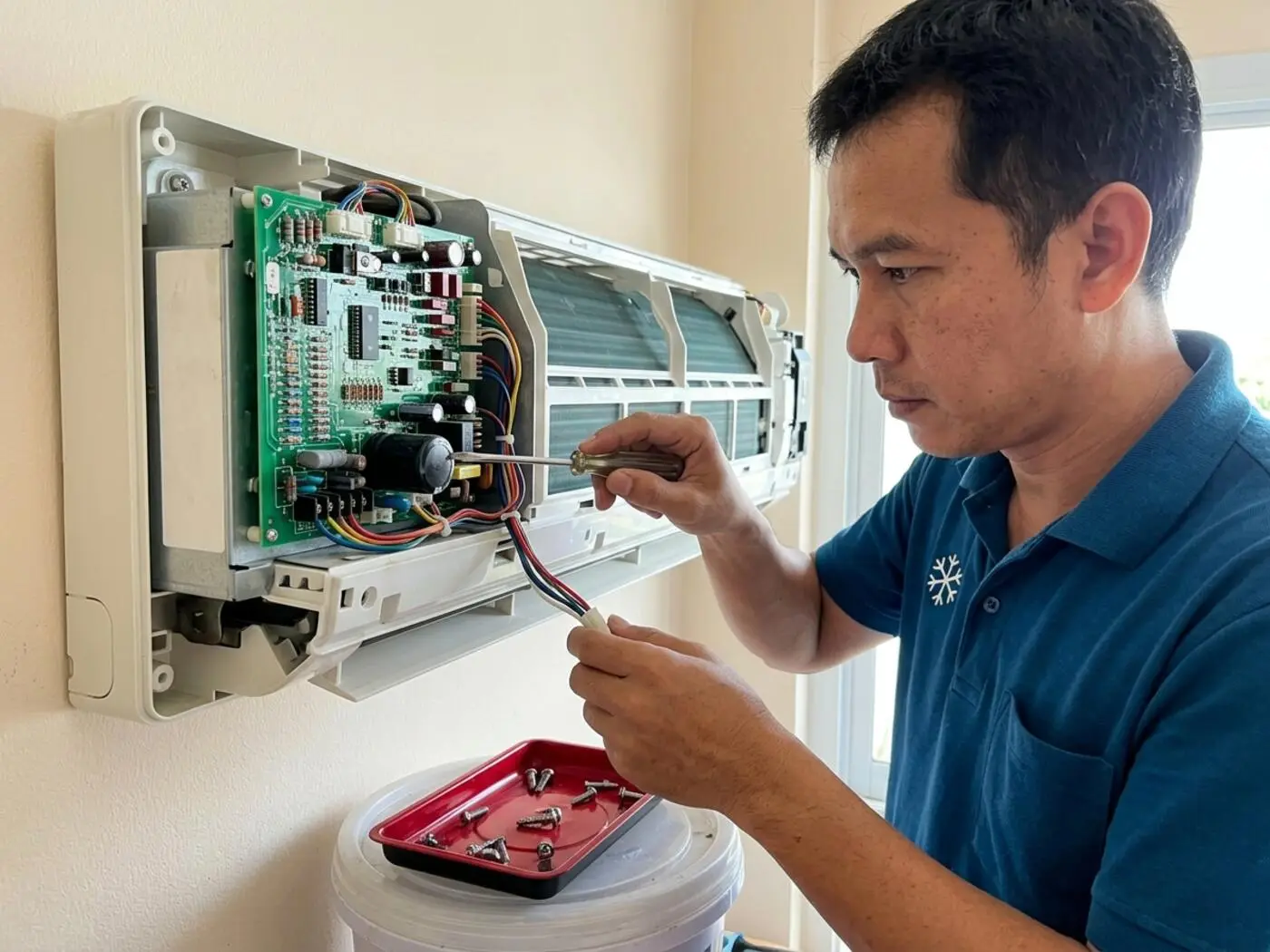
You walk into the bedroom and the air from the vent is weak and barely cool. You lift the front panel, or look at the thin copper pipe running to the wall, and there is white frost on it. Perhaps there is a sheet of ice behind the grille, or a puddle on the floor because it has started to melt. On a day when Bangkok is well over 30 °C outdoors, an air conditioner covered in ice feels like a contradiction.
It is not a mystery, and it is not a disaster if you handle it correctly. Ice on an indoor unit is a symptom with a short list of causes, and manufacturers such as Carrier, Trane, Bryant, LG and Samsung describe the same list. A note on those sources: the Carrier, Trane and Bryant pages are written for US ducted central systems, and LG's for US room units, so where they talk about ducts, registers and thermostats we translate to the wall-mounted split found in most Bangkok homes; the refrigeration principle is identical. This guide explains the physics in plain words, the three families of cause, what to do in the first hour, why adding gas is the wrong first move, how a technician finds the real cause, and how to stop it coming back.
What you are seeing: frost, ice and ordinary condensation
Three different things get described as "my AC is frozen", and it helps to tell them apart.
- Wet but not frosted. The pipe or the coil face is cold and beaded with water. That is condensation, the way the unit dehumidifies, and it is normal.
- White frost on the copper pipe or the edge of the coil. The early stage. The surface has dropped below 0 °C and moisture that should have run to the drain has frozen where it landed.
- A solid block of ice across the fins. The coil is now sealed. Air cannot get through, so the unit blows weak air, and when the ice melts it can overwhelm the drain pan and drip into the room.
Treat the second and third as a fault. A coil that is only wet is fine.
LG's help page also brings outside temperature into the picture: it tells owners to let frost melt if the outside temperature is below 65 °F (about 18 °C). That rarely applies in Bangkok, so ice here is far more likely to be one of the faults below than the weather.
Why a coil freezes: the physics in plain words
An air conditioner moves heat from your room to the outdoor unit. Inside the indoor unit, liquid refrigerant flows through the evaporator coil, a block of tubes and thin aluminium fins, and boils at low pressure. Boiling absorbs heat, so the coil is far colder than the room. The blower pushes room air across the fins, the air gives up its heat and leaves cooler. Because Bangkok air carries so much moisture, water also condenses on the coil and runs into the drain pan; our guide to evaporator coil cleaning covers that process in detail.
Normally the coil runs cold but stays above freezing, because warm room air keeps arriving to supply heat. Two things break that balance.
- Too little air crosses the coil. The refrigerant keeps absorbing heat, but less warm air arrives, so the coil temperature keeps falling. Below 0 °C, the water condensed on it turns to ice. Samsung's support page describes the first cause as air flow across the cooling coil that is too slow or has halted, and LG's help page says restricted airflow lets the coil get so cold that condensed moisture freezes instead of draining.
- Too little refrigerant. With less refrigerant in the loop, pressure inside the evaporator falls, and a lower pressure means a colder coil. Carrier puts it plainly: a leak or low refrigerant lowers coil pressure, which makes the coil colder and causes ice. Bryant says low refrigerant can lower the pressure and temperature in the evaporator, and Trane lists a refrigerant leak, and the low charge it causes, among its causes of a frozen coil.
Ice then makes everything worse. It blocks the fins, which cuts airflow further, which makes the coil colder still, and the cycle continues until the unit is switched off. A 2012 Purdue conference paper on frost on fan-supplied tube-fin evaporators of the kind used in light commercial refrigeration found that reduced airflow was the main cause of lost cooling capacity under frosting, with capacity falling by up to 40% from frost. It is a laboratory study, not your bedroom unit, but it makes the same point: once frost blocks the air path, cooling collapses.
Cause 1: restricted airflow
Every source we found puts airflow first. Carrier, Trane and Bryant list dirty filters and blocked vents; Samsung adds debris on the coil and a dirty or non-functioning blower fan; Bryant and Trane also name a dirty evaporator coil. In a wall-mounted split there are four places airflow gets choked.
The filter. Dust, lint and hair that have not been rinsed for weeks are the most common culprit. LG says that if it has been more than two weeks since the filter was cleaned, it may need washing, and recommends lukewarm water below 104 °F (40 °C). ENERGY STAR's checklist advises checking filters monthly on central systems and says a dirty filter can raise energy costs and lead to early equipment failure. A bedroom unit running every night in Bangkok, especially in PM2.5 season, collects a lot of dust.
The evaporator coil. Fine dust settles on the wet fins and forms a felt that narrows the gaps and insulates the metal. ENERGY STAR says dirty coils reduce cooling ability, make the system run longer and shorten equipment life. A US Department of Energy Building America guideline states that fouling of the evaporator reduces airflow, will eventually cause the coil to freeze over, and may damage the compressor. Our guide to dirty evaporator coil symptoms shows what that looks like, with a table separating coil problems from low gas.
The blower wheel. Behind the coil, a drum of curved blades moves the air. Dirt packs between the blades and a coated wheel moves far less air than a new one. It is the hardest part to see and to clean in place, which is why a unit so often freezes again after only the filter has been rinsed. See AC blower wheel cleaning.
Blocked inlets and outlets. A jammed swing flap, or a curtain or furniture too close to the unit, reduces airflow. Carrier, Trane and Bryant each list blocked vents or registers on ducted systems, and the principle is the same for a wall unit.
Engineers measure airflow in cubic feet per minute per ton of cooling (cfm per ton). The Department of Energy guideline puts typical design airflow at 350 to 400 cfm per ton and states that airflow below 200 cfm per ton can lead to coil icing and greatly shorten compressor life. Those figures are for ducted US systems, not a Bangkok condo split, but they show that ice follows a large loss of airflow, which a dirty coil and blower can produce together.
The encouraging part is that this cause is fixed by cleaning. A professional wash of the coil, blower wheel and drain removes the restriction, and if dust was the cause the ice should not return, provided the filter is kept up.
Cause 2: low refrigerant means a leak
Refrigerant is not fuel. It circulates in a sealed loop and is not consumed, so a unit that has lost refrigerant has a leak somewhere. Bryant says low refrigerant is often associated with a leak and that leaks can arise from age, vibration or corrosion. Trane says signs can include oily residue near the indoor coil or hissing near the indoor or outdoor coil, and that a suspected leak should be dealt with by a trained professional.
In our experience the usual weak points in a split are the flared joints at each end of the pipe run, the service valves on the outdoor unit and, less often, pinholes in the coil. A leak drains the charge slowly, so the typical pattern is a unit that cools a little less each week until ice appears. A dirty filter, by contrast, can cause icing within days.
The Department of Energy guideline lists shortened equipment life from coil freezing due to low refrigerant charge, and it also notes that standard charge tests are invalid when airflow is below 350 cfm per ton. That matters: if the coil is dirty, a technician who reads pressures and decides "low gas" may be reading a symptom of the dirt. Good practice is to restore airflow first, then test the charge.
Too much refrigerant is a fault as well. ENERGY STAR says both too much and too little reduce efficiency and equipment life, which is why the charge should be weighed in to the nameplate figure instead of added until the ice stops. If you are unsure which refrigerant your unit uses, our R32 vs R410A guide explains the difference in Thailand.
Cause 3: fan, sensor or control faults
Sometimes the filter is clean, the coil is spotless and there is no leak, yet ice appears. Then the cause is mechanical or electrical.
- A weak or failing indoor fan. Samsung lists dirty blower fan blades or a non-functioning blower fan among causes of restricted airflow, and Bryant lists a blower motor that fails or runs at reduced speed. A worn motor, a weak capacitor or a damaged blower wheel moves less air than the coil needs. A fan motor replacement at CoolRova typically costs ฿2,500–4,500 including parts and labour.
- A restriction in the refrigerant circuit. Samsung says a clogged capillary tube or a faulty expansion valve can restrict refrigerant flow and cause icing. This is uncommon and needs gauges and temperature readings to diagnose.
- A sensor or control that fails to protect the coil. Trane notes that a faulty thermostat may be the explanation when coils freeze overnight and the system fails to shut off. A 2020 SAE paper on car air-conditioning, a different system but the same refrigeration principle, found that a poorly responding thermistor was among the factors affecting evaporator frosting, alongside under- and over-charge and reduced airflow from a clogged filter. Split units generally rely on temperature sensors and a control board to manage the cycle, so a failed sensor or board can let a coil run too cold; how your model protects its coil varies, so the manual is the authority. A PCB repair at CoolRova typically runs ฿3,500–6,000 including parts and labour.
- A drain problem that looks like freezing. A blocked drain line backs water into the pan and onto the coil. EPA advises keeping drip pans clean and drain lines unobstructed. If your unit drips as well as icing, see indoor units leaking water in Bangkok.
Some units also show an error code when a protection function trips. Codes vary by brand, model and series, so check your own manual; our guide to Daikin, Mitsubishi Electric and Carrier error codes explains how to read them.
What to do right now
The next hour matters, because the wrong moves can damage the compressor or the coil. Follow this order.
- Stop the cooling. Turn the unit off or switch it to fan-only mode. Carrier says to turn the system off immediately and warns that running a frozen coil strains the compressor and can cause costly failure. Bryant gives the same warning.
- Run the fan if your unit has a fan-only mode. Samsung recommends fan mode on high, which it says should defrost the unit fairly quickly (it suggests 5 to 15 minutes for its room units), and keeping it there until the coil and vents are dry. Carrier's longer estimates below are for heavier ice on central systems.
- Catch the meltwater. Bryant suggests towels around the indoor unit, and Carrier says to check that the drain line is not overflowing as the ice melts.
- Rinse the filter. Slide it out, wash it in lukewarm water, let it dry and refit it. Replace it if it is torn.
- Clear anything blocking the inlet or outlet, and check that the swing flap moves.
- Wait for a complete thaw. Carrier estimates about one to three hours for a light frost and four to eight hours or longer for heavy ice. Do not restart cooling while ice remains.
- Restart and watch. Samsung suggests switching back to cooling with the set point only a few degrees below room temperature, then lowering it gradually. If ice returns, switch off again and call for help.
What not to do
- Do not chip, scrape or pry the ice. Trane warns that chipping can damage the coil and cause a leak, and Bryant that it can damage the coil or refrigerant tubing.
- Do not use a hairdryer, heater or hot water. Carrier says heat sources can cause thermal shock and crack components, and that hot water can crack or warp the coils.
- Do not keep running the unit to see if it clears. Bryant lists repeatedly restarting a freezing system, instead of having it diagnosed, among the things not to do.
- Do not buy a can of gas. The next section explains why.
Why "just add gas" is the wrong first move
When a unit blows weak air and has frost on the pipe, a top-up feels like the obvious fix. It usually is not, for four reasons.
First, a sealed system does not use up refrigerant. If it is low, the gas has gone somewhere. Bryant calls adding refrigerant without fixing the leak a temporary and costly band-aid, and Carrier says a professional must identify and repair the problem before recharging.
Second, the symptom may not be low gas. Airflow problems produce the same ice, and low airflow makes charge tests invalid. A unit with a dirty coil and a correct charge can be topped up until the pressures look right while the real fault remains, and overcharging reduces efficiency and equipment life.
Third, there is no universal correct pressure. Bryant notes that no single refrigerant pressure reading applies to every system, so a technician works from the manufacturer's specification and measurements.
Fourth, there are rules. In the United States, Section 608 of the Clean Air Act prohibits intentionally venting refrigerants during servicing, repair or disposal of air-conditioning equipment, as the EPA's Section 608 page explains. That is a US rule and this guide does not describe Thai regulations, but recovering refrigerant rather than releasing it is sound practice wherever the unit is.
CoolRova's refrigerant top-up service starts from ฿990 and begins with a pressure and leak test, with R32 and R410A weighed in to specification. If the test finds a leak, the repair comes before the gas.
How a technician finds the cause
A good diagnosis follows the order of the causes above, because the cheap, common faults should be ruled out before the expensive ones.
- Ask for the history. Did cooling fade over weeks (suggesting a leak) or collapse in days (suggesting dirt)? When was the last clean? Does ice return after the filter is rinsed?
- Inspect the airflow path. With the unit off, the technician opens the panel and checks the filter, coil face, blower wheel and drain pan with a torch. A felted coil or a blower wheel clogged between its blades explains most cases.
- Run the unit and measure. After the thaw, the technician checks the indoor fan speed and compares the temperature of the air leaving the unit with the air entering it.
- Test the refrigerant side. Gauges on the service valves show operating pressures to compare with the manufacturer's data. If the charge is low, a nitrogen pressure test and an electronic detector find the leak. The Department of Energy guideline describes superheat and subcooling measurements as part of its field charge diagnostics.
- Test the controls. The sensors, the fan motor and its capacitor and the control board are checked, and any error code is read.
- Quote before work. CoolRova's repair diagnostic is ฿590, waived if the repair goes ahead, with a fixed written quote before any work and a 90-day warranty on parts and labour.
If the cause is dirt, the answer is a clean, not a repair. A standard clean starts from ฿690 per unit, washing the filter, coil and blower wheel in place, flushing the drain and logging supply-air temperature before and after. Where years of build-up are the problem, a deep chemical wash from ฿1,290 per unit removes the blower wheel and strips the pan and louvres.
Prevention: a schedule that suits Bangkok
Almost every cause of icing is easier to prevent than to fix, and a unit that runs most nights in Bangkok's humidity needs more attention than the once-a-year advice in US guidance.
| Task | How often | Who |
|---|---|---|
| Rinse the filter | Every two to four weeks in heavy use (LG says to clean it if it has been more than two weeks) | You |
| Check that louvres, vents and the swing flap are clear | Whenever you rinse the filter | You |
| Professional wash of coil, blower wheel and drain | At least twice a year for a bedroom unit used most nights | Technician |
| Deep chemical wash | When the coil or blower is heavily coated or the unit smells musty | Technician |
| Gas and drain check | At each scheduled service | Technician |
| Act on early signs | The first time you see weak airflow, frost on a pipe or drips | You, then a technician |
CoolRova's 2-Visit Year Package starts from ฿1,240 for one unit and includes a free gas and drain check at each of two cleans; the 4-Visit Year Package starts from ฿2,190 and includes one deep chemical wash per unit. Either is a sensible way to catch low gas early.
Airflow also affects the electricity bill. ENERGY STAR states that airflow problems can reduce a system's efficiency by up to 15 percent, and a laboratory paper by Ali and Ismail found that a room air conditioner's coefficient of performance fell as its evaporator was loaded with fouling material. Those are not forecasts for your unit, but they are the same cause as the ice, seen from the cost side.
When to call a professional
Rinsing a filter and clearing a vent are safe for anyone. The coil, blower, electronics and refrigerant need the right tools and training. Call a technician if:
- the ice returns within a day or two of a full thaw and a clean filter;
- you see oily residue at a pipe joint, or hear hissing;
- the blower is noisy, slow or not spinning;
- the unit shows an error code or cycles oddly;
- cooling was fading for weeks before the ice appeared;
- you are not sure what you are looking at.
If your unit has stopped cooling and you cannot wait, CoolRova offers same-day no-cool call-outs until 22:00, and is open daily 8:00 to 20:00. Our AC repair service covers diagnosis, sensors, fan motors, boards and leak repair across all Bangkok BTS and MRT zones, and our 30-day cool-again guarantee means that if the unit is not cold within 30 days, we come back free. If the unit is old and keeps failing, the better question may be whether to keep repairing it at all; our guide to repairing or replacing an air conditioner sets out how to decide.
Ice on an indoor unit is your air conditioner telling you something is out of balance, and in most Bangkok homes the answer is dust on a coil or blower that has gone too long without a proper wash. Switch to fan mode, let it thaw, rinse the filter, and if the ice comes back, stop restarting it. Message us on WhatsApp or use the quote form at /contact and we will find the cause before you pay for more than the ฿590 diagnostic, which is waived if you go ahead with the repair.
Sources and further reading
- Carrier: will a frozen AC fix itself?
- Trane: causes of frozen evaporator coils
- Bryant: why does my AC keep freezing?
- Samsung India: frost formation on the air conditioner
- LG: ice or frost behind the front grille
- US Department of Energy Building America: Air Conditioner Diagnostics, Maintenance, and Replacement
- Purdue IRACC 2012: frost formation on fan-supplied tube-fin evaporators
- SAE: factors affecting evaporator frosting in a mobile air-conditioning system
- ENERGY STAR: heating and cooling maintenance checklist
- US EPA: Section 608 refrigerant management
- US EPA: a brief guide to mould, moisture and your home
- Ali and Ismail, HVAC&R Research: evaporator air-side fouling and room air conditioner performance
Frequently asked questions
Why is my air conditioner freezing up?
Ice forms when the indoor coil gets cold enough that the moisture condensing on it freezes. Manufacturers list the same short set of causes: restricted airflow from a dirty filter, dirty coil, blocked vents or a weak blower, low refrigerant from a leak, and mechanical or control faults such as a failing fan or a faulty expansion device.
How long does it take for a frozen air conditioner to thaw?
Carrier suggests that a light frost may take about one to three hours and heavy ice four to eight hours or longer. Running the fan with cooling off speeds the thaw, and Samsung says fan mode on high should defrost a unit fairly quickly, but the unit should stay in fan mode until the coil and vents are dry.
Can I just top up the gas if my aircon is icing?
No. Refrigerant circulates in a sealed loop and is not used up, so a low charge means a leak. Bryant calls adding refrigerant without fixing the leak a temporary and costly band-aid, and Carrier says a professional must find and repair the leak before the system is recharged.
Is it safe to run an air conditioner with ice on it?
It is not recommended. Carrier and Bryant both warn that running a frozen system strains the compressor, which is the most expensive part of the machine. Switch to fan-only mode or turn the unit off until the ice has melted and the cause is dealt with.
Why does my AC freeze up in Bangkok when it is so hot outside?
Heat outdoors does not protect the indoor coil, because the coil's temperature depends on the airflow across it and the refrigerant inside it. A filter or coil clogged with dust, a weak blower or a slow refrigerant leak can push the coil below freezing even on a hot afternoon, so ice in Bangkok is almost always a fault rather than weather.
How much does it cost to fix a frozen air conditioner in Bangkok?
It depends on the cause. A clean starts from ฿690 per unit, and a refrigerant top-up with a pressure and leak test starts from ฿990 at CoolRova. If a repair is needed, the diagnostic is ฿590, waived if the repair goes ahead, with a fixed written quote first.
Need it handled professionally?
Get a fixed quote for your units in under 60 seconds.
Written by the CoolRova Team
We're Bangkok's documented AC crew — everything we write comes from real cleaning, repair and installation visits across condos, homes and short-stay rentals.
Get our Bangkok AC guides straight in Google — add CoolRova as a preferred source.