
Your air conditioner worked fine last year. This year the room takes an hour to cool, the fan sounds strained, there is a damp patch under the unit, and the first thing you notice when it starts is a smell like a wet towel. Someone suggests that it just needs gas.
Very often it does not. When an indoor unit slowly gets worse in several ways at once, the usual culprit is the part you cannot see: the evaporator coil, the block of thin aluminium fins behind the filter (called คอยล์เย็น in Thai). It is the single most important heat-exchange surface in the unit, and when it is coated in dust and slime it quietly breaks five or six things in a predictable order. This guide walks through those symptoms one by one, shows how to separate a dirty coil from the other faults that look similar, and explains why "low on gas" is usually the wrong first diagnosis.
This guide is a diagnostic for split-type units in Bangkok homes and condos. It does not repeat what a dirty AC adds to your electricity bill or what to do when the AC is not cold after a clean.
What a clean coil does, and the five things a dirty one breaks
An evaporator is a heat exchanger: liquid refrigerant flows through tubes, boils at low temperature, and in doing so absorbs heat from whatever passes over it. Wikipedia's neutral definition of an evaporator describes exactly that conduction-and-convection exchange, and notes that deposits building up on heat-transfer surfaces reduce how efficiently they work. In your wall-mounted unit, the refrigerant is inside the tubes and fins; warm room air is pulled across the outside by the blower wheel. The air gives up heat, comes out colder, and the water vapour in it condenses on the cold fins and runs into a drain pan.
That one description contains the five jobs a coil must do at once, and the five things that go wrong when it is fouled:
- Transfer heat. Dust, grease and biofilm form an insulating layer on the fins. Bryant's guidance on dirty evaporator coils says dirt and dust build-up insulates the coil, restricts airflow and reduces its ability to absorb heat, so the system works harder to hit the set temperature.
- Pass air. The gaps between fins are fractions of a millimetre. A mat of lint and slime narrows or closes them, and the blower moves less air for the same effort.
- Stay above freezing. The coil is meant to run cold but not frozen. When airflow drops, less heat reaches it, and the surface temperature can fall below 0 °C.
- Shed water. Condensate has to run off the fins, through the pan and out of the drain. Sludge turns that path into a trap.
- Stay hygienic. A permanently wet surface in a dark box is where bacteria and mould settle, and the smell tells you they have arrived.
The six symptoms below map onto those five jobs. Some are obvious and some are easy to misread, so we take them in the order they usually appear.
Symptom 1: weaker airflow and a louder fan
This is typically the first change, and the one most people miss because it happens slowly. You stop feeling a firm stream of air from the louvres, or you notice the fan has to run at a higher speed to deliver what it used to deliver on low. The sound changes too: a harsher, rushing note as the blower works against a restriction.
Carrier's list of signs that an evaporator coil needs cleaning starts with reduced airflow from the vents and includes unusual noises and uneven cooling. ENERGY STAR's maintenance checklist makes the same connection from the efficiency side, noting that airflow problems can reduce system efficiency by up to 15 per cent and that dirty coils make a system run longer.
Two things restrict airflow in a split unit, and both are behind the front grille:
- The coil face. Lint that got past the filter mats onto the fins. You can sometimes see it with a torch: a grey felt on the front of the fins instead of clean metal.
- The blower wheel. The long plastic drum behind the coil has dozens of narrow curved blades. Slime and dust collect on their leading edges and change their shape, so each blade pushes less air. We cover this in more detail in our guide to AC blower wheel cleaning.
A 60-second check
Rinse the filter first and retest; a blocked filter gives the same airflow loss for a fraction of the cost. Then shine a torch through the front of the coil. If you cannot see light through the fins, or see a continuous grey film, the coil is loaded. Also check that nothing blocks the louvres.
Symptom 2: it takes longer to cool, the compressor runs longer, the bill creeps up
When heat transfer drops, the room still needs the same amount of heat removed. The unit simply needs more hours to do it. The setpoint is eventually reached, but later, and the compressor in the outdoor unit runs for longer stretches. That is why "it takes ages to cool" and "my electricity bill went up but I changed nothing" are often the same symptom described two ways.
There is hard laboratory evidence for the mechanism. A research paper indexed by the International Institute of Refrigeration tested how air-side fouling of a room air conditioner's evaporator coil changes its performance. Using real fouling material on the coil, the authors measured the coefficient of performance (COP), the ratio of cooling delivered to electricity used. A clean coil scored 2.82; after 100 g of fouling it fell to 1.89, and after 300 g to 1.23. Those are controlled laboratory loadings of fouling material, which may not match a household coil, and they should not be read as a prediction for your bill. What they establish is the direction and mechanism: fouling on the air side makes the same machine deliver less cooling per unit of electricity. The authors also found heavy colonies of Aspergillus fungi on the coil face afterwards, which links this symptom to the smell in symptom 5.
We avoid quoting a percentage saving for cleaning because it depends on the unit, the room and how fouled the coil was. What you can do is time how long the room takes to reach your setpoint on a normal evening, and compare after a clean. CoolRova logs supply-air temperature before and after every standard clean, so the result is on the photo report.
For the money side of the same symptom, see what a dirty AC adds to your Bangkok electricity bill.
Symptom 3: ice on the coil or the pipes (and why it is often not low gas)
Ice is the symptom that gets people to call a technician, and the one most likely to be misdiagnosed. You open the front panel and find frost or solid ice across the front of the coil, or you see frost on the thick copper pipe leaving the indoor unit or at the outdoor service valve.
The mechanism is straightforward. In normal running, warm room air constantly feeds heat into the boiling refrigerant and keeps the fin surface cold but above freezing. If airflow is restricted, there is not enough warm air to carry that heat in. The fin surface keeps cooling until it drops below 0 °C, the condensation on it freezes, and the ice then blocks airflow even further. It is a loop that makes itself worse.
Bryant's page lists ice or frost on the indoor coil or the outdoor refrigerant lines among the signs of a dirty coil, and it names a dirty air filter and low refrigerant charge as the other common causes of freezing. That list matters, because the same ice has several origins. A clogged filter, a fouled coil or blower wheel, a failed fan motor or blocked vents all restrict airflow, while a low refrigerant charge (a leak) lowers the pressure in the coil so the whole surface runs colder than normal.
What to do when you find ice
- Switch cooling off and run fan only for 30 to 60 minutes. The room-temperature air melts the ice safely.
- Do not chip or scrape the coil. The fins are soft aluminium and a screwdriver tip can puncture a tube.
- Expect water. A melting coil can overflow the pan in minutes, so place towels and a shallow container under the unit.
- Rinse the filter while it thaws.
- If ice returns within a day or two of a clean filter, the cause is not the filter. That is the point to book a coil clean or a diagnostic.
How to tell the causes apart at home: ice across the whole front face of a coil with a grey film points to airflow and fouling. Ice that starts at the pipe connection and creeps back along the pipe, with thinner cooling, points more towards refrigerant. Neither is certain without gauges, which is why the "it needs gas" section below matters.
Symptom 4: dripping, and drain blockages
Ice that thaws becomes water, so a frozen coil often turns into a dripping unit. But a dirty coil can also cause leaks without ever icing, because the sludge that builds up in the drain pan and the drain line eventually restricts the flow of condensate.
In Bangkok's humid air a running unit can pull a lot of water out of the room. That water runs off the coil fins into the drain pan under it and out through a sloped tube. Slime, lint and dead biofilm wash off the coil and accumulate in the pan and the tube. Over months, the tube narrows. The first sign may be a gurgling sound, the second a slow drip from the louvres or from the bottom edge of the unit, and the third a stain on the wall.
ENERGY STAR's checklist is explicit that a clogged condensate drain can cause water damage in the home and affect indoor humidity. The US EPA's guidance on controlling moisture in the home includes the instruction to keep air-conditioning drip pans clean and the drain lines unobstructed. Carrier's description of a coil clean includes inspecting the drain pan and drain, removing foreign matter and flushing both with clear water. The drain is part of the coil job, not a separate task.
There are other reasons a unit drips, including poor installation slope, a split condensate pipe, or a cracked pan, and our dedicated guide to why an indoor unit leaks water in Bangkok covers the full list. The point here is narrower: if the dripping appeared alongside weaker airflow, a smell, or ice, the coil and drain share a root cause.
If water is running down the wall
Switch the unit off at the remote and at the isolator or breaker if water is near sockets or the wall's wiring. Put a towel and a tray under the unit. Do not keep running cooling until the cause is cleared, because a blocked drain gets worse the longer it runs.
Symptom 5: musty smell and black specks
The smell is the most recognisable symptom and the clearest sign that the coil has become a habitat rather than a heat exchanger. A sour, wet-sock or damp-cellar smell on start-up is the volatile by-product of microbes growing on the wet fins and blower wheel. We explain that in depth in why your AC smells musty and why a filter clean will not fix it, so we focus here on what the research says about how fast it happens.
A study in Current Microbiology ran aluminium and copper heat exchangers in a full-scale test system and sampled them over 30 weeks. The authors report that ordinary aluminium exchangers developed stable mixed bacterial and fungal biofilms, in excess of 47,000 organisms per square centimetre, within four weeks of operation. The biofilms were densest towards the base of the coil, which is consistent with condensate carrying material downwards as it drains, although the study did not test that mechanism. Citing earlier work, the authors also note that biofilm on air-handling coils is associated with lowered heat-transfer efficiency and potential odour issues. This was a test rig running single-pass outside air, some authors had links to the copper industry, and it does not tell you your own count. But it supports the practical point: a wet aluminium coil does not stay clean for long.
On the health side, the US EPA's guidance on cleaning heating and cooling system components says that if moisture is present, the potential for microbiological growth such as mould is increased and spores may be released into living space. The American Lung Association lists a musty odour as a key sign of a moisture problem and names air conditioners among the places where condensation can build up. The CDC describes mould exposure as causing, in some people, a stuffy nose, sore throat, coughing or wheezing, and burning eyes, and identifies people with asthma or mould allergy as more likely to react strongly. Damp and mould are associated with respiratory symptoms and with worse asthma; that is an association, not proof that your unit is making you ill. If you or a family member have persistent symptoms, asthma attacks or a weakened immune system, see a doctor rather than relying on a cleaning visit.
Practical signs that the smell has become more than cosmetic:
- Black or dark flecks blowing from the louvres or collecting on the vent.
- Symptoms such as sneezing or a blocked nose that start soon after the unit runs and ease when it is off.
- A smell that returns within weeks of a filter wash. That tells you the source is behind the filter.
A word on Legionella, which some readers worry about. The NHS notes that Legionnaires' disease is usually caught in places such as hotels, hospitals and offices where bacteria have got into the water supply, and is less common at home. The NHS does list air conditioning systems among possible sources, alongside hot tubs, humidifiers and rarely used taps and showers, but the systems it has in mind are the water-based ones in large buildings: cooling towers and hot-water circuits that hold warm water. A wall-mounted split unit has neither; it chills air across a dry-cooled coil and its condensate is cold and drains away. So the risk sits mainly with cooling towers and large building water systems, not a typical household split unit. A musty smell signals general microbial growth on the coil, not that diagnosis.
Symptom 6: short-cycling, tripping and sensor errors
The last group is the least intuitive, because the coil is only an indirect cause.
Short-cycling. Bryant lists frequent on-off cycling among the signs of a dirty evaporator coil. The reason is that the unit senses temperature from sensors on the coil and in the return air. A coil that is iced or fouled sends misleading readings, or it reaches its protective low-temperature limit and the control board shuts the compressor off to protect it, then restarts a few minutes later. You hear the outdoor unit start and stop repeatedly and the room never settles.
Error codes. Many split units show a fault code when the indoor-coil sensor reads outside its expected range or the coil is too cold. Codes differ by brand and model, so check your manual. If a code appears together with ice or poor airflow, treat the coil as a prime suspect before replacing a sensor.
Tripping or outdoor-unit trouble. The indoor coil does not normally trip a breaker. A dirty outdoor coil, the condenser, is different: it forces the compressor to work against high pressure and can contribute to overheating and tripping, particularly in hot weather. If the problem is mostly outdoors, see our guide to condenser coil cleaning. Repeated breaker trips are an electrical safety matter, so do not keep resetting; call a technician.
The table: symptom, coil cause, other causes, how to tell at home
Use this table as a first-pass filter. It is designed to help you tell a technician what you see, not to replace diagnosis.
| Symptom | Coil cause | Other causes | How to tell at home |
|---|---|---|---|
| Weak airflow, louder fan | Fins matted with lint; slime on blower wheel | Clogged filter; failing fan motor; blocked louvres | Clean filter first; torch through the coil; compare with a year ago |
| Slow to cool, long run time | Insulating film on fins reduces heat transfer | Undersized unit; new heat load; low refrigerant; dirty condenser; open doors or windows | Time to reach setpoint; supply air temperature compared with before; check outdoor unit |
| Ice on coil or pipes | Restricted airflow drops coil below 0 °C | Clogged filter; low refrigerant charge; blower fault | Ice across the whole front face suggests airflow; ice creeping back along the pipe from the outdoor valve suggests refrigerant |
| Dripping | Thaw water overflow; sludge in pan and drain | Poor installation slope; cracked pan; split drain pipe | Dripping that follows an icing episode, or comes with smell and weak airflow, points to the coil |
| Musty smell, black specks | Biofilm on fins and blower wheel | Mouldy filter; damp room; smoke or cooking odour | Smell strongest on start-up; returns after filter wash; dark specks at the louvres |
| Short-cycling, error codes | Iced or fouled coil giving false readings or tripping protection | Faulty sensor; failing capacitor; dirty condenser; electrical fault | Appears together with ice or poor airflow; code listed in the manual |
If three or more rows describe your unit, the coil is the most economical suspect to rule out first. It is a wash, not a repair.
Why "it needs gas" is the wrong first answer
In Thailand the phrase "เติมน้ำยา", topping up the refrigerant, is the default response to a unit that is not cold enough. Sometimes it is right. A system with a genuine leak does need the leak found, fixed and the charge restored. But as a first diagnosis for a gradual decline in a unit that has not been cleaned in a year, it is usually wrong, for three reasons.
Refrigerant is not consumed. The refrigerant circuit in a split unit is a sealed loop. Unlike fuel, the charge does not get used up in normal running. The US EPA's FAQ for homeowners says that major leaks rarely develop in properly installed and regularly maintained units and asks owners to have a technician locate and repair a leak instead of "topping it off". If a unit really is low, there is a hole somewhere, and adding refrigerant without finding it just buys a few weeks.
Dirt mimics low gas. Weak cooling, lukewarm air and ice can be produced by airflow loss alone. That is why Carrier's guidance says that these symptoms can have several causes and that, if cleaning does not resolve them, the next step is a professional inspection. Clean first, measure second, add refrigerant last.
Overcharging does harm. Adding gas to a unit that is already correctly charged but fouled raises pressures and makes the compressor work harder. That is the opposite of what the system needs.
Questions worth asking before you agree to a top-up
- "Did you measure the pressure or the temperature drop across the coil, and what were the readings?"
- "Where is the leak, or how did you rule one out?"
- "Was the filter, coil and drain checked before the gas?"
- "Is the refrigerant R32 or R410A, and was it weighed in to specification?" (There is a difference; see R32 vs R410A in Thailand.)
At CoolRova, a refrigerant top-up starts at ฿990 and always begins with a pressure and leak test; R32 and R410A are weighed in to spec. The 2-Visit Year Package also includes a free gas and drain check at each visit, so a genuine low-charge unit is caught early rather than after the compressor has suffered.
How a coil clean resolves each symptom, and what it cannot fix
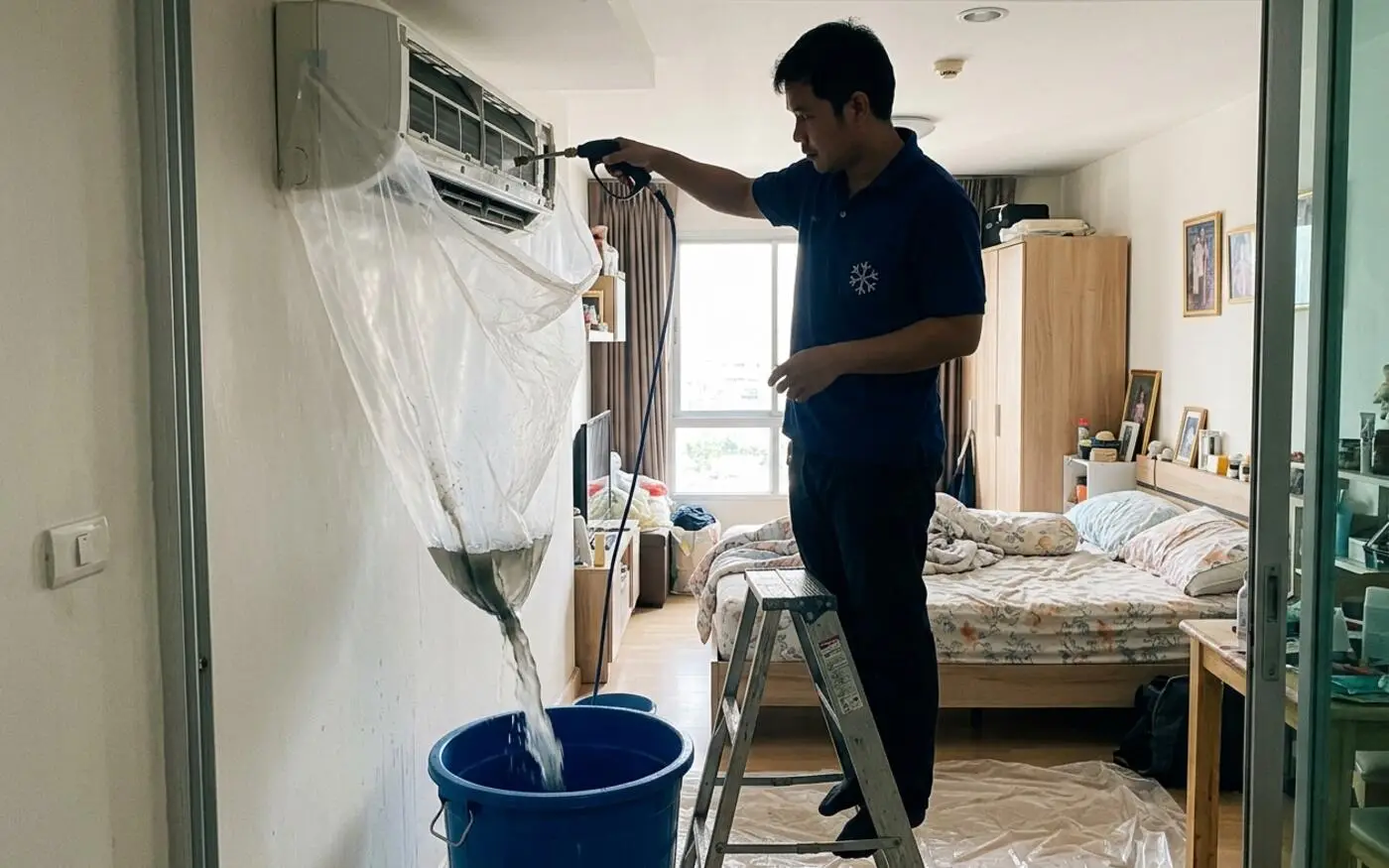
A standard clean at CoolRova washes the filter, evaporator coil and blower wheel in place inside a sealed wash bag with coil cleaner and a low-pressure rinse. The drain line is flushed and tested, supply-air temperature is logged before and after, and you receive a before-and-after photo report. A deep chemical wash goes further: the blower wheel is removed, louvres and drain pan stripped, the coil foamed with a biodegradable cleaner and soaked, everything pressure-washed, and an antibacterial anti-mould treatment applied, in 60 to 90 minutes per unit. Our standard clean vs deep chemical wash guide explains which one your unit needs, and the full technique is in the evaporator coil cleaning guide.
In practice, a clean resolves weak airflow, slow cooling, ice, dripping and smell when dirt on the coil, blower wheel and drain was the cause, and it often settles short-cycling too if the coil was iced or fouled. Where it falls short is listed below.
What cleaning cannot do
- Straighten bent fins. Carrier notes that coil fins are delicate and that repairing bent fins is generally professional work. A fin comb can improve it; heavy damage may not recover fully.
- Repair a refrigerant leak. Cleaning removes dirt, not holes.
- Replace failing parts. A tired capacitor, fan motor or sensor needs a repair.
- Correct a bad installation. A drain with no fall will drip again.
This is why a well-run visit includes inspection as well as washing. CoolRova's repair diagnostic is ฿590, waived if you go ahead with the repair, with a fixed written quote first and a 90-day warranty on repairs. If a clean is done and the unit is still not cold within 30 days, CoolRova's 30-day cool-again guarantee means we come back free.
How long a cleaned coil stays clean in Bangkok
Bryant recommends cleaning an evaporator coil at least once a year, and twice for homes with pets, a lot of dust or heavy use. Carrier also advises annual cleaning, ideally with a mid-season clean too. Those are guidelines written for climates with a real off-season, in which the coil dries out for months.
Bangkok has no off-season. The coil is wet every night the unit runs, city air carries dust and traffic particles, and the monsoon months keep indoor humidity high even when the unit is off. The biofilm study above suggests how quickly a wet aluminium coil can be colonised. So in Bangkok a practical baseline is two cleans a year for a bedroom that runs most nights, and four for units that run all day, serve a shop or short-stay rental, or sit in a home with pets or smokers. CoolRova's 2-Visit Year Package (from ฿1,240 for one unit) is built around the first pattern, and the 4-Visit Year Package (from ฿2,190 for one unit, including one deep chemical wash per unit) around the second. How often to clean your AC in Bangkok sets out the reasoning in more detail.
Between cleans, three habits slow the return of symptoms:
- Rinse the filter every two to three weeks. It protects the coil face.
- Dry the coil before you switch off. Use your remote's dry or clean mode, or run fan-only for about five minutes. A coil that is damp all night is the one that grows slime.
- Do not ignore early signs. A slight change in airflow or the first sniff of a musty smell is the cheapest moment to act.
When to call a professional
You can safely rinse a filter, thaw ice with fan-only mode and place a towel under a drip. The rest is professional work, because the coil is fragile and the refrigerant circuit is regulated and pressurised. Call a technician if:
- Ice comes back within a day or two of a clean filter.
- There is dripping that follows no obvious cause, or water near sockets or walls.
- The smell returns within weeks of a filter wash, or black specks appear at the louvres.
- The compressor cycles on and off, an error code shows, or a breaker trips.
- The unit has not had a proper coil and blower clean in a year or more.
- Someone proposes a gas top-up without measuring pressure or looking for a leak.
For any of these, book a standard clean from ฿690 per unit (two units ฿1,290, three ฿1,790, with larger bundles priced per visit), or ask for a diagnostic visit through AC repair if the unit is clearly faulty rather than dirty. CoolRova covers all Bangkok BTS and MRT zones, with 800+ units cleaned across homes, rentals and businesses, and is open daily from 8:00 to 20:00, with same-day no-cool call-outs until 22:00. Message us on WhatsApp or use the quote form on the contact page, tell us which symptoms you have, and we will tell you whether it sounds like a clean or a repair.
Frequently asked questions
What are the signs of a dirty evaporator coil?
The usual signs are weaker airflow from the vents, a unit that takes longer to cool the room, ice on the coil or refrigerant pipes, water dripping from the indoor unit, a musty smell on start-up, and the compressor switching on and off more often. Several together, especially after a long period without a coil clean, make a dirty coil the likely cause.
Can a dirty evaporator coil cause ice on the air conditioner?
Yes. Dirt insulates the coil and restricts airflow, so less warm room air passes over it and the coil surface drops below freezing. Condensation on it then turns to ice. A clogged filter and a low refrigerant charge cause the same thing, so a technician should check airflow first and pressure second.
How do I know if my AC needs gas or a coil clean?
Check the filter, then look at whether the weakness is general or started gradually. A slow decline over months with a musty smell points to a dirty coil; a sudden loss of cooling with ice starting at the outdoor service valve points more towards a leak. Refrigerant is not consumed in normal use, so ask for a pressure and leak test before agreeing to a top-up.
Will cleaning the coil fix a frozen air conditioner?
It fixes the freezing if the cause was dirt on the coil or blower. It will not fix ice caused by a refrigerant leak, a failed fan motor or a closed vent. A technician can tell which by checking airflow, temperature drop across the coil and refrigerant pressure.
How long does a cleaned evaporator coil stay clean in Bangkok?
It depends on how many hours the unit runs, dust, pets and cooking, but the coil is wet every night in Bangkok's humidity, so fouling and biofilm return faster than in a dry climate. Two professional cleans a year suits most bedrooms that run nightly, and heavier-use or dustier homes may need four.
Need it handled professionally?
Get a fixed quote for your units in under 60 seconds.
Written by the CoolRova Team
We're Bangkok's documented AC crew — everything we write comes from real cleaning, repair and installation visits across condos, homes and short-stay rentals.
Get our Bangkok AC guides straight in Google — add CoolRova as a preferred source.