
"Chemical wash" is one of those phrases that sounds either reassuring or alarming depending on who says it. Reassuring, because it suggests something stronger than a rinse. Alarming, because it is not clear what the chemical is, whether it is safe to breathe, and what it does to the delicate metal inside the unit.
The honest answer is that there is no single chemical. Coil cleaners are a family of products with different chemistry, different strengths and different risks, and the difference between a good job and a damaging one is often just which product was chosen and whether it was rinsed out. This guide sorts them into types, explains what each does to the dirt and to the metal, and gives you a household safety checklist and a list of questions to ask your cleaner. It is the chemistry companion to our guide to evaporator coil cleaning.
Why a coil needs a cleaner at all: biofilm does not rinse off with water
The indoor coil is a block of thin aluminium fins on copper tubes. It runs cold, so water condenses on it every time the unit cools, and in Bangkok it seldom dries out. Dust that passes the filter lands on the wet fins and the blower wheel behind them, and microbes grow on that damp film of dirt.
What forms is a biofilm. A review in the CDC's journal Emerging Infectious Diseases describes microbes attaching to a surface and becoming enclosed in a matrix, and says biofilms are highly resistant to most antimicrobial agents and disinfectants. You can read the details in the CDC's overview of biofilms. In practical terms, that means a layer which is sticky, holds onto dust and shrugs off a light rinse, and a spray of disinfectant on top of it mostly treats the surface.
That is why a coil clean needs two things that plain water cannot supply:
- A cleaning agent that loosens and lifts the film, the grease and the dust bound into it.
- A thorough rinse that carries the loosened material and the cleaner itself out of the coil and down the drain.
Everything in this guide is a variation on those two steps. The rest is about choosing an agent that does the first without harming the metal, the electronics or the people in the room, and making sure the second really happens.
If you want to see what the dirty state looks like and how it smells, our guide to why an AC smells musty covers it. If you wonder whether to do it yourself, see cleaning your air conditioner yourself versus hiring a professional.
Type 1: foaming alkaline cleaners
This is the workhorse. Alkaline cleaners are the most common coil cleaners because most of what clogs a coil is organic: oily dust, cooking grease in kitchens, skin and pet matter, and the biofilm itself. Alkalis are good at breaking those down into things water can carry away.
Why they foam. Most are applied as a foam. The foam clings to the vertical fins instead of running straight off, which gives the active ingredients contact time, and it pushes into the gaps between fins as it expands. The technician lets it sit for the time the label gives, then rinses.
What makes them risky. "Alkaline" covers a wide range, from mild detergent-like products to strongly caustic ones. At the strong end the base is often sodium hydroxide, and the U.S. NIOSH pocket guide entry for sodium hydroxide lists irritation and burns to the eyes and skin and irritation of the respiratory tract, including pneumonitis. That is workplace hazard information for the concentrated chemical, not a statement that every coil cleaner is dangerous, but it is a good reason to prefer milder products, dilute correctly and wear protection. Strongly alkaline products can also attack aluminium if left on too long or not rinsed, which is why contact time and rinsing matter.
What a good one looks like. A coil-specific foaming cleaner, mixed to the manufacturer's dilution, left on for the stated time and rinsed until the runoff is clear.
Type 2: biodegradable and enzyme cleaners
Many modern coil cleaners are sold as biodegradable, and some are enzyme-based. Enzymes are proteins that break other molecules apart: proteases target protein, and other enzymes target the sugars and fibres that help hold a biofilm matrix together. The idea is to dissolve the glue rather than scrub it. We have not seen independent tests of enzyme products on air conditioner coils, so how well a given product works on your coil depends on the product and on what the film is made of; treat the idea as sound but the claim "enzyme-powered" on a label as a starting point for questions, not proof.
The upside. Gentler on metal and on lungs, and easy to rinse. Enzyme products tend to work slowly, so they suit lighter soiling or a soak.
The limits. "Biodegradable" describes what happens to the product in the environment after disposal. It does not tell you the product is harmless to breathe or to touch. The American Lung Association warns that "green" labels do not guarantee safety and advises looking for products that meet recognised standards. The EPA's Safer Choice programme is one such standard, helping people find products with safer ingredients, though its listings centre on everyday categories such as all-purpose, floor and laundry cleaners rather than HVAC coil cleaners. Use it as a reference point for what "safer" can mean, not as a shopping list for coil work.
CoolRova's deep chemical wash uses a biodegradable cleaner, foamed onto the coil and left to soak, with the parts then pressure-washed. See standard clean versus deep chemical wash for what each includes.
Type 3: acid-based brighteners, and why they are a problem on aluminium
Some coil products are acid-based. They are sold as "brighteners" or for heavy scale, and they can make dull, oxidised aluminium look shiny. For an outdoor coil in a harsh environment some technicians use them with care. Indoors, on an evaporator coil, they bring more risk than benefit.
The metal. Aluminium protects itself with a thin oxide layer, and that layer is what keeps the fins from corroding in normal use. Strong acids and strong alkalis can both break it down. Bryant's guide to cleaning evaporator coils warns that vinegar, bleach and standard household cleaners can corrode aluminium fins and copper tubing and may cause refrigerant leaks, and lists ammonia and acidic cleaners among the harsh chemicals to avoid. The fins are very thin, so even a little corrosion removes a large share of the metal.
The people. Some acid products are based on hydrofluoric acid or fluoride salts. The NIOSH entry for hydrogen fluoride lists irritation of the eyes, skin, nose and throat, burns, pulmonary oedema and bronchitis, and names the eyes, skin, respiratory system and bones as target organs. You are unlikely to see this on a retail label in plain words, which is precisely why asking is sensible.
The mixing hazard. Acids are also the products most likely to be combined with something else by accident, as the section on bleach explains.
Our view, and a common-sense one: an indoor coil that is only dirty and biofilm-coated does not need an acid. If a cleaner proposes one, ask why.
Type 4: bleach and chlorine
Bleach is in nearly every Thai home, so it is the first thing many people think of for mould. It is also the product with the clearest official guidance against routine use.
The EPA, in its answer to whether to use bleach to clean up mold, says that using a biocide such as chlorine bleach is not recommended as a routine part of mould cleanup, though professional judgment may favour it in some cases, for example when immune-compromised people are present. It adds that in most cases it is neither possible nor desirable to sterilise an area, that a background level of spores will remain and will not grow if the moisture problem is fixed, that dead mould can still cause allergic reactions so it must be removed, not just killed, and that any biocide should be used with ventilation that exhausts air outdoors.
For a coil there are further reasons to avoid it:
- Corrosion. Bryant lists bleach among the products that can corrode fins and tubing.
- Fumes. Bleach releases irritating vapours in a closed room, and the American Lung Association notes that cleaning products can irritate the eyes and throat.
- Mixing. The EPA says never to mix chlorine bleach with products containing ammonia, because toxic fumes can result. A CDC Morbidity and Mortality Weekly Report describes hospital incidents in which bleach mixed with a phosphoric acid cleaner released chlorine gas, causing eye, nose and throat irritation, chest tightness, dizziness and in one case an asthma attack, and notes that the absence of odour does not mean the air is safe.
For a household with an asthmatic or a baby, a technician who reaches for bleach to "kill the smell" is a red flag. The smell comes from the biofilm, and the biofilm needs to be removed.
Type 5: antimicrobial and anti-mould treatments
After the coil is clean, some jobs finish with an antimicrobial product, sold as an anti-mould, antibacterial or "sanitising" treatment. They fall into a few families: quaternary ammonium compounds (often called quats), other disinfectant actives, and coatings meant to leave a thin residual layer on the surface.
What they do. They are meant to slow the return of bacteria and mould on a freshly cleaned, but still damp, coil.
What they do not do.
- They do not remove biofilm. The CDC review above is clear that biofilms resist disinfectants. A laboratory study of disinfectant products against biofilms of two common bacteria found that hydrogen peroxide and sodium hypochlorite products performed significantly better than quaternary ammonium products, which failed to meet the EPA's minimum standard against biofilms. It is a lab test on specific bacteria, not an air conditioner trial, but it supports the order of work: remove the film first, treat second.
- They do not remove moisture. The EPA's point that spores will not grow once moisture is controlled cuts both ways. A coil that is wet every night gives growth every chance to return.
- They are not a health product. The EPA's guidance on air duct cleaning says that when providers propose chemical biocides you should understand the pros and cons, and that research has not demonstrated their effectiveness in duct cleaning or their potential adverse health effects. That page concerns ducts, not wall-mounted splits, but the caution about overclaiming applies.
- They are not always benign for people. A California Department of Public Health guide for employers on disinfectants and work-related asthma, held in the CDC and NIOSH library, names bleach and quaternary ammonium compounds among ingredients known to cause asthma, and says regular cleaning with asthma-safer cleaners and microfibre is usually adequate and disinfecting is often unnecessary. That is workplace guidance for employers, but it is a good reminder that more disinfectant is not automatically better, especially in a bedroom.
How long does it last? There is no reliable published figure for how long an anti-mould treatment protects an air conditioner coil, and anyone quoting a precise number of months is guessing. In a unit that cools every night in humid weather, regrowth depends on how much dust reaches the coil, how long it stays wet and how clean the surface was to begin with. Treat the treatment as a modest extra on top of a proper clean, not as a substitute for the next one, which is why our guide to preventing mould in an air conditioner puts drying and scheduled cleans ahead of it.
The five types side by side
| Type | What it does well | Main risks | Rinse needed? |
|---|---|---|---|
| Foaming alkaline | Lifts oily dust, organic soil and light biofilm | Strong versions irritate or burn; can attack aluminium if left on | Yes, thoroughly |
| Biodegradable / enzyme | Gentle break-up of organic film; easier to handle | Slower; "biodegradable" is not "harmless" | Yes |
| Acid brightener | Removes scale and oxidation | Corrodes fins and tubing; some contain hydrogen fluoride; mixing hazards | Yes, and rarely worth it indoors |
| Bleach / chlorine | Kills surface organisms | Corrosion, fumes, toxic gas if mixed; not recommended routinely for mould | Yes, and best avoided |
| Antimicrobial / anti-mould | May slow regrowth on a clean coil | Does not remove biofilm; asthma concerns for some actives; benefit not well quantified | Per product label |
What a cleaner should never touch
A coil clean is wet work done inside an electrical appliance. A competent technician keeps cleaner and water away from:
- The fan motor and its capacitor. Water in a motor shortens its life and can trip the unit.
- The control board. The PCB is often at the side of the indoor unit, and a wash bag, plastic sheeting and careful positioning keep spray off it.
- The thermistors and sensors. Moisture or residue changes their readings, so the unit may then cool badly or cycle oddly; our guide to why a unit may not be cold after cleaning lists the sensor faults that follow careless work.
- The louvre motor and gears. The swing mechanism is delicate plastic and small gears.
- The outdoor unit's electrics, where an outdoor coil is washed at all. Our guide to condenser coil cleaning covers that side.
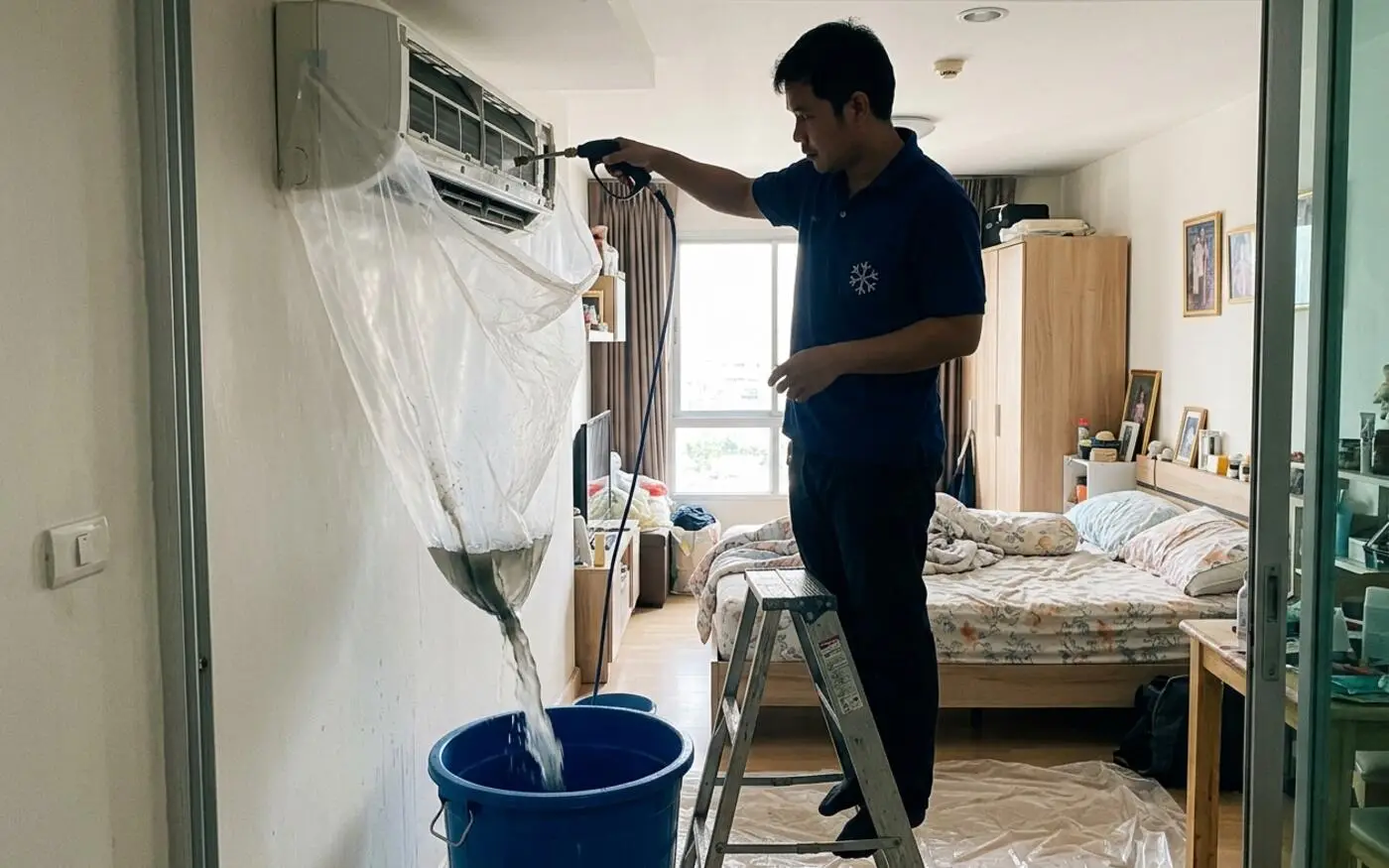
CoolRova's standard clean washes the filter, evaporator coil and blower wheel in place inside a sealed wash bag with coil cleaner and a low-pressure rinse, where the bag is there to channel runoff to a drain rather than over the unit's electrics.
Safety for the household: ventilation, pets, re-entry, residue, mixing
You do not need to be anxious about a professional coil wash, but sensible habits cost nothing.
- Ventilate. Open windows and doors in the room during the job and afterwards. The American Lung Association advises keeping the area well ventilated when using cleaning products and avoiding small enclosed spaces. The EPA's page on volatile organic compounds and indoor air quality notes that many cleaning and disinfecting products contain organic solvents, that concentrations of many VOCs are consistently higher indoors, that levels can stay elevated long after the activity, and that increasing ventilation and following label precautions are the practical steps.
- Keep pets, children and sensitive people out. That means the room being worked in, not just the unit. Pets and anyone with asthma or a lung condition may react to fumes that a healthy adult barely notices. Take pet bowls and baby items out beforehand.
- Re-entry. Do not walk back in and run the unit hard at once. Ask the cleaner what the product's label or safety data sheet says about ventilation time, and let the room air first.
- Residue. A properly rinsed coil leaves little. If the room smells strongly of product, or the unit drips foamy or slippery water, the rinse was not thorough.
- Never mix products. Do not add your own bleach, vinegar or cleaner to what the technician uses, or spray something into the unit afterwards. The American Lung Association states that bleach should never be combined with cleaners containing ammonia, and the CDC report above shows what bleach plus an acid can do.
- People with asthma or lung conditions. Be in another part of the home during the work, and say so when booking.
- If something goes wrong. The NHS says a chemical on the skin or in the eyes needs immediate first aid: remove contaminated clothing if possible, brush off dry chemical, and run cool or lukewarm water over the area for about an hour, applying nothing to it, then get medical help (see the NHS page on acid and chemical burns). In Thailand the Ramathibodi Poison Center lists a 24-hour hotline, 1367, for advice on chemical exposure. Keep the product name handy.
Fumes and smells after a chemical wash: normal versus not
| What you notice | Usually fine | Act on it |
|---|---|---|
| A mild soapy or clean smell for a short time when the unit starts | Yes, as residual moisture dries and the room airs | Open windows, run the fan |
| The old musty note still present | Not a chemical issue; the film was not fully removed | Ask for a re-check; a deep wash may be needed |
| A sharp, stinging or chlorine-like smell | No | Switch off, ventilate, leave the room, ask what was used |
| Headache, nausea, dizziness, watering eyes or throat irritation after the job | No | Fresh air; the EPA lists these among symptoms of VOC exposure; see a doctor if they persist |
| Foam or slippery water dripping from the unit hours later | No | The rinse and drain flush were incomplete; call the cleaner |
| Wheezing or breathlessness in someone with asthma | No | Follow their action plan and seek medical advice |
Anyone with persistent symptoms, asthma attacks or a weakened immune system should see a doctor. Do not assume a chemical smell is harmless because it is "just cleaner".
What to ask your cleaner about the products they use
You are entitled to plain answers, and a reputable technician will give them without fuss. Useful questions:
- What product are you using on the coil, and can I see the label or safety data sheet? A safety data sheet is the standard document that lists a product's hazards, handling and first aid, and a reputable supplier will have one.
- Is it acid-based, bleach-based or alkaline? Is it biodegradable?
- How is it rinsed, and how do you know it is gone? The answer should include low-pressure rinsing until the runoff is clear.
- How do you protect the motor, board and sensors?
- Will you apply an anti-mould treatment, what is in it and what does it add? If the answer is a promise of months of protection, be cautious.
- Will you show me before and after photos? Evidence beats assurances; our guide to how to tell an AC was cleaned properly lists what to check.
- Do I need to leave the room, and for how long?
When to call a professional
Unless the unit is lightly soiled and you are comfortable with it, leave chemical work to someone trained. Hardware-store coil cleaners vary widely in strength. Bryant recommends a specialised no-rinse foaming coil cleaner applied by a professional; products of that kind are designed to drain away with the unit's condensate, which is a different protocol from the wash-bag rinse used in a standard clean, so follow the label of whatever you use. Call a professional if:
- the blower wheel or coil is visibly black or the smell has persisted for months;
- there is any sign of corrosion, a refrigerant leak or oily residue on the fins;
- someone in the home has asthma, an immune condition, or is a baby or elderly;
- the cleaner is proposing acid, bleach or a product they cannot name;
- you have already tried a store-bought spray and the smell returned.
CoolRova's standard clean starts from ฿690 per unit and the deep chemical wash from ฿1,290 per unit, 60 to 90 minutes each, with a photo report so you can see the result. Full pricing, including the year packages, is on the pricing page. Ask us which product is going on your coil: reach us on WhatsApp or through the quote form on the contact page. If a cleaned unit is not cold within 30 days, we come back free under our cool-again guarantee.
Sources and further reading
- CDC, Biofilms: microbial life on surfaces (Emerging Infectious Diseases)
- U.S. EPA, should I use bleach to clean up mold?
- NIOSH Pocket Guide, sodium hydroxide
- NIOSH Pocket Guide, hydrogen fluoride
- Bryant, how to clean an evaporator coil
- American Lung Association, cleaning supplies and household chemicals
- U.S. EPA, Safer Choice
- U.S. EPA, volatile organic compounds and indoor air quality
- U.S. EPA, should you have the air ducts in your home cleaned?
- CDC MMWR, chlorine gas toxicity from mixing bleach with other cleaning products
- California Department of Public Health via CDC Stacks, disinfectants and work-related asthma: information for employers
- PMC, disinfectant efficacy against bacterial biofilms
- NHS, acid and chemical burns
- Ramathibodi Poison Center, contact
Frequently asked questions
Is AC coil cleaner safe for my family?
Used correctly, with the room ventilated, the coil rinsed and the unit left to air before you re-enter, coil cleaning is a routine job. The risk comes from strong products, from mixing chemicals and from poor ventilation. Ask which product is used, keep pets and children out during the work, and treat stinging fumes or coughing as a reason to open windows and stop.
What chemical is used to wash an air conditioner?
There is no single chemical. Most professional coil washes use a foaming cleaner, often alkaline and biodegradable, that loosens grease and organic dirt. Some products are enzyme-based, some are acid-based brighteners, and some jobs add an antimicrobial or anti-mould treatment at the end. Bleach and strong acids are best avoided on indoor coils.
Can coil cleaner damage the aluminium fins?
Yes, if the product is wrong or left on too long. Bryant warns that vinegar, bleach and standard household cleaners can corrode aluminium fins and copper tubing, which may lead to refrigerant leaks. Using a coil-specific cleaner at the right dilution and rinsing it off properly protects the metal.
What is an anti-mould treatment for an air conditioner?
It is an antimicrobial product applied to the cleaned coil and surrounding parts to slow the regrowth of bacteria and mould. It does not replace cleaning, because biofilm must be removed first, and it does not stop moisture from returning, so growth can restart. Regular cleaning and drying the coil after use do the most to keep a unit clean.
Is it normal for my AC to smell of chemicals after a wash?
A mild clean or soapy odour that fades within a short time as the unit runs and the room airs is common. A sharp, stinging or chlorine-like smell, headaches, coughing or watering eyes are not normal. Switch the unit off, open windows, leave the room and ask the cleaner what was used. If symptoms persist, see a doctor.
Need it handled professionally?
Get a fixed quote for your units in under 60 seconds.
Written by the CoolRova Team
We're Bangkok's documented AC crew — everything we write comes from real cleaning, repair and installation visits across condos, homes and short-stay rentals.
Get our Bangkok AC guides straight in Google — add CoolRova as a preferred source.