
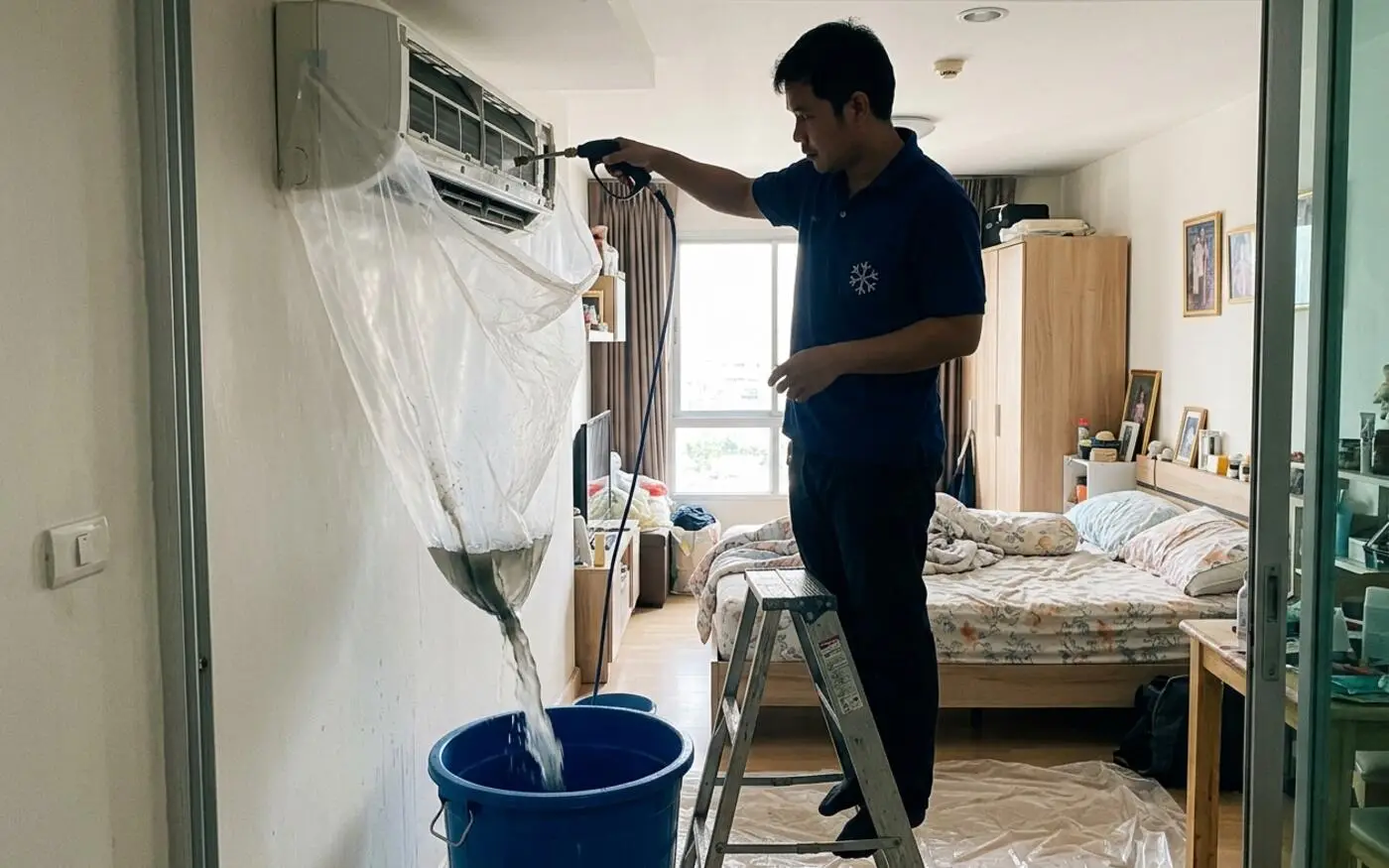
Every few months someone in Bangkok stands under a wall-mounted AC with a spray can, a towel and a rising sense of doubt. The search is usually the same: ล้างแอร์เอง, or in English, how to clean an air conditioner yourself. The motive is fair. A professional visit costs money, and a filter rinse feels like something any adult can manage.
The honest answer is that some of it is. This guide splits the work into three tiers so you can keep the jobs that are safe and cheap, think carefully about the one that is risky, and hand over the rest without feeling you have wasted a weekend. It is written for split-type units in Bangkok homes and condos, where the air is humid, the unit runs every night and the coil never really dries.
The three tiers of AC cleaning
The ENERGY STAR maintenance checklist draws the same line most manufacturers do. The homeowner's task is the air filter. The professional's tasks include cleaning the evaporator and condenser coils, checking refrigerant, cleaning and adjusting blower components, and inspecting the condensate drain. That split is a good starting map.
| Tier | Jobs | Who should do it | Main risk |
|---|---|---|---|
| 1. Routine | Filter rinse, louvre and cover wipe, drain outlet check, fan-dry habit | Anyone | Very low if the unit is off |
| 2. Careful DIY | In-place coil rinse with a wash bag and foam | A patient person with the right kit | Water in the electronics, bent fins, cleaner left in the unit |
| 3. Technician | Blower wheel removal, drain pan stripping, deep wash, anything electrical or refrigerant | A trained technician | Damage, injury or a leak if done wrongly |
Tier 1 costs almost nothing. Tier 2 saves a little and risks a lot. Tier 3 is where a unit stops being a cleaning job and becomes a small repair job if it goes wrong.
Tier 1: the jobs anyone should do
These four habits cost nothing and they are the reason some units stay fresh for a year between visits.
Rinse the filters
Switch the unit off at the remote and, ideally, at the wall isolator. Lift the front panel, slide the filters out, and vacuum the dust off the dry mesh first. Then rinse under lukewarm running water. A TCL Thailand filter-cleaning guide recommends soaking in warm water, optionally with a mild detergent, gently rubbing off stubborn dirt, and, importantly, letting the filter dry completely before it goes back so mould does not spread from a damp mesh.
How often? Midea Thailand advises cleaning the filter at least every two weeks, weekly in dusty rooms or with heavy use. Thailand's Department of Health suggests at least monthly for home units. For a bedroom unit that runs every night, every two weeks is a practical habit; the wider schedule is in how often to clean an AC in Bangkok.
Wipe the louvres and cover
The louvres are the angled flaps at the outlet, and the cover is the front plastic panel. Wipe both with a cloth wrung out in mild soapy water, then dry. Midea notes that strong chemicals can fade the casing paint. Move the flaps only as far as your manual allows, because forcing a motorised louvre by hand can damage it.
Check the drain outlet
Somewhere outside, a small pipe carries condensate away from the unit. When the AC is cooling, water should drip or run from the end freely. If it does not, or the end is sitting in a puddle, bent upwards or choked with algae, water will back up inside and leak into the room. Carrier's evaporator coil guide says a restricted drain line can generally be cleared with high-pressure water, using professional procedures and equipment, so your job here is to look and notice, not to push a wire up the pipe. If it is already dripping indoors, read why your AC leaks water from the indoor unit.
Make the fan-dry habit
Before switching off for the night, set the unit to fan-only for around five minutes, or use the dry or self-clean mode on your remote if it has one. This dries the surface of the coil so it spends fewer hours wet. It does not remove an established film, but it slows regrowth, and it is free.
Tier 2: an in-place coil rinse, and its real risks
The coil is the block of thin aluminium fins behind the filter, and it is where a musty smell usually starts. Some owners rinse it with a foaming spray or a wash bag kit, and a few get a good result. The kit works like this: a plastic bag hangs under the unit and funnels run-off into a bucket while you foam and rinse the coil.
If you decide to try it, this is the careful sequence.
- Photograph everything first. Take a photo of the open unit, the board and the wiring so you can compare afterwards.
- Isolate the power. Bryant's coil-cleaning guide says to shut power off at both the thermostat and the electrical panel; on a split, that means the breaker as well as the remote. Midea Thailand also says to unplug before cleaning.
- Protect the electronics. Cover the control board and motor area with plastic. Carrier warns to keep water away from insulation and electrical components.
- Remove loose dust first. A soft brush or a narrow vacuum nozzle, moving along the fins rather than across them. Midea cautions against pressing hard because the fins are thin.
- Foam, wait, rinse. Use a cleaner made for coils, follow the label for contact time (Midea mentions five to ten minutes), then rinse with low-pressure clean water until the run-off is clear. Bryant describes a no-rinse foam for central coils, but on a split most owners use a rinse-out product, and any product must be fully flushed according to its label.
- Check the drain. Make sure the bucket is catching water and the drain pan is not overflowing.
- Let it dry, then refit and test. Run fan-only first, then cooling, and watch for drips.
What goes wrong
- Water in the board. The control board and fan motor sit close to the coil. Water reaching them can cause faults that appear days later, when you have forgotten what you did.
- Bent fins. Carrier and Bryant both warn that pressure washers and aggressive brushing bend the fins, which blocks airflow. A bent coil cools worse than a dirty one.
- Wrong chemicals. Bryant says household products such as vinegar, bleach, ammonia and acidic cleaners can corrode a coil and cause refrigerant leaks. The longer-form explanation is in coil cleaner chemicals explained.
- Residue. Cleaner that is not rinsed out can stay in the fins and drain pan. If you can smell a chemical or perfume from the vent afterwards, it was not removed.
- A partial clean. This is the one people miss. The blower wheel, a long plastic drum behind the coil, collects the same film, and a rinse in place only wets the blades you can see. Researchers who swabbed the filter, coil, fan and air outlet of room air conditioners in 17 Japanese homes reported that the coil's humid conditions appeared to favour some bacterial genera, and they recommended periodic cleaning of internal components. The study did not measure health effects, but it shows why cleaning only the front of the unit leaves most of the surface alone.
If you read the list and feel uneasy, that is a sensible reaction. A tier 2 clean is optional, not a duty.
Tier 3: what needs removal and a technician
Some jobs need the unit apart, tools you may not own or training you may not have.
- Blower wheel removal. The wheel is usually fixed to the motor shaft and sits behind the coil. Removing it, washing it and refitting it so it spins true is standard for a technician and awkward for everyone else.
- Drain pan stripping. The pan sits under the coil and holds sludge that no front-on rinse reaches.
- Deep chemical wash. Foam, soak and pressure-wash of coil, wheel and pan, with the electronics bagged away from water.
- Electrical faults. Anything involving the board, capacitor, wiring or breaker.
- Refrigerant. Low cooling after a clean is sometimes a leak. Midea Thailand says plainly not to refill the gas yourself. CoolRova's refrigerant top-up starts with a pressure and leak test for that reason.
The US EPA's guidance on cleaning heating and cooling system components makes a point that applies to every tier. If a service provider does not clean all components of a contaminated system, the part that was missed can re-contaminate the rest. A partial DIY clean has the same logic: the unit looks cleaner and the reservoir remains.
Spray-can cleaners and self-cleaning AC features
Two products sit between tiers 1 and 2: the aerosol coil cleaner and the brand's own auto-clean mode.
Spray-can coil cleaners are foam or liquid sprayed over the front of the coil, usually followed by a rinse. They can lift loose, recent dirt. Their limits are structural. A can reaches the coil face but not the inside of the blower drum or the drain pan, the foam and dirty water have to go somewhere, and you need to follow the label exactly on whether the product is rinse-out or no-rinse. If you use one, treat the run-off, the board and the drain exactly as in tier 2.
Self-cleaning and auto-clean modes vary by brand, so read your manual to see what yours actually does. In general they dry the coil, run the fan or cycle the surface to shed water. That is useful and costs nothing, and it works on the same principle as the fan-dry habit. What they do not do is remove a film packed inside the wheel, flush the drain line or tell you whether the pan is full of sludge. Think of them as slowing regrowth, not as a cleaning service.
Safety first
Cleaning an AC is a small job with three kinds of hazard: electricity, chemicals and height. Add a fourth if mould is involved.
Electricity. Isolate the power at the breaker, not just the remote. Do not spray water towards the board, and do not work with wet hands near the wall socket. If you are not confident reaching behind the front cover, do the exterior and the filter and stop, which is also Midea Thailand's own advice.
Chemicals. Some strongly alkaline cleaners contain sodium hydroxide. The CDC's NIOSH pocket guide entry for sodium hydroxide lists irritation of the eyes, skin and mucous membranes, eye and skin burns, and says to prevent skin and eye contact. Whatever product you use, read the label, wear gloves and eye protection, and keep the room ventilated. The American Lung Association's guidance on cleaning supplies adds that you should never combine bleach with an ammonia-based cleaner and should ventilate when you use cleaning products.
Height. Indoor units sit high and outdoor units on a condo wall or balcony ledge are worse. Never lean over a railing to reach a condenser. If you cannot stand on the floor or a stable step to do it, the job belongs to someone with the equipment and the training. In a condo, check your building rules before anyone works on an external unit.
Mould (mold in US spelling). If you see black or dark growth on the louvres or blower, the US EPA's mould-cleanup guidance says a patch under about 10 square feet can usually be handled by the householder, but it also says not to run an HVAC system you know or suspect is contaminated, because it could spread mould through the building, and to consult a health professional before cleanup if you have health concerns. The EPA's protective equipment guidance lists gloves, an N-95 respirator and goggles without vent holes as the minimum for a small area. An N-95 filters particles, not chemical vapour, so it does not protect you from cleaner fumes. If anyone in the home has asthma or a weakened immune system, hand the job over. Persistent symptoms or asthma attacks should be seen by a doctor.
How DIY mistakes show up later
The trouble with a partial clean is that the evidence arrives weeks later.
| What you notice | Likely DIY cause |
|---|---|
| Water dripping from the indoor unit | Drain pan or line partly blocked by loosened debris, or a pan knocked out of level |
| New rattle or humming | Blower wheel disturbed or fan motor wetted |
| Weak cooling after cleaning | Bent fins, or a coil still blocked behind the front face |
| Smell returns within weeks | Film left inside the blower wheel and pan |
| Chemical or perfumed smell | Cleaner not fully rinsed out |
| Unit will not start | Water reached the board; switch off and call a technician |
Poor cooling after any clean has several possible causes, and a damaged coil is only one of them.
What a professional clean does that DIY cannot
A technician brings three things beyond skill: access, pressure control and testing.
CoolRova's standard clean washes the filter, evaporator coil and blower wheel in place inside a sealed wash bag with coil cleaner and a low-pressure rinse, flushes and tests the drain line, logs the supply-air temperature before and after, and gives you a before-and-after photo report. Our deep chemical wash goes further: the blower wheel comes out, the louvres and drain pan are stripped, the coil is foamed with a biodegradable cleaner and soaked, everything is pressure-washed, and an antibacterial, anti-mould treatment is applied. It takes 60 to 90 minutes per unit and ends with a photo report. Which one a unit needs depends mostly on how black the blower wheel is when the cover comes off.
The extra value is not mystique. It is a sealed bag that keeps water off the wall, a controlled rinse, a drain that is tested rather than assumed, a number on the supply-air temperature and a photograph you can check. If you want to judge any clean, yours or someone else's, use how to tell your AC was cleaned properly. The coil work itself is explained in more depth in the evaporator coil cleaning guide.
A cost-benefit table
| Option | Time | Tools | Risk | Result |
|---|---|---|---|---|
| Tier 1 routine | 10 to 20 minutes | Vacuum, tap, cloth | Very low | Better airflow and a slower build-up; does not remove biofilm |
| Tier 2 coil rinse | Around an hour, plus drying | Wash bag, bucket, foam, plastic sheeting, PPE | Moderate: water, fins, residue | Cleaner coil face; wheel and pan untouched |
| Standard clean by CoolRova | Booked visit | Supplied | Low, with a wash bag and guarantee | Coil, wheel and drain washed; from ฿690 per unit |
| Deep chemical wash by CoolRova | 60 to 90 minutes per unit | Supplied | Low | Wheel removed, pan stripped, anti-mould treatment; from ฿1,290 per unit |
The DIY times are estimates and vary by unit. The point is not that one row wins. Tier 1 should be yours always. Tier 2 saves less than it seems once you count the kit, the time and the risk. A professional visit is worth the money when you have a smell, a drip or a unit you have not had cleaned for more than a year. Current prices are in what AC cleaning costs in Bangkok.
What Thai manufacturer and health guidance says
It helps to see where Thai sources draw the line.
- Midea Thailand suggests filters at least every two weeks, a gentle brush or vacuum on the coil, a foam spray and rinse every two to three months for older grime, and a professional clean about every six months. It also says that if you are not comfortable taking parts apart you should clean only the exterior and the filter, and not to refill gas yourself.
- TCL Thailand pairs regular DIY filter cleaning with an annual professional inspection of items such as refrigerant levels and electrical connections, and notes that improper cleaning can damage the unit.
- The Department of Health says to wash the filter with soapy water at least monthly and to do a full-system clean at least once a year, around every six months with daily use. If a smell persists after washing the filter, it advises calling a technician for a full-system clean.
- EGAT lists filter cleaning every month and a major clean at least twice a year in its energy-saving advice for air conditioners.
The sources do differ. Midea suggests foam sprays and diluted bleach on the drain pan for owners comfortable with it; Bryant warns against household chemicals on the coil. That disagreement is a reason to read your own manual and to be cautious, not to treat any single page as the last word. All of them agree on the same boundary: the filter is yours, and the full-system clean is a technician's.
When to call a professional
Skip tier 2 and book a technician if any of these apply:
- The smell comes back after you have cleaned the filter.
- You can see dark growth on the louvres, blower wheel or inside the outlet.
- Water is dripping from the indoor unit.
- Airflow is weak with a clean filter, or the unit freezes up.
- The unit has not been cleaned for a year or more.
- Anyone in the home has asthma, allergies or a weakened immune system, and the unit is in their bedroom. The World Health Organization's review of dampness and mould links damp indoor environments with respiratory symptoms, allergies and asthma, and says preventing persistent dampness and microbial growth is the most important means of avoiding those effects.
- You are not comfortable with the power, the ladder or the chemicals. That is reason enough.
Do your tier 1 jobs every fortnight and leave the rest to someone with a wash bag, a drain test and a photograph. When you want a clean you can check, CoolRova's AC cleaning service starts at ฿690 per unit and comes with a 30-day cool-again guarantee. You can ask a question or request a quote through WhatsApp or the quote form, and we will tell you honestly whether your unit needs a standard clean or a deep wash.
Sources and further reading
- ENERGY STAR maintenance checklist
- Carrier: how to clean evaporator coils
- Bryant: how to clean an evaporator coil
- US EPA: mould cleanup in your home
- US EPA: should you have the air ducts in your home cleaned?
- CDC NIOSH: sodium hydroxide pocket guide
- American Lung Association: cleaning supplies and household chemicals
- Thailand Department of Health: air-conditioner cleaning advice
Frequently asked questions
Can I clean my own air conditioner at home?
You can safely rinse the filters, wipe the louvres and cover, check that the drain outlet runs freely and dry the coil with a fan-only cycle. Cleaning the coil in place with foam is possible but carries a risk of water damage and bent fins. Removing the blower wheel, stripping the drain pan or touching refrigerant and wiring should be left to a technician.
Does AC cleaning spray work?
A foaming coil spray can lift loose dirt from the front face of the coil if it is rinsed out properly. It cannot reach the film packed inside the blower wheel or the drain pan, and the run-off has to be caught somewhere. Treat it as a light top-up between professional cleans, not a replacement.
Is it safe to use a pressure washer on an air conditioner?
No. Carrier and Bryant both warn that high-pressure water bends the thin aluminium coil fins and restricts airflow, and Carrier adds that water should be kept away from electrical components. A hand spray bottle or a gentle low-pressure rinse is the most that should touch an indoor coil.
How often should I clean the filter myself?
Midea Thailand suggests at least every two weeks, or weekly in dusty rooms or heavy use. Thailand's Department of Health suggests at least monthly. In Bangkok, with daily use and city dust, every two weeks is a practical habit.
Why does my AC still smell after I washed the filter?
The musty smell usually comes from a biofilm on the wet coil and blower wheel behind the filter, so a clean filter does not remove it. Thailand's Department of Health advises calling a technician for a full-system clean if the smell persists after the filter is washed.
What should I never do when cleaning my AC?
Never clean with the power on, never use a high-pressure washer or hard brush on the fins, never mix bleach with ammonia-based products, and never top up refrigerant yourself. Do not run a unit you know or suspect is contaminated with mould until it has been cleaned.
Need it handled professionally?
Get a fixed quote for your units in under 60 seconds.
Written by the CoolRova Team
We're Bangkok's documented AC crew — everything we write comes from real cleaning, repair and installation visits across condos, homes and short-stay rentals.
Get our Bangkok AC guides straight in Google — add CoolRova as a preferred source.