
Look up in a Bangkok office, café or condo living room and you may see a square white panel set into the ceiling with slots along its edges. That is a ceiling cassette. It cools just like a wall-mounted split, but almost everything that matters is above the panel, out of sight, which is exactly why cassettes are cleaned late, or not at all, until a ceiling tile stains or the room stops feeling cold.
This guide explains how a cassette is built, what collects inside it, why the drain pump is the part that deserves respect, what a proper clean involves step by step, and how often to book one. It is written for homeowners with a cassette in the living room and for managers of shops and offices with a dozen. If you run a larger site, our companion piece on office air conditioning maintenance in Bangkok covers the contract side.
What a cassette unit is, and how it differs from a wall split
A cassette is the indoor half of a split or VRF system, shaped to sit inside the ceiling void instead of on a wall. Daikin's brochure for its four-way cassette range describes four-way air discharge from a unit only 246 mm high in the smaller sizes and 288 mm in the larger ones, designed to fit into tight ceiling spaces. Mitsubishi Electric lists a slimline 290 mm body on a two-way cassette, and Hitachi says its compact four-way unit fits a 600 x 600 mm false ceiling. These are examples from three brands, not a Bangkok market survey, but they show the idea: the machine lives in the void, and the room sees only the panel.
Inside, the working parts are the same as in any split indoor unit:
- Filter and grille. Room air is drawn up through the central grille, past a filter, and into the unit.
- Evaporator coil. The cold, wet heat exchanger where the air gives up heat and moisture. Our guide to evaporator coil cleaning explains why this surface fouls.
- Fan. A motor-driven fan pushes the cooled air back out through the discharge slots around the panel.
- Drain pan. Condensate from the coil collects here.
- Drain pump and float switch. Unlike most wall splits, which let water run downhill, a cassette often has to lift its condensate up and away. More on that below.
Cassettes suit shops, restaurants, clinics, offices and larger homes because they distribute air from the middle of a room and keep walls clear. Wikipedia's neutral summary describes variable refrigerant flow as refrigerant conditioned by one or more condensing units and circulated to multiple indoor units, and notes that because VRF does without air handlers and large ducts it can reduce the height needed above a dropped ceiling, which is one reason it is common in office buildings. If your building is VRF, your cassettes are likely part of that system, and the cleaning logic below still applies to each indoor unit.
Why cassettes get skipped
Three things conspire against a cassette.
Out of sight. A wall unit shows its dust and its dripping. A cassette shows a clean-looking panel while the coil above it quietly fouls. Nobody sees the problem until it reaches the room.
Awkward access. Cleaning needs a ladder or scaffold, protection for floors and furniture, and often the removal of ceiling tiles or an access hatch. In a restaurant or clinic, that means working around customers.
Shared responsibility. In rented spaces, tenant and landlord can each assume the other looks after ceiling equipment.
The result is that cassettes tend to be maintained by event (a leak, a smell, a warm room) rather than by calendar.
What builds up inside a cassette, and where
The same stages that foul any coil apply here: dust sticks to the cold, wet fins, forms a mat and then a biofilm. Our pillar guide to the evaporator coil covers the mechanism. For cassettes, four locations matter.
The filter and grille. In a shop or office, the filter catches lint, paper dust and skin flakes; in a restaurant it also catches the sticky haze of cooking. Daikin's brochure describes a washable filter on its range, which is useful: it means the owner can rinse it between professional visits, if the manual shows how.
The coil. A fouled coil restricts airflow and insulates the fins. ENERGY STAR's maintenance checklist says that dirty coils reduce the system's ability to cool and cause it to run longer, which raises energy costs and shortens the life of the equipment. That page is written for household central systems, but a cassette coil is a coil.
The fan. The fan is the part most easily missed, because it is behind the coil and only visible when the unit is open. Dirt on the blades throws the fan off balance and cuts airflow. We cover the equivalent problem in wall units in AC blower wheel cleaning.
The drain pan and line. This is the dark, damp low point where everything the coil sheds ends up. The US EPA's guidance for schools and commercial buildings lists condensate drain pans inside air handling units among the places where hidden mould can grow, and advises keeping HVAC drip pans clean, flowing properly and unobstructed. It also recommends regular building and HVAC inspections and maintenance as scheduled. A cassette is not an air handling unit in the strict sense, but it has the same wet pan, and the principle carries over.
Why this matters for health in a workplace
Cleaning a cassette is a hygiene measure, not a medical one, and the evidence needs to be stated carefully.
WHO's guidelines on dampness and mould identify increased prevalence of respiratory symptoms, allergies and asthma as major effects of damp indoor environments and name prevention or minimisation of persistent dampness and microbial growth as the main way to avoid harm. A drain pan with standing water is persistent dampness in a very small space.
For offices specifically, there is field evidence of an association with maintenance. A summary of three analyses of the US EPA's BASE study, covering 100 large US office buildings, linked more occupant symptoms to a lack of scheduled cleaning of air-conditioning drain pans and cooling coils, and to poor coil condition. The authors say the findings need replication and suggest preventive actions rather than prove causes. In other words: an association, in US buildings, not proof that your cassette is making anyone ill. Our guide to sick building syndrome and air conditioning in Bangkok offices covers how to separate air-conditioning causes from everything else.
If anyone in the space has asthma, recurring respiratory symptoms or a weakened immune system, a clean unit is good housekeeping, but a doctor is the right person for the symptoms.
The drain pump and float switch: the part that deserves respect
A wall-mounted split drains by gravity: the pan tilts, the hose runs downhill and water leaves through the wall. A cassette sits in the ceiling, and the drain pipe may need to rise before it falls, run over a long distance or reach a riser in a corridor. So many cassettes carry a small built-in pump.
Manufacturers publish how high the pump can lift, and the figures differ:
| Brand and series | Published lift | Reference point stated |
|---|---|---|
| Daikin FCRN-A four-way cassette | 700 mm | Up to 700 mm higher than the drain pipe outlet |
| Mitsubishi Electric PLFY two-way cassette | 583 mm | Up to 583 mm from the ceiling's surface |
| Hitachi compact four-way cassette | 850 mm | Standard drain pump with 850 mm lift |
These figures come from the manufacturers' own brochures and product pages (Daikin, Mitsubishi Electric, Hitachi). They are for specific series, the reference point is worded differently by each brand, and your own model may differ, so read the installation manual for the lift allowed on your unit. The point for owners is not the number but the principle: the pump can only lift so far, and a drain line routed beyond that limit will not clear.
Daikin's brochure also notes that a safety float is incorporated to monitor water level. That is the float switch: a small buoyant sensor in the pan. If the water rises too high, it tells the control board to stop the unit or raise an alarm instead of letting the pan overflow.
Why does this assembly matter so much?
- It has moving parts, wet. A pump motor, impeller and float sit in a pan that is damp all the time. Sludge from the coil can clog the pump inlet or jam the float.
- It fails quietly. When a wall unit's drain blocks, it drips from the unit, which is annoying but obvious. In a cassette the water backs up into the pan, and the first sign may be a stain on the tile or a drip at the panel.
- The damage is expensive. Water in a ceiling void soaks insulation and tiles. EPA's table for responding to clean water damage lists ceiling tiles for discard and replace, and the same document recommends cleaning and drying wet or damp spots within 48 hours.
We want to be careful here: pumps and floats do not fail at some known rate, and we are not claiming one in ten cassettes will leak. The honest statement is that in a cassette, the pump, float and line are the components whose failure produces the most visible damage, so a proper clean always includes testing them. For the full list of causes of a dripping indoor unit, see our guide to why an air conditioner drips water.
Step-by-step: how a cassette is cleaned properly
Methods vary by brand and model, so a technician follows the unit's own service manual. In general, a proper clean follows this sequence.
- Survey and photograph. The technician notes the model, the ceiling height and the access route, photographs the grille, the coil and the pan before touching anything, and checks whether tiles or an access hatch must be opened.
- Log the starting condition. Supply-air temperature and the state of the drain are recorded, so there is something to compare against at the end.
- Protect the room. Floors, desks, counters or beds under the unit are covered. In a shop or restaurant, the work area is closed off.
- Isolate the power. The unit is switched off at the breaker or isolator, not only on the remote. The control box sits on the same unit as the pan, the fan motor and the pump.
- Open the panel and remove the filter. The panel is hung or released, following the manufacturer's method. Daikin's brochure notes a panel-hook mechanism that lets the installer work with both hands, which is a reminder that these units are designed to be opened and serviced.
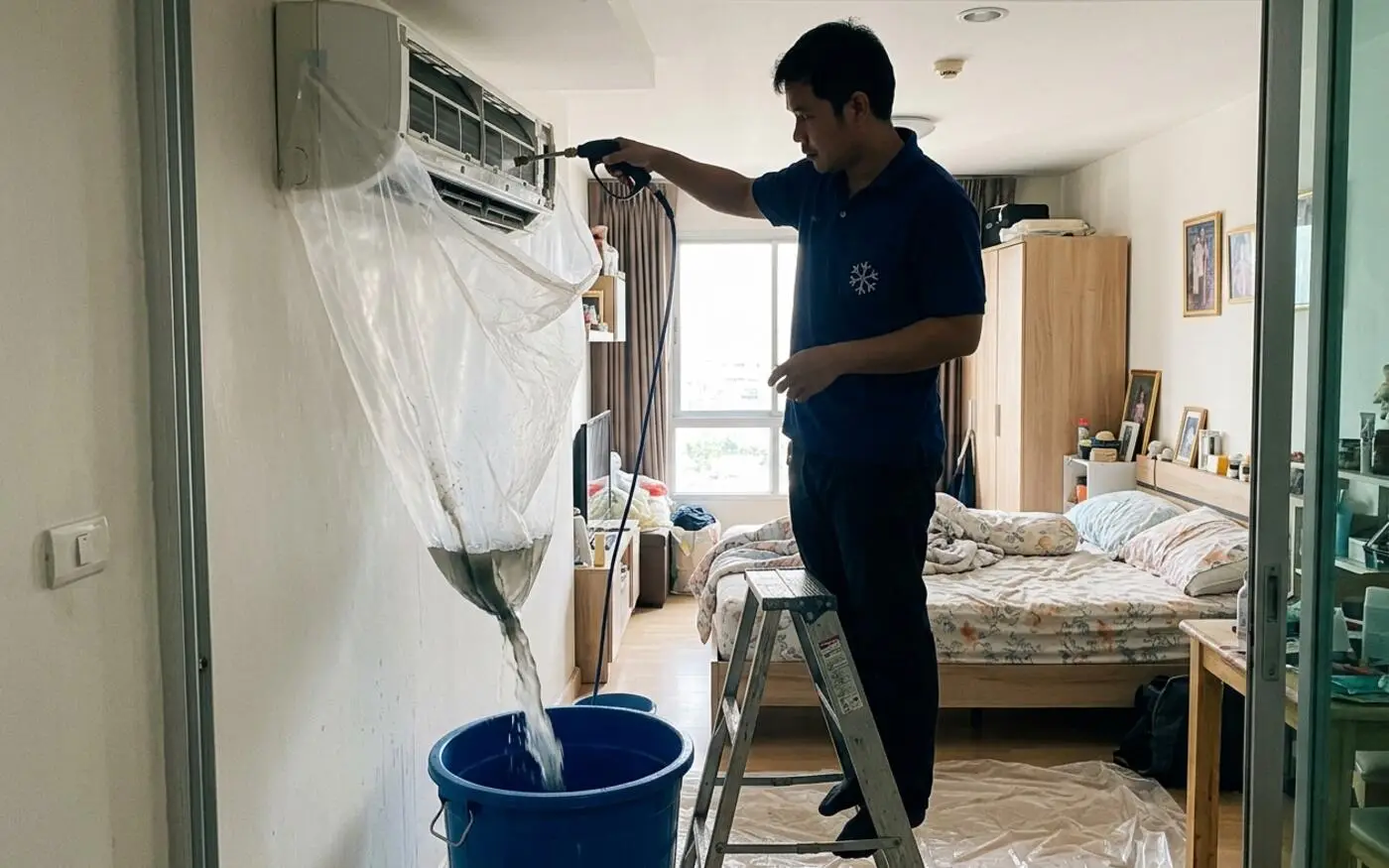
- Protect the electronics and set the catch. The control box and motor are covered, and a catch sheet or tray is positioned so wash water goes into a bucket, not through the ceiling void or onto the floor.
- Apply cleaner to the coil and dwell. Coil cleaner is applied evenly and left for the time its label specifies.
- Rinse at low pressure. Water carries the loosened film out of the fins. Pressure that flattens fins is not cleaning.
- Clean the fan and the pan. Depending on how fouled they are, the fan and the pan may be wiped and rinsed in place or, for heavy build-up, removed.
- Flush the drain and test the pump and float. Clean water is poured into the pan; the pump should lift it and discharge it, and the float should respond when it is lifted. The drain line must flow freely to its outlet.
- Rinse the filter and panel, reassemble. The filter is washed and dried, the panel is wiped, and everything is refitted.
- Run and measure. The unit runs; supply-air temperature is measured again and an after photo is taken.
If a coil is badly fouled, the fan is heavily coated or the pan is full of sludge, a lighter wash will not shift it, and a heavier method is used. CoolRova's deep chemical wash for wall units, for example, removes the blower wheel and strips the drain pan. For cassettes, the survey decides what is needed.
How often to clean a cassette
There is no single interval, because use varies so much. A useful starting point is Thailand's own guidance. The Department of Alternative Energy Development and Efficiency (DEDE), in an EGAT-published energy-saving campaign, advised cleaning air-conditioner filters every one to two months, with a major cleaning every six months, and said that cleaning can reduce electricity costs by up to 10 percent. Those are the agency's figures for air conditioners in general, in a 2023 campaign, and your own savings will depend on the unit and how dirty it was.
On top of that baseline, adjust for the space:
| Setting | Filter rinse | Professional clean (typical starting point) | Why |
|---|---|---|---|
| Home living room, used evenings and weekends | Every 1–2 months | About once or twice a year | Lower running hours, less dust |
| Quiet office, weekday hours | Every 1–2 months | About every 6 months | Steady daytime use; paper and fibre dust |
| Retail shop, open all day | Monthly | Every 3–6 months | Door traffic brings dust in; long running hours |
| Café or restaurant | Monthly or more often | Every 3 months, then reviewed | Cooking haze and humidity coat filters and coils faster |
| Clinic, salon or gym | Monthly | Every 3–6 months | Heavy occupancy and humidity |
The professional intervals are starting points that CoolRova's surveyors would refine after seeing the units, not a rule. For the general picture in Bangkok, see how often to clean your air conditioner. If a unit is in a space where cooking oil is airborne, expect to adjust the schedule down; a survey of the actual fouling is better than a guess.
Signs your cassette needs attention
Cassettes give hints before they fail. Look for:
- Stains or dampness on the ceiling tile next to or beneath the panel. Treat it as urgent; turn the unit off.
- Water dripping at the panel slots or a wet grille.
- A musty smell when the unit starts, which suggests a fouled coil or pan.
- Weak or uneven airflow from the four sides, or a room that cannot hold its set temperature.
- Gurgling from the ceiling void, or a pump that runs constantly.
- Dust or dark deposits on the louvres or panel edges.
- Ice on the discharge slots, which needs a technician.
- An error code or alarm on the controller. Codes vary by brand and series, so check your manual.
The first two signs carry real risk to the building, so do not wait for the next scheduled visit.
Homes, shops and restaurants
Homes. The main risks are unnoticed leaks and a smell nobody can place. Rinse the filter, keep the grille clear and book a professional clean once or twice a year.
Shops and offices. Long running hours and public footfall bring dust in. Several cassettes usually share a ceiling, so one failing pump can stain a whole row of tiles. Schedule cleans before opening or after closing and keep a record per unit.
Restaurants, cafés, clinics and gyms. Heat, steam, cooking haze, humidity and occupancy mean more fouling per hour, so these spaces need shorter intervals, and the drain matters most where a ceiling leak onto a food service floor or a treatment room is least tolerable.
Access, protection and after-hours work
Most of the extra effort in cassette work is logistics:
- Access. A stable ladder, platform or scaffold depending on ceiling height, and a hatch or lift-out tiles.
- Protection. Floors and furniture covered, wash water caught, ceiling tiles handled carefully.
- Timing. In a trading space, the clean is done before opening or after closing, so customers never meet a ladder. CoolRova offers after-hours service windows for cassette, ducted and VRF work for this reason.
- Order of work. On a multi-unit site, one zone at a time, so rooms are back in use quickly.
- Records. Per-unit logs, with readings and photographs, mean the next visit starts from facts.
Condominium and building rules may also affect when work can be done, who must be notified and where wash water and equipment may go, so check with building management before booking.
What cassette cleaning costs at CoolRova
CoolRova's cassette, ducted and VRF service starts from ฿1,590 per unit, and the first step is a free site survey. Our wall-unit prices are different: a standard clean for a wall split starts from ฿690 per unit, and the deep chemical wash from ฿1,290 per unit. Cassette work is priced separately from wall units because it involves ceiling access, protection of the room below and extra components such as the pump and float. For sites with more than 8 units, or any cassette, ducted or VRF system, CoolRova gives a free survey and a fixed quote on the spot.
What changes the price at any provider is worth knowing so you can compare quotes fairly:
- ceiling height and access;
- how many units, and how fouled they are;
- whether work must be done out of hours;
- whether the pump and float need repair, which is quoted separately from cleaning.
For regular site work, ask about a programme: CoolRova's commercial maintenance includes a written schedule per unit, a fixed per-visit price and one invoice across branches. See /commercial and our cassette, ducted and VRF service.
What to ask a technician before they open the ceiling
- Do you wash the coil and the fan, or only the grille and filter?
- How will you catch the wash water and protect the floor?
- Do you test the pump and float switch, and will you show me?
- Do you flush the drain line to its outlet and measure cooling before and after?
- Will I get photographs and a record per unit?
- If a pump or float is worn, is that a separate quote?
- Can you work before opening or after closing?
Photographs and per-unit readings are the evidence to look for.
When to call a professional
Rinsing the washable filter, if your manual shows how, is a task for the owner. Everything above the grille is a job for a technician, because the unit contains live electrical parts and the work happens at height. Call someone if:
- water is staining the ceiling or dripping from the panel;
- the unit smells musty a few days after a filter rinse;
- cooling is weak, or the unit runs constantly without reaching temperature;
- you hear a pump running continuously or gurgling in the ceiling;
- there is ice on the louvres;
- you have not had the unit cleaned for more than a year, or more than six months in a shop or restaurant.
If symptoms such as persistent cough, wheeze or breathlessness appear to flare when the air conditioning runs, see a doctor as well as booking a clean.
Sources and further reading
- Daikin: ceiling-mounted cassette four-way FCRN-A series brochure
- Mitsubishi Electric Australia: PLFY two-way ceiling cassette
- Hitachi: four-way cassette compact type
- US EPA: mould remediation in schools and commercial buildings
- US EPA: a brief guide to mould, moisture and your home
- WHO guidelines for indoor air quality: dampness and mould
- Mendell et al.: indoor environmental risk factors for occupant symptoms in 100 US office buildings (BASE study)
- ENERGY STAR: heating and cooling maintenance checklist
- EGAT: 2023 energy-saving campaign with DEDE advice on air conditioner cleaning
- Wikipedia: variable refrigerant flow
If you have cassettes that nobody has opened in a while, the simplest first step is a survey. Message CoolRova on WhatsApp or use the quote form at /contact, and we will visit, tag and photograph each unit, and give you a fixed quote for cleaning them, in the hours that suit your business.
Frequently asked questions
What is a cassette air conditioner?
It is an indoor unit recessed into the ceiling, with only a square panel and grille visible from the room. Most discharge air in four directions, and the coil, fan and drain pan sit in the void above the ceiling. It connects to an outdoor unit like any split system, or to a VRF outdoor unit that serves several indoor units.
How often should a ceiling cassette be cleaned in Bangkok?
Filters should be rinsed every one to two months, a frequency Thailand's DEDE suggests for air conditioners generally, and DEDE suggests a major clean every six months, which for a coil, fan and drain means a professional visit. Shops, restaurants and rooms with heavy foot traffic usually need shorter intervals, and a site survey can set a schedule per unit.
Why is my ceiling cassette dripping water?
The usual cause is condensate that cannot leave: a clogged drain line, a drain pan with sludge, or a pump or float switch that has stopped working. Switch the unit off, protect the area under it and have it checked, because a cassette that keeps running can overflow onto ceiling tiles. See our guide to dripping indoor units for the full list of causes.
Can I clean a cassette air conditioner myself?
You can safely remove and rinse the washable filter behind the grille if your manual shows how. The coil, fan, pan and pump sit above the ceiling beside live electrical parts, so that work should be done by a technician with ladders, protection and a way to catch the wash water.
How much does cassette air conditioner cleaning cost in Bangkok?
CoolRova's cassette, ducted and VRF service starts from ฿1,590 per unit, with a free site survey first. Sites with more than 8 units, or any cassette, ducted or VRF system, get a free survey and a fixed quote on the spot.
Need it handled professionally?
Get a fixed quote for your units in under 60 seconds.
Written by the CoolRova Team
We're Bangkok's documented AC crew — everything we write comes from real cleaning, repair and installation visits across condos, homes and short-stay rentals.
Get our Bangkok AC guides straight in Google — add CoolRova as a preferred source.