
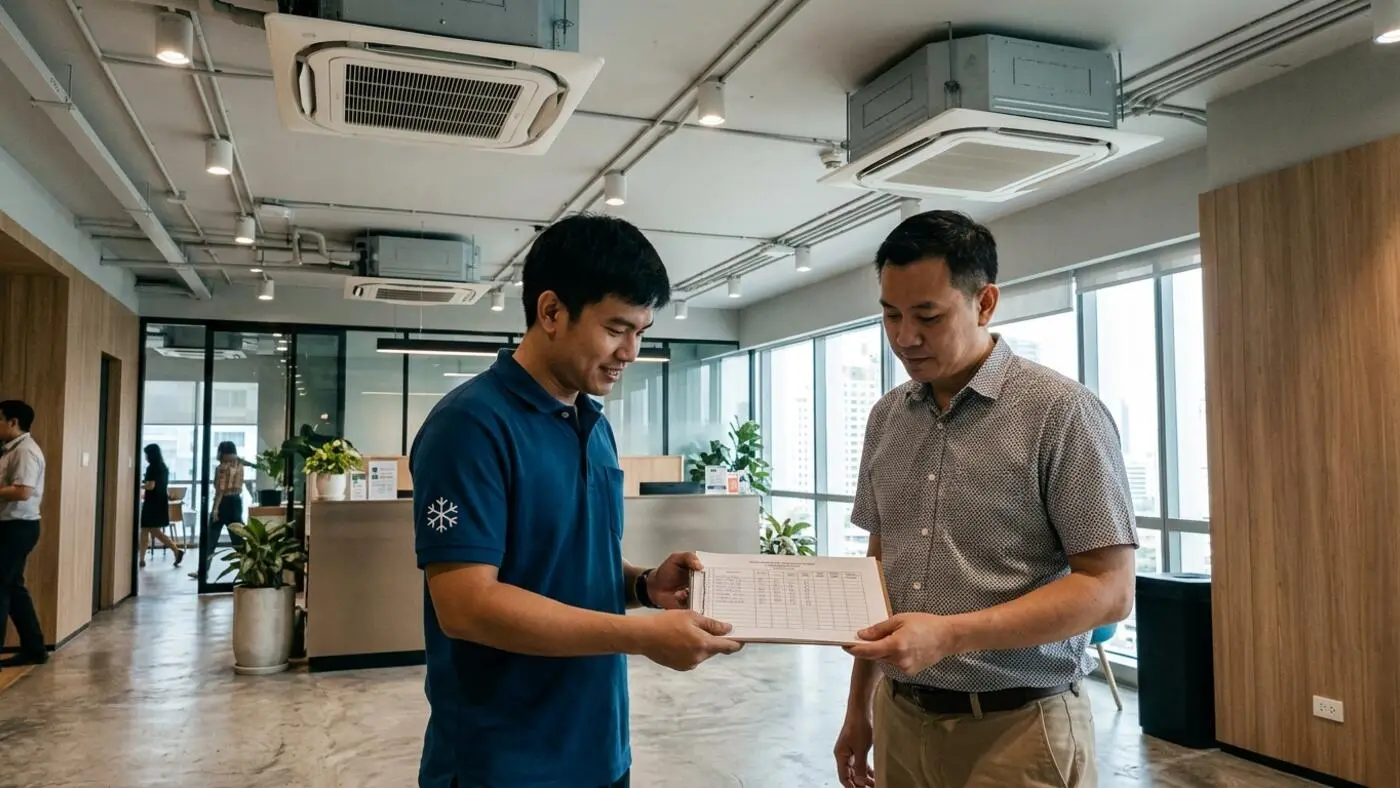
In most offices, air conditioning is only discussed when it is not working. A meeting room is too warm, a row of desks is dripping, someone complains of headaches, and a call goes out. That is reactive maintenance, and it is how many buildings run. This guide is about the alternative: a planned programme that treats the air conditioning as equipment with a service life, an energy bill and an effect on the people sitting under it.
It is written for facility managers, office managers and business owners in Bangkok who are setting up a maintenance arrangement or comparing providers. It covers what preventive maintenance includes for each system type, how often, what a visit should check, what records to keep, what belongs in a contract and how CoolRova's commercial programme is set up. It does not give legal advice, and it avoids invented savings numbers: where a figure appears, it is attributed to a source you can open.
Why office air conditioning maintenance pays
The case rests on four things: failures, energy, comfort and air quality.
Failures cost more than prevention. The US Department of Energy's Federal Energy Management Program published an operations and maintenance guide in December 2002 that describes reactive maintenance as allowing equipment to run to failure, and lists increased cost from unplanned downtime, overtime labour and possible secondary damage among its disadvantages. The same O&M best practices guide, written by Pacific Northwest National Laboratory, says studies indicate preventive maintenance can save as much as 12 to 18 percent on average over a purely reactive programme, and cites a 1999 estimate that O&M programmes targeting energy efficiency can save 5 to 20 percent on energy bills without significant capital investment. Those are estimates for US federal facilities, more than twenty years old, and the guide does not break them down by building or equipment type. Treat them as evidence of direction, not a promise for a Bangkok office.
Energy use follows condition. Thailand's own campaigns make the same point in plain terms. In a 2023 energy-saving campaign published by EGAT, DEDE recommended setting air conditioners to 26 to 27 °C, said that raising the setting by 1 °C can cut electricity costs by up to 4.5 percent, and said that cleaning the unit can reduce electricity costs by up to 10 percent. Those percentages are for household-scale units in the campaign material, so your result will depend on the equipment and how dirty it was. For the mechanism, see our guide to what a dirty AC adds to the electricity bill.
Comfort complaints are a maintenance signal. A unit that cannot hold temperature is often a fouled coil, a clogged filter or a failing component, and each complaint costs staff time. Tracking complaints by zone is a cheap way to find which units to inspect first.
Air quality is part of the picture. The US EPA's introduction to indoor air quality lists central heating and cooling systems among indoor pollutant sources and says that how well a source is maintained can matter. It names inadequate ventilation as a primary cause of indoor air problems. A summary of the EPA BASE study of 100 large US office buildings associated more occupant symptoms with a lack of scheduled cleaning of drain pans and cooling coils, and with poor coil condition. The authors say the findings need replication and point to preventive actions, not proven causes. We cover how this plays out locally in our guide to sick building syndrome and air conditioning in Bangkok offices.
None of this means every complaint is the air conditioning's fault. It means that a well-maintained system removes a major suspect.
What preventive maintenance covers
Preventive maintenance, as the DOE guide defines it, is actions performed on a time- or run-based schedule that detect, preclude or mitigate degradation of a component or system. For an office, that translates into four layers:
- Cleaning. Filters, coils, fans or blower wheels, drain pans and drain lines, which are the parts that foul. Our guide to evaporator coil cleaning explains why.
- Inspection. Looking for corrosion, loose electrical connections, damaged insulation, worn fan motors, vibration and refrigerant leaks.
- Measurement. Supply-air and return-air temperatures, electrical readings and drain function, recorded so that trends can be seen.
- Reporting. A record of what was found and done, with photographs and readings, and a list of anything needing repair.
The aim is to catch a failing fan motor or a leaking joint at a scheduled visit, not at 3 p.m. on a Friday with a full floor.
ASHRAE Standard 180: the benchmark worth knowing
ASHRAE publishes ANSI/ASHRAE/ACCA Standard 180, the Standard Practice for Inspection and Maintenance of Commercial Building HVAC Systems. ASHRAE describes it as establishing minimum HVAC inspection and maintenance requirements for new and existing commercial buildings. An ASHRAE fact sheet adds that the standard was created to address inconsistent practice and to maintain the entire system rather than each component individually. It defines the tasks needed to meet the minimum, includes appendices on indicators of potential issues and on situations where the maintenance plan should be reviewed, and is intended for facility managers, operations and maintenance staff and consulting engineers.
What that means for a Bangkok manager:
- It is a US standard, sold by ASHRAE. It is not a Thai law or a requirement of most Thai leases, so check your own lease and building rules.
- It is a useful framework for what a maintenance plan should contain: tasks by equipment type, set intervals, and a review when conditions change.
- We do not reproduce its task tables here, because they are in the standard itself, and quoting intervals from memory would risk getting them wrong. If you want to align a contract with it, ask the provider whether their programme follows it, or have a consulting engineer map it.
Schedules by system type
Different equipment fouls and fails in different ways. The table below summarises the main systems found in Bangkok offices, what usually needs attention and a sensible starting point. The intervals are starting points that a site survey will refine, not a standard: they build on the 1-2 month filter and six-month major clean guidance DEDE published, and on the rule that more hours and more dust mean shorter gaps.
| System type | Where it is found | Main wear points | Typical starting schedule |
|---|---|---|---|
| Wall-mounted split | Small offices, meeting rooms, server rooms | Filter, coil, blower wheel, drain line, outdoor condenser coil | Filter rinse every 1-2 months; professional clean about every 6 months |
| Ceiling cassette | Open-plan offices, reception, shops | Filter and grille, coil, fan, drain pan, drain pump and float | Filter rinse monthly; professional clean every 3-6 months; pump test each visit |
| Ducted / concealed duct | Larger floors, boardrooms | Filters, coil, fan, drain pan, duct condition, grilles | Filter check monthly; coil and pan clean at least twice a year |
| VRF / VRV | Multi-floor offices, hotels | Every indoor unit as above, plus outdoor unit coils, refrigerant circuit, controls | Indoor-unit schedule per type; outdoor coil and controls checked at each scheduled visit |
| Chilled-water / AHU / FCU | Large towers | Coils, drain pans, filters, chillers and cooling towers | Defined by the building operator and the plant's maintenance plan |
VRF deserves a note. Wikipedia's neutral description is that variable refrigerant flow circulates refrigerant from one or more condensing units to multiple indoor units, with inverter-driven compressors adjusting speed to the load. That means one outdoor unit may serve many rooms, and a fault at the outdoor unit can affect all of them. Indoor units, whether cassettes or ducted, still need cleaning individually; our guide to cassette air conditioner cleaning covers the ceiling units in detail.
For chilled-water systems and tower-top plant, the maintenance plan is usually the building operator's responsibility, and tenants usually service only their own fan coils and splits. Know where the boundary lies in your lease.
What a good visit checks, unit by unit
A per-visit checklist should be specific enough that you can tell later whether it was done. A typical list for an indoor unit and its outdoor partner:
Indoor unit
- Filter removed, washed or replaced, and seated correctly.
- Evaporator coil inspected and washed; fins checked for damage.
- Fan or blower wheel checked and cleaned; vibration or noise noted.
- Drain pan and drain line cleaned and flushed; pump and float tested on cassettes.
- Supply-air temperature measured before and after.
- Condition of insulation, trunking and electrical connections noted.
- Photographs taken before and after.
Outdoor unit
- Condenser coil inspected and cleaned; airflow clearance checked.
- Fan and mounting checked; refrigerant pipework and insulation inspected.
- Electrical connections and any visible oil staining at joints noted.
System-level
- Controller settings, schedules and set points recorded. Thailand's government campaign sets 26 to 27 °C for government agencies and encourages factories and commercial buildings to adjust their temperatures; check that office controllers match what you intend.
- Faults and alarms noted, with codes recorded exactly as shown.
- A list of recommended repairs, ranked by urgency, with a quote before any work.
Where you find the same fault on the same unit repeatedly, the list should say so. That is the kind of pattern that justifies repair or replacement.
Logs and records worth keeping
You cannot manage what you cannot see, and air conditioning records get lost when staff change. At a minimum, keep for each unit:
- an asset register: tag number, location, brand, model, capacity and refrigerant type;
- the date and content of every service visit;
- before and after readings and photographs;
- repairs, parts replaced and warranty dates;
- complaints logged against the unit;
- any alarms, error codes or shutdowns.
The EPA's Building Air Quality Guide for owners and facility managers includes HVAC checklists and a log of activities and system operation among its forms, and its companion action plan emphasises changing how a building is operated and maintained. That is the same idea in a different format: records turn maintenance from folklore into a process.
If you track energy, the ENERGY STAR Portfolio Manager benchmarking tool is US-oriented, but its stated logic carries over: compare a building's energy use against a yearly baseline, identify underperforming buildings and verify that your efforts are actually reducing energy use. For a multi-branch business, simple monthly kWh per site against maintenance dates will show whether visits move the number. A quarterly energy and fault review, which CoolRova's programme includes, formalises that.
Indoor air quality: what to look at and who is responsible
Office indoor air quality involves ventilation, filtration, moisture and sources, not only the air conditioner. Where the air conditioner matters is in moisture and cleanliness: wet coils and pans, and filters that are loaded.
On the regulatory side, we cannot give legal advice, and obligations depend on the building, the lease and the type of occupancy. What we can point to is Thai public-health work. The Thai Department of Health, in a workshop summary (in Thai), reported on indoor air measurements in 62 public buildings in 2019, covering building types such as hotels, hospitals and child-care centres rather than typical offices. The same document notes that most people spend more than 8 hours a day at work, and recommends assessing indoor air quality first through interviews with building staff and a walk-through survey, then with detailed sampling where needed. That two-step approach is a sensible model for any office: begin with a survey of the air-conditioning units and complaints before you pay for air testing.
If staff report headaches, fatigue or respiratory symptoms, the first move is to see a doctor where needed and to map complaints to areas of the building. Our sick-building-syndrome guide gives a manager's audit checklist.
A note on Legionella
Legionella is often mentioned alongside air conditioning, so it helps to be exact. The CDC's toolkit describes cooling towers as systems that use water evaporation to remove heat, and says that where Legionella is present, spray from a tower can carry the bacteria over miles. It names sediment and biofilm, temperature, water age and disinfectant levels as the main factors for growth, and identifies an effective water management programme as the primary control strategy. Split, cassette and ducted units that reject heat to outdoor air do not involve a cooling tower. If your building has a chilled-water plant or a water-cooled system, ask the building operator how the cooling tower is managed. It is a landlord or plant-operator question, not a tenant's split-unit one. Our sick building syndrome guide covers the WHO's view of Legionella sources in more detail.
Moisture, drain pans and the risk of leaks
For most offices, the most common air-conditioning damage is water. A blocked drain or failed pump on a ceiling unit can stain tiles, damage carpet and ruin equipment below. The EPA's guidance for schools and commercial buildings recommends keeping HVAC drip pans clean, flowing properly and unobstructed, performing regular building and HVAC inspections and maintenance as scheduled, and cleaning and drying wet or damp spots within 48 hours. A good programme therefore treats drains as a first-class item, not an afterthought.
What to put in a maintenance contract
A contract should leave no doubt about what you are paying for. Use this checklist:
- Scope. Every unit by tag and location, with indoor and outdoor units listed, and exclusions stated.
- Tasks and frequency. What is done on each unit and how often, with a schedule you can print.
- Standards. Whether the provider follows ASHRAE Standard 180 or another stated method, and who will sign off the plan.
- Records. The report you receive after each visit: photographs, readings, faults, recommendations.
- Pricing. Fixed per-visit price, what triggers extra charges, and how parts, refrigerant and repairs are quoted. A fixed written quote before any repair is the baseline.
- Response terms. What happens when a unit fails between visits: who to call, hours covered and how quickly someone will attend. Get the terms in writing; do not accept vague promises.
- Access and timing. After-hours windows, building management notifications, permits for ladders or scaffolds, and access to ceiling voids.
- Warranty. Warranty on parts and labour for repairs, and the effect of the contract on manufacturer warranties.
- Review. A scheduled review of faults, energy and the plan itself, at least quarterly in the first year.
- Exit. Notice period and handover of records if you change provider.
Thai businesses with several branches should also ask about one invoice across sites and per-branch reporting.
How to compare providers
Quotes from different companies are only comparable if they cover the same work. Ask each provider:
- Will you survey the site first, and will you tag and photograph every unit?
- What exactly do you do on a cassette, a ducted unit and a VRF indoor unit?
- How do you protect the room, and how do you catch the wash water?
- What do I receive after each visit?
- How do you price repairs, and do I get a fixed quote first?
- Can you work before opening or after closing?
- Who will do the work: your own staff or subcontractors?
- Can you show me a sample report?
Be wary of per-unit prices that look far below the market, because the difference usually comes from a spray-and-wipe clean with no drain flush, no log and no fan. Our guide to how to tell if your AC was cleaned properly shows the evidence to ask for. For the health and performance case behind regular cleaning, see benefits of AC cleaning.
How CoolRova's commercial programme works
CoolRova runs air-conditioning maintenance for offices, shops and multi-branch businesses across Bangkok. The programme is built around the points above:
- Free site survey. Every indoor and outdoor unit is tagged and photographed, which becomes the asset register.
- Written programme with a fixed per-visit price. The programme states what is done, on which units and how often, so there are no surprises on the invoice.
- Scheduled cleans before opening or after closing, so staff and customers are not disturbed.
- Per-unit logs and readings after every visit.
- A filter and coil-wash schedule for each unit, set from the survey.
- A quarterly energy and fault review, comparing kW before and after, so you can see what the programme is doing.
- One invoice across branches.
For pricing, wall-mounted splits follow CoolRova's standard clean rates, from ฿690 for one unit to ฿3,290 per visit for six to eight units. Cassette, ducted and VRF service starts from ฿1,590 per unit, with after-hours service windows. For large sites, meaning more than 8 units or any cassette, ducted or VRF system, CoolRova gives a free survey and a fixed quote on the spot. Repairs found along the way follow the usual terms: a ฿590 diagnostic that is waived if the repair goes ahead, a fixed written quote before any work and a 90-day warranty on parts and labour. See our commercial page and the cassette, ducted and VRF service.
When to call a professional
Start the conversation about a programme when:
- complaints about temperature or smell recur in the same areas;
- ceiling units have stained tiles or drips;
- nobody can say when the units were last cleaned, or which units there are;
- energy use is rising without a change in occupancy;
- you have taken over a lease and inherited equipment with no records;
- staff report symptoms that seem to follow time in the building. In that case a doctor should see them too.
Sources and further reading
- US DOE FEMP / PNNL: operations and maintenance best practices guide
- ASHRAE: Standards 180 and 211
- ASHRAE: Standards 180 and 211 fact sheet
- Mendell et al.: indoor environmental risk factors for occupant symptoms in 100 US office buildings
- US EPA: building air quality guide for owners and facility managers
- US EPA: introduction to indoor air quality
- US EPA: mould remediation in schools and commercial buildings
- CDC: controlling Legionella in cooling towers
- ENERGY STAR: benchmark your building with Portfolio Manager
- EGAT: 2023 energy-saving campaign with DEDE advice
- Royal Thai Government PRD: energy-saving measures for the public sector, March 2026
- Thai Department of Health: indoor air quality workshop summary (Thai)
- Wikipedia: variable refrigerant flow
If you manage an office or several branches and want a survey, message CoolRova on WhatsApp or use the quote form at /contact. We will tag and photograph every unit, write the programme and give you a fixed price per visit.
Frequently asked questions
How often should office air conditioners be serviced in Bangkok?
Thailand's DEDE suggests cleaning air-conditioner filters every one to two months with a major clean every six months, and that is a sensible baseline for a weekday office. Heavily used, humid or dusty spaces may need shorter intervals, and the right schedule is set per unit after a site survey.
What is ASHRAE Standard 180?
It is the ANSI/ASHRAE/ACCA standard practice for inspection and maintenance of commercial building HVAC systems. ASHRAE describes it as setting minimum inspection and maintenance requirements aimed at acceptable thermal comfort, energy efficiency and indoor air quality, and says it is meant for facility managers, operations staff and consulting engineers.
What should an air conditioning maintenance contract include?
It should list every unit covered, the tasks and frequency for each, the records you will receive after each visit, the response terms for breakdowns, access and after-hours arrangements, what is excluded such as parts and refrigerant, and how pricing works across sites. A free survey that tags and photographs each unit is a good basis for it.
Is Legionella a risk in an office with split or cassette units?
The CDC links Legionella control mainly to building water systems such as cooling towers, not to air-cooled split or cassette units. If your building has a chilled-water plant or a water-cooled system with a cooling tower, the landlord or building operator should have a water management programme. Ask them what it covers.
How much does commercial air conditioning maintenance cost in Bangkok?
It depends on the number and type of units. CoolRova's wall-split standard clean runs from ฿690 for one unit up to ฿3,290 per visit for six to eight units, and cassette, ducted and VRF service starts from ฿1,590 per unit. Sites with more than 8 units, or any cassette, ducted or VRF system, get a free survey and a fixed quote on the spot.
Need it handled professionally?
Get a fixed quote for your units in under 60 seconds.
Written by the CoolRova Team
We're Bangkok's documented AC crew — everything we write comes from real cleaning, repair and installation visits across condos, homes and short-stay rentals.
Get our Bangkok AC guides straight in Google — add CoolRova as a preferred source.