
Almost everyone in Bangkok has heard the warning. Sleep with the air conditioner on and you will wake up with a cold. Walk from the 35 °C street into a freezing mall and you will catch "AC flu". Someone's cousin got pneumonia from the office air conditioner. A hotel in the news had Legionnaires' disease.
Some of this is folklore, some is a half-truth, and a small part is real. This guide takes each claim in turn and sorts it into supported, partly true or myth, with the mechanism and the sources behind each verdict. It also keeps one distinction clear that most articles blur: the wall-mounted split in your bedroom is a very different machine from a building's cooling tower.
The short answer
Air conditioning itself does not cause infections. What it circulates, and how it is run, can affect you.
A microbiologist writing for PBS NewsHour puts the same point plainly: the problems tend to arise when a system is poorly maintained and becomes contaminated with microbes, and when people spend long periods in air-conditioned buildings, where the symptom cluster called sick building syndrome can develop. A well-maintained system is not the villain. In the writer's account, regularly maintained and sanitised units can even reduce circulating levels of some common viruses.
The whole guide in one table:
| Claim | Verdict | One-line reason |
|---|---|---|
| Cold air or an AC gives you a cold | Myth as stated; partly true in a narrow way | Colds are caused by viruses spread between people; chilling the nose may help a virus you are already exposed to |
| "AC flu" | Not a diagnosis | A label for several ordinary and some uncommon causes |
| A home split causes Legionnaires' disease | Not supported | A home unit does not use water to cool the air |
| Cooling towers and building water systems cause Legionnaires' disease | Supported | Aerosols from warm, stagnant water carry the bacteria |
| Dirty AC causes pneumonia | Partly true, for specific settings and people | Contaminated large systems are linked to lung inflammation and some infections; a typical home unit is not a usual cause |
| Contaminated systems can cause hypersensitivity pneumonitis or humidifier fever | Supported, but specific | Repeated inhalation of microbes from contaminated humidifiers and ventilation systems |
| Headaches and fatigue from AC | Partly true | Sick building syndrome is real; its cause is often unclear |
| Dry eyes, sore throat, dry skin | Largely true | Drier air and direct airflow irritate membranes |
Claim 1: air conditioning gives you a cold or "AC flu"
Verdict: myth as stated, with a narrow grain of truth.
The NHS is clear on cause: colds are caused by viruses and spread easily between people through the germs in coughs and sneezes, which can survive on hands and surfaces for around 24 hours. Symptoms build over two to three days, and most people feel better within one to two weeks. Nothing in that description needs a machine. A cold needs a person who has the virus.
So why does the belief persist? Two reasons, plus a grain of biology.
Timing and company. Symptoms appear two or three days after you catch the virus, by which time you remember only that the air conditioner was on. And a shut bedroom with a sick person in it is where a cold passes between people: the machine is present, but the people are the source.
The grain of biology. A widely reported 2015 study from Yale found that a common cold virus, rhinovirus, replicated more readily at the cooler temperature of the nasal cavity than at core body temperature, and that the immune response to the virus was weaker at the lower temperature. The Yale News report on the study is careful about its limits. The experiments used airway cells from mice, not people, and the study did not test real-world exposure to cold air. It may lend some support to the old advice to keep your nose warm, but the virus still has to be there first.
The fair summary: cold air does not give you a cold, though a chilled nose may in theory help a virus you are already exposed to. That is a long way from "sleeping with the AC on gives you a cold".
What "AC flu" usually is
"AC flu" is a popular phrase, not a diagnosis. Feeling flu-ish after hours in an air-conditioned room usually has one of these explanations:
- An ordinary cold or flu from another person, coincidentally timed.
- Dry airways: a scratchy throat, blocked or dry nose and a dry cough from drier air (more on this below).
- Sick building syndrome: headache, fatigue and irritation that fade once you leave the building.
- Less commonly, a reaction to a contaminated humidifier or air-handling system, covered under Claim 4.
If the symptoms include a high temperature that lasts, breathlessness or chest pain, treat them as an illness, not as an air-conditioning effect, and see a doctor.
Claim 2: Legionnaires' disease from the air conditioner
Verdict: not supported for a home split; supported for cooling towers and large water systems.
Legionnaires' disease is a form of pneumonia caused by Legionella bacteria. The World Health Organization says the most likely sources are artificial water systems that allow the bacteria to grow and spread, with examples including air-conditioning cooling towers, hot and cold water systems, humidifiers and whirlpool spas. The main route is breathing in contaminated aerosols, meaning fine droplets of water. WHO states that no direct human-to-human transmission has been reported, and that the bacteria live and multiply in water systems at roughly 20–50 °C, with an optimum near 35 °C.
The NHS lists air-conditioning systems among the sources, alongside humidifiers, spa pools, hot tubs and taps and showers that are not used often. It adds that the disease is usually caught in hotels, hospitals or offices where the bacteria have entered the water supply, that it is less common at home, and that you usually cannot catch it from another person.
The key is what kind of air-conditioning system.
Why a wall split is different
A cooling tower is a structure holding warm water, with a fan, as part of a building's central cooling. Water is recirculated, it sits at temperatures bacteria like, and the fan throws a fine mist into the air. That combination of warm stored water, nutrients and aerosol is what makes it a recognised Legionella source.
A household split-type air conditioner works differently. A refrigerant circuit moves heat from the room to the outdoor unit. The indoor coil runs cold while it is cooling, well below the 20 °C at which WHO says growth starts. The water you see is condensation, which forms on the coil and runs by gravity down the drain line and out of the building. Nothing is stored warm, recirculated and sprayed.
The US Centers for Disease Control and Prevention states the point directly: home and car air-conditioning units do not use water to cool the air, so they are not a risk for Legionella growth. That includes window units. The same CDC page lists the real sources: building water systems and devices that produce mist, including showerheads, sink faucets, hot tubs, decorative fountains, large plumbing systems and cooling towers.
Two honest caveats keep this accurate:
- A water-cooled or evaporative system is a different machine. Chillers and cooling towers in large buildings, and humidifiers, do use water. Portable "air coolers" that you fill with water or ice cool by evaporation, not refrigeration, so they should be treated like any other water reservoir and kept clean and drained.
- "Not a risk for Legionella growth" is not the same as "no hygiene issue". A neglected split can still grow mould, which is a separate problem covered below.
The Thai context
Legionnaires' disease is not a new threat in Thailand, and the official picture is of limited clusters tied to building water systems. In September 2022, Thai PBS reported that the Director-General of the Department of Disease Control, Dr Opas Karnkawinpong, said the disease is not new and does not spread easily, with outbreaks usually confined to people sharing the same environment. He named cooling-tower water from air-conditioning systems, showers, whirlpool baths and fountains as sources, and said tourist establishments should maintain chlorine in tap water and check central hot-water and air-conditioning systems. The article cited 131 cumulative cases in Thailand from 2013 to that date, many in foreign tourists.
A more recent Department of Disease Control document, a situation report on Legionnaires' disease among foreign tourists in Bangkok hotels, says Thailand records roughly 15–30 cases a year, mostly in travellers, and counts 21 cases linked to Bangkok trips between October 2023 and September 2024, most reported by patients after they had flown home. It lists showers, jacuzzis, chiller-type air-conditioning systems, cooling towers and internal plumbing at 20–50 °C as places the bacteria can grow, and notes a 2011 Department of Health notification on cooling-tower control.
Read together, the Thai sources point at hotel and building water systems, not at the split unit on your bedroom wall. Water temperatures, disinfectant levels and cooling-tower upkeep are the building owner's job.
Claim 3: pneumonia from a dirty air conditioner
Verdict: partly true, for particular systems and particular people.
Two different mechanisms get confused under the word pneumonia.
Infection. The PBS microbiologist notes that a faulty or neglected system can become contaminated and act as a source of airborne infection, and gives the example of fungi such as Aspergillus and Penicillium, found in water-rich parts of hospital ventilation systems. Those fungi are particularly dangerous for people with weakened immunity, such as transplant and dialysis patients and premature babies. That is a hospital concern for immunosuppressed patients, not a reason for panic in a healthy household.
For Legionella, the WHO records that 75–80% of reported cases are over 50, with smoking, heavy drinking, lung disease and immune suppression adding to the risk. If you develop a cough, breathlessness, chest pain or a high temperature after a hotel, spa or hospital stay, see a doctor promptly and mention the stay.
Inflammation. The other route is not an infection at all. The US EPA's introduction to indoor air pollution for health professionals notes that hypersensitivity pneumonitis is frequently misdiagnosed as a pneumonia of infectious cause, and that outbreaks in office buildings have been traced to air-conditioning and humidification systems contaminated with bacteria and moulds. That is the subject of the next claim.
The honest conclusion for a home: a typical wall split with ordinary dust on its filter is not a usual source of infectious pneumonia. A badly neglected unit, in a damp room, used by someone with a weakened immune system or lung disease, is a different matter and deserves a clean and a conversation with a doctor.
Claim 4: hypersensitivity pneumonitis and "humidifier fever"
Verdict: supported, but specific.
These are the two documented, non-infectious reactions to microbes in air-handling and humidification systems.
Hypersensitivity pneumonitis (HP) is lung inflammation triggered by repeatedly breathing in a substance the immune system reacts to. The US National Heart, Lung, and Blood Institute lists bacteria, mould and chemicals as triggers, and names air conditioners, humidifiers and ventilation systems among the sources, alongside bird droppings and feathers, hay, hardwood dust and hot tubs. Symptoms include shortness of breath, cough, a flu-like illness that often starts soon after exposure, chest pain and extreme tiredness; they can come on quickly or slowly and worsen over months or years. Diagnosis rests on history, examination and lung and blood tests, and the first step in treatment is avoiding the trigger.
The EPA's health-professionals document adds detail on timing: acute symptoms appear four to six hours after exposure and recur on re-exposure, the period of sensitisation before a reaction can be months or years, and HP generally responds to treatment or to ending exposure. In homes, it says HP is often caused by contaminated humidifiers or by bird antigens.
Humidifier fever is milder. The same EPA source describes it as a disease of uncertain cause, with onset a few hours after exposure, flu-like fever, headache, chills, muscle ache and malaise but no prominent lung symptoms, and it normally subsides within 24 hours. It has been related to micro-organisms found in humidifier reservoirs, air conditioners and aquaria. Because it resolves quickly, the EPA notes that a doctor is rarely consulted. That pattern, feeling unwell after a few hours in one place and fine again the next day, is exactly what people call "AC flu".
In short, these reactions follow an ongoing exposure to a contaminated source, and a doctor diagnoses them. A stuffy nose in a cold room is not, on its own, evidence of either. If you do have a diagnosis of HP, avoiding the source comes first, and that includes a mouldy air conditioner, a damp wall, a humidifier or a bird in the bedroom.
Claim 5: headaches, fatigue and sick building syndrome
Verdict: partly true. The syndrome is real; the cause is often unclear.
The US EPA's fact sheet on sick building syndrome defines it as a situation in which building occupants experience acute health and comfort effects that appear linked to time spent in the building, but no specific illness or cause can be identified. Typical complaints are headache; eye, nose or throat irritation; dry cough; dry or itchy skin; dizziness and nausea; difficulty concentrating; fatigue; and sensitivity to odours. Most people report relief soon after leaving the building. It contrasts this with building-related illness, where symptoms can be clinically defined and have clearly identifiable causes.
The EPA lists inadequate ventilation, indoor chemical sources (adhesives, carpets, furniture, cleaning products), outdoor pollutants and biological contaminants among the contributing factors, and says bacteria and moulds can breed in stagnant water in ducts, humidifiers and drain pans. It cautions that complaints may also come from an illness caught elsewhere, allergies or job-related stress.
The PBS article describes a 2023 Indian study comparing 200 air-conditioned office workers with 200 who did not work in air conditioning, which found more of these symptoms in the air-conditioned group. That is an association in offices, not proof that cooling itself was the cause. Office air conditioning is usually bundled with sealed windows, shared air and less control by the people inside.
For a Bangkok home, two practical points follow. Fresh air matters as much as cold air, so air a sealed bedroom in the morning. And run a pattern test: note whether symptoms start after the unit has run for some hours and fade soon after you leave the room, and bring that diary to your doctor.
Our separate guides cover sick building syndrome and air conditioning in Bangkok and bedroom air-conditioner hygiene and sleep in more depth.
Claim 6: dry eyes, sore throat and dry skin
Verdict: largely true, and the least controversial of the lot.
Air conditioning cools by removing heat and, as a side effect, moisture. The PBS microbiologist notes that it makes indoor air drier than outdoor air and that long exposure can dry the mucous membranes of the nose and throat, reducing their ability to block bacteria and fungi, which may increase the risk of deep sinus infections. That last link is an expert's suggestion rather than a measured Bangkok finding, but the first half, a drier throat and nose, matches most people's experience.
For eyes, the US National Eye Institute's dry eye page explains that dry eye happens when the eyes do not make enough tears, when tears evaporate too fast, or when tears do not work well enough. Its advice for easing symptoms includes trying to avoid smoke, wind and air conditioning, and limiting screen time and taking breaks. Heavy use of computers, tablets or phones is itself a listed cause, which is worth remembering if you scroll in bed with the air conditioner blowing on your face.
Simple fixes:
- Do not aim the louvres at the bed or at your face. Angle the airflow along the ceiling or towards a wall.
- Avoid a very low setpoint; a comfortable room dries you less than an icy one.
- Drink water through the day, and use lubricating eye drops if your eye doctor recommends them.
- If your eyes are red, itchy and watery in the morning rather than dry and gritty, think allergy and mould before dryness.
What a dirty wall split does circulate, and what cleaning changes
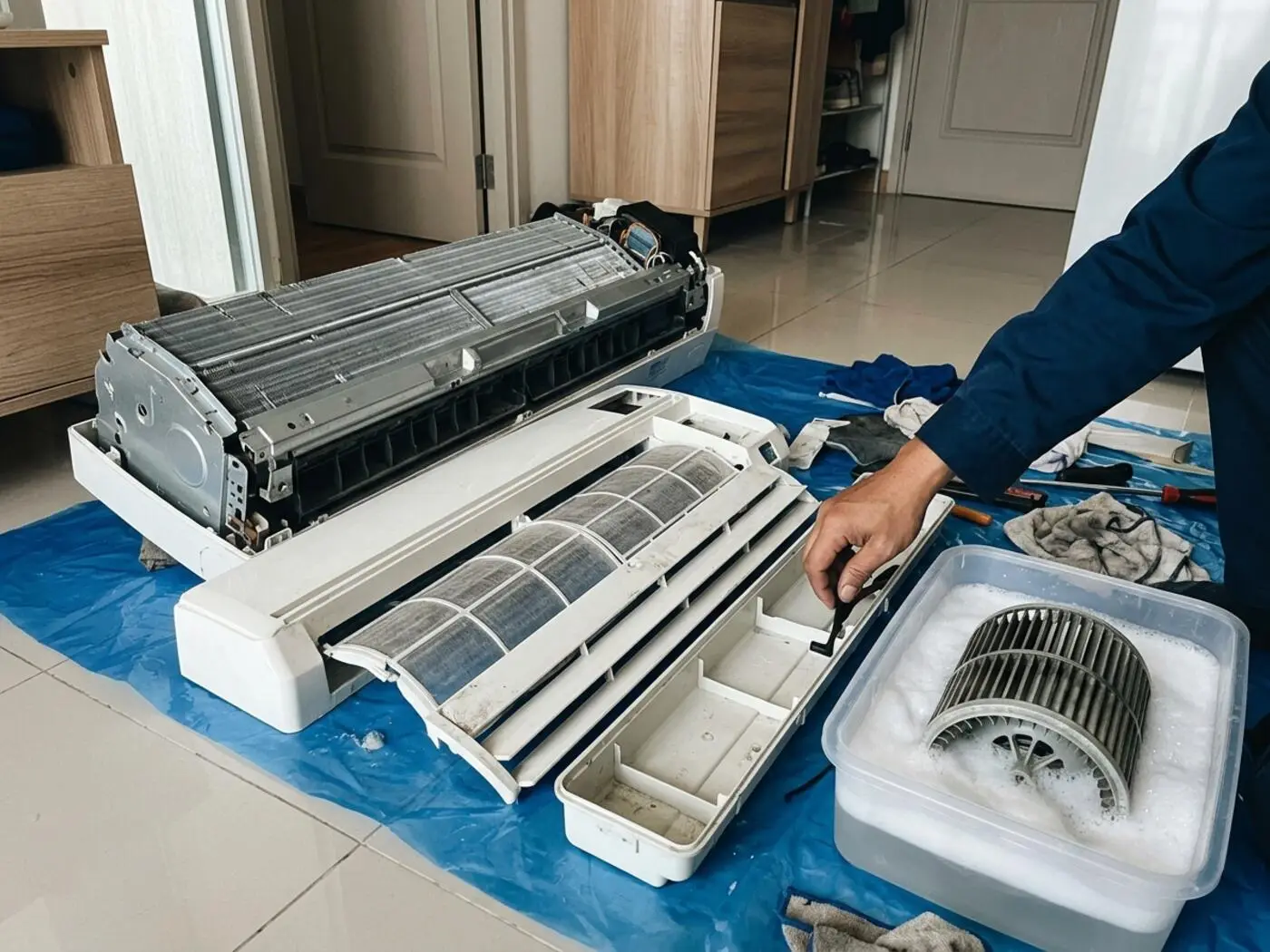
A split's evaporator coil is wet whenever it cools. In Bangkok's humid air, that is most nights of the year. Dust that gets past the filter lands on the wet fins and the blower wheel, and microbes feed on it, forming the dark film technicians call biofilm. If you have ever noticed a wet-sock smell for the first minute after switching on, that is the film, as we explain in our guide to why an AC smells musty.
Is it a health risk? The sources here are consistent and cautious:
- The WHO guidelines on indoor air quality: dampness and mould identify higher rates of respiratory symptoms, allergies and asthma, and disruption of the immune system, as the most important health effects of dampness and microbial growth indoors. Its main recommendation is to prevent or minimise persistent dampness and microbial growth on interior surfaces and in building structures.
- The EPA's guidance on cleaning air ducts says that where heating and cooling components such as coils, fans and drip pans are not properly maintained they can become contaminated with dust and debris, and that if moisture is present the potential for microbiological growth rises and spores from such growth may be released into the living space. It also notes that research suggests condensation on or near cooling coils is a major factor in moisture contamination, while cautioning that duct cleaning has never been shown to prevent health problems, a good reason to stay measured about any claim.
So the careful statement is this. Damp and mould are associated with respiratory symptoms and with worse asthma. Dirty air-conditioning components can harbour microbes and may circulate them. Cleaning removes the reservoir. It does not follow that a clean unit protects you from colds, and a cleaning visit does not treat or cure any illness. If you or a family member has asthma, allergies or a weakened immune system, the reservoir is worth removing; if you do not, it is still better to breathe air that has not just crossed a mouldy coil. Our guide to health effects of a dirty air conditioner goes through the symptoms, and the mould in air conditioner guide shows how to spot it.
How to run AC to reduce each real risk
You cannot control a hotel's cooling tower, but you can control the machine in your room.
| Risk | What drives it | What to do |
|---|---|---|
| Mould and dust circulating | Wet coil, dust, long damp periods | Rinse the filter every two to three weeks; run the fan for a few minutes before switching off so the coil can dry; arrange regular cleaning |
| Cold, dry draughts | Low setpoint, louvres aimed at the body | Set a moderate temperature; point airflow away from bed and sofa |
| Sealed, stale room | No fresh air for hours | Air the room when you wake; open a window when the weather allows; avoid heavy fragrance sprays |
| Water-based sources | Humidifiers and water-tank "air coolers" | Empty and dry them daily, and clean as the maker directs; do not leave water standing |
On timing: our guide to how often to clean an AC in Bangkok explains why a six-monthly interval suits most homes here and a three-monthly one suits pet, allergy and heavy-use rooms. Rinsing the filter yourself stretches the interval but does not touch the coil or the blower wheel.
When to see a doctor, and when to call a technician
See a doctor if you have any of these, whatever you think the cause is:
- A high temperature that lasts more than three days, or symptoms that worsen. (These thresholds follow the NHS guidance on colds and Legionnaires' disease.)
- Shortness of breath or chest pain.
- A cough lasting three weeks or more, or coughing up blood.
- A cold that is not improving after ten days.
- Asthma attacks, wheeze or tightness that is new or worse.
- A long-term health condition or a weakened immune system, with any of the above.
Tell the doctor where you have been in the last couple of weeks, including hotels, spas and hospitals, and mention if your symptoms are worse in one room.
Call a technician if you notice:
- A musty or sour smell when the unit starts.
- Black specks blowing from the vent, or visible dark film on the louvres or blower.
- Symptoms that begin when the unit runs and ease when you leave the room.
- Water dripping from the indoor unit, which usually means a blocked drain, covered in our guide to indoor units that drip water.
- Weak airflow despite a clean filter.
A technician is not a doctor, and a clean is not a treatment. What a technician can do is open the unit, show you the coil and the blower wheel, and remove the dirt that feeds mould.
Next step
If your unit has not been cleaned in six months, smells musty, or the people in the room are asthmatic, allergic, elderly or very young, a clean is the sensible step. A CoolRova standard clean is from ฿690 per unit: filter, evaporator coil and blower wheel washed in place inside a sealed wash bag, drain line flushed and tested, supply-air temperature logged before and after, and a before-and-after photo report. If the blower wheel is already black, our deep chemical wash from ฿1,290 removes the blower wheel, strips the drain pan and louvres and soaks the coil. We are open daily from 8:00 to 20:00 across Bangkok. Message us on WhatsApp or use the quote form on the contact page, and see the FAQ for common questions.
Sources and further reading
- PBS NewsHour: can air conditioning make you sick? A microbiologist explains
- WHO: legionellosis fact sheet
- US CDC: how Legionella spreads
- NHS: Legionnaires' disease
- US NHLBI: hypersensitivity pneumonitis
- US EPA: should you have the air ducts in your home cleaned?
- US EPA: sick building syndrome fact sheet
- US EPA: indoor air pollution, an introduction for health professionals
- WHO: guidelines for indoor air quality, dampness and mould
- NHS: common cold
- Yale News: cold virus replicates better at cooler temperatures
- US National Eye Institute: dry eye
- Thai PBS: Department of Disease Control on Legionnaires' disease (in Thai)
- Department of Disease Control: Legionnaires' disease situation report, Bangkok hotels (in Thai)
This guide is general information, not medical advice. If you are unwell, see a doctor.
Frequently asked questions
Can air conditioning make you sick?
Not in the way people usually mean. Colds and flu are caused by viruses spread between people, not by cold air or by the machine. A neglected air conditioner with a mouldy coil can circulate microbes and dust and may aggravate allergies or asthma, and cold, dry air can irritate eyes, nose and throat, but a clean, well-run unit is not a source of infection.
Can you get Legionnaires' disease from a home air conditioner?
The US CDC states that home and car air-conditioning units do not use water to cool the air, so they are not a risk for Legionella growth. Legionnaires' disease is linked to aerosols from water systems such as cooling towers, showers, hot tubs and building plumbing. A Bangkok wall-mounted split is a different machine from a building's cooling tower.
What is 'AC flu'?
It is a popular label, not a medical diagnosis. Flu-like symptoms in an air-conditioned room usually have an ordinary explanation, such as a cold you already caught from another person, dry airways, or sick building syndrome. Rarer causes include humidifier fever or hypersensitivity pneumonitis from a contaminated system, which a doctor has to diagnose.
Why do I get a sore throat, dry eyes or a headache in air conditioning?
Air conditioning makes indoor air drier than outdoor air, which can dry the membranes of the nose and throat and aggravate dry eye, and airflow aimed at the face adds to it. Headaches, fatigue and irritation that fade after leaving a building are the pattern of sick building syndrome, whose cause is often unclear and can include poor ventilation.
Can a dirty air conditioner cause pneumonia?
For a healthy person in a home, a dirty wall split is not a typical cause of infectious pneumonia. Contaminated large air-handling and humidification systems have been linked to hypersensitivity pneumonitis, an inflammatory lung condition that can be mistaken for pneumonia. People with weakened immunity or lung disease should ask their doctor about mould exposure.
How do I know if my air conditioner is making me ill?
Look for a pattern. Symptoms that start when the unit runs and ease within hours of leaving the room, together with a musty smell on start-up, black specks from the vent or water dripping from the unit, point to the unit. See a doctor for persistent symptoms and have the unit inspected and cleaned.
Need it handled professionally?
Get a fixed quote for your units in under 60 seconds.
Written by the CoolRova Team
We're Bangkok's documented AC crew — everything we write comes from real cleaning, repair and installation visits across condos, homes and short-stay rentals.
Get our Bangkok AC guides straight in Google — add CoolRova as a preferred source.