
Every year around November, Bangkok's phones fill with orange and red air quality alerts, and the same question comes up in condo lobbies and group chats: if I keep the air conditioner on, am I protected? Does the filter catch the dust? Do I need to do anything to the unit when the season ends?
The honest answer is more nuanced than the "air conditioner purifies the air" claims you will see on packaging, and more useful than "air conditioners do nothing". An air conditioner is good at what it was built for, which is cooling and drying a room so that you can keep it closed. It is not a particle filter. This guide separates what it does, what it cannot do, what does protect a room, and why the dust season is a good reason to have the unit cleaned afterwards. It is not medical advice, and CoolRova's cleaning is maintenance for the unit, not a PM2.5 solution.
What PM2.5 is and why it matters for health
PM2.5 is particulate matter with a diameter of about 2.5 micrometres or smaller. The US EPA's PM basics page compares it with a human hair, which averages about 70 micrometres across, making the hair roughly 30 times larger than the largest fine particle. EPA explains that particles under 10 micrometres can get deep into the lungs and some may enter the bloodstream, and that those under 2.5 micrometres pose the greatest risk to health. The sources are mixed: combustion, vehicles, industry, construction and fires, plus particles that form in the atmosphere from other pollutants.
EPA's page on health effects of particulate matter says numerous studies have linked particle pollution to aggravated asthma, decreased lung function, increased respiratory symptoms such as coughing and difficulty breathing, and heart problems. It identifies people with heart or lung disease, children and older adults as the groups most likely to be affected.
The World Health Organization's fact sheet on ambient air pollution estimates that outdoor air pollution caused 4.2 million premature deaths worldwide in 2019, with the greatest burden in the WHO South-East Asia and Western Pacific regions, and that in 2019 about 99 percent of the world's population lived where WHO air quality guideline levels were not met. It also notes that most sources of outdoor air pollution are beyond the control of individuals. That last point is worth holding on to: you cannot clean outdoor air, and what you can do at home is limit how much of it gets in and clean what does.
Bangkok's dust season: when, why, and how to read the numbers
The season is not a fixed date. It is a stretch of weeks when weather traps pollution close to the ground, usually from the cool months of roughly November to March, with the worst episodes clustered in the coolest weeks.
The Thai Meteorological Department's seasonal climate outlook for October to December describes October as the transition from the rainy to the winter season, with the south-west monsoon turning into the north-east monsoon and cold high-pressure air from China prevailing over Thailand from time to time, and November as a month of much reduced rain in upper Thailand. That cooler, drier, calmer pattern is what holds pollution in place. The Pollution Control Department's October 2024 briefing on PM2.5 preparedness warned that an incoming cold air mass would produce stagnant air in Bangkok and its vicinity that stops particles dispersing, and urged the public to monitor levels on the Air4Thai website and app. A 2025 study using five years of hourly measurements (2019 to 2023) at a monitor at Chulalongkorn University's Faculty of Engineering, published in Environmental Challenges, found PM2.5 and PM10 significantly higher in the cool dry season (December to February), attributing it to reduced mixing heights, lower wind speeds and more human activity. The authors themselves note that a single monitoring site may not reflect how PM varies across the city, so treat it as a clear seasonal pattern rather than a city-wide measurement.
The Thai standard and index
Thailand tightened its 24-hour PM2.5 standard from 50 to 37.5 micrograms per cubic metre (µg/m³), and its annual standard from 25 to 15, from 1 June 2023, according to the Pollution Control Department. The same department revised its index bands to match, and its announcement of the 2023 air quality index sets them out. Readings are published in real time on Air4Thai.
| PM2.5 24-hour level (µg/m³) | Colour | Meaning | PCD advice in brief |
|---|---|---|---|
| 0–15 | Blue | Very good | Normal life |
| 15–25 | Green | Good | Normal activity; at-risk people watch for symptoms |
| 25.1–37.5 | Yellow | Moderate | Reduce strenuous outdoor activity; at-risk people use protection outdoors |
| 37.6–75 | Orange | Starting to affect health | Everyone uses a PM2.5 mask outdoors and limits strenuous outdoor activity |
| 75.1 and above | Red | Affects health | Everyone avoids outdoor activity; people with existing conditions stay in a safe space |
Check which figure you are reading. The standard is defined on a 24-hour average, so a single hourly spike is not the same thing as a day over the standard. Do not panic at one spike; do pay attention to several orange or red days in a row.
Does an air conditioner filter PM2.5?
For the usual wall-mounted split unit in a Bangkok condo, no, not in any meaningful way. Two design facts explain why.
It recirculates room air. A split system's indoor unit draws air from the room, passes it over the cold coil and returns it to the same room. Most models do not bring in outdoor air at all. That is actually helpful in haze, because the unit is not importing dust, but it also means the unit is only ever treating air that is already inside.
The filter is a coarse screen. The washable mesh filter behind the front panel is there to stop lint, hair and large dust from clogging the coil. Filters are rated on a scale called MERV (minimum efficiency reporting value), and the US EPA's MERV explainer gives the capture efficiencies in the table below. Manufacturers rarely publish a MERV rating for a washable mesh filter, but its job places it at the low end of this scale, and you should ask before assuming anything else.
| Filter | What EPA's table says it captures on average |
|---|---|
| MERV 1–4 | Under 20% of particles of 3.0–10.0 µm |
| MERV 8 | At least 20% of 1.0–3.0 µm; at least 70% of 3.0–10.0 µm |
| MERV 13 | At least 50% of 0.3–1.0 µm; at least 85% of 1.0–3.0 µm; at least 90% of 3.0–10.0 µm |
| HEPA | At least 99.97% of 0.3 µm particles |
EPA's table gives no capture figure at all for particles under 3 micrometres until MERV 8, and even there it is only at least 20 percent of the 1.0 to 3.0 micrometre range, whereas PM2.5 includes everything below 2.5. EPA's guide to air cleaners in the home recommends a rating of at least MERV 13, or as high as the system can accommodate, when upgrading a furnace or HVAC filter. It also points out that such filters only work while the system is running. That is a useful caution: a unit that cycles on and off cleans only while it runs.
A few unit models carry optional fine-dust filters or ionisers. Treat marketing claims with care. EPA notes that ionisers and plasma air cleaners can emit ozone, a lung irritant, and advises avoiding devices that intentionally produce it.
How indoor levels track outdoor levels in Bangkok homes
If the unit does not filter PM2.5, how much does the dust get in? A 2025 study in the journal Heliyon, open access on PubMed Central, measured PM2.5 and PM10 inside and outside a small set of houses in Bangkok and Chiang Mai (17 in the abstract's count), comparing haze and non-haze periods in 2019. In Bangkok, indoor PM2.5 averaged 19.85 µg/m³ in the haze period and 11.40 in the non-haze period, against outdoor averages of 26.26 and 16.68. The indoor-to-outdoor ratios were about 0.76 in haze and 0.68 outside it. In Chiang Mai the ratio was higher, which the authors linked to the characteristics of the houses and local habits.
The authors concluded that indoor particulate levels were dominated by outdoor air quality and recommended that people close doors and windows during haze and non-haze periods to avoid accumulation. Three caveats keep this in proportion. It was a handful of houses, not a representative sample of condos. It measured ordinary houses, not sealed, air-conditioned rooms. And the same pattern means indoor air is cleaner than outdoor air but far from clean when outside is bad: a ratio near 0.7 still means indoor levels rise and fall with the street.
The lesson is simple. Indoors is better than outdoors, a closed room is better than an open one, and neither one is a purified room.
What actually helps: sealing the room and filtering it
The Thai Department of Health's answer is the clean room (ห้องปลอดฝุ่น, "dust-free room"). Its February 2025 guidance sets out four steps, which can be summarised as follows:
- Choose the room. Pick a room away from dust sources such as roads, car parks and construction, with no indoor sources (candles, incense, smoking) and as few doors, windows and vents as possible. If a room has an air conditioner, the department says to choose it, because it has fewer leaks and a better seal.
- Clean it with wet cloths, not brooms or vacuums, which can throw dust back into the air. Clear out clutter, and wash fans, air conditioners, air filters and window screens.
- Close it up. Shut doors and windows tightly and seal gaps and holes with tape, door seals or similar.
- Add filtration or fresh-air pressure. Use a purifier sized to the room, with a clean air delivery rate (CADR) more than three times the room volume, placed where air circulates freely. Or use a positive-pressure approach: a fan that pulls outdoor air through a filter of MERV 11 or above into the room so the room sits at higher pressure than outside.
Notice what the department says about the air conditioner: it makes a good room choice because the room is better sealed, and its filter should be cleaned. It does not list the air conditioner as the filtration step.
Why the purifier matters
EPA's guide to air cleaners says that portable air cleaners are designed to filter air in a single room, that many achieve a high CADR by using a HEPA filter, and that some can filter the small particles of greatest health concern. It adds that several studies using portable HEPA cleaners have shown small improvements in cardiovascular and respiratory health, typically small and not always noticeable to the individual. It also says filtration does not replace controlling pollutant sources and ventilating with clean outdoor air. That framing matters: a purifier reduces what is in a closed room; it does not make dirty outdoor air clean.
A bedroom clean-room checklist
For a Bangkok condo bedroom, a practical set-up is:
- Close the balcony door and windows and seal visible gaps with tape or draught seals.
- Wipe surfaces with a damp cloth; avoid sweeping or dry dusting.
- Run the air conditioner for comfort, with its filter clean and the louvres set so air does not blow directly onto sleepers.
- Place a correctly sized HEPA purifier where air can circulate, and run it continuously on high-pollution days.
- Do not burn incense or candles, or smoke, in the room.
- Check Air4Thai each morning. When outdoor readings drop to the blue or green bands, open the room to ventilate, because a sealed room also accumulates cooking fumes, moisture and exhaled air over time.
The air conditioner's real role
If it is not the filter, what is the unit doing for you in a PM2.5 season? Two things, and both matter.
It makes a sealed room liveable. In Bangkok's heat, the only reason most people open windows is to cool the room. An air conditioner lets you keep them shut, which is what the Bangkok house study recommends. In effect the unit is what makes the clean room possible.
It controls humidity. A closed room with people in it gets humid, and humidity is what feeds mould. EPA's brief guide to mould and moisture recommends keeping indoor relative humidity below 60 percent, ideally between 30 and 50 percent, and lists air conditioners and dehumidifiers among the ways to do it. A unit with a clogged coil or blocked drain does this job less well, which is one more reason to maintain it.
What it does not do is turn dusty outdoor air into clean indoor air. If you see "purifies the air" or "PM2.5 filter" on a split unit, ask what the filter's tested efficiency is and at what particle size, and whether it is certified by an independent body.
How a dust season loads the coil and blower
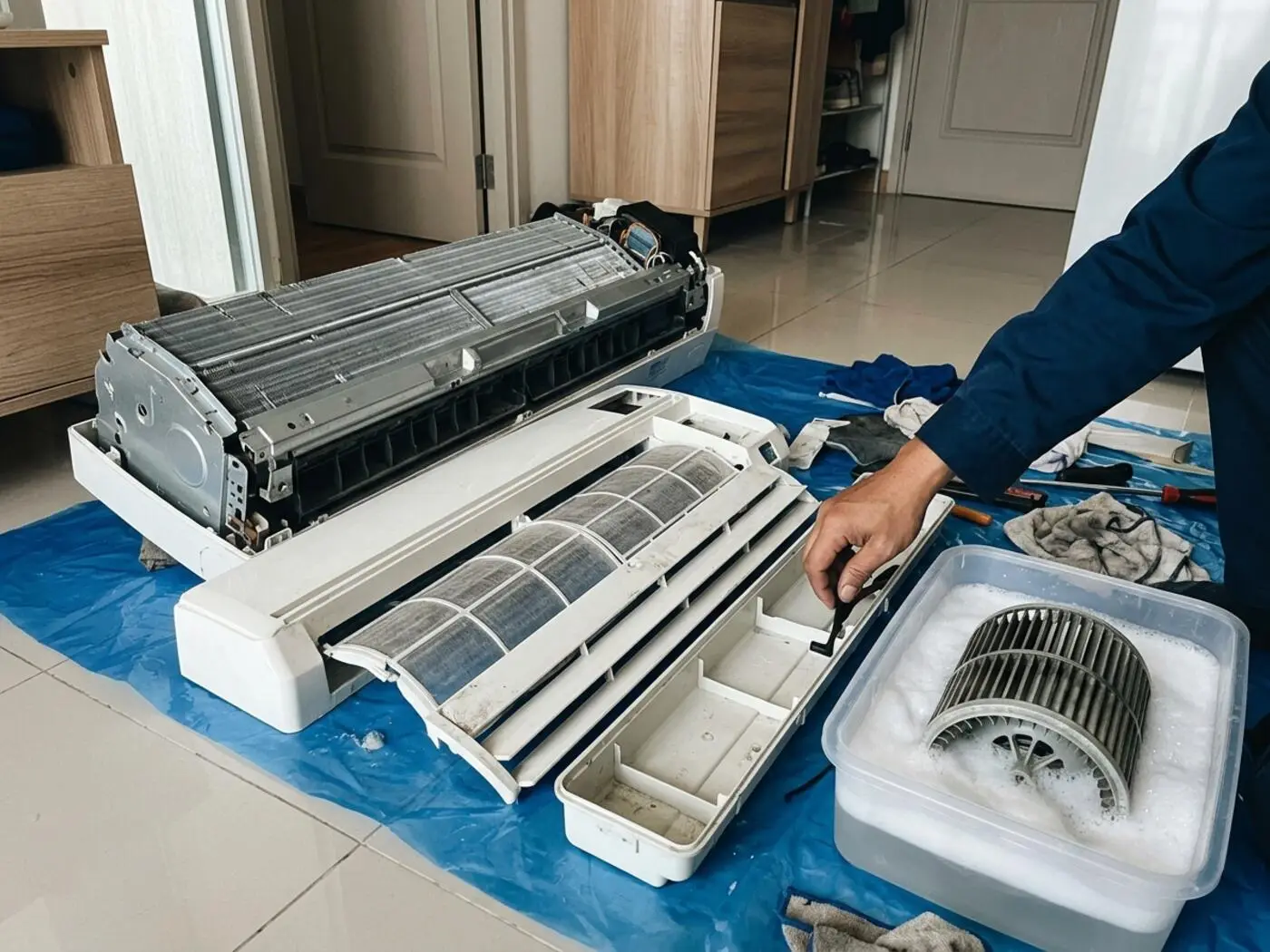
Here is where the season becomes a maintenance issue for the unit itself. The mesh filter is coarse. The finest dust passes through it, and in a closed room that air passes through the unit again and again for weeks. The cold coil is permanently damp, and fine particles stick to a wet surface. The blower wheel behind it, with its narrow blades, collects whatever gets past the coil.
The result, as a technician sees it when the cover comes off, is a grey or black film between the coil fins and a coating on the blower blades. PM2.5 is a mixture; WHO notes its major components include sulphates, nitrates, ammonia, sodium chloride, black carbon, mineral dust and water, and EPA lists soot, smoke and dust among the particles in the air. A layer of fine, dark particles on a wet coil does three things:
- It restricts airflow, so the unit moves less air and takes longer to cool the room, which you notice as weaker flow or longer running.
- It insulates the coil, so heat transfer falls.
- It gives microbes more to feed on. EPA's guidance on heating and cooling systems notes that components such as cooling coils, drain pans and fans can become contaminated with dust, pollen and debris, and that where moisture is present, microbiological growth such as mould is more likely. The musty smell that follows is covered in our guide to dirty evaporator coil symptoms.
The dust season does not create a new problem. It speeds up the usual one, because the unit runs more, with the windows shut, in air that is dustier than normal.
The post-season clean: what to ask for and why timing matters
Timing. Bangkok's dust season gives way to its hottest months. If the unit is going to lose cooling performance, it will do so in March and April when it is working hardest. Cleaning at the end of the haze season, rather than waiting for a failure, puts a clean coil and blower in place for the peak. For many households the natural rhythm is one clean before the cool season starts and one after. If you are on a twice-yearly plan, that is a convenient pair of dates; our guide to how often to clean an AC in Bangkok covers the general interval.
What to ask for. A filter rinse is not enough, because the load is on the coil and blower. Ask for:
- the evaporator coil and blower wheel washed, not just the filter and cover;
- the drain line flushed and tested, because loosened debris ends up there;
- before and after photos of the coil, so you can see what the season left behind;
- a supply-air temperature reading before and after, so the improvement is measured rather than assumed.
CoolRova's standard clean includes all four: filter, evaporator coil and blower wheel washed in place inside a sealed wash bag with coil cleaner and a low-pressure rinse, drain line flushed and tested, supply-air temperature logged before and after, and a before and after photo report. The evaporator coil cleaning guide explains what the wash involves. If the blower wheel is visibly coated, or the unit smells musty, the deep chemical wash is the right level: blower wheel removed, louvres and drain pan stripped, coil foamed with a biodegradable cleaner and soaked, everything pressure-washed, then an antibacterial and anti-mould treatment.
What not to expect. Cleaning the unit does not remove PM2.5 from your room, and it does not treat any health condition. It removes the build-up inside the machine, restores airflow and cooling, and stops that build-up becoming a damp reservoir for microbes.
Protecting children, older adults and people with lung disease
EPA names people with heart or lung disease, children and older adults as the groups most likely to be affected by particle pollution. The Department of Health's advice for at-risk groups, including young children, older adults and people with respiratory disease, is to avoid outdoor activity when levels are red and wear a properly fitted dust mask if they must go out. The PCD index advice for the orange level adds that at-risk people should avoid strenuous outdoor activity.
At home, the practical points are:
- Put the household's most vulnerable person in the clean room, and run the purifier where they sleep. Our guide to air conditioner hygiene for babies, children and the elderly covers settings and cleaning for those households.
- If someone has asthma, follow their action plan and keep reliever medication at hand. Our asthma and air conditioning guide goes into what the unit can aggravate and what it can't.
- Keep the filter clean and the coil maintained, so the unit is not adding smells or microbes to a closed room.
- Pay attention to symptoms. Persistent cough, wheeze, chest tightness or breathlessness, an asthma attack, or any symptoms in someone with a weakened immune system need a doctor, not a cleaning appointment.
Filter upgrades and add-ons: what is worth it on a wall split
It is tempting to solve the problem by fitting a denser filter. On a wall split, that rarely works well, for a mechanical reason. EPA's advice is to choose a rating of at least MERV 13 or as high as the system's fan and filter slot can accommodate, and to consult a technician to determine the highest-efficiency filter that works for your system. A split unit has a thin filter slot and a small fan designed around a coarse screen. A dense filter there can starve the coil of airflow, which lowers cooling and can lead to icing and dripping.
In practice:
- Keep the standard mesh filter clean. It protects the coil. Rinsing it regularly does more good than any add-on.
- Be sceptical of stick-on and clip-in "PM2.5" filters unless the maker can show a tested rating and confirm the unit's airflow tolerates it.
- Avoid ozone-producing features. EPA advises against air cleaners that intentionally generate ozone.
- Put the filtration where it belongs. A HEPA purifier sized to the room does the particle work without touching the air conditioner's airflow. Ducted systems may be able to take a higher-rated filter, subject to what the fan can handle; ask a technician before changing anything.
When to call a professional
Rinse the filter yourself and leave the rest to a technician if:
- the unit has run through the dust season and has not been cleaned since;
- airflow is weaker, or the room takes longer to cool, than it did before the season;
- the vents smell musty, or you see dark specks or streaks on the louvres;
- the unit drips water indoors;
- anyone at home has asthma or another condition that makes a damp or dusty unit a concern;
- you are not sure the last "clean" included the coil and blower wheel.
A standard clean starts from ฿690 for one unit, with multi-unit rates on the pricing page. If you want the cleans scheduled around the season, the 2-Visit Year Package from ฿1,240 for one unit covers two cleans a year with a free gas and drain check each time, and the 4-Visit Year Package from ฿2,190 for one unit adds quarterly cleans including one deep chemical wash per unit. To arrange a visit after the season, use the standard AC cleaning service page or send a request through the quote form or WhatsApp on our contact page.
Sources and further reading
- US EPA: particulate matter (PM) basics
- US EPA: health and environmental effects of particulate matter
- WHO: ambient (outdoor) air pollution fact sheet
- Air4Thai: Pollution Control Department real-time air quality
- Pollution Control Department: PM2.5 situation forecast and preparedness (October 2024)
- Pollution Control Department: new PM2.5 standard from 1 June 2023
- Pollution Control Department: 2023 air quality index announcement
- Thai Meteorological Department: three-month climate outlook
- Heliyon: indoor and outdoor PM2.5 and PM10 in Bangkok and Chiang Mai houses (PMC)
- Long-term PM2.5 and PM10 monitoring in urban Bangkok (Environmental Challenges, 2025)
- Thai Department of Health: how to make a dust-free room (February 2025)
- Thai Department of Health: dust-free rooms and advice for at-risk groups (March 2024)
- US EPA: what is a MERV rating?
- US EPA: guide to air cleaners in the home
- US EPA: a brief guide to mould, moisture and your home
- US EPA: should you have the air ducts in your home cleaned?
Frequently asked questions
Does an air conditioner filter PM2.5?
Not in any meaningful way in a typical wall-mounted split unit. The washable mesh filter is a coarse screen meant to keep lint, hair and large dust off the coil, and the unit recirculates room air rather than bringing in filtered outdoor air. A HEPA air purifier is the usual tool for PM2.5 indoors.
Should I run my air conditioner during Bangkok's PM2.5 season?
Running it helps because you can keep windows and doors closed without overheating, and research in Bangkok homes found indoor PM2.5 follows outdoor levels. It does not clean the air by itself, so pair it with a sealed room and a correctly sized purifier on high-pollution days.
What is Thailand's PM2.5 standard and where do I check it?
Since 1 June 2023 Thailand's 24-hour PM2.5 standard is 37.5 micrograms per cubic metre, tightened from 50, and the annual standard is 15. The Pollution Control Department publishes real-time readings and colour-coded index levels on Air4Thai, which has a website and an app.
Should I clean my air conditioner after the haze season?
Yes, it is a sensible time. A season of running the unit with the windows shut and dusty air passing through leaves fine material on the wet coil and blower wheel. Having the coil and blower cleaned after the season, before the hottest months, restores airflow and cooling performance and removes the build-up.
Can I put a better filter in my split air conditioner to catch PM2.5?
Usually not safely. EPA advises using the highest-rated filter your system's fan and filter slot can accommodate, and a wall split has a thin slot and a small fan, so a dense filter can choke airflow. Check with the manufacturer or a technician before fitting any add-on, and avoid devices that produce ozone.
Need it handled professionally?
Get a fixed quote for your units in under 60 seconds.
Written by the CoolRova Team
We're Bangkok's documented AC crew — everything we write comes from real cleaning, repair and installation visits across condos, homes and short-stay rentals.
Get our Bangkok AC guides straight in Google — add CoolRova as a preferred source.