
You wake up with a blocked nose, again. By mid-afternoon your throat is scratchy, your eyes feel gritty and there is a dull headache behind your forehead. After a night away from home it eases. On Monday it starts over.
Plenty of things can cause that pattern, and a dirty air conditioner is only one of them. But if the symptoms follow a room cooled by a unit that has not been properly cleaned in a year or more, it is worth checking. This guide explains how a dirty unit can plausibly affect you, which symptoms have real evidence behind them and how to test the idea at home. It cannot diagnose you. It can help you describe a pattern clearly to a technician or a doctor.
The pattern that points at the air conditioner
A single sneeze means nothing. What matters is the shape of the symptoms over days and weeks, and three questions do most of the work.
Timing. Do symptoms start or worsen after the unit has been running for a while? Mould and dust are blown across a room only when the fan is moving. A cold builds over a day or two, runs a course and passes; a pattern that returns every night you sleep under the unit is different.
Place. Do you feel worse in one room, usually the bedroom or a home office with the door shut? Many Bangkok condo bedrooms are closed boxes with the unit running all night, so you breathe the same recirculated air for seven or eight hours.
Relief when away. Do symptoms ease within a day or two somewhere else? The US EPA's 1991 sick building syndrome fact sheet, still the agency's reference summary, describes exactly this: occupants report acute discomfort that seems linked to time spent in a building, with relief soon after leaving, while no specific illness or cause is identified.
None of the three proves anything. Pollen, a new mattress, cooking smoke, stress and poor sleep can produce the same pattern. But when all three line up and the unit is visibly dirty, it moves up the list of suspects. One caution: the evidence here is mostly about association. Studies of damp buildings show occupants report more respiratory symptoms, which is not proof that the film in your particular unit caused your particular cough.
Mechanism 1: mould and bacteria on the coil and blower wheel
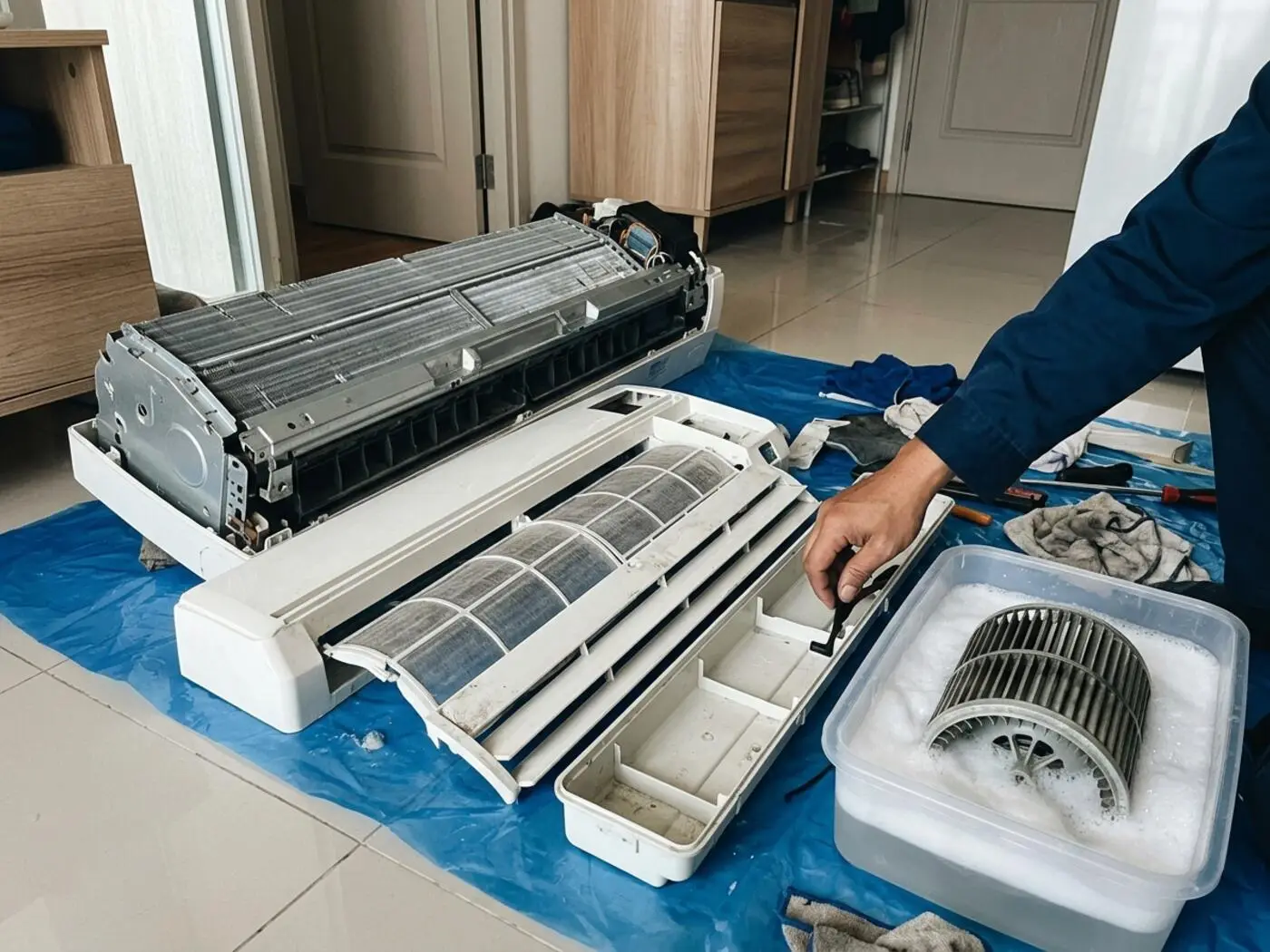
The first route is microbial growth inside the unit. Each time a split-type unit cools, water condenses on the evaporator coil, the cold block of aluminium fins behind the filter, and drips into a drain pan. Behind the coil sits the blower wheel, a plastic drum that pulls room air across the fins. In a humid city these parts are wet most of the year, dust that slips past the filter lands on them, and over months a dark film forms. Technicians call it biofilm.
A 2022 study in the journal Microorganisms sampled bacteria from filters, cooling coils, fans and air outlets in air conditioners in 17 Japanese houses and found bacterial communities on all of them, varying with the house location, how the unit was used and what the occupants did. It describes what lives in these units; it does not measure what people breathe in.
Why would that matter? Mould spores and fragments are allergens and irritants. The EPA explains that mould can cause hay fever-type symptoms such as sneezing, a runny nose, red eyes and skin rash in sensitive people, and that exposure can also irritate the eyes, skin, nose, throat and lungs of people who are not allergic. It adds that symptoms other than the allergic and irritant types are not commonly reported after inhaling mould, which is worth remembering when you read frightening claims online.
The CDC's overview of mould and health lists the common effects as a stuffy nose, sore throat, coughing or wheezing, burning eyes and skin rash. It says some people have no reaction, and that people with asthma or mould allergy may react severely. The CDC does not recommend mould testing, which matters for the do-it-yourself section later.
The World Health Organization's guidelines on dampness and mould conclude that the most important effects of building moisture and microbial growth are increased respiratory symptoms, allergies and asthma, and effects on the immune system, and that prevention of persistent dampness and microbial growth is the key. The EPA's page on biological contaminants names poorly maintained ventilation systems as one route by which they build up indoors.
The fair summary: a damp, dirty coil and blower is a plausible local source of the particles health agencies associate with damp indoor spaces, and the fan moves air across it into your room. Whether that changes how you feel depends on how heavy the growth is, how long you are in the room and how sensitive you are. A sour, musty smell on start-up is one sign the growth is heavy; our full mould in air conditioner guide covers how it develops.
Mechanism 2: dust, dander and pollen re-circulated by a loaded filter
The second route has nothing to do with mould. A split-type air conditioner does not bring in fresh air. It takes air from the room, passes it through a filter and over the coil, and returns it. Everything the filter fails to hold goes round again.
A mesh filter is designed to stop lint, hair and larger dust. When it is loaded, airflow drops and the fan works harder for less air, fine dust collects on the fins and blades behind it, and some of that can be blown back out when the fan accelerates at start-up. House dust carries biological contaminants, as the EPA notes, including dust mite allergen, pet dander and pollen. The EPA lists mould, dust mites, pollen and pet allergens as triggers of asthma symptoms and allergic reactions, including nasal inflammation, allergic rhinosinusitis and headaches. A filter does not make these allergens, but a neglected unit in a closed bedroom can keep moving them past your face all night. Our guide to air conditioner allergies in Bangkok takes the allergens one by one.
Particle pollution adds to it. The EPA's page on indoor particulate matter says indoor particles include those that migrate in from outdoors, and that exposure to inhalable particles has been linked to eye, nose and throat irritation and to worse respiratory symptoms. When fine-dust levels rise in the dry months, a loaded filter and coil have less capacity to cope.
This is the mechanism most often missed, because it is the easiest to fix. A filter rinsed in the last two or three weeks and a clean coil give it little to work with. Our cleaning frequency guide explains why intervals are shorter in Bangkok than in a dry climate.
Mechanism 3: cold, dry air and draughts on eyes, nose and throat
The third route is not about dirt at all, and it can make a clean unit feel as bad as a dirty one. An air conditioner cools and dehumidifies. Air leaving the louvres is cold and relatively dry, and if it blows across your face and neck for hours, the surfaces it touches lose moisture.
Eyes. The NHS lists air-conditioned and heated environments, along with windy, dry or dusty weather, smoke and long screen use, among the things that make dry eyes more likely. Its self-care advice includes using a humidifier to reduce dry air, and it says to see an optician or GP if dry eyes persist after a few weeks of home treatment. A painful red eye, or a red eye if you wear contact lenses, needs prompt medical advice.
Nose and throat. The Merck Manual's entry on nonallergic rhinitis describes vasomotor rhinitis as the most common subtype, caused by nasal lining that over-responds to temperature, pressure and humidity, with cold air and a dry atmosphere named as particular triggers. In plain language, some people get a runny or blocked nose from cold, dry air with no allergy involved. The NHS makes the same distinction on its non-allergic rhinitis page, which lists changes in temperature or humidity among the causes.
The mechanisms stack: a cold dry draught on a nose already inflamed by dust or mould makes things worse. If you clean the unit and symptoms continue, this is the next explanation to try. Point the louvres away from where you sit or sleep and avoid setting the temperature far lower than you need.
Symptom by symptom: what the evidence links to damp and mould
The most careful summary of the research remains the Institute of Medicine's 2004 review of damp indoor spaces. The National Academies' news release on that report says the committee found sufficient evidence that mould and damp conditions are associated with asthma symptoms in people with asthma who are sensitive to mould, and with coughing, wheezing and upper respiratory tract symptoms in otherwise healthy people, but that the evidence did not meet the strict standard needed to establish cause. It also says the evidence did not support links to the much wider range of complaints sometimes blamed on mould, while noting that for problems such as fatigue there were too few good studies to rule anything out.
That report covered damp buildings in general, not air conditioners. A mouldy coil is one possible source of the same exposures. The table sorts common symptoms by how they are treated in the sources.
| Symptom | What the sources say | Other common causes | Clue pointing to the unit |
|---|---|---|---|
| Blocked or runny nose, sneezing | Listed by CDC and EPA; part of the IOM "upper respiratory" association | Colds, hay fever, dust mite allergy, cold-air rhinitis | Worse at night or after the unit has run for hours |
| Sore or scratchy throat | Listed by CDC | Colds, dry air, mouth-breathing | Worse on waking after a night of cooling |
| Cough | Associated with damp and mould in the IOM review | Colds, asthma, smoking, pollution | Dry cough that follows time in the room |
| Wheeze, chest tightness | Associated in the IOM review; an asthma trigger per EPA | Asthma, infection, pollution | Medical, not an AC puzzle; see a doctor |
| Itchy, red or burning eyes | Listed by CDC and EPA | Dry eyes from cooled air, screens, contact lenses | Better outdoors or in a humid room |
| Skin rash or itch | Listed by CDC and EPA as an allergic effect | Dry skin, eczema, detergents | Appears after time in the room |
| Headache | EPA lists it among allergic effects of biological contaminants; a sick-building complaint | Dehydration, poor sleep, screens, sinus problems | Develops after hours in the cooled room, clears outdoors |
| Fatigue, poor concentration | IOM: too few good studies to rule out; little evidence of an association | Poor sleep, stress, illness | Weak clue on its own |
Where the sources agree most is nose, throat, cough, eyes and wheeze. Wheeze is flagged deliberately: it is a reason to see a doctor, especially with asthma, not a symptom to test at home. Our asthma and air conditioning guide covers that side. The last row is the weakest. Some websites attribute memory loss and chronic exhaustion to mould; the review found the evidence did not support such an association, while acknowledging that research was thin. A careful guide should neither feed that fear nor dismiss anyone's tiredness. A blocked nose that wakes you at three in the morning is a far more likely route to feeling exhausted.
Headaches, fatigue and poor concentration: the sick-building overlap
The EPA's fact sheet defines sick building syndrome (SBS) as acute health and comfort effects that appear linked to time spent in a building, with no specific illness or cause identified. Indicators include headache; eye, nose or throat irritation; dry cough; dry or itchy skin; dizziness; difficulty concentrating; and fatigue, with most complainants reporting relief soon after leaving. The causes it cites include inadequate ventilation, chemical contaminants from indoor and outdoor sources, and biological contaminants that can breed in stagnant water in ducts, humidifiers and drain pans. It also states that complaints may have other causes, including illness contracted elsewhere, allergies and job-related stress.
That description fits a closed Bangkok bedroom or home office reasonably well. But SBS is a pattern with no single identified cause, not a diagnosis of mould poisoning. The EPA also says air sampling seldom explains the cause and can be misleading, which is one reason we do not suggest a test kit. Our sick building syndrome guide goes further.
For headaches in a cooled room:
- Rule out plain causes first. Dehydration, poor sleep, screens and caffeine are more common than anything biological in an air conditioner.
- Ventilate at some point in the day. The EPA lists inadequate ventilation as an important SBS factor, and a bedroom sealed for twenty-two hours is poorly ventilated whatever state the unit is in.
- Check the setpoint. A very low temperature causes shivering, dry membranes and broken sleep, none of which involves dirt.
- Note facial pressure and a blocked nose. The NHS describes sinusitis as pain or tenderness around the cheeks, eyes or forehead with a blocked or runny nose. It is usually mild and often clears within about four weeks, but see a GP if there is no improvement after three weeks of self-care or you keep getting it.
Who reacts more strongly, and why
Two people can sleep under the same unit and feel completely different. The sources point to several groups.
People with asthma or allergies. The CDC says people with asthma or mould allergies may have severe reactions. The American Lung Association's mould page adds that dampness alone can cause asthma attacks, and that anyone, allergic or not, may get irritated eyes, skin, nose, throat or lungs from airborne mould particles.
Children, older adults and pregnant women. The EPA says these groups, and people with existing medical conditions, can be more vulnerable to many biological contaminants. Children also spend long hours asleep in one room. Households with babies or elderly relatives should be especially strict about filter and coil hygiene.
People with weakened immune systems or chronic lung disease. The CDC notes they can develop lung infections from mould. If that describes you or a relative, speak to your doctor and do not handle a heavily contaminated unit yourself.
People with non-allergic sensitivity. Cold-air sensitivity is common and unrelated to hygiene. If cleaning does nothing and the draught seems to be the trigger, change the airflow direction and temperature before assuming the unit is still dirty.
What a dirty unit does not cause
Some frightening claims deserve a direct answer.
Legionnaires' disease from a wall-mounted unit. The WHO's legionellosis fact sheet says infection mainly occurs by breathing in mist or droplets from contaminated water, that outbreaks have been linked to air conditioning cooling towers, hot and cold water systems, humidifiers and whirlpool spas, and that no direct human-to-human transmission has been reported. A household split unit has a condensate drain but no cooling tower or stored water system, and the sources we checked do not name it as a typical cause. We are not claiming zero risk for every device; we are saying the recognised sources are large water systems. If you have a persistent cough, chest pain, breathlessness or a high temperature, see a doctor and say where you have stayed.
"Toxic" poisoning. As noted, the EPA says symptoms other than allergic and irritant types are not commonly reported after inhaling mould. We found nothing in the health agency sources supporting toxic poisoning from a home air conditioner.
Colds and flu. These are infections caused by viruses, not by cold air or a dirty coil. The EPA notes that respiratory viruses spread easily indoors through the air and on surfaces. A shut cooled room means shared air if someone in it is infected, which is a ventilation point rather than a coil point.
None of this means a visibly dirty unit can be ignored. The reason to clean it is the well-supported one: damp, dust and microbial growth in a recirculating system are associated with irritation and allergy, and they also reduce airflow and cooling. Our guide to whether air conditioning can make you sick takes the same calm approach.
Testing the theory at home without buying a kit
You do not need a swab kit. A week or two of observation tells you more and costs nothing.
Step 1: keep a symptom diary
For two weeks, note which room you slept in, when the unit ran and at what temperature, your symptoms on waking, in the afternoon and at bedtime (score 0 to 3), and other likely causes such as new bedding, smoke, a family cold or a bad pollution day. Look for a pattern, not a single day.
Step 2: compare
- Room swap. If you have two rooms with separate units, spend a few nights in the other one and note whether symptoms follow you.
- Fan-only test. On a mild night, run fan-only for a few hours instead of cooling. Fan-only still blows air across the coil, so if symptoms ease with fan-only but return with cooling, cold air on your airways is a stronger suspect than dust.
- Time away. After two or three nights elsewhere, note how you feel, and how you feel in the first nights back.
Step 3: look at the unit, safely
With the unit off at the remote and the wall isolator, lift the front panel and look at the filter; grey felt means it is overdue, so rinse it. Shine a torch up at the louvre area: a dark or furry coating on the blower wheel, or black spots on the fins, means growth is established. Check the drain pan area for slime or standing water. Do not take panels apart, because the components are electrical.
Step 4: change one thing at a time
Rinse the filter, redirect the louvres, raise the setpoint slightly, then have the unit properly cleaned. Wait several days between changes and record the scores again; change five things at once and you will never know which one worked. A pattern that follows the room, improves after a clean and returns as the unit gets dirty is a sensible reason to keep the unit on a schedule. It is not evidence of any particular illness.
What cleaning changes, and how long it takes to notice
Cleaning properly removes the reservoir: the dust and microbial film on the coil, blower wheel, louvres and drain pan. It does not remove allergens from your mattress, cure a mould allergy or fix a cold draught. That matches how the agencies describe prevention. The WHO says the key is preventing persistent dampness and microbial growth; the EPA's biological contaminants page calls source control, meaning preventing the conditions that let contaminants multiply and managing those present, usually the most effective approach to indoor air quality; and the American Lung Association includes keeping appliance drip pans clean in its moisture-control list.
What the work involves depends on how dirty the unit is.
- A standard clean from ฿690 per unit washes the filter, evaporator coil and blower wheel in place inside a sealed wash bag with coil cleaner and a low-pressure rinse. The drain line is flushed and tested, supply-air temperature is logged before and after, and you get a before-and-after photo report.
- A deep chemical wash from ฿1,290 per unit suits established growth. The blower wheel is removed, the louvres and drain pan are stripped, the coil is foamed with a biodegradable cleaner and soaked, everything is pressure-washed and an antibacterial, anti-mould treatment is applied. It takes 60 to 90 minutes per unit and includes a photo report.
How soon will you notice a difference? We will not give a number. Some households report a cleaner smell straight away and easier breathing at night within days; others notice nothing because the unit was never the main cause. Smell and airflow change first, and the photo report shows what was removed. Symptoms change later and less predictably, so compare diary scores over two to four weeks. And growth returns: in a humid city the coil is wet every night, so a clean resets the unit rather than protecting it for good. Rinsing the filter every two to three weeks and cleaning on a schedule keep the reservoir small. If symptoms are unchanged after a thorough clean, that is useful information too. It points to bedding, cold-air irritation, outdoor pollution or an allergy a doctor can test for.
When to see a doctor, and when to call a technician
These are separate questions, and neither replaces the other.
See a doctor if:
- Symptoms last more than a few weeks, keep returning, or affect sleep or daily life. The NHS advises seeing a GP for rhinitis that is getting worse or affecting sleep.
- You wheeze, feel short of breath or your chest feels tight. If you have asthma and it is worsening, follow your action plan and seek care.
- You have a fever, chest pain, a cough lasting three weeks or more, or you cough up blood.
- You have a weakened immune system or chronic lung disease and suspect mould exposure.
- A child or older adult at home has persistent symptoms, or your eyes are painful and red.
Persistent symptoms, asthma attacks or immune suppression always warrant a doctor's advice, whatever the unit looks like.
Call a technician if there is a musty smell on start-up that a filter rinse does not remove, you can see dark flecks at the vent or on the blower wheel, airflow is weak or the room cools slowly, the unit drips, it has been six months or more since a proper coil and blower clean, or you are moving into a rental with a unit that has sat idle.
In Bangkok, a CoolRova standard clean or deep chemical wash comes with a photo report, so you can see what was removed rather than take our word for it. We have cleaned 800+ AC units across Bangkok homes, rentals and businesses, cover all BTS and MRT zones and are open daily from 8:00 to 20:00. To book or ask a question, use WhatsApp or the quote form on our contact page. We will tell you what the unit needs, and we will not tell you it cures anything.
Sources and further reading
- CDC: About mould and health
- US EPA: Mold and health
- National Academies: news release on the Institute of Medicine damp indoor spaces report
- WHO guidelines for indoor air quality: dampness and mould
- US EPA: Sick building syndrome fact sheet
- US EPA: Biological contaminants and indoor air quality
- US EPA: Indoor particulate matter
- American Lung Association: Mold
- NHS: Dry eyes
- NHS: Sinusitis
- NHS: Non-allergic rhinitis
- Merck Manual: Nonallergic rhinitis
- WHO: Legionellosis fact sheet
- Microorganisms (2022): Bacterial communities in air-conditioning units in 17 Japanese houses
This guide is general information, not medical advice.
Frequently asked questions
What are the symptoms of a dirty air conditioner?
Common complaints are a blocked or runny nose, sneezing, a dry or sore throat, cough, itchy or burning eyes and headaches that start when the unit runs and ease when you leave the room. These symptoms are not specific to air conditioners, so the pattern and timing matter more than any single symptom. Health agencies link damp, mouldy indoor spaces to cough, wheeze and upper respiratory symptoms.
Can a dirty air conditioner make you sick?
It can contribute to symptoms, especially in people with allergies, asthma or sensitive airways, because a damp coil and blower wheel can hold microbes and a loaded filter can re-circulate dust. It does not usually cause an infection in the way a cold or flu does, because those are caused by viruses. If symptoms are persistent, see a doctor.
What are aircon mould symptoms?
Mould exposure is associated with a stuffy nose, sore throat, cough, wheezing, burning or red eyes and skin rash, according to the CDC. People with mould allergy or asthma may react more strongly. Many people have no symptoms at all, and the same complaints have plenty of other causes.
How do I know if my symptoms are from the AC or from something else?
Keep a two-week note of when symptoms start, which room you were in and how you felt after a day away. Compare the bedroom with the living room, and note whether symptoms change after the unit has been cleaned. A pattern that follows the room is a clue, not a diagnosis, and a doctor can test for allergies.
Can a dirty air conditioner cause Legionnaires' disease?
Legionella is mainly linked to air conditioning cooling towers, hot and cold water systems, humidifiers and whirlpool spas in larger buildings. A typical household split-type unit has no cooling tower or stored water system, so it is not a recognised source in the way those systems are. If you have a cough, fever or breathlessness, see a doctor.
How long after cleaning an air conditioner will I feel better?
Some people notice a cleaner smell and less irritation within days, but there is no guaranteed timeline and symptoms often have other causes. Cleaning removes a source of microbes and dust from the unit, which is why it is worth doing, but it is not a treatment for any condition.
Need it handled professionally?
Get a fixed quote for your units in under 60 seconds.
Written by the CoolRova Team
We're Bangkok's documented AC crew — everything we write comes from real cleaning, repair and installation visits across condos, homes and short-stay rentals.
Get our Bangkok AC guides straight in Google — add CoolRova as a preferred source.