
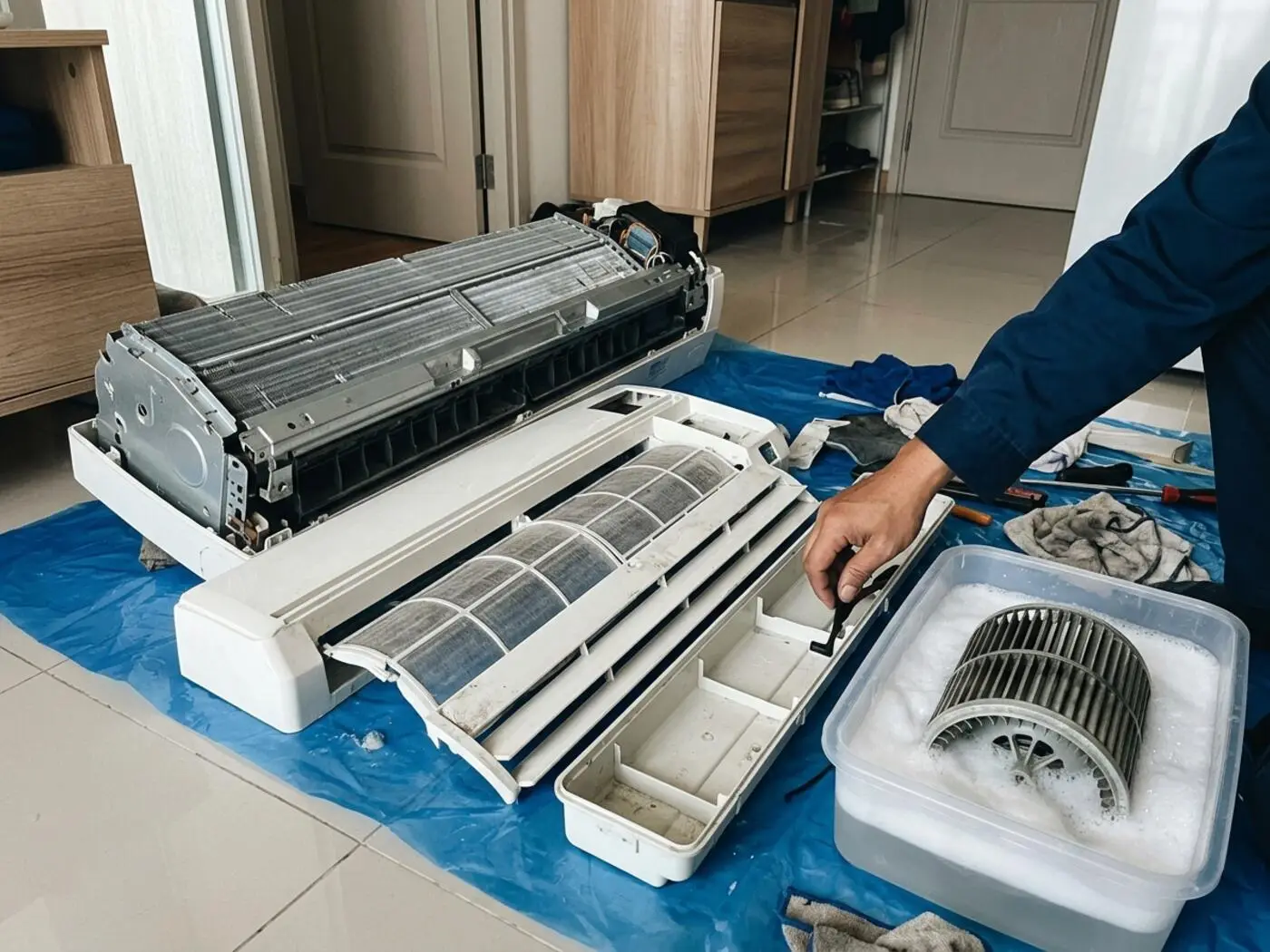
When a baby is due, or when a parent or grandparent moves in, most families do the same things: wash the bedding, tidy the room, and perhaps add a night light. The air conditioner is rarely on the list, yet it is working in that room for most of the day and night, and the people it serves are the ones least able to shrug off poor air.
This guide explains why the youngest and oldest members of a household are more affected, what a neglected unit can add to the air, and a practical "high-care" routine for nurseries and elderly bedrooms in Bangkok. It is a guide to maintaining equipment and not medical advice: we are not suggesting that cleaning an air conditioner prevents or treats any illness, only that it reduces one source of dust and microbes in a room where it matters.
Why children and older adults are more affected by what an AC circulates
Two unrelated groups share a common feature: their bodies handle airborne exposures less well than a healthy adult's.
The US Environmental Protection Agency says that children may be more vulnerable to pollutants than adults because of differences in behaviour and biology, which can mean greater exposure and windows of susceptibility during development. UNICEF puts one reason plainly: children breathe faster than adults on average and take in more air relative to their body weight. The World Health Organization's summary on children and air pollution says air pollution affects children in uniquely damaging ways, and cites an estimate that about 93 percent of the world's children live in areas where air pollution exceeds WHO guidelines.
Older adults are vulnerable for different reasons. WHO notes that as people age they are more likely to experience several conditions at the same time, and lists chronic obstructive pulmonary disease (COPD) among the common conditions of older age. The EPA adds that children, pregnant women, older adults and people with existing medical conditions can be more vulnerable to many types of biological contaminants such as mould, dust mites and bacteria.
Another factor is time. A baby may spend most of the day and night in one room, and a frail relative may spend nearly all day in a bedroom or a single armchair. A unit that adds a little to the air is not trivial when the same person breathes it for most of the day.
Keep the framing calm and proportionate. Most children and older adults live perfectly well with air conditioning. The point is that where exposure is long and tolerance is lower, small improvements are worth making.
Babies and toddlers: breathing rate, developing lungs and time in one room
The NHS describes bronchiolitis as a common chest infection affecting babies and children under 2, usually mild and managed at home but sometimes serious. Babies under six months, babies born prematurely, and children with a weakened immune system or a long-term heart or lung condition are at higher risk of serious illness.
It matters to be accurate about where such infections come from. Bronchiolitis is usually caused by respiratory syncytial virus (RSV), which the NHS says spreads easily through coughs and sneezes, and almost all children catch it before the age of two. An air conditioner does not cause it, and a spotless unit will not prevent it. The NHS's prevention advice is about hand washing, cleaning toys and surfaces, not sharing cups and cutlery, keeping newborns away from people with colds or flu, and not smoking around children.
So what does the AC contribute? Two things. First, a neglected unit can be a source of dust and mould spores in the air the baby breathes. Second, damp and mould in the home are linked to worse respiratory outcomes in children. A major review of epidemiological studies in Environmental Health Perspectives found that indoor dampness and mould are associated with asthma development and worsening, wheeze, cough, respiratory infections and allergic rhinitis, and that the evidence strongly suggested causation of asthma exacerbation in children. The review also noted that causal links remain unclear for several other outcomes, so the honest summary is: reducing damp and mould is sensible, and it is most clearly worthwhile for children who already have asthma or allergy.
For toddlers, add the usual hazards of small children and equipment: a cot or play area not directly under the vent, remote controls out of reach, and no climbing near the outdoor unit or its pipework.
Older adults: immunity, COPD, heart disease and pneumonia risk
Older bodies often have less reserve, and long-term conditions such as COPD and heart disease reduce what is available when something goes wrong. The NHS says that people at higher risk from pneumonia include babies and young children, adults over 65, and people with heart disease or a long-term lung condition, and notes that confusion is a common symptom in older people.
Mould has a particular profile for this group. A 2019 survey of 302 social housing residents in South West England, published in the International Journal of Environmental Research and Public Health, found that exposure to mouldy odour was associated with a higher risk of asthma in adults over 50. The authors noted that older people spend more time indoors. This is a single observational study in a different climate, so treat it as supporting evidence and not as proof, but it fits the wider picture.
What lives in a neglected unit and why that matters for these groups
The evaporator coil is the block of thin aluminium fins behind the filter, and it is cold and wet whenever the unit cools. Behind it sits the blower wheel, which pushes air across the coil. Dust that passes the filter settles on these damp surfaces and, over months, forms a dark layer of bacteria, mould and fine debris that technicians call biofilm. Our guide to mould in air conditioners describes this layer, and the musty smell it produces, in detail.
What do authorities say about this? The NHS page on aspergillosis, an infection caused by breathing in Aspergillus mould, lists air conditioning systems among the places the mould is found alongside soil, compost, dust, bedding and damp buildings.
The same page keeps the risk in proportion: aspergillosis is rare in healthy people, and most people who breathe in the mould do not become unwell. The CDC makes a similar distinction: for some people mould causes congestion, sore throat, cough, wheeze or eye irritation, while people with asthma or mould allergy may have severe reactions, and people with weakened immune systems or chronic lung disease may develop lung infections from mould.
That is why a cleaning plan is framed as reducing a reservoir. A clean coil does not treat a child's asthma or an older person's lung disease. It removes a damp, dirty surface that could otherwise be adding to the exposure of people who are already more sensitive.
One more point of accuracy: Legionella, the bacterium behind Legionnaires' disease, is mainly a concern for cooling towers, hot-water systems and large building water systems. The EPA lists those among the places it can grow, and a typical household split unit is not in the same category.
The high-care cleaning protocol
For a nursery or an elderly relative's bedroom, we suggest a tighter routine than the general advice in how often to clean an AC in Bangkok, which already recommends a three-month interval for homes with allergy or asthma sufferers and for units that run twelve hours a day or more. Treat the following as a practical schedule to adapt:
| Task | Suggested timing | Why |
|---|---|---|
| Deep chemical wash | Several weeks before a baby comes home or a relative moves in | Resets the coil, blower wheel and drain pan, and leaves time to air the room |
| Standard clean | About every three months in the nursery or elderly bedroom | Keeps the coil and blower from re-accumulating a layer |
| Filter rinse | Every two to three weeks | Removes lint, hair and dust before they reach the coil |
| Fan-only run before switching off | After each cooling session where practical | Helps the coil dry between uses |
| Drain check | At every professional visit | A blocked drain leaves standing water in the unit |
| Deep wash repeat | Once a year, or sooner if smell, black specks or weak airflow return | Annual reset for a unit in daily use |
What to ask for. A proper clean washes the coil and blower wheel, not just the filter and cover. When you book, ask what is included, whether the blower wheel is washed or removed, whether the drain line is flushed and tested, and whether you will get before-and-after photos. These are the same questions we answer in standard clean vs deep chemical wash.
Timing a deep wash before a baby arrives. The deep chemical wash removes the blower wheel, strips the louvres and drain pan, soaks the coil with a biodegradable cleaner, pressure-washes everything and applies an antibacterial, anti-mould treatment. It takes 60 to 90 minutes per unit. Book it a few weeks before the due date and not in the final days, so there is time to air the room and run the unit before anyone sleeps there. Ask which products are used and whether they recommend leaving windows open and the unit running for a period afterwards.
Costs and packages. At CoolRova a standard clean starts at ฿690 per unit and a deep chemical wash at ฿1,290 per unit. For a room that needs both, the 4-Visit Year Package from ฿2,190 for one unit schedules quarterly cleans and includes one deep chemical wash per unit, which matches the high-care rhythm above. The 2-Visit Year Package from ฿1,240 for one unit suits less demanding rooms. Our pricing page lists the per-unit rates.
Temperature, airflow and humidity rules for a nursery or an elderly bedroom
Temperature for babies. The NHS advises keeping a baby's sleeping room between about 16 and 20°C and monitoring it with a thermometer, and warns that overheating can raise the risk of sudden infant death syndrome (SIDS). It says to check a baby's temperature by feeling the chest or the back of the neck, and that cool hands and feet are normal. That guidance is written for UK homes. Holding 16 to 20°C in a Bangkok nursery would mean running the unit very cold, so discuss a sensible target with your paediatrician. What transfers without argument is the principle: avoid overheating, use light bedding and clothing, check the baby's chest or neck, and keep a thermometer in the room.
Airflow. Do not point the louvres at the cot, the bed or the chair. Angle the vane so air travels along the ceiling or across the room. A steady cold stream onto a small body is uncomfortable and can dry the nose and throat. This is practical advice and not a figure from a study.
Older adults and temperature. Older people often feel cold more readily, and a setting that is comfortable for a younger carer may be chilly for a relative. Ask them, check with their doctor if they have heart or lung conditions, and avoid sudden drops in temperature between rooms.
Humidity. For both groups the aim is a room that is dry enough to discourage mould and dust mites but not parched. The EPA says to keep indoor relative humidity below 60 percent and ideally between 30 and 50 percent, and that while air conditioning can reduce humidity, a room that stays consistently above 60 percent needs a specific dehumidification strategy. A small hygrometer shows what the room is doing. The related issues are covered in more detail in our guide to bedroom air conditioner hygiene and sleep.
Asthma in children. If a child has asthma, the AC is one part of a plan that includes the treatment their doctor prescribes. If symptoms are waking a child at night, or reliever use is rising, see the doctor and mention if the pattern is worse in the bedroom. Our guide to asthma and air conditioning in Bangkok goes further.
PM2.5 season with infants and older relatives at home
Bangkok's fine-particle season changes how you run the home. The EPA notes that fine particles can get deep into the lungs, and that people with heart or lung disease, children and older adults are the most likely to be affected by particle pollution. Both groups in this guide are on that list.
Practical steps for those months, none of which depend on a sophisticated purchase:
- Check the readings. The Pollution Control Department publishes live air quality through Air4Thai, so you can decide when to keep windows and balcony doors shut.
- Keep the room closed on bad days. A sealed room with a working air conditioner is better than an open window when outdoor particle levels are high. Note that a split-type unit recirculates indoor air and does not bring in fresh air, which is also why a sealed room needs some ventilation on cleaner days.
- Rinse the filter more often. A filter loaded with fine dust restricts airflow and sends more through to the coil. Check it weekly during heavy-pollution weeks.
- Add a portable air cleaner if you wish. The EPA says filtration should supplement other strategies because it removes some, but not all, biological contaminants, so an air cleaner supplements a clean unit and does not replace it. Filters in any air cleaner need regular replacement.
- Schedule the clean before the season. A standard clean in the weeks before pollution rises means the coil starts clean.
For more on the season, read our guide to the PM2.5 season and your AC.
Immune-suppressed relatives: extra caution with mould
Some relatives need more than the standard precautions. The NHS says people at risk of aspergillosis include those with a lung condition such as asthma, cystic fibrosis or COPD, people with a weakened immune system, for example after an organ transplant or during chemotherapy, and people who have had tuberculosis. Its advice for at-risk people includes avoiding places where mould often grows, airing rooms, considering a dehumidifier and a HEPA air purifier, and drying laundry outside or in a dryer instead of in bedrooms or living areas.
For a family caring for someone in this situation:
- Ask their medical team first. Their specialists know their risk, and may have specific advice on mould, plants, building work and humidity.
- Do not neglect the unit. Schedule a deep wash before they move in, and stay on a short standard-clean interval.
- Keep the drain and drip pan clean. Standing water is where growth starts.
- Avoid disturbing mould yourself. If a room has visible mould on walls or ceilings, deal with the moisture source and get professional advice. Do not scrub it in the room where the person sleeps.
- Act on early signs. A musty smell, black specks at the vent or a new wet patch should trigger a visit, not a wait-and-see.
Cleaning the air conditioner is only one part of a plan that includes humidity control, ventilation and medical follow-up, and no cleaning service should claim to prevent infection.
Filter and daily habits a carer can do
You do not need to be technical to do the following, and together they make a visible difference between professional visits:
- Rinse the filter every two to three weeks. Slide it out, rinse with cool water, dry in the shade and refit. Check it weekly if there are pets, smokers or heavy dust.
- Run fan-only for about five minutes before switching off, or use the clean or X-fan mode if the remote has one.
- Look at the vent. Black specks, a musty smell on start-up or water dripping from the unit are signs to book a clean; dripping usually means the drain line is partly blocked.
- Wash bedding weekly and damp-dust surfaces. Dry dusting simply moves particles back into the air.
- Keep the room free of damp laundry, wet towels and clutter. Moisture and dust reservoirs compound the unit's job.
- Keep smoking out of the home. The NHS notes that smoke exposure increases the risk of severe bronchiolitis in children.
- Keep a log. A note of the last deep wash, the last clean and the last filter rinse takes ten seconds and saves guesswork.
Warning signs that need a doctor now
Cleaning an air conditioner is never the answer to a medical emergency. Know the signs, and act on them.
In babies and young children, the NHS says to call emergency services for difficulty breathing such as grunting, the tummy sucking under the ribs or rapid breathing, pauses in breathing, blue or grey skin, lips or tongue, or floppiness and being unable to stay awake. It advises urgent medical advice for a cold that is getting worse, much less feeding than usual, no wet nappy for 12 hours or more, or a fever of 38°C or higher in babies under 3 months. If a parent is worried, that alone is reason to get advice.
In older adults, the NHS's pneumonia guidance lists cough, shortness of breath, high temperature, chest pain, loss of appetite and wheezing, and notes that confusion is common in older people. It advises emergency help for struggling to breathe, pale, blue or blotchy skin, lips or tongue, coughing up blood or sudden confusion.
In anyone with asthma, a worsening pattern, increased reliever use or night-time symptoms should go to the doctor, and an attack follows the person's asthma plan and emergency instructions.
The NHS pages above are written for the UK. In Thailand, go to the nearest hospital or call local emergency services; the warning signs are the same.
When to call a professional for the unit
Call a cleaning professional when:
- the nursery or elderly bedroom has a unit that has not had a proper coil and blower clean in the last six months, or you do not know,
- there is a musty smell on start-up, black specks at the vent, or visible dark residue on the louvres,
- water is dripping from the indoor unit, which indicates a drain problem,
- airflow is weak even with a clean filter, or
- a baby is due or a relative is moving in within the next month or two.
If the room is for someone more vulnerable, say so when you book. A standard clean covers the filter, evaporator coil and blower wheel washed in place inside a sealed wash bag, a drain line flush and test, supply-air temperature logged before and after, and a before-and-after photo report. If the blower wheel is dark or the smell has been there for months, a deep chemical wash is the reset. CoolRova serves all Bangkok BTS and MRT zones, open daily 8:00 to 20:00.
To book a clean for a nursery or an elderly relative's room, message us on WhatsApp or use the quote form on our contact page, and tell us who the room is for. See the deep cleaning service for what the deeper wash involves.
Sources and further reading
- EPA: children's environmental health
- UNICEF: clean the air for children
- WHO: air pollution and child health (summary)
- WHO: ageing and health
- NHS: bronchiolitis
- NHS: pneumonia
- NHS: aspergillosis
- NHS: reducing the risk of sudden infant death syndrome
- EPA: biological contaminants and indoor air quality
- EPA: particulate matter health effects
- Air4Thai (Pollution Control Department)
- Research on mouldy odour and asthma in older adults (PMC)
- CDC: about mould and health
- Environmental Health Perspectives review of dampness, mould and respiratory effects (PMC)
Frequently asked questions
Is it safe to use an air conditioner in a newborn's room?
Generally yes, with sensible settings. The main concerns are overheating, which is linked to a higher risk of sudden infant death syndrome, and a dirty unit. Keep the room at a comfortable temperature using a thermometer, dress the baby lightly, keep airflow away from the cot, and make sure the unit has been properly cleaned before the baby sleeps there. Ask your paediatrician about the right temperature for your climate.
How often should a baby's room air conditioner be cleaned?
In Bangkok a nursery unit is a good candidate for a professional clean about every three months, with the filter rinsed every two to three weeks and a deep chemical wash before the baby comes home. The aim is to reduce the dust and microbial build-up on the coil and blower wheel.
Can a dirty air conditioner make an elderly person sick?
A dirty unit can circulate dust and microbes, and mould is a recognised problem for people with lung disease or weakened immunity. But most chest infections spread from person to person, so a clean unit is one precaution among several. Any older person with fever, new cough, breathlessness or confusion should see a doctor promptly.
Does air conditioning make asthma worse in children?
It can if the unit is dirty, the air is very cold and dry, or the room stays damp enough for mould and dust mites. Damp and mould in homes are associated with worse asthma in children, so a well-kept unit that keeps humidity down is generally better than a damp room. Follow your doctor's asthma plan and report night symptoms.
What air conditioner settings are best for an elderly relative?
A moderate temperature, airflow directed away from the bed or chair, and no sudden temperature swings are sensible starting points. Older adults may feel cold more easily, so check with them and their doctor, particularly if they have heart or lung conditions.
Need it handled professionally?
Get a fixed quote for your units in under 60 seconds.
Written by the CoolRova Team
We're Bangkok's documented AC crew — everything we write comes from real cleaning, repair and installation visits across condos, homes and short-stay rentals.
Get our Bangkok AC guides straight in Google — add CoolRova as a preferred source.