
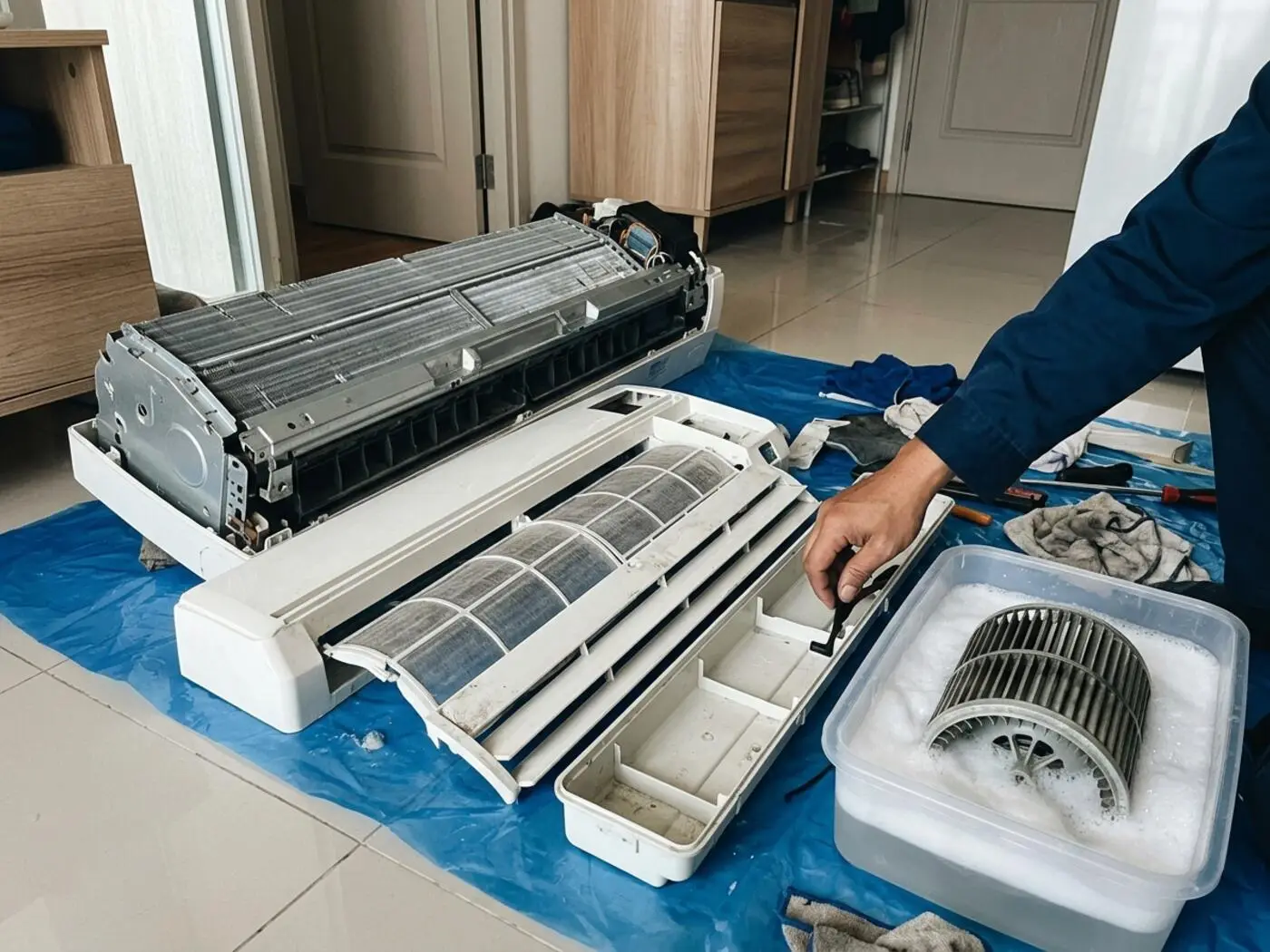
If you or your child has asthma, an air conditioner is a more complicated appliance than it looks. In Bangkok it is also close to unavoidable: a bedroom without cooling can be too hot to sleep in, and heat is itself something people with asthma are told to watch. So the useful question is not whether to use air conditioning, but how to run it so that it helps rather than hurts.
The honest answer to "is air conditioning bad for asthma?" is that it can go either way. A clean unit, set sensibly, can keep pollution outside and humidity down. A neglected one can blow cold dry air across a sleeping person and add mould spores and dust to the room. This guide sets out what the evidence supports, what it does not, and a practical routine for Bangkok homes.
One boundary, stated early: this is general information, not medical advice, and cleaning an air conditioner does not treat asthma. Follow the asthma action plan your doctor gave you, and if you do not have one, ask for one.
How asthma triggers work, and which ones live in an air conditioner
Asthma is a chronic lung condition in which the airways become inflamed and the muscles around them tighten, which makes breathing harder. The World Health Organization's asthma fact sheet describes the usual symptoms as cough, wheeze, shortness of breath and chest tightness, often worse at night, and notes that asthma cannot be cured but can be controlled, commonly with inhalers.
A trigger is anything that sets those inflamed airways off. Triggers differ from person to person, and the Cleveland Clinic's asthma overview adds that a reaction can start straight after exposure or build over hours or days. WHO lists indoor and outdoor air pollution, house dust mites and mould among them; the US Centers for Disease Control and Prevention adds pets, smoke and cold, dry air. Several of these can be connected to an air conditioner, directly or indirectly.
| Trigger | How it can connect to an air conditioner | What helps |
|---|---|---|
| Mould spores | Mould and biofilm on a coil, blower wheel or drain pan that stays wet while the unit runs | Keep the coil and blower clean, fix drips, have a persistent musty smell dealt with |
| House dust mites | Live in bedding and soft furnishings; a closed, cool bedroom is where you spend hours with them | Hot-wash bedding weekly, use mattress and pillow covers, keep humidity in range |
| Pet dander | Collects on filters and can reach the coil in pet households | Keep pets out of the bedroom, rinse filters more often |
| Outdoor air pollution, including PM2.5 | Enters when windows are open; a closed room with AC lets you avoid it | Keep windows shut on bad-air days and check the air-quality reading |
| Cold, dry air | Blown directly from the unit, especially at a low set-point | Moderate temperature, airflow angled away from you |
| Smoke and strong smells | Incense, cigarettes, air fresheners and strong cleaning products in a closed, cooled room | Keep them out of the bedroom; ventilate after any chemical cleaning |
An air conditioner does not create most of these triggers; it changes how much of each you meet. The two it is most directly responsible for, mould on the coil and blower and the temperature of the air it delivers, are also the two a household can do the most about.
The evidence on damp, mould and asthma
The strongest evidence concerns damp and mould in buildings generally, not air conditioners specifically, so it helps to be clear about what it covers.
A large review in Environmental Health Perspectives by Mendell and colleagues examined epidemiological studies up to late 2009 and found that indoor dampness or mould was consistently associated with asthma development, asthma exacerbation, wheeze, cough and upper respiratory symptoms. The associations appeared in allergic and non-allergic people. For worsening of asthma in children, the evidence was strong enough that the authors described it as strongly suggesting a causal link. They also concluded that preventing and remediating damp and mould is likely to reduce risk, while measuring particular microbes in a home is not a reliable guide to action.
A separate meta-analysis by Fisk, Lei-Gomez and Mendell pooled studies on dampness and mould in homes and reported that they were associated with higher odds of a range of respiratory and asthma-related outcomes, with most central odds ratios between about 1.3 and 1.8. A WHO Europe expert review of dampness and mould put the higher risk of respiratory symptoms and asthma in damp or mouldy buildings at up to 75 percent, and its main recommendation was to prevent dampness and mould or to remediate them when they occur.
The CDC puts it most plainly: breathing mould can trigger an asthma attack whether or not you are allergic to mould.
How does this apply to an air conditioner? Through mechanism rather than direct proof. An evaporator coil is cold and wet by design, because it pulls water out of the air. In a humid city that surface is wet every night, and dust that gets past the filter settles on it. We explain the resulting layer in why a unit smells musty and in our wider guide to mould in an air conditioner. The Cleveland Clinic's article on air conditioning notes that a system that is not maintained can give rise to new allergens, mould included, and the US EPA's guidance on biological contaminants lists poorly maintained ventilation systems as a route by which such contaminants reach indoor air.
The limits are worth stating. These studies show associations in populations; they do not show that a specific unit caused a specific attack, and we are not aware of trial evidence that cleaning a household split unit reduces asthma attacks. What the evidence supports is a sensible precaution: if someone has asthma, do not let a permanently wet part of the unit grow a film. For the broader picture of what a neglected unit can do, see health effects of a dirty air conditioner.
Cold, dry air as a trigger, and how to soften it
The second route is the air itself. The NHS lists cold air among common triggers, as do the Cleveland Clinic and the Asthma and Allergy Foundation of America, which also mentions dry wind and sudden changes in weather or temperature. A Cleveland Clinic article on whether air conditioning can make you sick says that air that is too cold or too dry can irritate the airways, that people with asthma are especially sensitive to low humidity, and that air conditioning dehumidifies as it cools.
Here too it pays to be careful. Most research and advice on cold air and airways concerns winter weather and exercise, not a bedroom at 24 degrees, and as far as we can tell no study identifies a safe set-point for a home air conditioner. What recurs in the advice is moderation and avoiding sudden shifts. In Bangkok there is a further twist: the usual indoor problem is a room that is too damp rather than too dry, so whether dryness applies to you is something to measure. A basic hygrometer shows the room's relative humidity.
Practical ways to soften the air your lungs receive:
- Do not chase the lowest number. A moderate setting such as 25 to 26 degrees is a reasonable start; adjust to what your chest tolerates.
- Angle the louvres up and away from the bed or sofa. Cold air should mix into the room, not land on a sleeping face.
- Use the sleep or timer mode. Many remotes raise the set-point gradually through the night, which avoids a long stretch at the coldest setting.
- Step down, not plunge. AAFA names sudden temperature change as a trigger, so soften the swing between a hot street and a very cold room.
- Check the humidity. If a hygrometer shows the room well below the 30 to 50 percent range the US EPA suggests, talk to your doctor before adding a humidifier, because some can spread microbes if not kept clean.
- Note the pattern. If coughing or wheezing reliably starts within minutes of the unit switching on, write it down; it is a useful clue for your doctor.
Where air conditioning helps
Because the risks get the headlines, the benefits are easy to overlook. There are at least three.
Keeping pollution out. Outdoor air pollution is a recognised asthma trigger; the CDC and WHO both list it. Bangkok has a seasonal haze period, usually in the cooler, drier months, when fine particles (PM2.5) climb. With windows shut and the unit running, a bedroom can be a refuge. Thailand's Pollution Control Department publishes live readings through Air4Thai, and our guide to PM2.5 season and your air conditioner explains what a split unit can and cannot filter. A typical split unit recirculates room air through a coarse mesh filter; it is not an air purifier, so on bad days the aim is simply to keep the outdoors out and the unit clean.
Keeping humidity down. Dust mites and mould both thrive in damp conditions. The CDC advises keeping indoor humidity under 50 percent to discourage mould and around 30 to 50 percent to limit dust mites. A working air conditioner removes moisture as it cools, which helps toward those figures, but a bedroom that is switched off all day and opened up can climb back quickly, so a hygrometer is again the honest check.
Avoiding heat. The Department of Medical Services in Thailand, quoted by Thai PBS, lists extreme heat and extreme cold, rain and both dry and humid air among the things that can set off asthma. Going without cooling in a Bangkok summer is therefore not a free option.
There is also some population evidence, with the usual caveats. In a cross-sectional survey of 2,994 preschool children, Zuraimi and colleagues found that heavy traffic near the home was linked with more asthma and rhinitis symptoms among children who slept in homes without air conditioning, while no such association appeared for children who slept in air-conditioned homes. The authors suggested that bedroom air conditioning may modify the health effects of traffic. A survey like this cannot prove cause, but it fits the idea that closed, cooled rooms can shelter people from outdoor pollution.
The asthma-safe AC protocol for Bangkok
This routine draws on the guidance above and on how split units behave in a humid city. It sits alongside your action plan, never in place of it.
1. Know your baseline
For two weeks, note each evening whether you coughed, wheezed or used your reliever, and whether the AC was running and at what setting. Patterns that track the unit are worth showing to your doctor; patterns that do not suggest the unit is not your main trigger, which is also useful.
2. Set the cleaning cadence
| Task | Suggested frequency | Why |
|---|---|---|
| Rinse the mesh filters | Every two weeks; weekly in a pet home or during haze season | Stops lint, hair and dust building up before they reach the coil |
| Coil and blower wheel clean | Every three months for a home with asthma, per our guide to how often to clean an AC in Bangkok | Removes the film where mould and bacteria grow |
| Deeper strip-down wash | When the blower wheel is visibly black or a musty smell returns soon after a clean | A rinse in place cannot reach film packed between the blades |
| Hot-wash bedding | Weekly | Reduces dust mite allergen, per the CDC and EPA |
| Mattress and pillow covers | Fit once, wash as directed | Creates a barrier against dust mites |
| Humidity reading | A glance each day | Keeps the room in the 30 to 50 percent range the EPA suggests |
3. Choose settings that are kind to airways
Moderate set-point, louvres angled away from the sleeper, sleep mode, and a fan speed that moves air without a draught. If your remote has a dry or clean mode, or you can run fan-only for a few minutes before switching off, use it: it helps the coil dry and slows regrowth between cleans.
4. Treat the filter as a screen, not a purifier
Rinse the filters under the tap, shake them, let them dry fully and refit them. A mesh filter catches lint and hair; it is not a HEPA filter and will not remove fine particles or most allergens. If your doctor suggests an air cleaner, a portable HEPA unit sized for the room is a separate purchase.
5. Make the bedroom a low-trigger room
Keep pets out, as the CDC advises for people with pet allergy. Do not smoke indoors or burn incense or mosquito coils in a closed room; smoke from any source irritates inflamed airways. Avoid scented sprays and strong cleaning products, which the Cleveland Clinic lists as triggers. And fix leaks quickly: the EPA advises drying damp or wet things completely within one to two days, and a unit that drips onto the wall has a blocked drain that needs attention.
6. Keep the action plan close
Know your daily medicines, your reliever, and the signs that mean you must step up treatment or get help. Keep the inhaler where you can reach it at night, and bring the plan to every review. The NHS advises a check-up at least once a year to confirm your inhaler technique and that the plan is current.
Night-time symptoms: why the bedroom matters most
WHO notes that asthma symptoms are often worse at night, and the NHS says the same of night and early morning. The bedroom happens to be where several of the factors in this guide meet.
You spend six to nine hours there, close to the unit, in bedding that holds dust mites, in a shut room where the air is recirculated. If the unit blows cold air across the bed, you get the temperature effect all night. If the coil or blower is coated, spores and dust are pushed into the air you breathe while you are asleep and cannot notice the smell. That is why the routine above puts so much weight on the bedroom: a moderate setting, angled airflow, clean bedding, a washed unit and a bedside inhaler. Our guide to bedroom air conditioner hygiene and sleep goes into the room in more detail.
If you are waking at night with cough or wheeze more than usual, do not assume the air conditioner is the cause. The NHS says to see a GP if symptoms wake you at night or your reliever is not helping. A review of your treatment may matter more than any change to the AC.
Children with asthma: extra considerations
The Mendell review found its strongest evidence for a causal link between damp or mould exposure and worse asthma in children, and the EPA notes that children, pregnant women, older adults and people with existing medical conditions can be more vulnerable to biological contaminants.
Practical points for a child's room:
- Keep the unit clean and the set-point moderate, with airflow that does not land directly on the bed or cot.
- Wash bedding weekly in hot water and use mattress and pillow covers if dust mites are a trigger.
- Keep the room smoke-free, including incense, and avoid air fresheners and strong sprays.
- Choose washable soft toys and wash them regularly.
- Share the child's action plan with anyone who looks after them, and keep a reliever where an adult can reach it.
- If a child wheezes or coughs repeatedly, especially at night, see a doctor rather than adjusting the AC and waiting.
We cover infants, toddlers and older relatives in more detail in AC hygiene for babies, children and elderly relatives. For allergic symptoms that overlap with asthma, such as sneezing, itchy eyes and a blocked nose, see our guide to air conditioning and allergies in Bangkok.
What to ask a cleaning technician when someone has asthma
For a household with asthma, the method of a clean matters as much as the result. Tell the company before booking that someone has asthma, and ask:
- Will the coil and blower wheel be cleaned, or only the filter and cover? The filter is the easy part. The film that matters sits on the coil and the blower wheel behind it. CoolRova's standard clean washes the filter, evaporator coil and blower wheel in place inside a sealed wash bag with coil cleaner and a low-pressure rinse, flushes and tests the drain line, and records supply-air temperature before and after.
- What products will be used? Ask for the product name and, if you want, the safety data sheet. Cleaning chemicals can irritate airways; the EPA's advice on chemical irritants is to keep children out of the room, open windows or run an exhaust fan while a product is in use, and follow the label.
- How is overspray contained? A sealed bag that drains into a bucket keeps mist and dirty water out of the room.
- Where should the person with asthma be? Arrange for them to be elsewhere during the work and for a while afterwards, with the room ventilated.
- Will there be before and after photos? A photo report shows what was on the coil and blower and whether the film was removed.
- Is an anti-mould or antibacterial treatment applied, and what is it? CoolRova's deep chemical wash includes one. For an asthmatic household, ask to see the product and its label.
- Is a fogging or fumigation add-on being pushed? We are not aware of evidence that fogging a room improves asthma, and strong fumes are a recognised trigger.
You can see how the two main service levels differ in standard clean versus deep chemical wash. Prices are on the pricing page: a standard clean starts from ฿690 per unit and a deep chemical wash from ฿1,290 per unit.
What AC cleaning does not do
Marketing around air conditioner hygiene sometimes oversells, so it is worth being blunt.
- Cleaning does not treat or cure asthma. WHO describes it as controllable with medicines, not curable.
- Cleaning removes one possible source of triggers. If your asthma is driven by pollen, pets, smoke, infections or exercise, a spotless coil will not change that.
- Cleaning is no substitute for your inhalers, your reviews or your action plan. The EPA's advice is to work with a doctor to identify triggers and build a treatment plan that includes reducing exposures.
- If symptoms continue after a proper clean, the unit was probably not the main cause, which is a reason to go back to your doctor rather than to clean again.
What cleaning can reasonably claim is narrower: it reduces the reservoir of mould, biofilm and dust on the parts of the unit that handle your room's air. For someone with asthma that is a worthwhile precaution.
Warning signs: when symptoms mean urgent medical help
Do not wait to see if things settle. The NHS advises calling emergency services during an attack if symptoms worsen, if they do not improve after the maximum dose of your reliever, or if you do not have an inhaler, and says not to drive yourself to hospital. In Thailand, the national emergency number for an ambulance is 1669.
The Cleveland Clinic lists signs that an attack is severe, including:
- blue, white or grey fingernails, lips or gums
- chest pain or pressure
- trouble speaking or swallowing
- severe wheezing, a cough that will not stop, or rapid breathing
- anxiety or panic, or a pale, sweaty face
After any serious attack, see a doctor promptly to review your treatment; the NHS suggests within two days. See your doctor too if you need your reliever more often than before, if symptoms are waking you at night, or if they disrupt daily activities. Anyone with asthma attacks that keep happening, or with a weakened immune system, should be seen by a doctor and not managed through housekeeping alone.
When to call a professional for the unit
Arrange a proper clean, rather than another filter rinse, if you notice any of these:
- a musty or sour smell when the unit starts
- black specks blowing from the vent, or visible dark growth on the louvres
- symptoms that start or ease reliably with the unit on or off
- water dripping from the indoor unit
- noticeably weaker airflow even with clean filters
- the unit has sat unused for months, or has been affected by a leak or flooding
If a blower wheel is visibly black when the cover comes off, a rinse in place will not reach the film packed between the blades. The deep chemical wash removes the blower wheel, strips the louvres and drain pan, soaks and pressure-washes the parts and applies an antibacterial, anti-mould treatment; it takes 60 to 90 minutes per unit.
For households with asthma the sensible rhythm in Bangkok is a coil and blower clean every three months, with a deep wash as the occasional reset. CoolRova's 4-Visit Year Package covers quarterly cleans and includes one deep chemical wash per unit from ฿2,190 for one unit; the 2-Visit Year Package starts from ฿1,240.
If you would like a technician to look at a unit where someone has asthma, or just want to ask what a clean involves, our standard AC cleaning service is where to start, and you can reach CoolRova by WhatsApp or the quote form on the contact page. Tell us about the asthma when you book so the visit can be planned with it in mind.
Sources and further reading
WHO asthma fact sheet · CDC asthma triggers · NHS on asthma · Cleveland Clinic on asthma · Cleveland Clinic on air conditioning · AAFA asthma triggers · EPA asthma triggers · EPA biological contaminants · Mendell et al. on dampness and mould · Fisk et al. meta-analyses · WHO Europe on dampness and mould · Zuraimi et al. on home air-conditioning and children · Thai PBS on asthma · Air4Thai readings
This guide is general information, not medical advice. Follow your doctor's asthma action plan.
Frequently asked questions
Is air conditioning bad for asthma?
Not automatically. Cold, dry air is a recognised trigger for some people, and a dirty unit can release mould and dust, but air conditioning also lets you keep windows shut during polluted days and helps keep indoor humidity down, which limits dust mites and mould. How it affects you depends on the unit, how clean it is and how you run it.
Can mold in an air conditioner trigger an asthma attack?
It can contribute. Indoor mould is a recognised asthma trigger, and an evaporator coil and blower wheel that stay wet can grow mould and biofilm. There is no test that proves a particular unit caused a particular attack, so treat a musty smell, black specks or symptoms that start when the unit runs as a reason to have it cleaned and to tell your doctor.
Why is my asthma worse at night when the AC is on?
Asthma symptoms are often worse at night in general. In an air-conditioned bedroom, extra factors can add to that: cold air blowing across the bed, dust mites in bedding, and spores or dust from a unit that needs cleaning. Keep a short symptom diary for two weeks and show it to your doctor.
What temperature should I set the AC to if I have asthma?
There is no medically established asthma-safe temperature. A moderate setting such as 25 to 26 degrees Celsius, with the airflow angled away from the bed and a sleep or timer mode, is a sensible starting point. If cold air makes you cough or wheeze, raise the setting and tell your doctor.
Will cleaning my air conditioner cure or reduce my asthma?
No. Asthma is a chronic condition controlled with medicines and a personal action plan. Cleaning removes one possible trigger source, the mould, biofilm and dust on the coil and blower, which may help if that was contributing, but it is not a treatment and should never replace your inhalers or a doctor's advice.
Need it handled professionally?
Get a fixed quote for your units in under 60 seconds.
Written by the CoolRova Team
We're Bangkok's documented AC crew — everything we write comes from real cleaning, repair and installation visits across condos, homes and short-stay rentals.
Get our Bangkok AC guides straight in Google — add CoolRova as a preferred source.