
If you wake with a blocked nose, a dry throat or a cough that fades by mid-morning, the air conditioner above your bed is an obvious suspect. Sometimes it is guilty, sometimes it is innocent, and quite often it is one of three contributors working together. This guide sorts out which is which, so you can fix the right thing instead of switching the unit off and sweating through a Bangkok night.
The short version: the bedroom unit matters more for health than any other air conditioner in your home, because of how long you spend breathing its output. It can be a source of trouble if it is neglected, and it is also one of your best tools for keeping the room dry enough that dust mites and mould struggle. The difference is maintenance and settings.
Why the bedroom unit is the one that matters for health
Exposure is dose multiplied by time. Your living-room unit might run for four or five hours on an evening; a bedroom unit typically runs the whole night, often with the door shut and the same air circulating again and again. In a Bangkok condo that is more pronounced: the room is small, the windows are sealed, the unit is frequently mounted directly above the bed, and there is no fresh-air supply, so whatever the unit adds to the room stays in the room.
The US Environmental Protection Agency notes that people spend about 90 percent of their time indoors, where much exposure to biological contaminants such as mould, dust mites and bacteria occurs. It also says that source control, meaning preventing the conditions that let these things multiply, is usually the most effective way to deal with them. For a bedroom, "source control" has three parts, and they are the three sections of this guide: the unit's own hygiene, the bedding that holds dust mites, and the airflow and humidity that the unit creates.
None of this means the unit is dangerous by default. Most healthy people sleep well under air conditioning for years. It means that if you put effort into one room, the bedroom is where it pays back.
The morning-symptom pattern and what it suggests
Indoor allergens and irritants tend to produce a recognisable cluster: sneezing, a blocked or runny nose, itchy eyes, a cough, sometimes wheeze. The NHS lists house dust mites and mould among the triggers of allergic rhinitis and notes that symptoms usually start soon after contact with the trigger. The CDC says mould can cause nasal congestion, sore throat, coughing or wheezing, eye irritation and skin rash in some people.
What matters is when your symptoms happen and what changes them. Use this as a rough guide, not a diagnosis:
| What you notice | A possible explanation | A clue worth checking |
|---|---|---|
| Blocked nose, sneezing and itchy eyes on waking, better by afternoon | Dust mite allergy to bedding, or allergen from the unit | Does a night in another room or another bed change it? |
| Dry throat, dry mouth, dry or gritty eyes on waking | Cold, dry airflow aimed at your face; mouth breathing | Do symptoms improve when the louvres are angled away and the temperature is raised? |
| Musty smell on start-up, then symptoms that ease when the unit is off | Microbial growth on the coil or blower wheel | Is there a wet-sock smell for the first minute? Any black specks at the vent? |
| Cough and tight chest at night in someone with asthma | Asthma triggered by mould, mites or cold dry air | This needs a doctor's input, not just a cleaning appointment |
| Congestion all day, every day, whatever the room | Unrelated: hay fever, a lingering infection, pollution, smoke | Not a bedroom problem; see a pharmacist or doctor |
If allergy is the likely cause, our guide to air conditioner allergies in Bangkok goes into triggers and testing. The pattern suggests a cause but cannot prove one. The review of epidemiological evidence published in Environmental Health Perspectives concluded that indoor dampness and mould are consistently associated with respiratory and allergic effects, including asthma, wheeze, cough and allergic rhinitis, while also stressing that causal links remain unclear for several outcomes. That is the right level of confidence: damp and mould are worth reducing, and your own symptoms are the best data you have about whether it is making a difference to you.
If your symptoms are persistent, or if anyone in the room has asthma, see a doctor. The NHS advises seeing a GP when asthma symptoms are waking you at night or treatment is not helping, and a bedroom clean is not a substitute for that conversation.
What is on the coil and blower that you breathe at night
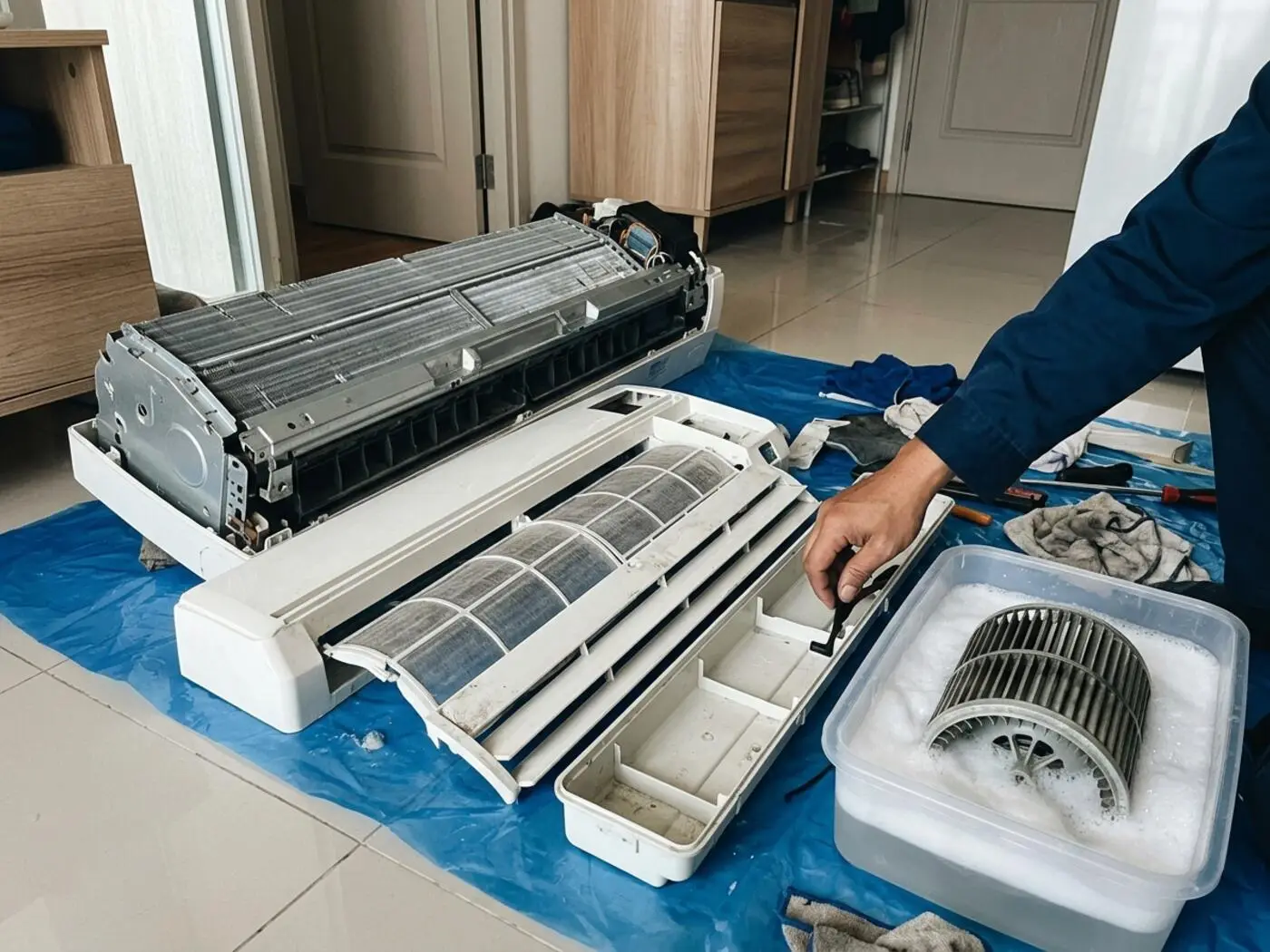
Every time a split unit cools, water condenses on the cold evaporator coil, the block of thin aluminium fins behind the filter, and runs into the drip pan and out through the drain line. In humid Bangkok the coil is wet for hours every night and rarely dries completely. Behind it sits the blower wheel, a plastic drum with dozens of narrow blades that pushes air across the coil and into the room.
Dust that gets past the filter lands on these wet surfaces. Over months it becomes a thin, dark, slimy layer that technicians call biofilm: bacteria, mould and fine debris living together in moisture. Our guide to why an AC smells musty explains the smell it produces, and the broader picture is in the guide to mould in air conditioners.
The authorities rarely write about split units specifically, but the principle is consistent. The EPA's practical home guide to mould says to keep air conditioning drip pans clean and drain lines unobstructed and flowing properly, and it warns against running an HVAC system that you know or suspect is contaminated with mould, because it could spread the mould through the building. The NHS page on aspergillosis, a fungal infection that mainly affects people with lung conditions or weakened immune systems, lists air conditioning systems among the places the mould is found, alongside soil, compost, dust, bedding and damp buildings. It adds that the infection is rare in healthy people and most people who breathe the mould in do not become unwell.
Two limits are worth stating. First, a neglected coil is a reservoir, not a guaranteed cause: the effect depends on how much is released, how sensitive you are and how long you are exposed. Second, Legionella, the bacterium behind Legionnaires' disease, is mainly a concern for cooling towers, hot-water systems and large building water systems rather than household split units. The EPA lists hot-water systems, storage tanks, pipes, cooling towers, decorative fountains and hot tubs as the building water systems where Legionella can grow.
A clean coil reduces the reservoir. It does not treat anything.
Dust mites, bedding and the humidity the AC controls
The second bedroom issue has little to do with the unit's cleanliness and a lot to do with the bed. House dust mites are microscopic creatures that live in mattresses, pillows, bedding, upholstered furniture and carpets. The American Lung Association says their allergens settle into dust and fabric and that keeping indoor humidity below 50 percent helps, with air conditioners and dehumidifiers useful in humid areas. National Jewish Health goes further, noting that dust mites do not survive well below 50 percent humidity, calling 40 to 50 percent marginal, and warning against humidifiers and vaporisers in the bedroom because they raise humidity in favour of the mites.
This is where the air conditioner earns its place. A working unit that cools and dehumidifies the room is doing exactly what the allergy organisations recommend. The risk is the opposite scenario: a bedroom that is only cooled for a few hours, or a unit that is switched off at 3 am, so that the room reverts to Bangkok's humid air, the mattress absorbs moisture, and the mites and mould are comfortable for the rest of the day.
The EPA's biological-contaminants page gives a broader humidity target for a home: below 60 percent, and ideally between 30 and 50 percent, while the CDC says to keep humidity no higher than 50 percent and that an air conditioner or dehumidifier can help. The sources differ slightly on the exact number, so treat roughly 30 to 50 percent as the target and buy a cheap hygrometer, a small humidity meter, to see what your room really does overnight and in the morning after the unit has been off for a while.
The bedding advice is dull but effective, and the Asthma and Allergy Foundation of America puts it near the top: zippered allergen-resistant covers on the mattress, box spring and pillows, and weekly washing of bedding in hot water. It says encasing mattresses works better than air cleaners to reduce allergy symptoms. Sources differ on the wash temperature, with some suggesting at least 49°C and others 54°C or more, so follow the care label and use the hottest setting the fabric allows.
Cold dry air on the face: dry eyes, throat and skin
The third bedroom issue is nothing to do with microbes at all. A unit blowing a cold, dry stream directly at the bed can irritate the parts of you that are exposed: eyes, nose, throat, lips and facial skin.
The NHS lists time spent in air-conditioned or heated environments as a factor that can cause dry eyes and, among its self-help advice, suggests avoiding long stays in smoky, dusty, dry or air-conditioned spaces and using a humidifier to prevent dry air. The Sleep Foundation links low humidity to dry skin, itchy eyes, a sore throat and nasal irritation or night-time coughing.
There is a tension here. The NHS suggests a humidifier for dry eyes, while National Jewish Health warns against humidifiers for mite allergy. In Bangkok the practical resolution is straightforward: your room is more likely to hold too much moisture than too little, and the dryness people feel under air conditioning is mostly the local effect of cold air moving across the face. Fix the airflow direction first, not the humidity.
This pattern looks like a parched mouth, gritty eyes, a scratchy throat that improves within an hour, and tight lips or skin. If your eyes become painful or red, or your vision changes, get them checked; the NHS says a painful or red eye needs prompt medical advice.
Settings for sleep: temperature, fan, louvre direction, timer and dry mode
Most sleep guidance is written for temperate climates. The Sleep Foundation recommends a bedroom temperature of about 65 to 68°F (15.6 to 20°C), and says that a higher core body temperature is associated with less restorative deep sleep, while very hot rooms also appear to shorten REM sleep. It adds that a cold room is not considered as detrimental as an overly warm one, but can still cause discomfort. Almost nobody in a Bangkok condo will hold 18°C; trying means the unit runs flat out and the airflow becomes a chilly blast.
What transfers is the principle: heat disrupts sleep, but over-cooling has its own costs. The suggestions below are our practical judgement, not numbers from those sources, so adjust them to your comfort.
- Temperature. Start in the mid-twenties and adjust in one-degree steps until you sleep under a light cover without feeling chilled or sweaty. A small fan can improve comfort at a higher setpoint.
- Louvre direction. Angle the horizontal vane so air travels along the ceiling or across the room rather than onto the bed. Airflow aimed at your face and neck is the most common cause of a dry mouth and a stiff neck.
- Fan speed. A medium or auto fan setting usually feels gentler than a high setting and still circulates air. If your remote has a "sleep" mode, it typically raises the set temperature gradually through the night.
- Timer. Switching off completely at 2 or 3 am lets the room warm up and humidity rise, which is bad for both sleep and mites. A sleep mode or a modest setpoint all night is usually better than a hard cut-off.
- Dry (dehumidify) mode. On many units dry mode lowers humidity with less temperature drop, which can help on a humid but not very hot night. Results vary by model, so check your hygrometer rather than assuming.
- Before you switch off in the morning. Run fan-only for five minutes, or use the clean or X-fan mode if your remote has one. This helps the coil dry and slows regrowth between cleans, though it cannot remove an established layer. More habits like this are in our guide to preventing mould in an air conditioner in Bangkok.
Cleaning cadence for a bedroom unit, and when to deep wash
The right interval depends on use, and a bedroom unit running every night is the heavy-use case. Our guide to how often to clean an AC in Bangkok covers the general reasoning. For a bedroom, a reasonable pattern is:
- Filter rinse every two to three weeks. Slide it out, rinse it gently, dry it in the shade and refit it.
- A professional clean about every six months. A standard clean washes the filter, evaporator coil and blower wheel in place inside a sealed wash bag, with coil cleaner and a low-pressure rinse, and flushes and tests the drain line. It is the maintenance clean for a unit in decent shape.
- A deep chemical wash when the unit has gone past maintenance. This removes the blower wheel, strips the louvres and drain pan, soaks the coil with biodegradable cleaner, pressure-washes everything and adds an antibacterial, anti-mould treatment.
Signs that the bedroom unit needs the deep wash rather than another rinse include a musty smell that returns within weeks, a blower wheel that looks dark when the technician opens it, black specks from the vent, weak airflow with a clean filter, or a unit that has not been properly cleaned for a year or more. Costs are covered in the AC cleaning price guide.
At CoolRova a standard clean is from ฿690 for one unit and a deep chemical wash from ฿1,290 per unit, taking 60 to 90 minutes. A package can suit a bedroom: the 2-Visit Year Package is from ฿1,240 for one unit, and the 4-Visit Year Package from ฿2,190 for one unit includes a deep chemical wash.
Filter rinsing and what it does and doesn't catch
Filter rinsing is the one job you can do yourself. The mesh filter catches lint, hair, skin flakes and coarse dust before they reach the coil, which helps airflow and keeps the coil cleaner for longer. The EPA's consumer guide notes that all filters need regular replacement and that a dirty, overloaded filter won't work well.
What a filter rinse does not do is reach the film on the coil and blower wheel behind it. If a technician "cleaned" your AC and the wet-sock smell is back within weeks, a likely explanation is that the filter was rinsed and the coil left alone. The EPA also makes the general point that filtration can remove some but not all biological contaminants, so it supplements source control rather than replacing it.
A few practical rules:
- Rinse with cool water and a soft brush. Do not use hot water, which can warp the mesh.
- Dry the filter fully before refitting it.
- Replace a torn filter or one that no longer sits flush, because gaps let dust straight through to the coil.
Bedroom layout: where the unit blows, pets, plants and laundry drying
Small habits in the room change what the unit has to cope with.
Where the unit blows. If the unit sits directly above the headboard, angle the louvre away and consider moving the bed a little to one side.
Pets. The AAFA advice is blunt: keep pets out of the bedroom, keep the door closed when you are out, and consider covering vents with a dense material. Pet hair and dander are exactly what clogs a filter and feeds a coil. If pets do sleep with you, expect to rinse the filter more often.
Laundry. Drying clothes in the bedroom adds a large amount of moisture to a small sealed room. The NHS advice for people at risk of fungal infection is to dry laundry outside or in a dryer rather than in bedrooms or living areas. A condo balcony or a ventilated space works better than a rack at the foot of the bed.
Ventilation. Sealed condos have no fresh-air supply. When outdoor air quality is good, opening a window briefly helps dilute indoor pollutants, but in Bangkok's high-PM2.5 months, check the Pollution Control Department's readings first and keep the room closed on bad days.
A one-week test to see if the unit is the cause
If you want evidence rather than guesses, change one thing at a time and note how you feel each morning. Keep a short diary: congestion, throat, eyes, cough, sleep quality, each scored from 0 to 3. A week is long enough to see a pattern.
- Days 1 and 2: baseline. Change nothing. Record symptoms and, if you have a hygrometer, the humidity at bedtime and on waking.
- Days 3 and 4: redirect the airflow. Angle the louvres away from the bed and raise the temperature one or two degrees. If dry mouth and gritty eyes improve, airflow was the issue.
- Days 5 and 6: change the bedding. Wash the sheets and pillowcases hot, air the mattress, and put the pillow in a zipped cover if you have one. If congestion improves, mites were a major contributor.
- Day 7 onward: sleep in another room. If you can spend one or two nights in a room with a different, cleaner unit or no AC but a fan, note the difference.
Interpret the results with care. If symptoms ease in a different room, the bedroom is implicated, but you still need to work out whether the unit or the bedding is responsible. If nothing changes, the cause is probably elsewhere. Either way, a professional clean with a photo report shows you the coil and blower wheel directly, which is more reliable than guessing. Do not stop prescribed medication or change an asthma plan as part of any home experiment.
When to call a professional, and when to see a doctor
Call a cleaning professional when:
- the unit smells musty on start-up and the smell returns after a filter rinse,
- you can see black or dark specks at the vent, or dark residue on the louvres,
- airflow is weak even though the filter is clean,
- water drips from the indoor unit, a sign that the drain is partly blocked,
- the unit has gone more than a year without a clean, or
- you are preparing the room for someone who is more vulnerable, such as a baby, an older relative or a person with asthma. The guide to AC hygiene for babies, children and elderly relatives covers that situation in detail.
See a doctor when:
- symptoms persist for more than a few weeks or keep coming back,
- anyone has asthma symptoms that wake them at night, or needs a reliever inhaler more often,
- there is wheeze, chest tightness or breathlessness,
- symptoms come with fever, facial pain or discoloured mucus,
- a person has a weakened immune system or chronic lung disease, since the CDC says these groups are at higher risk from mould exposure, or
- the eyes are painful or red, or vision changes.
Anyone with severe breathing difficulty needs emergency care, not a cleaning appointment.
A good bedroom is a dry, moderately cool room with a clean unit blowing away from the bed, bedding in covers and washed hot, and a humidity reading you actually know. Most of it costs little. The unit itself is the part you cannot assess without opening it, which is where a professional clean with before-and-after photos earns its keep.
If your bedroom unit is more than six months from its last proper clean, or you are not sure when that was, you can book a standard AC clean in Bangkok, with the filter, coil and blower wheel washed in place, the drain flushed and tested, and the supply-air temperature logged before and after. CoolRova can also advise on whether the unit needs the deep wash. To ask a question or book, message us on WhatsApp or use the quote form on our contact page.
Sources and further reading
- Sleep Foundation: best temperature for sleep
- Sleep Foundation: humidity and sleep
- American Lung Association: dust mites
- National Jewish Health: dust mite allergy
- CDC: about mould and health
- EPA: biological contaminants and indoor air quality
- EPA: a brief guide to mould, moisture and your home
- NHS: dry eyes
- AAFA: control indoor allergens
- Environmental Health Perspectives review of dampness, mould and respiratory effects (PMC)
Frequently asked questions
Is it bad to sleep with the air conditioner on?
For most healthy people it is not harmful in itself, and cooling can help sleep in Bangkok's heat. Problems come from specific things: a dirty unit circulating mould or dust, very cold or very dry air blowing across your face, or a room so sealed and humid that mites and mould thrive. Fix those and sleeping with the AC on is usually fine.
Why do I wake up congested in an air-conditioned room?
Common causes are dust mite allergy to bedding, mould growth on a neglected coil or blower, dry cold air irritating the nose and throat, or an unrelated cold or hay fever. A useful clue is whether symptoms ease when you spend a night or two in a different room. If congestion is persistent or disturbs your sleep, see a doctor.
What is the best AC temperature for sleep?
Sleep guidance written for temperate climates suggests a cool room of roughly 15.6 to 20°C, which is hard to reach in a Bangkok condo. In practice, pick a moderate setting where you sleep under a light cover without feeling cold or sweaty, and avoid pushing the unit to its lowest setting, which dries the air and chills your face.
Can mould grow inside a bedroom air conditioner?
Yes. The evaporator coil and blower wheel are damp whenever the unit cools, and dust that passes the filter gives microbes something to feed on. Rinsing the filter does not reach this layer. A musty smell on start-up, black specks from the vent, or symptoms that ease when the unit is off are signs it needs cleaning.
How often should a bedroom air conditioner be cleaned?
A bedroom unit used every night in Bangkok is a good candidate for a professional clean about every six months, with the filter rinsed every few weeks in between. A deep chemical wash is worth booking when the blower wheel is visibly dark, the smell persists, or the unit has not been cleaned for a year or more.
Need it handled professionally?
Get a fixed quote for your units in under 60 seconds.
Written by the CoolRova Team
We're Bangkok's documented AC crew — everything we write comes from real cleaning, repair and installation visits across condos, homes and short-stay rentals.
Get our Bangkok AC guides straight in Google — add CoolRova as a preferred source.