
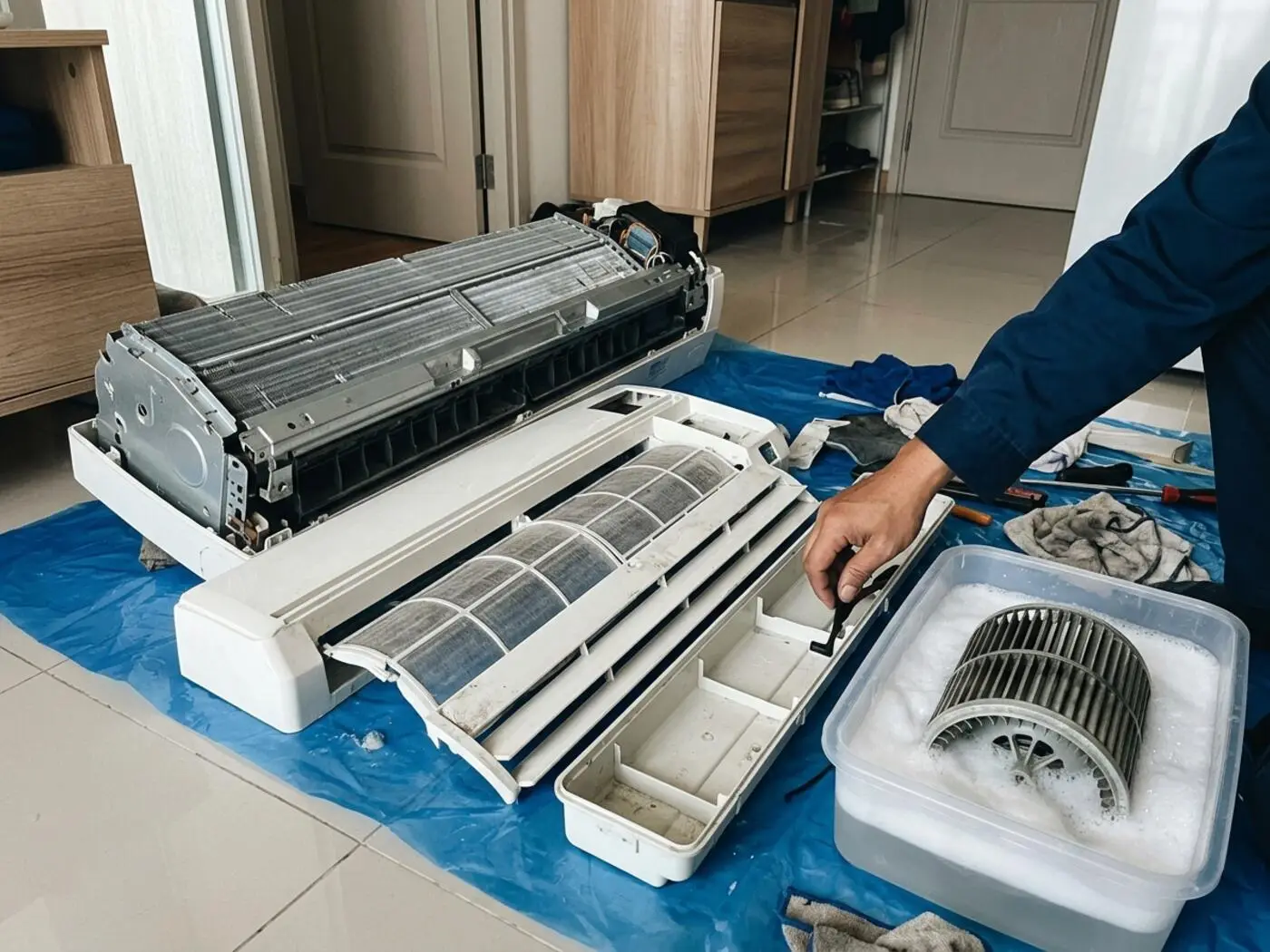
Most people notice it before they see it. The unit starts, and for a minute the room smells of damp towels. Or you take the front cover off to rinse the filter and see a dark, speckled coating on the plastic drum behind it. Either way the question is the same, whether you type it as "mould" or "mold in air conditioner": is it really mould, does it matter, and what actually gets rid of it?
This guide is the full answer: why a split unit is such a good home for mould, where it hides, how Bangkok's climate speeds things up, what WHO, EPA and CDC say about health, and which cleaning method removes it. Mould in an AC is common and fixable, and not a reason to panic.
Why an air conditioner is an ideal place for mould to grow
Moulds are fungi, and the one thing every species needs is moisture. EPA's overview of moulds says they grow wherever moisture and oxygen are present, and that they reproduce by releasing tiny spores, roughly 2 to 10 micrometres across, which drift through indoor and outdoor air. Spores are always around. What decides whether they grow is whether they land somewhere wet.
An air conditioner manufactures that wet place on purpose. The evaporator coil, the block of thin aluminium fins behind the filter, runs far colder than the room air. Warm, humid air meets the cold metal and water condenses out of it, exactly as it does on a cold glass on a humid day. EPA's page on biological contaminants describes that same mechanism, and the WHO guidelines on dampness and mould note that air-conditioning systems produce moisture on their cool surfaces, over which all the air delivered to the occupants flows. The same chapter names the wet surfaces of cooling coils and condensate drip pans as the places where microorganisms grow in such systems.
So the first ingredient, water, is built in. The other three arrive for free:
- Food. Mould does not need much. Household dust is organic material that EPA notes can carry many biological contaminants, and CDC notes that mould can grow in dust. Every litre of air the fan pulls through the unit leaves a little more on the wet surfaces.
- A surface that never fully dries. The coil is wet while the unit cools, the drain pan holds water until it drains, and the blower wheel sits in damp air. In a house that is occupied daily there is little time for anything to dry out.
- Time. Growth is gradual. A coil that was clean at the start of the rainy season can carry a visible film by the end of it.
None of this means your AC is badly made or that you did something wrong; it is the physics of cooling humid air. The goal is not to prevent all growth, which is not practical, but to keep the reservoir small.
Where mould hides inside a wall-mounted split unit
A split indoor unit looks simple from the outside, but air passes through several surfaces on its way to you, and they are not equally easy to see or clean.
| Part | What it does | Why mould likes it | How visible |
|---|---|---|---|
| Filter (mesh at the front) | Catches lint, hair and large dust | Collects the dust that feeds growth; stays damp near the coil | Easy: you can pull it out and see it |
| Evaporator coil fins | Cold surface that cools and dehumidifies the air | Permanently condensing; fins are tightly spaced and trap dust | Hard: only the front edge shows |
| Blower wheel (the long plastic drum) | Pushes air across the coil and out into the room | Sits right after the wet coil; the blades are deep and curved so film packs in | Hard: behind the coil, partly visible through the outlet |
| Drain pan and drain line | Collects and carries away condensate | Standing water and sludge | Hard: low and behind the cover |
| Louvres, vanes and air outlet | Direct the air into the room | Damp air and fine droplets pass over them | Easy: visible from the room |
A 2023 study in Indoor Air took apart household ductless units in 17 Japanese homes and swabbed the filter, heat exchanger (the coil), blower fan and air vent. Every interior part carried a high level of fungal DNA, and the blower fans were the most contaminated. The authors concluded that the parts downstream of the coil are the main contamination sites. In other words, the area you can reach with a damp cloth is the least important part of the picture.
A separate 2024 study in Frontiers in Public Health sampled the air outlet, filter, cooling fins and water sink of ten household units in Chengdu, China, finding large bacterial counts in all four (highest in the water sink) that dropped sharply after a professional disassembly clean. Both studies are small and neither was done in Bangkok, but they agree on where the growth concentrates: behind the filter, around the coil, blower wheel and drain pan.
Why Bangkok units grow it faster than units in dry climates
In a dry or cold climate, an air conditioner is a seasonal appliance. It runs for a few hot weeks, the coil dries out between uses, and the film that builds up dies back. Bangkok is the opposite case.
The Thai Meteorological Department's May 2025 summary records the rainy season beginning on 15 May that year, as the southwest monsoon set in over the Andaman Sea and Thailand. Outside the rains the air is still warm and humid. EPA's guidance also points out that in warm, humid climates the outdoor air brings extra moisture indoors, and that while air conditioning reduces humidity, a home that stays above 60% needs a dedicated dehumidification strategy.
Then add the usage pattern. Many Bangkok bedrooms run the AC every night, which means more condensate, more dusty air pulled through and fewer dry hours. A 2026 pilot study in Indoor Air, a follow-up to the Japanese work above, found fungal DNA inside units had returned to pre-cleaning levels one year after high-pressure washing, and that heavier summer use correlated with a higher fungal burden in the cleaning effluent. That was 17 homes in Japan, so treat it as an indication, not a prediction; we are not aware of a published measurement for Bangkok.
Some situations add more food or more moisture:
- Homes with pets, cooking or smoking. More organic dust passes the filter.
- A partly blocked drain line. It keeps the pan wet, which is why a dripping unit and a musty unit often go together (a leaking unit is covered in our guide to indoor-unit water leaks).
- Rooms that sit closed for weeks. Still, humid air and leftover dust are a poor combination, so a unit in a rental or holiday flat that has been shut for a month deserves a look before it is switched on.
How to tell mould from dust and soot
You cannot identify mould by eye with certainty, and you do not need to. CDC's guidance says mould can appear as spots in many different colours and can smell musty, and that if you see or smell it you should remove it without needing to know the type. EPA's brief guide adds that a building may hold hidden mould if it smells mouldy but you cannot see the source.
Use these clues as a rough sorting guide:
| What you notice | More likely | Notes |
|---|---|---|
| Grey, fluffy, dry material on the filter or front edge | Ordinary dust and lint | Rinse the filter; this is normal |
| A sour, damp-towel smell for the first minute after start-up | Microbial film on the coil or blower | The smell usually fades once the air is cold; see why an AC smells musty |
| Dark spots, speckles or a slimy film on louvres, vanes or blower blades | Mould or biofilm, possibly mixed with dust | Wiping the louvre does not reach the blower wheel behind it; see black mould in an AC unit |
| Fine black powder that smears like soot on vent edges | Dust and other airborne particles | Can be mixed with mould, so look at the blower wheel as well |
| Specks blown out of the vent when the unit starts | Fragments of film or dust loosened from inside | Treat as a sign the interior is dirty |
The most useful home check takes two minutes. Switch the unit off at the wall, shine a torch into the air outlet and look at the blower wheel: a clean one is pale or lightly greyed, a problem one is dark, patchy or coated. Take a photo to compare later.
Resist the urge to buy a mould test kit. EPA says sampling is generally unnecessary when visible growth is present, because there are no federal limits for mould or spores against which to compare a result, and CDC does not recommend testing either. A photo of the blower wheel is more informative than a lab report.
What the evidence says about mould exposure and health
This is the part where it is easy to either under- or over-state the risk, so here is what the major agencies actually say.
The WHO review behind its guidelines on indoor dampness and mould links damp buildings and the microbial growth that goes with them to respiratory symptoms, allergies and asthma, and to disturbance of the immune system. The health-effects chapter of the same guidelines adds that a number of studies have suggested increased risks of building-related symptoms, including lower respiratory symptoms, from poorly maintained heating, ventilation and air-conditioning systems, probably because of microorganisms growing on their moist surfaces. It singles out a blinded intervention study in office buildings in which treating the wet cooling coils and condensate drip pans with ultraviolet germicidal light substantially reduced symptoms among occupants. Those were large commercial systems, not wall-split units, but the mechanism is the same: wet, dusty surfaces in the air path.
EPA's page on mould and health explains that mould produces allergens and irritants. Allergic reactions look like hay fever (sneezing, runny nose, red eyes, rash), mould can trigger asthma attacks in people who are allergic to it, and it can irritate the eyes, skin, nose, throat and lungs of allergic and non-allergic people alike. EPA adds that other kinds of symptoms are not commonly reported from inhaling mould and that research is ongoing.
CDC uses similar language: exposure to damp, mouldy environments may cause a variety of health effects, or none at all. It lists a stuffy nose, sore throat, coughing or wheezing, burning eyes and skin rash, and notes that a 2004 Institute of Medicine review found sufficient evidence linking indoor mould exposure with upper respiratory symptoms, cough and wheeze in otherwise healthy people and with asthma symptoms in people who have asthma.
Three honest limits apply:
- Association is not certainty. These sources describe risks across populations. They do not say a particular mouldy AC will make a particular person ill.
- The AC-specific research is small. The Japanese study was done in homes of patients with allergic fungal lung disease; it shows units can carry fungi and be cleaned, not that the AC caused anyone's illness. The Chengdu authors say they did not demonstrate a causal link to infection.
- Legionella is a different issue. EPA's list of settings where Legionella grows is building plumbing, hot-water tanks, cooling towers, fountains and hot tubs, not a typical household split unit, and the Chengdu study's bacterial sequencing did not detect Legionella in any of the ten household units it sampled.
If you have persistent symptoms, an asthma attack that is hard to control, or a weakened immune system, see a doctor. For a wider look at what a dirty unit can and cannot do to health, see dirty air conditioner health effects. Cleaning the unit is a sensible way to reduce a possible source of exposure, but it is not a treatment.
Who should take it more seriously
Mould exposure is not equally important for everyone. CDC lists people with asthma or mould allergy, immune-compromised people and people with chronic lung disease as groups who can have more severe reactions or lung infections. EPA's overview adds that the health risks of indoor mould are especially harmful for children, older people and those with pre-existing respiratory illness.
The NHS page on aspergillosis keeps a sense of proportion. It lists air-conditioning systems among the many places Aspergillus mould is found, but says the infection is rare in healthy people and that most people who breathe the mould do not become ill. Those at risk have a lung condition such as asthma or COPD, a weakened immune system, or a history of tuberculosis.
In practical terms, that means:
- If you are healthy and the unit just smells a bit musty, book a coil and blower clean at the next convenient time rather than treating it as an emergency.
- If someone in the room has asthma, mould allergy, a chronic lung condition or lowered immunity, or the room is a baby's or an older person's bedroom, act sooner and clean the whole unit, not just the filter. Our guide to asthma and air conditioning in Bangkok goes into more detail.
- If symptoms are persistent or severe, talk to a doctor. Do not rely on cleaning alone.
CDC's cleanup guidance adds one more point worth knowing: people with asthma, allergies, immune suppression or underlying lung disease should not be the ones doing mould cleanup, because the cleaning itself disturbs spores. If you are in one of those groups, hand the job to someone else.
What removes it: filter rinse, standard clean or deep chemical wash
Three levels of cleaning are available, and they reach different depths. The choice is a matter of how established the growth is.
| Option | What it reaches | When it is enough | Cost at CoolRova |
|---|---|---|---|
| Filter rinse at home | Filter only | Routine upkeep; does not touch the coil or blower | Free |
| Standard clean | Filter, coil and blower wheel washed in place with coil cleaner and a low-pressure rinse inside a sealed wash bag; drain line flushed and tested | Light film, faint smell, regular maintenance | From ฿690 per unit |
| Deep chemical wash | Blower wheel removed; louvres and drain pan stripped; coil foamed and soaked; everything pressure-washed; antibacterial and anti-mould treatment applied | Visibly dark blower wheel, smell present for months, symptoms | From ฿1,290 per unit |
EPA explains why removal matters: chlorine bleach and other biocides are not recommended as routine mould treatment, and dead mould can still cause allergic reactions, so it is not enough to kill it. In an AC, removal means flushing the film out of the coil fins and blower blades with water.
The research supports physical cleaning. In the 2023 Japanese study, disassembly followed by high-pressure washing reduced fungal abundance by more than 99% in every part tested, and the Chengdu study recorded sharp falls in bacterial and fungal counts after a professional disassembly clean. Those were research protocols, not a promise about any particular job, and measuring DNA is not the same as measuring health benefit. The full comparison of the two professional options is in standard clean vs deep chemical wash.
What a technician does during a mould-focused clean
Whatever company you use, a mould-focused job should follow a recognisable sequence, with evidence you can see.
- Inspect and photograph first. The technician opens the cover and photographs the filter, coil face and blower wheel before touching anything. This is the baseline you will compare against.
- Protect the unit and the room. Wet cleaning needs a way to keep water off the electronics, walls and floor. CoolRova's standard clean works inside a sealed wash bag.
- Wash the coil and blower with coil cleaner, then rinse. On a standard clean, the filter, coil and blower wheel are washed in place and the rinse is low pressure.
- Remove and strip the parts that cannot be reached in place. On a deep chemical wash the blower wheel comes out, the louvres and drain pan are stripped, the coil is foamed with a biodegradable cleaner and soaked, and everything is pressure-washed. An antibacterial and anti-mould treatment is part of the job. Allow 60 to 90 minutes per unit.
- Flush and test the drain. A clean coil on top of a sludgy drain line just moves the problem.
- Run the unit and record the result. Supply-air temperature is logged before and after on a standard clean, and the finished job comes with a before and after photo report.
Questions worth asking any technician: Will I see photos of the blower wheel, not just the front panel? Is it cleaned in place or removed? How is water kept off the electronics? Is the coil cleaner rinsed out? Our guide to blower wheel cleaning shows what good evidence looks like.
Why it comes back, and how to slow regrowth between cleans
The standard mould advice, from EPA's brief guide to mould and moisture, is that if you clean mould but do not fix the water problem it will most likely return. In an air conditioner you cannot remove the water source, because condensation is how the machine works. That is why the aim here is a slower return, not a permanent cure, and why the pilot study above found fungal levels back at baseline after a year.
These habits help, but none replaces a clean:
- Rinse the filter every two to three weeks. It keeps dust from reaching the coil.
- Dry the coil after use. Many remotes have a "dry", "clean" or fan-only mode, or you can switch to fan only for a few minutes before turning the unit off. This is a low-cost habit, not a proven fix; we are not aware of strong research on how much it helps.
- Keep the drain working. EPA's guide says to keep air-conditioning drip pans clean and drain lines unobstructed. A pan that stays wet feeds growth.
- Control room humidity. CDC suggests keeping indoor humidity no higher than 50%, and EPA's biological contaminants page says below 60%, ideally 30 to 50%. A bathroom door left open after a shower works against you.
- Schedule cleans rather than waiting for a smell. Our guide to preventing mould in an air conditioner in Bangkok covers a practical schedule, and CoolRova's year packages (from ฿1,240 for two cleans a year, or from ฿2,190 for four, which includes one deep chemical wash per unit) exist for this reason.
Mistakes to avoid
Spraying bleach or disinfectant into the unit. EPA does not recommend bleach as a routine mould treatment and warns never to mix it with ammonia-containing cleaners, because toxic fumes result. And an indoor unit holds a circuit board and motors that are not meant to be sprayed.
Using scented sprays, essential oils or odour neutralisers. They mask the smell and leave the film where it is. CDC's advice is to remove mould, not cover it.
Wiping the louvres and calling it done. The blower wheel behind them is a much larger surface.
Running the unit as normal when you suspect heavy contamination. EPA's brief guide says not to run an HVAC system you know or suspect is contaminated with mould, because it could spread it through the building. That advice is general, and a bedroom AC in Bangkok is not something most people can simply leave off. A sensible compromise is to use the unit as little as comfort allows until it is cleaned, particularly if someone in the room is in a sensitive group, and to book the clean promptly.
Doing the cleaning yourself if you are in a sensitive group. CDC says people with asthma, allergies, immune suppression or underlying lung disease should not take part in mould cleanup.
When to call a professional
Rinse the filter yourself, but call a professional when:
- the smell has lasted weeks or returned after a filter clean,
- the blower wheel looks dark, patchy or slimy through the outlet,
- dark specks are coming out of the vent, or the unit is dripping or the airflow has weakened,
- someone in the room has asthma, allergies, a chronic lung condition or lowered immunity, or the room is a baby's or an older person's bedroom,
- you have just moved into a rental or a unit that has been closed for months.
If symptoms are persistent or severe, see a doctor as well. The clean addresses a possible source; the doctor addresses the symptoms.
CoolRova cleans split units across all Bangkok BTS and MRT zones and has cleaned more than 800 AC units in homes, rentals and businesses. If the growth is light, a standard clean (from ฿690 per unit) removes it; if the blower wheel is visibly dark, the deep chemical wash (from ฿1,290 per unit) is the reset. You can see current rates on the pricing page, and you can reach us on WhatsApp or through the quote form on the contact page. Every clean comes with a before and after photo report so you can see what was removed, and the 30-day cool-again guarantee applies: if the unit is not cold within 30 days, we come back free.
Frequently asked questions
Is mold in an air conditioner dangerous?
For most healthy people it is an air quality nuisance rather than an emergency, but mould produces allergens and irritants and can trigger asthma and allergy symptoms. People with asthma, mould allergy, lung disease or weakened immunity, plus young children and older adults, are more sensitive. If you have persistent symptoms, see a doctor and have the unit cleaned.
How do I know if there is mould in my aircon?
The usual signs are a musty smell when the unit starts, dark specks or a slimy film on the louvres and blower wheel, and respiratory symptoms that seem to ease when you leave the room. Because most growth is behind the filter, the only reliable check is looking at the blower wheel with the cover open or in a technician's photo.
How do I get rid of mould in an air conditioner?
Rinse the filter, then have the coil, blower wheel and drain pan cleaned. A standard clean washes them in place; a deep chemical wash removes the blower wheel and strips the drain pan and louvres, which is the right choice when the growth is established. Killing mould is not enough, because dead mould can still cause allergic reactions, so it needs to be removed.
Can I spray bleach or disinfectant into the unit?
Not recommended. EPA does not advise bleach as a routine mould treatment, and you must never mix it with ammonia-based cleaners. Liquids sprayed into an indoor unit can also reach the circuit board and motors, and spraying does not remove the growth packed between the blower blades.
Why does mould come back after cleaning?
Every cooling cycle produces fresh condensate on the coil, so the moisture source never goes away, and dust arrives with the air that passes through. A Japanese pilot study found fungal levels inside residential units had returned to pre-cleaning levels a year after high-pressure washing, which is why regular cleans matter more than one big clean.
Do I need to test the mould to know what type it is?
No. EPA says sampling is usually unnecessary when mould is visible, and CDC does not recommend mould testing because the advice is the same whatever the type: remove it and fix the moisture. A photo of the blower wheel tells you more than a lab result would.
Need it handled professionally?
Get a fixed quote for your units in under 60 seconds.
Written by the CoolRova Team
We're Bangkok's documented AC crew — everything we write comes from real cleaning, repair and installation visits across condos, homes and short-stay rentals.
Get our Bangkok AC guides straight in Google — add CoolRova as a preferred source.