
It happens in the first ten minutes. You switch the air conditioner on, settle on the sofa or into bed, and within a few minutes your nose runs, you sneeze, and your eyes itch. Switch it off, open a window, and it gets better. Naturally you conclude that you are allergic to the air conditioner.
That conclusion is half right, and the half that is wrong matters, because it decides what you should fix. This guide explains what is really happening, how to separate allergy from simple cold-air irritation, why Bangkok makes the allergen problem a year-round one, and a three-layer plan that starts with the unit and ends with your bedroom. It is general information. It cannot diagnose an allergy, which needs a doctor.
Why "allergic to the AC" is half right
Nobody is allergic to cold air. An allergy is an immune reaction to a specific substance, such as a protein from dust mites, mould spores or pet dander. The NHS describes allergic rhinitis as the nose becoming irritated by something you are allergic to, with common triggers including pollen, house dust mites, animal dander and mould, and symptoms that usually appear within minutes of contact.
What an air conditioner can do is change your exposure to those substances in two ways.
It can concentrate and re-circulate allergens. A split-type unit takes air from the room, passes it through a filter and across the coil, and returns it. If dust, dander and mould build up on the filter, fins and blower wheel, the fan can push some of it back into the room every time it runs. The US EPA's page on biological contaminants says contaminants can enter and build up through poorly maintained ventilation systems, and lists mould, dust mites, pollen and pet allergens among the triggers of asthma symptoms and allergic reactions, including nasal inflammation, allergic rhinosinusitis and headaches. The Asthma and Allergy Foundation of America (AAFA) is more direct about air conditioners: on its mould allergy page it says air conditioners and dehumidifiers can also be a source of mould.
It can irritate the nose without any allergy. Cold, dry air can inflame the lining of the nose in some people. That is non-allergic rhinitis, and it is covered below.
Many people have a mix: an allergy to dust mites or mould, plus a nose that over-reacts to cold air. That is why cleaning the unit often helps but does not always solve everything. For a broader look at how a dirty unit can affect you, including non-allergic effects, see our guide to dirty air conditioner health effects.
The four allergens an unclean unit concentrates
1. Mould spores and fragments
The coil is wet every time the unit cools, and the blower wheel sits in that damp airstream. Dust lands on the wet surfaces and microbes grow on it. The AAFA says inhaling mould spores causes allergic reactions in some people, that spores reach the nose and can trigger rhinitis symptoms or asthma, and that mould is an irritant as well as an allergen, so spores can cause irritation or inflammation even in people who are not allergic. Its symptom list is familiar: runny or stuffy nose, postnasal drip, sneezing, itchy nose, eyes, ears and mouth, red and watery eyes, and swelling around the eyes. It notes that indoor moulds can cause symptoms year-round, and that mould allergy can give delayed symptoms as well as immediate ones.
2. Dust-mite allergen
Dust mites are microscopic animals that feed on shed skin and thrive in warm, humid conditions. The American Lung Association's dust mite page explains that people who are allergic react to proteins from mite faeces, urine and decaying bodies, that the allergen settles quickly into fabrics rather than staying airborne, and that most exposure happens while sleeping. So the mites mostly live in your mattress, pillows and soft furnishings, not in the air conditioner. What the unit does is stir that dust when the air moves, and a loaded filter and coil add to the dust in the room. This is why bedroom control, covered in Layer 3 below, matters as much as the unit.
3. Pet dander
Dander is the flakes of skin shed by animals. The AAFA notes that there is no such thing as a hypoallergenic pet, and that pet allergens are sticky, so they cling to filters, fins and fabrics. A unit in a room where a cat or dog sleeps will collect fur and dander on the filter quickly. Our guide to pets and air conditioner hygiene covers how to manage that.
4. Pollen and fine dust
Thai clinic data (below) points to mites as the leading allergen, so pollen is probably a smaller part of the indoor picture here than in a temperate country. Fine particles from traffic, construction and smoke are a separate issue. The EPA's page on indoor particulate matter says indoor particles include those that migrate in from outdoors, and the WHO Thailand office says air pollution in Thailand is seasonal, with people in Bangkok commonly seen wearing masks or running air purifiers at home from December to February. Particles are not allergens in the strict sense, but the EPA links exposure to eye, nose and throat irritation and to worse respiratory symptoms. See our PM2.5 season guide for how a loaded filter copes with dust in those months.
Allergic or non-allergic: how to tell
Both can make you sneeze and fill your nose when the unit is on. Both can happen to the same person. The table sets out the differences using NHS and Cleveland Clinic descriptions.
| Feature | Allergic rhinitis | Non-allergic (cold-air) rhinitis |
|---|---|---|
| What happens | Immune reaction to an allergen such as dust mite, mould or dander | Nasal lining irritated without an allergic reaction |
| Typical triggers | Dust mites, mould, pet dander, pollen | Temperature or humidity changes, smoke, perfume and paint fumes, certain medicines |
| Symptoms (NHS lists) | Sneezing, itchy nose, runny or blocked nose, itchy red watery eyes, cough | Blocked or runny nose, sneezing, sore throat, post-nasal drip |
| Timing | Usually within minutes of contact | Follows the trigger, such as a cold draught or temperature change |
| Clue | Worse in dusty or damp rooms and after disturbing bedding; may run in families with eczema or asthma | Worse in a cold, dry draught; may ease when the setpoint is raised or the airflow redirected |
| Testing | Skin prick or blood test | A doctor rules out allergy and other causes |
On cold air specifically, the Merck Manual's clinical entry on nonallergic rhinitis singles out cold air and a dry atmosphere as particular triggers of vasomotor rhinitis, which it calls the most common subtype. The underlying problem is a nasal lining that reacts too strongly to ordinary changes in temperature, pressure and humidity, and no allergy can usually be identified. That is a fair description of what a louvre blowing cold, dry air at a face all night does to some noses. The NHS page on non-allergic rhinitis lists changes in the weather, such as temperature or humidity, among the causes and says the condition is not harmful but can affect your life. The Cleveland Clinic's page on allergic rhinitis makes the same point: not all rhinitis is allergic, and non-allergic rhinitis produces similar symptoms. It also notes that itchy, red, watery eyes are common with allergies but less common with a cold.
A few practical tells. Itchy eyes and an itchy nose lean towards allergy. A watery, blocked nose that eases when you move out of the draught leans towards cold-air irritation. A fever, body aches and a pattern that lasts a week or two and then goes lean towards a cold. None of this is definitive, which is the reason testing exists.
Why Bangkok's humidity makes it a year-round problem
Dust mites do not drink; they absorb moisture from the air. The American Lung Association calls humidity the most important factor in whether a home has high levels of dust mites. National Jewish Health says mites are most common in humid climates and do not survive when the humidity is below 50 per cent, rating 40 to 50 per cent as marginal, 50 to 60 per cent as bothersome and anything above 60 per cent as worse. The AAFA says that if indoor humidity is above 50 per cent, mould will thrive, and that its goal is 30 to 50 per cent.
Bangkok's outdoor air is routinely well above those figures. Air conditioning pulls humidity down while it runs, which is a point in its favour: National Jewish Health calls air conditioning an effective way to control indoor moisture, and the American Lung Association says air conditioning and dehumidifiers help in humid areas. But in a typical Bangkok home the unit cycles on and off, runs only at night, or is switched off while everyone is out, and humidity climbs back each time. Bedding and soft furnishings spend long periods in the range mites like.
Thai clinical data agrees that mites are the main inhaled allergen. In a twenty-year retrospective study of chronic rhinitis patients at clinics in Chiang Mai, mite sensitisation was the most frequent finding among those with allergic rhinitis, at about 86 per cent on skin testing, and the authors cite earlier Bangkok and Ayutthaya studies reporting 50.1 to 62.2 per cent. A study of 100 children with allergic rhinitis at a clinic in eastern Thailand found that 90 per cent were sensitised to Dermatophagoides pteronyssinus, a common house dust mite, and the authors concluded that house dust mites are the most common cause of allergic rhinitis in that group. These are clinic patients, not the general population, so they do not tell us how common allergy is in Bangkok overall. They do suggest which allergen to take most seriously.
For you the practical conclusion is simple: do not rely on the season. In Bangkok the mite and mould problem does not switch off in the cool months.
The self-test: a week of notes, a filter check, two rooms
You can narrow things down at home before you spend money.
- Keep a symptom diary for one to two weeks. Note the room, whether the unit was running, the setpoint, and symptoms on waking, in the afternoon and at bedtime. Add anything else that changed: new bedding, a cleaning session, smoke, a pet's visit.
- Compare bedroom and living room. If you sneeze in the bedroom but not the living room, suspect the bed and its dust, not the unit alone. If both rooms are equally bad, suspect something broader or the units themselves.
- Check the filter. Switch off the unit, lift the front panel and look at the filter. Grey felt means overdue; rinse it and note whether symptoms change over the next few days.
- Try fan-only. Pick a mild evening and run the unit in fan mode for an hour or two without cooling. The fan still moves room air across the coil and filter, so any dust or spores are still in play; what changes is the temperature and dryness of the air. No reaction in fan mode but a reaction once cooling starts points towards cold-air irritation. A reaction in both modes points towards what is on the coil, in the filter or in the room.
- Change the airflow. Aim the louvres away from where you sit or sleep and raise the setpoint a little. If symptoms ease, the draught was part of the problem.
- Change one thing at a time and wait several days before judging.
Treat the result as a clue, not a diagnosis. Persistent, repeating symptoms are a reason to see a doctor.
Fix layer 1: clean the coil, blower wheel and drain pan
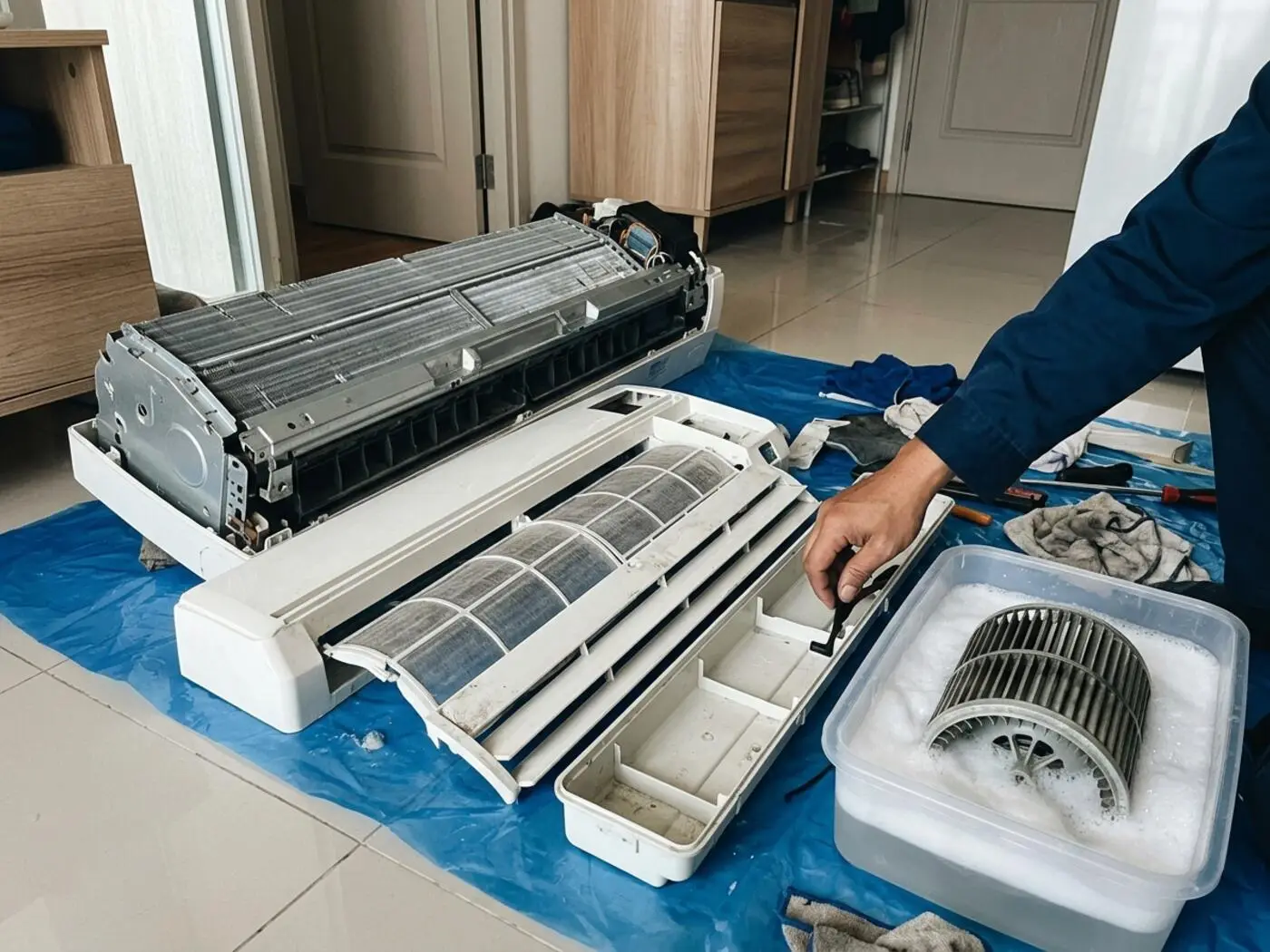
The unit comes first, because it is the one thing that is both a source and a distribution system. A proper clean removes the dust, biofilm and mould from the surfaces the air passes over.
- A standard clean (from ฿690 per unit) is the routine option. The filter, evaporator coil and blower wheel are washed in place, with a sealed wash bag over the unit to catch the coil cleaner and the low-pressure rinse. The drain line is flushed and tested so condensate leaves the pan instead of pooling in it, the supply-air temperature is logged before and after, and the before-and-after photos show you what came off.
- A deep chemical wash (from ฿1,290 per unit) is for a unit where growth is established, which for an allergy household is usually the one that has gone a year or more without a proper clean. The blower wheel comes out, the louvres and drain pan are stripped, the coil is foamed with a biodegradable cleaner and left to soak, everything is pressure-washed, and an antibacterial, anti-mould treatment is applied. Allow 60 to 90 minutes per unit; a photo report is included.
Standing water matters too. National Jewish Health advises that an indoor air conditioner should have good drainage so that there is no standing water inside or around it, and the American Lung Association recommends keeping appliance drip pans clean.
For households with allergy sufferers, our cleaning frequency guide suggests a shorter interval than the usual six months, and the 4-Visit Year Package, from ฿2,190 for one unit, schedules quarterly cleans and includes one deep chemical wash per unit. Cleaning does not cure an allergy, and we do not claim it does. It removes the unit as a source.
Fix layer 2: filter habits, and what filters can and cannot catch
Between cleans, the filter is the part you control.
- Rinse the mesh filter every two to three weeks in Bangkok, and every week or two if a pet sleeps in the room. Let it dry fully before it goes back; a damp filter is a place for growth.
- Do not run the unit without the filter. It lets dust straight onto the coil.
- Do not expect the filter to catch allergens. The mesh in a typical split-type unit is built for lint, hair and coarse dust. Fine particles, dust-mite allergen fragments and spores pass through, which is why the coil and blower wheel need washing too. The EPA's guidance makes the same point about filtration generally: filters can remove some but not all biological contaminants, and a dirty, overloaded filter will not work well.
- Run fan-only for a few minutes before you switch off where your remote allows it, so the coil dries rather than staying wet overnight.
Windows and doors matter as well. The AAFA's guidance on controlling indoor allergens advises keeping windows and doors closed and running the air conditioner on recirculate to cut outdoor allergens such as pollen and mould, and says that air conditioners help reduce humidity too. In Bangkok, that suggests running the unit with the room closed rather than leaving a window ajar, and ventilating briefly at times of the day when outdoor air is clean.
Fix layer 3: bedding, humidity and bedroom habits
Since most dust-mite exposure comes during sleep, the bed deserves as much attention as the unit. The AAFA, the American Lung Association, National Jewish Health and the NHS agree on the main steps.
- Cover the mattress and pillows with zippered allergen-resistant covers. The AAFA says these are very effective and that encasing mattresses works better than air cleaners to reduce allergy symptoms.
- Wash bedding every week in hot water. The AAFA and National Jewish Health recommend at least 130 degrees Fahrenheit (about 54 degrees Celsius); the American Lung Association says at least 120 degrees; the NHS suggests 60 degrees Celsius and above. Dry thoroughly.
- Reduce places where dust collects: heavy curtains, rugs, stuffed toys and clutter. Bare floors are best in the bedroom. If you must have soft toys, wash them weekly in hot water.
- Dust with a damp cloth and vacuum with a HEPA filter, ideally while the allergic person is out of the room.
- Keep pets out of the bedroom, as the AAFA and NHS both recommend.
- Watch humidity. A small hygrometer (a humidity meter) costs little. Aim for as low as is comfortable, with the AAFA's 30 to 50 per cent as the target, and fix leaks and damp. Our guide to bedroom air conditioner hygiene and sleep goes into night-time routines in more detail.
None of these steps is dramatic, and together they do more than any single gadget.
Air purifiers: what they add and what they do not replace
A portable air cleaner is a sensible supplement for some households, and the evidence is modest. The EPA's guide to air cleaners in the home says several studies with portable HEPA air cleaners have shown small improvements in cardiovascular and respiratory health, and that multiple studies have found improvements in one or more allergy or asthma symptoms, though not always major ones and not in all symptoms. It also says no air cleaner eliminates all pollutants, filtration does not replace controlling pollutants and ventilating, and, crucially, portable air cleaners and HVAC filters do not address the cause of mould and musty odours, which is a moisture problem.
For an air conditioner problem, that means:
- A purifier can reduce airborne particles in a bedroom, including some of the particles from mould, but it will not stop a wet, dirty coil from growing more.
- Pick one sized for the room, using the clean air delivery rate (CADR) on the label, and replace filters on schedule.
- The AAFA advises avoiding devices that treat air with heat, electrostatic ions or ozone.
- A purifier is one layer, not a substitute for Layers 1 to 3.
When to see a doctor or allergist, and what tests exist
Home steps are worth trying, but some situations need a professional. The NHS advises seeing a GP if allergic rhinitis symptoms get worse, you also have asthma that is worsening, symptoms affect your sleep and everyday life, you are not sure what is causing them, or treatments from a pharmacist are not working. The same list applies to non-allergic rhinitis. Seek care promptly for wheeze, chest tightness or breathlessness. The Cleveland Clinic notes that people with airborne allergies have a higher risk of ear and sinus infections.
On testing, the AAFA explains that a doctor diagnoses mould allergy from your history, an examination and often skin or blood tests. National Jewish Health describes skin prick testing, intradermal testing and blood tests for allergy-specific antibodies for dust mite allergy. On treatment, a pharmacist can advise on options such as antihistamines and nasal sprays; the NHS notes that decongestant nasal sprays should not be used for longer than five days because they can make a blocked nose worse. A GP can prescribe stronger medicines or refer you to a specialist. Allergen immunotherapy exists for some allergies, and your doctor can say whether it suits you. Do not treat your own persistent symptoms for weeks without advice.
Our asthma and air conditioning guide covers the extra care needed if you have a diagnosed asthma condition.
When to call a professional for the unit
Call a technician if:
- A musty or sour smell on start-up does not go after a filter rinse.
- You can see dark flecks at the vent, on the louvres or on the blower wheel.
- Symptoms clearly follow the unit, and it has been six months or more since a proper coil and blower clean.
- The unit drips, airflow is weak, or the room cools slowly.
- Someone in the home has asthma, allergies or a weakened immune system, and the unit has not been cleaned for a long time.
CoolRova has cleaned 800+ AC units across Bangkok homes, rentals and businesses, covers all BTS and MRT zones and is open daily from 8:00 to 20:00. A standard clean starts from ฿690 per unit, and the photo report shows what came off the coil and blower wheel. To book or ask a question, use WhatsApp or the quote form on our contact page. We will tell you what your unit needs, and we will not tell you it will cure an allergy.
Sources and further reading
- AAFA: Mold allergy
- AAFA: Control indoor allergens
- NHS: Allergic rhinitis
- NHS: Non-allergic rhinitis
- Cleveland Clinic: Allergic rhinitis (hay fever)
- Merck Manual: Nonallergic rhinitis
- American Lung Association: Dust mites
- National Jewish Health: Dust mite allergy
- US EPA: Guide to air cleaners in the home
- US EPA: Biological contaminants and indoor air quality
- WHO Thailand: The cost of clean air in Thailand
- Journal of Asthma and Allergy: Aeroallergen sensitisation in chronic rhinitis in Chiang Mai
- Burapha Journal of Medicine: Aeroallergen sensitisation in children with allergic rhinitis in eastern Thailand
- US EPA: Indoor particulate matter
This guide is general information, not medical advice.
Frequently asked questions
Can an air conditioner cause allergies?
An air conditioner does not create an allergy, but a dirty one can concentrate and re-circulate the things people are allergic to, such as mould spores, dust-mite allergen and pet dander. Cold, dry air can also irritate the nose without any allergy involved. Both can produce sneezing and a runny nose when the unit is on.
Why do I sneeze when the AC is on?
There are two common reasons. Airflow can stir up dust and allergens that have settled on a loaded filter, coil or blower wheel, or in the room itself, which triggers an allergic reaction. Or cold, dry air can irritate the lining of your nose, a condition called non-allergic rhinitis. A symptom diary and a clean unit help you tell which is which.
How can I tell AC allergy from a cold?
A cold usually builds over a day or two, passes within a week or two and may come with a fever or aches. Allergic symptoms such as sneezing and itchy nose or eyes tend to start within minutes of contact with the trigger and last as long as exposure continues. If symptoms keep returning in the same room, think allergy or irritation rather than infection.
Does cleaning my air conditioner help with allergies?
It can help by removing mould, dust and biofilm from the coil, blower wheel and drain pan, so the unit stops re-circulating them. It will not remove dust mites from your mattress or treat an allergy. Combine it with filter rinsing, hot-washed bedding and humidity control, and see a doctor if symptoms continue.
Do air purifiers help with air conditioner allergies?
Studies with portable HEPA air cleaners have found improvements in some allergy and asthma symptoms, though not always large ones. They do not fix a mouldy coil, because they do not address the moisture and growth behind it. Use them as a supplement to cleaning the unit and controlling the source.
Should I see an allergist?
Yes if symptoms are persistent, affect your sleep or daily life, or you also have asthma. Allergy testing is usually done with a skin prick test or a blood test, and a doctor can advise on medicines and avoidance. This guide is general information and cannot diagnose an allergy.
Need it handled professionally?
Get a fixed quote for your units in under 60 seconds.
Written by the CoolRova Team
We're Bangkok's documented AC crew — everything we write comes from real cleaning, repair and installation visits across condos, homes and short-stay rentals.
Get our Bangkok AC guides straight in Google — add CoolRova as a preferred source.