
Most people clean their air conditioner when something goes wrong: the room will not cool, water appears on the floor, or a smell makes the bedroom unpleasant. If nothing is wrong, the sensible question is whether cleaning is worth paying for at all.
This guide makes the case for cleaning, and also marks its limits. It sorts the benefits into four buckets that the evidence supports (the air you breathe, airflow and comfort, energy and compressor life, and a clear drain), then says plainly what cleaning does not do. It is written for a Bangkok household or small business with split-type units, and it avoids invented percentages. Where a source gives a figure we report it with its context; where nobody has measured, we say so.
Why "it still works" is not the same as "it is clean"
An evaporator coil does not fail suddenly. Dust that gets past the filter lands on wet aluminium fins, bacteria and mould settle in the film, and the layer thickens over months. Each week the unit loses a little airflow and a little heat transfer, and the compressor quietly compensates by running longer. Nothing looks wrong because nothing changed overnight.
That gradual pattern is why the first obvious symptom comes late. By the time you see ice, smell mustiness or find a puddle, the coil has usually been loaded for a long time. Our diagnostic guide to dirty evaporator coil symptoms lists them in the order they appear; this article is about getting ahead of that sequence.
The speed matters too. A study of HVAC heat exchangers in a full-scale test system found that ordinary aluminium exchangers developed stable mixed bacterial and fungal biofilms within four weeks of operation. It was a test rig with single-pass outside air, and some of the authors had links to the copper industry, so it is not a measurement of your unit. But it supports a simple point: a wet aluminium coil is colonised quickly, and "still works" says little about what is growing on it.
ENERGY STAR makes the same argument in a more practical way. Its maintenance checklist recommends annual pre-season check-ups by a contractor, with cooling systems checked in spring, precisely because problems are cheaper to prevent than to react to. Bangkok has no off-season, so the schedule here is tighter, as we explain below.
Benefit 1: a smaller reservoir of mould, bacteria and allergens in the air you breathe
This is the benefit most people care about and the one that needs the most careful wording.
What the sources actually say
The US EPA lists bacteria, fungi such as mould, dust mites, pollen and pet allergens among biological contaminants that can affect indoor air and occupant health, and notes that poorly maintained ventilation systems are one way they get indoors and that moist areas encourage their growth. The EPA's separate guidance on duct and system cleaning adds that if heating and cooling components are not properly maintained, dust and debris can accumulate, and where moisture is present the potential for mould growth increases and spores may be released into living space. A cooling coil is a permanently damp component by design, which is why it comes up.
On health effects, the WHO's review of the evidence on indoor dampness and mould concludes that the most important effects are increased prevalence of respiratory symptoms, allergies and asthma, and that preventing or minimising persistent dampness and microbial growth is the most important way to avoid harm. The EPA lists mould among the asthma and allergy triggers that can cause coughing, chest tightness, wheezing and allergic reactions, and says children, pregnant women, older adults and people with existing medical conditions can be more vulnerable to many biological contaminants. The CDC identifies people with asthma, mould allergy, chronic lung disease or a weakened immune system as higher-risk groups, and notes that an air conditioner or dehumidifier can help keep indoor humidity down.
Source control is also the logic the EPA uses to rank approaches: it says that usually the most effective way to improve indoor air quality is to eliminate individual sources of pollution or reduce their emissions. For an air conditioner, the source on the unit's own side is the wet, dirty coil, blower wheel and drain pan.
What that supports, and what it does not
Taken together, these sources support a modest, defensible claim: a dirty, wet air conditioner can hold microbes and dust, the fan can move some of them into the room, and cleaning reduces that reservoir. They do not support claims that cleaning cures asthma, prevents infections or treats any disease, and we do not make them. Damp and mould are associated with respiratory symptoms; association is not proof that a particular unit is behind a particular person's symptoms.
If you or someone in the home has persistent symptoms, asthma attacks or a weakened immune system, see a doctor. A clean unit is a good habit, not a treatment. Our guides on mould in air conditioners and the health effects of a dirty air conditioner go deeper on the evidence.
A note on Legionella
Readers often ask whether a dirty split unit can cause Legionnaires' disease. The NHS says it is usually caught in places like hotels, hospitals and offices where bacteria have got into the water supply, and is less common at home. The NHS does list air conditioning systems among possible sources, together with hot tubs, humidifiers and rarely used taps, but it means the water-based systems of large buildings: cooling towers and hot-water circuits that hold warm water. A household split unit has no cooling tower or hot-water circuit, and its condensate is cold and drains away, so the risk sits mainly with large building water systems rather than with the unit on your bedroom wall. The case for cleaning your unit rests on mould, bacteria and dust, not on Legionella.
Benefit 2: airflow, faster cooling and comfort
Airflow is the benefit you can feel. Fouling narrows the gaps between the fins and coats the blower blades, so the fan pushes less air across the coil. The room takes longer to reach its setpoint, cooling feels uneven, and the fan runs louder to compensate. ENERGY STAR notes that airflow problems can reduce system efficiency by up to 15 per cent, which is why it recommends cleaning and adjusting blower components. That figure comes from a US central-system context, so it describes the size of the effect rather than predicting what your wall-mounted unit will do.
For comfort, this means:
- a stronger, steadier stream from the louvres;
- a room that reaches temperature sooner and holds it, so you are less tempted to drop the setpoint;
- a quieter fan, because the blower is no longer fighting a restriction;
- no first-minute gust of musty air at start-up, if biofilm was the cause.
CoolRova logs supply-air temperature before and after a standard clean, so the improvement shows up on the photo report rather than being a feeling. For the mechanism behind the symptoms, see how to tell your evaporator coil is dirty.
Benefit 3: energy use and compressor life (what the evidence supports, without invented percentages)
Air conditioning is a large share of household electricity where it is widely used. The US Energy Information Administration reports that in 2020 air conditioning was the largest single category of US residential site electricity consumption at 19 per cent. Bangkok's climate means the share here may well be higher, but we have not found a comparable official figure for Thailand and do not quote one.
What the sources say about cleaning and energy:
- ENERGY STAR says dirty coils make a system work harder and run longer, which raises energy costs and shortens equipment life.
- A laboratory study of room air conditioners found that fouling on the evaporator's air side reduced the coefficient of performance, the cooling delivered per unit of electricity. The loadings were controlled and may not match a household coil, so the lesson is direction, not size.
- The EPA is more cautious than many sales pages. It says that some research suggests cleaning heating and cooling system components such as cooling coils and fans may improve efficiency and extend operating life, while little evidence exists that cleaning ducts alone improves efficiency.
Our honest summary: cleaning a fouled coil and blower should restore some lost efficiency and take strain off the compressor, but nobody can promise a particular saving on your bill. If you want to see the effect for yourself, compare how long the room takes to cool and look at your bill over a few comparable months. We cover the money side separately in what a dirty AC adds to your Bangkok electricity bill. The outdoor coil matters as well; a blocked condenser makes the compressor work harder, which is why a good service looks at both units.
Benefit 4: a clear drain and no water damage
A coil that sheds slime also loads the drain pan and the condensate line. Left alone, the line narrows, then drips, then overflows. ENERGY STAR's checklist is plain that a clogged condensate drain can cause water damage in the home and affect indoor humidity.
In a condo, a dripping indoor unit can mean a stained wall, ruined cabinetry or an argument with the neighbour below. The consequence is also a health one: standing water and damp walls are the conditions the WHO and the EPA associate with mould. A clean that flushes and tests the drain removes one of the commonest causes of leaks. For the other causes, see why an indoor unit leaks water in Bangkok.
Benefit 5: catching faults early (gas, capacitor, drain fall) during the visit
A cleaning visit is also an inspection. The technician has the cover off, the coil exposed and the drain running, which is the best moment to notice problems before they become breakdowns:
- Refrigerant. A low charge is a leak, not a consumable. The EPA's homeowner FAQ says that major leaks rarely develop in properly installed and regularly maintained units and asks owners to have leaks located and repaired rather than "topped off", which it says keeps the system at its best while reducing refrigerant emissions and energy use. Catching a slow leak early is cheaper than losing a compressor.
- Capacitor and fan motor. A weak start capacitor or a slowing blower motor shows up as hard starts, noise or reduced airflow.
- Drain fall. A drain line that sags or has no fall will block again, and a visit is when it gets noticed.
- Bent fins and corrosion. Visible once the coil is clean.
ASHRAE's preventive-maintenance checklist for building operators makes the same point at commercial scale, stating that most indoor air quality problems in operating buildings are operations and maintenance failures such as clogged filters, fouled coils and blocked condensate drains. Routine, documented maintenance is the lever it recommends, and a before-and-after photo report is the household version of that record. CoolRova's 2-Visit Year Package includes a free gas and drain check each time for this reason.
What cleaning does not do
Honest limits make the benefits more credible.
- It does not cure or treat illness. It reduces a source of microbes and dust. Medical conditions need a doctor.
- It does not filter outdoor PM2.5. A split unit recirculates room air through a coarse mesh filter and does not bring in or purify outdoor air. The EPA's guide to air cleaners says that no air cleaner or filter will eliminate all of the air pollutants in your home and presents filtration as a supplement to source control and ventilation. In Bangkok's high-PM2.5 season, check the outdoor level on the Pollution Control Department's Air4Thai monitoring site and consider a properly sized air purifier. Our PM2.5 season AC guide covers this in detail.
- It does not remove indoor sources. Cooking fumes, smoking, damp walls and a leaking window will keep producing the problem the unit then circulates. Fix the moisture source as well.
- It does not repair a leak or a worn part. A refrigerant leak, a failing capacitor and a cracked pan need repair. See AC repair.
- It does not last forever. In a wet, dusty climate the film returns, which is why the schedule matters.
- It does not replace humidity control. The CDC suggests keeping indoor humidity no higher than 50 per cent through the day, and the EPA says humidity should stay below 60 per cent and ideally between 30 and 50 per cent. A clean unit that runs properly helps; a damp room still needs attention.
Why Bangkok units need it more often than the manual says
Manufacturer manuals and US guidance typically assume a cooling season followed by months when the unit is off, with a check once a year before the season starts, as in the ENERGY STAR advice above. Bangkok differs in four ways:
- Year-round condensation. The coil is cold and wet every night, with no dry months in which films die back.
- Humid air. Warm, humid outdoor air is brought in around doors and windows. The EPA notes that in warm, humid climates outdoor air can bring additional moisture indoors.
- Dust. Construction, traffic and cooking dust reach the coil face, particularly in condos facing busy roads.
- Long run time. Bedrooms and home offices run for many hours a day, so more air, more dust and more condensate pass over the coil.
The practical effect is that annual service, as the manual says, often leaves a Bangkok coil fouled for most of the year. That is why how often to clean your AC in Bangkok recommends a shorter interval, and why we suggest two cleans a year as a baseline for a bedroom that runs most nights.
Who benefits most: asthma and allergy homes, infants and elderly, pets, rentals, offices
Anyone running a unit benefits, but some households have more to gain:
- Homes with asthma or allergies. The CDC, EPA and WHO identify these as groups for whom mould and damp matter most. Cleaning is one of several steps; read asthma and air conditioning in Bangkok and talk to your doctor.
- Infants, children and elderly residents. The EPA notes that children, pregnant women, older adults and people with existing medical conditions can be more vulnerable to many biological contaminants. See AC hygiene for babies, children and the elderly.
- Pet homes. Fur and dander load filters and coils quickly. See pets and air conditioner hygiene.
- Rentals and Airbnbs. Guests quickly notice smells and weak cooling, and reviews can follow. See the AC schedule for Airbnb hosts and the hosts page.
- Offices, shops and clinics. Units run longer and in rooms with more people. See commercial AC cleaning.
- Bedrooms in general. You spend several hours every night breathing the air that unit moves.
Decision table: household type, interval and standard vs deep wash
This table reflects CoolRova's practical guidance for Bangkok. It is not a clinical recommendation.
| Household or situation | Suggested interval | Standard clean or deep wash |
|---|---|---|
| Bedroom, typical use, no known sensitivity | Twice a year | Standard clean; deep wash if the blower wheel is visibly black |
| Asthma, allergies or a mould-sensitive resident | Four times a year (discuss with your doctor) | Standard clean quarterly; start with a deep wash if never cleaned properly |
| Infants, children or elderly residents | Four times a year | Standard clean, with a deep wash if there is any musty smell |
| Pets in the room | Four times a year | Standard clean; deep wash annually if fur reaches the blower |
| Unit never professionally cleaned, or over a year since | Now, then per the rows above | Deep chemical wash first |
| Airbnb or short-stay rental | Around bookings | HostCool plan, or standard cleans between guests |
| Shop, café, clinic or office | Quarterly, or by use | Standard clean; deep wash on an annual cycle |
Not sure which applies? Standard clean vs deep chemical wash explains how a technician decides when the blower wheel is opened.
Cost versus benefit in baht: what you pay and what you avoid
The price side is simple and published. A standard clean is from ฿690 for one unit, with bundles at ฿1,290 for two, ฿1,790 for three, ฿2,290 for four, ฿2,790 for five and ฿3,290 per visit for six to eight. A deep chemical wash is from ฿1,290 per unit and takes 60 to 90 minutes. For regular schedules, the 2-Visit Year Package starts at ฿1,240 for one unit, with a free gas and drain check at each visit, and the 4-Visit Year Package starts at ฿2,190 for one unit, including one deep chemical wash per unit. Airbnb hosts can look at HostCool from ฿3,490 per property per year. Full details are on the pricing page and in what AC cleaning costs in Bangkok.
What you avoid is harder to put in baht without inventing numbers, so we will not. The honest list is:
- Repair diagnostics. CoolRova's diagnostic is ฿590 (waived if you go ahead with the repair), and a refrigerant top-up starts at ฿990. A unit that is checked on a schedule is less likely to arrive at those visits as an emergency.
- Water damage. We cannot price a stained wall or a neighbour's ceiling, but they are what a blocked drain eventually produces.
- Higher running costs. A fouled coil makes the compressor run longer. The size depends on your unit and use, and the electricity bill guide shows how to compare.
- Shorter equipment life. ENERGY STAR links dirty coils to shorter equipment life. A new split unit costs far more than years of cleans.
- Time without cooling. A unit that fails on a hot night needs a same-day call-out at a stressful moment.
If a clean is done and the unit is still not cold within 30 days, CoolRova's 30-day cool-again guarantee means we return free.
When to call a professional
Rinse the filter yourself every two to three weeks, run the fan or dry mode before switching off, and keep the outdoor unit clear. Everything behind the filter is professional work, because the coil fins are delicate and the refrigerant circuit is regulated. Book a visit if:
- the unit has not had a coil and blower clean in six months or more;
- there is a musty smell, black specks at the vent, or symptoms that start when the unit runs and ease when it is off (see a doctor too);
- airflow, cooling time or your bill has drifted the wrong way;
- ice, dripping or short-cycling appears;
- you are moving into a rental, a new condo or a unit with no service history.
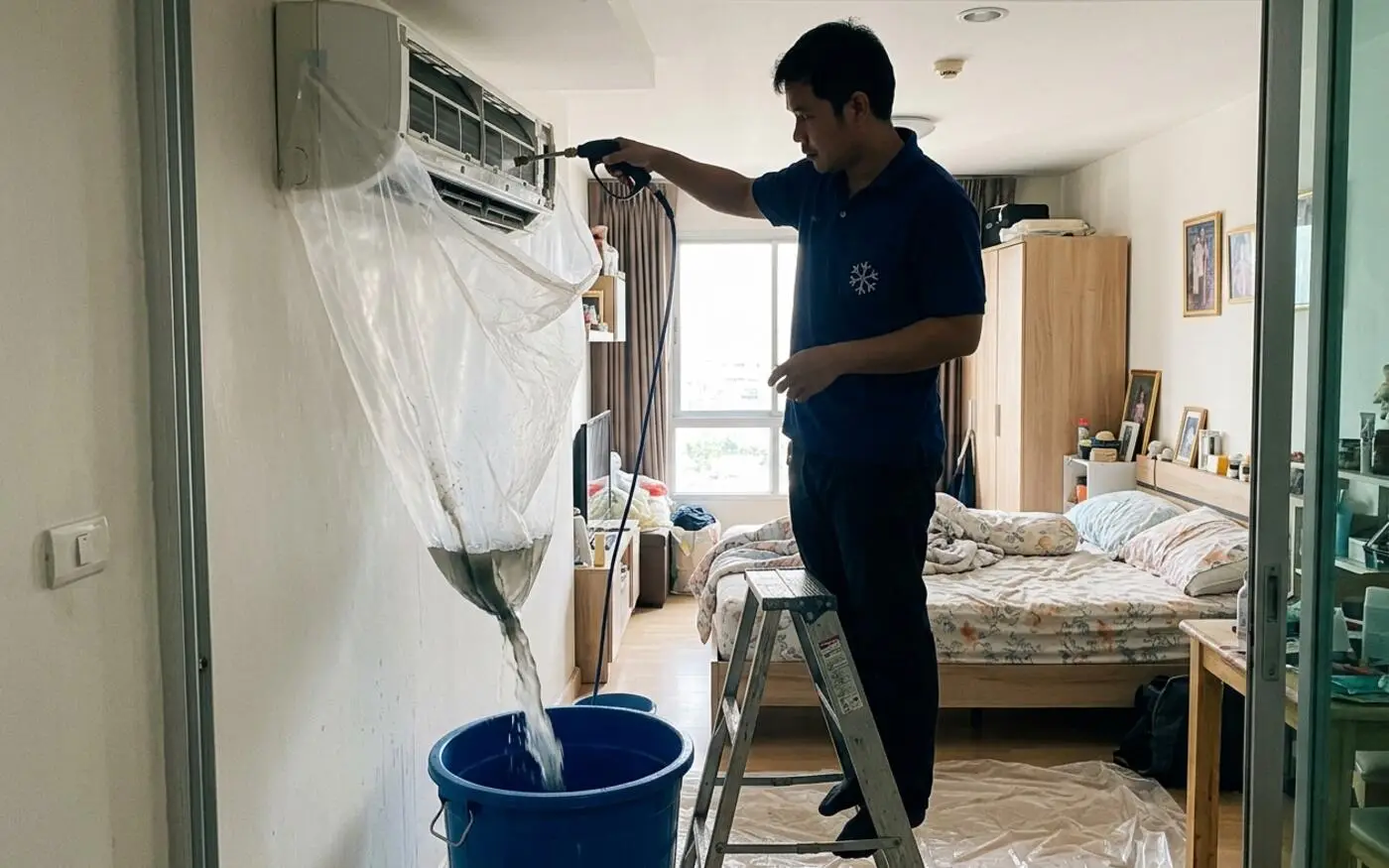
CoolRova cleans split and cassette units across all Bangkok BTS and MRT zones, and has cleaned 800+ units in homes, rentals and businesses. A standard clean washes the filter, coil and blower wheel in place in a sealed wash bag, flushes and tests the drain, logs supply-air temperature before and after, and sends a photo report. The deep chemical wash removes the blower wheel for a full strip-down and anti-mould treatment. We are open daily from 8:00 to 20:00, with same-day no-cool call-outs until 22:00. Message us on WhatsApp or use the quote form on the contact page and we will suggest the right clean for your unit and household.
Frequently asked questions
What are the main benefits of cleaning an air conditioner?
The main benefits are a smaller build-up of mould, bacteria and dust on the coil and blower, stronger airflow and faster cooling, less strain on the compressor, and a clear drain that prevents leaks. A technician also sees early faults during the visit. Cleaning is maintenance, not a medical treatment.
Does AC cleaning improve air quality?
It improves the part of indoor air quality that your air conditioner controls. A dirty wet coil and blower can harbour microbes and dust that the fan then moves around the room, so removing that build-up is source control. It does not filter outdoor PM2.5 or remove cooking, smoking or other indoor sources.
Is it worth cleaning an AC that still works?
Usually yes, because fouling is gradual and the first obvious symptom often comes late. If the unit runs most nights in Bangkok's humidity, the coil is wet every night, so checking it on a schedule costs less than waiting for a smell, ice or a leak.
How often should I clean my air conditioner for health reasons?
For a bedroom that runs most nights, two professional cleans a year is a sensible baseline in Bangkok, and homes with asthma, allergies, infants, elderly residents or pets often choose four. Ask your doctor about any specific condition, since cleaning is not a treatment.
Can a dirty air conditioner make you sick?
Damp and mould are associated with respiratory symptoms and worse asthma, and a wet, dirty coil can grow mould and bacteria. That is an association, not proof that any one unit is causing a particular illness. If you have persistent symptoms, asthma attacks or a weakened immune system, see a doctor.
Need it handled professionally?
Get a fixed quote for your units in under 60 seconds.
Written by the CoolRova Team
We're Bangkok's documented AC crew — everything we write comes from real cleaning, repair and installation visits across condos, homes and short-stay rentals.
Get our Bangkok AC guides straight in Google — add CoolRova as a preferred source.