
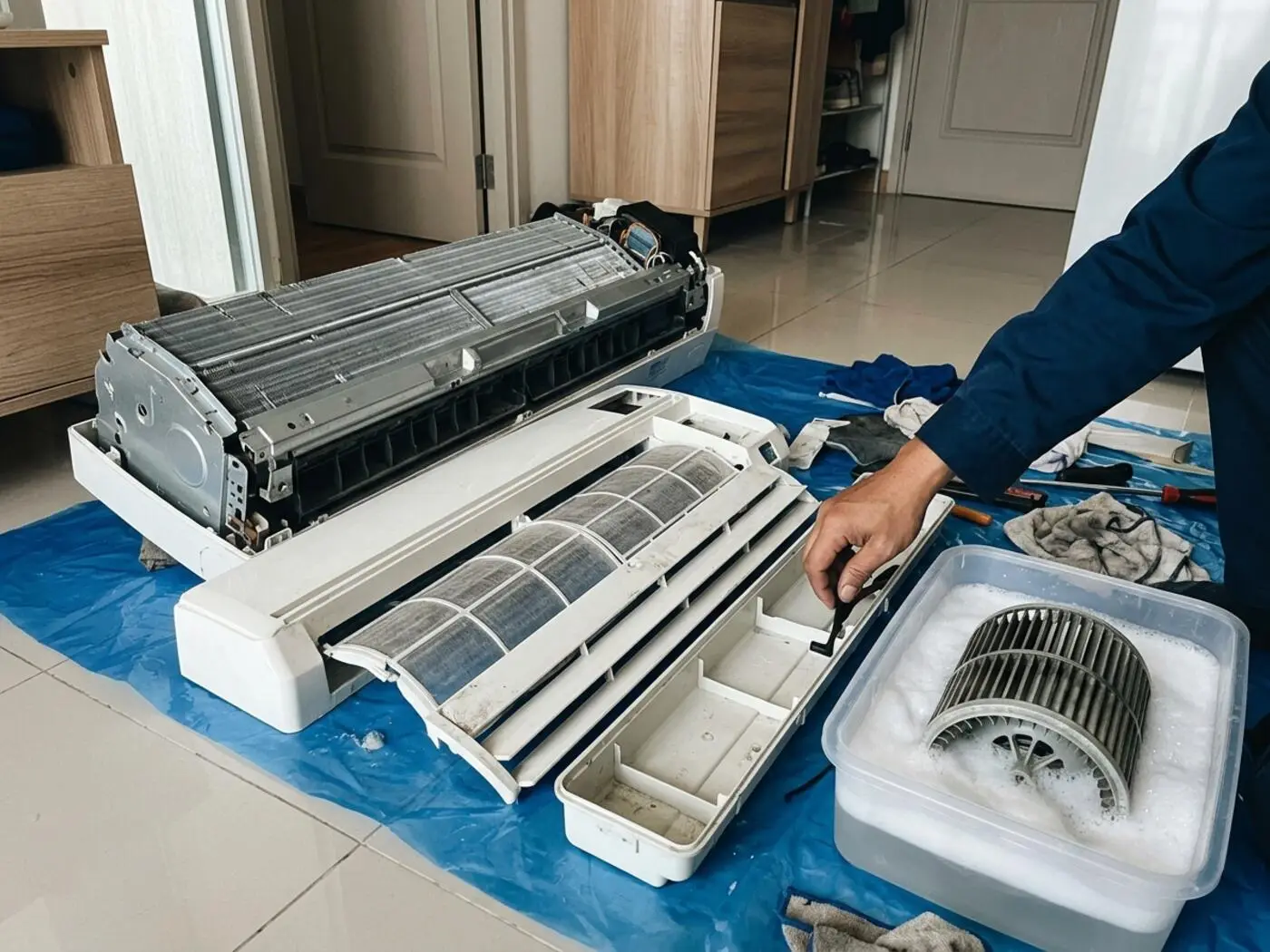
If you share a Bangkok condo with a dog or a cat, you already know the air conditioner is not the same appliance it is in a pet-free flat. The filter looks furry within days. The vents sometimes smell faintly of animal, even when the animal has just been bathed. A family member sneezes more in the bedroom than in the living room and nobody is quite sure why.
None of this means your pet is a problem or that the unit is broken. A pet home simply puts a different load on an air conditioner, and the maintenance has to match. This guide covers what dogs and cats add to the air your unit pulls in, where it ends up inside the machine, why the smell happens, what the evidence says about allergy and asthma, and a realistic cleaning plan. It also covers something most pet guides skip: what happens to the animals if the unit fails in a sealed condo in April.
What pets add to the air an air conditioner pulls in
An indoor split unit works by drawing room air in through the top and front, pushing it across a cold, wet aluminium coil, and blowing it back out. Whatever is floating in the room is what arrives at the filter. In a pet home that is a longer list than usual:
- Hair and fur. The most visible load. The filter catches most of it, but fine hairs slip past worn or loose-fitting filters.
- Dander. Microscopic flakes of shed skin, the part that matters most for allergy (more below).
- Saliva and urine proteins. The Asthma and Allergy Foundation of America (AAFA) explains that people are allergic to proteins found in a pet's dander, saliva and urine, and that fur and feathers act as carriers that collect those proteins along with dust mites, mould spores and pollen. In other words, a licked, groomed coat is not allergen-free; the saliva proteins are part of what rides on it.
- Litter dust and bedding fibres. If a litter tray, pet bed or crate shares the room with the unit, fine dust from it joins the mix. Asthma + Lung UK notes that animal bedding such as sawdust or wood shavings can itself trigger symptoms for some people.
- Outdoor material carried in on fur. Dogs that walk outside bring pollen and mould spores indoors on their coats, as Asthma + Lung UK notes.
Add Bangkok's year-round humidity and the unit's habit of running most nights, and you have the ingredients for a faster build-up than the average home sees. "Clean every six months" is a sensible default for a flat with no animals; an animal household usually benefits from a shorter interval.
Why dander is different from hair
Most people picture the problem as hair. Hair is the easy part: you can see it and pull it off a filter. Dander is the part you cannot see.
The American Lung Association's page on pet dander describes dander as microscopic and jagged in shape, which helps it stay airborne and stick to surfaces, and says pet allergens can linger in the air longer than many other allergens. Mayo Clinic's overview of pet allergy makes the same point: dander is small, can stay airborne for long periods, and collects in upholstery and clothing. A 2025 review of cat allergen proteins in indoor environments in the International Journal of Molecular Sciences, open access on PubMed Central, reports that the major cat allergen, Fel d 1, is carried on particles of varying sizes. Some studies find it mostly on fine particles of about five micrometres or smaller that can stay suspended for extended periods, others tie it more to larger particles, and a stable share on small particles shows up across studies. The review also notes that allergen can travel on clothing into places a cat has never been.
There are three practical consequences for an air conditioner.
First, the mesh filter is built for hair, not dander. The washable filter in a wall-mounted split unit is a coarse screen, there to protect the coil from lint. Much dander is fine enough to pass through a coarse screen, which is one reason a spotless-looking filter does not mean allergen-free air.
Second, dander is sticky. The same property that makes it cling to sofas and clothing makes it cling to a wet coil. A coil that is permanently damp acts like flypaper for fine material.
Third, hair is not the thing to measure. The CDC's asthma guidance states that people with asthma are not allergic to a pet's fur, so trimming a pet's coat will not help. Shaving the dog may reduce shedding on the sofa, but it does not remove the proteins that cause the reaction.
How a pet home loads each part of the unit
Each component inside the indoor unit meets pet material differently. A technician opening a unit in a pet home usually finds the same pattern.
| Part | What reaches it in a pet home | What it causes |
|---|---|---|
| Mesh filter | Hair, fluff, coarse dander, dust | Reduced airflow; the unit works harder; more material bypasses a clogged or loose filter |
| Evaporator coil | Fine dander and dust that pass the filter, stuck to a wet surface | A grey felt-like layer between the fins; less heat exchange; food for biofilm |
| Blower wheel | Hair and fibres that wrap around the blades; fine dander that sticks | Weaker airflow, noise, and an uneven black or grey coating |
| Drain pan and drain line | Slime and debris washed off the coil | Slow drainage or blockage, which shows up as dripping |
| Louvres and vents | Dust and dander blown back out, collecting on the edges | Visible streaks and a smell at the vent |
The mechanism is the same as in any home; pets increase the quantity and the organic content. The US EPA's guidance on heating and cooling systems explains that components such as cooling coils, condensate drain pans and fans can become contaminated with dust, pollen and debris if not maintained, and that where moisture is present the chance of microbiological growth such as mould increases. In an air conditioner the moisture is there by design, because the coil's job is to condense water out of the air. EPA's short guide to mould and moisture lists keeping air conditioning drip pans clean and drain lines flowing among its basic moisture-control steps. In a pet home the debris arriving on that wet surface contains more animal protein than usual, which gives microbes more to feed on.
The blower wheel deserves special mention. It is a long plastic drum of narrow blades in a cramped housing behind the coil; hair that gets past the filter wraps there and fine dander sticks to it. You cannot see it without opening the unit, so it is the part pet owners most often do not know about. Our guide to cleaning the blower wheel explains why a rinse in place only goes so far.
The "pet smell from the vents" explained
A common complaint is that the air conditioner smells of dog, or of "wet animal", for the first few minutes after switching on. People assume the animal or the bedding is to blame, wash everything, and find the smell returns.
In most cases the smell is coming from the unit. The coil and the blower wheel are wet whenever the unit has been cooling. Dander, hair and dust settle on those wet surfaces, and bacteria and mould colonise them, forming a slimy, dark layer called biofilm. When the fan starts, air moves across that layer and carries its odour into the room. The smell reads as "pet" because the layer is feeding on pet material, not because the animal is dirty. Our guide to dirty evaporator coil symptoms lists the other signs that the problem is at the coil: weak airflow, longer cooling times, and dripping.
Two points follow. Bathing the pet or washing the bedding is worth doing for allergy reasons but will not remove an established smell, because the reservoir is inside the machine. And a filter rinse is not a fix either: the filter sits in front of the coil and the layer is behind it.
A standard clean usually handles a faint, recent smell. If the smell has been there a long time, or the blower wheel is visibly coated when the cover comes off, that is the situation the deep chemical wash is designed for.
Pet allergy, asthma and the household
Pets and allergy symptoms. Mayo Clinic lists the most common pet allergy symptoms as sneezing, a runny or blocked nose, itchy, red or watery eyes and post-nasal drip, with coughing, wheezing and chest tightness possible in people with asthma. Asthma + Lung UK says symptoms can start within minutes of contact with a pet or several hours later, and AAFA notes that in people with asthma an episode can begin within 15 to 30 minutes of inhaling allergen.
Pets and asthma. Asthma + Lung UK describes pets as a common asthma trigger, notes that animals with fur or feathers are the usual concern, and says that no pet is completely hypoallergenic; cats and dogs that shed less hair can still trigger symptoms. The CDC's guidance for people with asthma lists keeping pets out of bedrooms, washing furry pets and using a HEPA air cleaner among its practical measures.
Allergen lingers. AAFA states that pet dander can remain in a home for up to six months after the animal has been removed, and that cat allergen in particular can keep causing symptoms for that long, because it settles into furniture, carpets, walls and clothing. In a rented condo, allergen does not vanish when the previous occupant and their pet leave.
What an air conditioner can and cannot do about it. A dirty unit is not the only source of allergen, but it can add its own load: microbes growing on the coil and blower, plus accumulated pet material that can be blown around the room. The EPA's guide to air cleaners says that reducing sources and ventilating are the most effective ways to improve indoor air, with filtration as a supplement. For the broader picture on household allergy, see our guide to air conditioners and allergies in Bangkok.
To be clear about what is not being claimed: cleaning an air conditioner does not cure or prevent allergy or asthma, and nothing here replaces medical advice. If someone in your household has persistent symptoms, frequent night-time coughing, an asthma attack or a weakened immune system, see a doctor. Testing can confirm whether a pet is the cause, which guessing from the sofa cannot.
A cleaning plan that fits a pet home
The right interval depends on the number of animals, their coats, the size of the room, how often the unit runs and how sensitive the people in it are. The schedule below is a starting point for a typical Bangkok condo with one or two pets, not a rule. If the vents smell or the airflow drops, shorten it. For the general picture without pets, see how often to clean an AC in Bangkok.
| Task | Pet home | Who does it |
|---|---|---|
| Rinse the mesh filter | Weekly; check it every few days in moulting season | You |
| Wipe the louvres and front panel with a damp cloth | Every two to four weeks | You |
| Vacuum or damp-dust around the unit, pet beds and skirting | Weekly | You |
| Coil and blower wheel clean in place | About every three months | A technician |
| Deep chemical wash (blower wheel removed, coil soaked) | Yearly, or when the blower wheel is visibly coated | A technician |
| Drain line flush and test | Each professional visit | A technician |
The weekly filter rinse is the single most useful habit. Slide the filter out, tap loose hair into a bin, rinse it under a tap, shake off the water and let it dry before putting it back. Do not run the unit without the filter; that sends everything straight onto the coil.
A quarterly professional clean tends to suit pet homes. At a standard clean, CoolRova washes the filter, evaporator coil and blower wheel in place inside a sealed wash bag with coil cleaner and a low-pressure rinse, flushes and tests the drain line, logs supply-air temperature before and after, and sends a before and after photo report. In a pet home the photos show the felt-like layer on the coil that you would otherwise never see.
The yearly deep wash resets the unit. A deep chemical wash takes the blower wheel out, strips the louvres and drain pan, foams and soaks the coil with a biodegradable cleaner, pressure-washes everything and applies an antibacterial, anti-mould treatment, in 60 to 90 minutes per unit. For a pet home it is a sensible annual baseline, with standard cleans between.
CoolRova's 4-Visit Year Package is built around exactly this rhythm: quarterly cleans, including one deep chemical wash per unit, from ฿2,190 for one unit. The 2-Visit Year Package, from ฿1,240 for one unit, suits a lighter-load home, such as one small cat in a living room. Both include a free gas and drain check each time. Current prices for one-off cleans are on the pricing page.
Between professional visits, two small habits help the coil stay drier. If your remote has a "dry", "clean" or fan-only mode, use it after cooling to run the fan for a few minutes. And keep the room's humidity in check: EPA suggests keeping indoor relative humidity below 60 percent, ideally between 30 and 50 percent, which in Bangkok is a target rather than a given.
Room setup: where the unit blows, where the pets sleep
How the room is arranged changes how much material reaches the unit and how much of it you breathe.
Keep the bedroom pet-free if someone is allergic. AAFA recommends keeping pets, cages and bedding out of the bedrooms of allergic people and keeping the door closed; the CDC lists keeping pets out of the bedroom; Asthma + Lung UK suggests limiting where a pet can go in the house. It is the hardest advice to follow, and a half-measure such as weekend sleepovers undermines it, because allergen settles into bedding and stays.
Point the airflow away from pet beds and litter trays. Louvres that blow straight across a pet bed stir settled dust and dander into the room. Where the layout allows, angle the airflow away from where the animal sleeps and sheds, and brush the pet in another room (on the balcony, if you have one) rather than below the indoor unit. AAFA suggests having someone without the allergy do the brushing.
Choose surfaces you can wipe. AAFA suggests damp or microfibre cloths for hard surfaces, weekly hot washing of throw rugs and blankets, and a HEPA vacuum cleaner.
Do not cover the vents. Some owners tape cloth over louvres to keep hair out. Do not do this while the unit runs; it restricts airflow and strains the unit. Keep the airflow clear and manage the load with cleaning instead.
Air purifiers and HEPA: what they add for dander
An air conditioner conditions the air's temperature and humidity; it is not designed to clean it. A portable air cleaner with a HEPA filter is. The US EPA's page on HEPA filters explains that a true HEPA filter can theoretically remove at least 99.97 percent of airborne particles of 0.3 micrometres, with larger and smaller particles captured even more efficiently. EPA's guide to air cleaners adds that studies of portable HEPA air cleaners have found improvements in one or more allergy or asthma symptoms, though not always major ones and not in every symptom, and that filtration does not replace controlling sources and ventilating.
For a pet household, the practical advice is:
- Put the air cleaner where the allergic person spends the most time, usually the bedroom, and size it to the room. EPA tells buyers to choose a clean air delivery rate (CADR) large enough for the space.
- Run it long enough. EPA notes that higher fan speeds and longer run times increase the amount of air filtered; AAFA suggests at least four hours a day, especially where people sleep.
- Keep its filters fresh, because EPA states that an overloaded filter does not work well, and avoid devices that intentionally produce ozone, a lung irritant.
- Do not expect it to fix mould in the unit. EPA states that air cleaners do not address the cause of mould and musty odours, which is a moisture problem. A purifier in the room does not clean the coil.
In practice the combination is a clean air conditioner, a HEPA purifier in the bedroom, a pet-free sleeping area and regular damp cleaning. Each does a different job.
When the air conditioner fails: pet heat safety in a Bangkok condo
Most pet guides stop at allergens. In Bangkok there is a second, more urgent link: pets are left in closed flats in the hottest months, and a failure can turn a closed room dangerous.
Dogs and cats cannot shed heat the way people do, and a hot room affects them sooner than it affects us. The American Veterinary Medical Association's warm weather safety page lists signs of heat stress including anxiousness, excessive panting, restlessness, excessive drooling, unsteadiness, abnormal gum or tongue colour and collapse, and says to seek emergency veterinary care if you see any of them. It also notes that overweight pets and short-nosed (brachycephalic) dog breeds are at higher risk of problems in warm weather, and recommends giving pets different temperature zones within the home. A sealed condo with the curtains shut can heat up for hours with no one there to notice.
A few preventive measures cost almost nothing:
- Have the unit serviced before the hot season, not during it. A unit with a blocked drain or low refrigerant tends to fail when it is working hardest. A standard clean flushes and tests the drain line, and both Year Packages include a free gas and drain check each time.
- Leave fresh water in more than one place, interior doors open, and the number of the nearest 24-hour vet where you can see it.
- Consider a smart plug or temperature sensor with phone alerts if you leave animals alone for long periods. They are inexpensive and tell you when a room is getting hot.
If the unit fails while you are home, move the animals to the coolest, best-ventilated space, offer water and watch for the signs above. If you see heavy panting that does not settle, drooling, weakness or collapse, take the pet to a vet immediately rather than waiting for the repair. Then arrange the repair: CoolRova offers same-day no-cool call-outs until 22:00, and a repair diagnostic costs ฿590, waived if the repair goes ahead. For a pet home, treat a failed unit as urgent.
Pet-friendly Airbnb listings: the host angle
If you host guests who bring pets, the air conditioner matters twice. Pet allergen persists on furnishings for months, so the next guest, who may be allergic, meets what the last one left behind, and a unit that smells of animal is the kind of thing that appears in a review.
A host's version of the plan: say clearly in the listing whether pets are allowed and where; clean the unit on a schedule tied to bookings rather than the calendar, because frequent turnover loads it faster; use washable covers and hard floors where you can, as AAFA suggests for allergy-sensitive occupants; and have a no-cool plan, because a guest's dog in a closed apartment with no cooling is a safety issue as well as a bad review.
Our guide to the AC schedule for Airbnb hosts in Bangkok covers the cleaning rhythm in detail. CoolRova's HostCool plan, from ฿3,490 per year per property, includes four cleans around bookings and unlimited same-day no-cool call-outs, which matches both risks.
When to call a professional
You can handle the weekly filter rinse, damp dusting and room setup yourself. Book a professional when:
- the vents smell of pet or "wet socks" for more than the first minute, or the smell returns soon after a filter rinse;
- airflow is weaker than it used to be even with a clean filter, or the unit drips water indoors, which can mean the drain line is blocked with slime and hair;
- black specks come from the vent, or someone sneezes, coughs or wheezes more when the unit runs and settles when it is off (see a doctor too if symptoms persist);
- it has been more than three to four months since the coil and blower were cleaned in a heavy pet-load home;
- you are moving into a place where pets lived before, or letting a pet-friendly property.
Ask the technician to show you the coil and blower wheel before and after. A photo report makes it easy to see what the animals have added between visits.
Pets change an air conditioner's workload, not its design: hair clogs the filter, dander sticks to the wet coil and blower wheel, and the extra organic matter feeds the biofilm behind the smell. If you would like a technician to look at a pet-home unit, the standard clean is the usual starting point, and its photo report shows what is on the coil. Send the details through the quote form or WhatsApp on our contact page and we will recommend the interval that fits your home.
Sources and further reading
- American Lung Association: pet dander
- AAFA: pet and dog or cat allergies
- Mayo Clinic: pet allergy symptoms and causes
- Asthma + Lung UK: pets and asthma
- CDC: controlling asthma
- PubMed Central: indoor cat allergen proteins review
- US EPA: guide to air cleaners in the home
- US EPA: what is a HEPA filter?
- US EPA: should you have the air ducts in your home cleaned?
- US EPA: a brief guide to mould, moisture and your home
- AVMA: warm weather pet safety
Frequently asked questions
Does pet hair in an air conditioner make allergies worse?
Hair itself is not the main allergen, but it carries dander and traps dust, and it builds up on the filter and the blower wheel. Allergens come mostly from the proteins in dander, saliva and urine, so a clean filter, a clean coil and a bedroom the pet does not sleep in matter more than how much hair you see.
How often should I clean my air conditioner if I have a dog or cat?
Rinse the filter weekly, since pet households fill filters faster than average. A professional clean of the coil and blower wheel about every three months suits many pet homes, with a deep chemical wash once a year or whenever the blower wheel is visibly coated. Treat this as a starting point and shorten it if the vents smell or airflow drops.
Why does my air conditioner smell like my dog or cat?
The smell is usually biofilm, a damp layer of bacteria and mould, growing on the coil and blower wheel and feeding on the skin flakes and hair that reach them. It smells of animal because that is what it is feeding on. Bathing the pet will not fix it; cleaning the coil and blower wheel will.
Can an air conditioner filter remove pet dander?
The mesh filter in a typical wall-mounted unit is meant to protect the coil from lint and hair, not to clean the room's air. EPA guidance notes that portable air cleaners and higher-grade filters can reduce airborne particles, but they supplement, rather than replace, controlling the source. A correctly sized HEPA purifier is the usual add-on for dander.
What should I do if my air conditioner stops working and I have pets at home?
Move the pets to the coolest ventilated space you can, give them water, and watch for heavy panting, drooling, weakness or collapse, which need urgent veterinary care. Then arrange a repair quickly; in a sealed Bangkok condo, heat builds fast once the unit stops.
Need it handled professionally?
Get a fixed quote for your units in under 60 seconds.
Written by the CoolRova Team
We're Bangkok's documented AC crew — everything we write comes from real cleaning, repair and installation visits across condos, homes and short-stay rentals.
Get our Bangkok AC guides straight in Google — add CoolRova as a preferred source.